
CRE-330 · Lesson 11 of 12 · 32 min
Managers, agents, insurance and protecting your IP
As a creator business grows, three kinds of protection and support become important: people who sell and manage on your behalf, insurance that transfers risks you cannot afford to carry, and legal protection for the brand and content you have built. Each involves contracts and costs that can quietly shape the business for years. This lesson explains the roles of managers, agents, networks and other representatives and how to read their agreements, the types of insurance creators use, and how to protect intellectual property through copyright, trademarks and takedown procedures.
Who does what: the representation landscape
- Talent manager: guides the creator's career, finds and negotiates brand deals, manages schedules and often handles day-to-day business. Usually paid a commission on income.
- Talent agent: focuses on booking work and negotiating deals, especially larger brand campaigns, TV, publishing and speaking. Usually paid a commission on deals they procure or that fall within their scope.
- Multi-channel network (MCN) or network: provides services such as rights management, brand deal access, production support or audience development, often in exchange for a share of platform revenue.
- Business manager: handles finances, bill payment, bookkeeping and tax coordination, usually for higher-earning creators; paid a percentage, often around 5 %, or a monthly fee.
- Publicist: manages press and public relations; usually paid a monthly retainer.
- Lawyer: drafts and reviews contracts and handles disputes; usually paid by the hour, by flat fee or, in entertainment practice, sometimes a percentage.
Commissions for managers and agents commonly range from 10 % to 20 % of the income within their scope, and creators with both may pay 30 % or more in total before a business manager or lawyer. That can still be worth it if representation brings bigger deals, better terms and time saved, but the total cost should be deliberate.
Regulation of representatives varies by state. California's Talent Agencies Act requires anyone who procures employment for artists to be licensed as a talent agent, and courts have voided management commissions when unlicensed managers procured deals. New York regulates theatrical employment agencies. Most creator management is otherwise unregulated, so the contract is the main protection.
Is a manager worth it?
A manager is worth the commission if the income and time they add exceed what they cost. A simple model compares the creator's net income with and without representation.
Worked problem
Manager economics
A creator earns $60,000 a year from brand deals they find themselves, spending about 10 hours a week on pitching and negotiation. A manager proposes a 20 % commission on all brand income and expects to raise brand revenue to $95,000 through higher rates and more deals, while freeing most of the creator's pitching time. Compare the creator's brand income after commission.
Show solution
- Without a manager: $60,000.
- With a manager: $95,000 × (1 − 0.20) = $76,000.
- Gain: $76,000 − $60,000 = $16,000, plus about 400 hours a year of the creator's time.
- Break-even revenue with the manager: $60,000 ÷ 0.80 = $75,000.
Answer: If the manager lifts brand revenue above $75,000, the creator is better off financially, and the time saved is a bonus. If the manager mainly takes a cut of deals the creator would have found anyway, the arrangement costs money; that is why the scope of commission matters so much.
Reading a management agreement
Management agreements can run for years and claim commission long after the relationship ends. Key terms to understand and negotiate:
- Scope: which income streams are commissionable. Brand deals the manager negotiates are standard; platform ad revenue, existing deals, merchandise and income from businesses the creator builds alone are often excluded or commissioned at a lower rate.
- Commission base: gross income or net of production costs, agency fees and expenses. Commission on gross deal value when the creator must pay for travel and a crew can be very expensive.
- Term: a fixed initial term, often one to three years, with clear renewal terms. Avoid long automatic renewals.
- Performance clause: a right to terminate if commissionable income falls below a stated level, or if the manager fails to secure a minimum number of deals.
- Key-person clause: if a specific individual at a management company leaves, the creator may terminate.
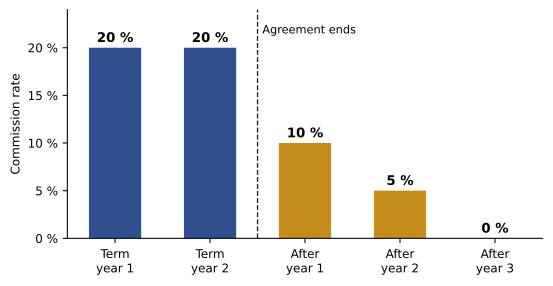
- Post-term commissions, or sunset clauses: how long the manager keeps earning on deals after the agreement ends. A reasonable approach limits commission to deals substantially negotiated during the term, sometimes tapering over a year or two.
- Money flow: ideally brands pay the creator, who pays the commission. If payments go through the manager, require a separate trust account, payment within a short period such as 10 business days, itemized statements and audit rights.
- Expenses: which expenses the manager may charge back, with a cap and approval for anything large.
- Authority: whether the manager can sign contracts for the creator. A power of attorney to sign is risky; approval rights over every deal are safer.
- Conflicts: whether the manager represents competing creators or takes fees from brands on the same deals.
Worked problem
The cost of a sunset clause
A creator ends a management agreement. Deals the manager negotiated during the term will pay the creator $40,000 in the first year after termination and $25,000 in the second year. Compare two sunset clauses: (a) full 20 % commission for three years on those deals, and (b) 10 % in year 1, 5 % in year 2, nothing after.
Show solution
- (a) Year 1: 20 % × $40,000 = $8,000. Year 2: 20 % × $25,000 = $5,000. Total $13,000 (plus any year 3 income).
- (b) Year 1: 10 % × $40,000 = $4,000. Year 2: 5 % × $25,000 = $1,250. Total $5,250.
- Difference: $13,000 − $5,250 = $7,750.
Answer: The tapering clause saves the creator $7,750 and makes it easier to hire a new manager, who will not want to work on deals still subject to a full commission to someone else.
Networks and agency agreements
Network agreements often involve platform revenue sharing and rights management. Check what share of revenue the network takes, what services it actually provides, whether it controls your channel or content claims, how long the agreement lasts and how easy it is to leave. Some older network agreements locked creators in for years with automatic renewals and broad rights. Agency agreements are usually narrower, covering specific deal types, but check exclusivity: an exclusive agency may be entitled to commission on deals in its field even if you found them yourself.
Insurance for creators
Insurance transfers the cost of rare but expensive events to an insurer in exchange for a premium. The main types for creators are:
| Coverage | What it covers | When it matters |
|---|---|---|
| Equipment (inland marine) | Theft, loss or damage to cameras, computers and gear, including on location and in transit | Most creators with valuable kit; home policies often exclude business equipment |
| Commercial general liability (CGL) | Bodily injury and property damage to others, such as a guest tripping over a light stand | Shoots, events, studio rentals; venues often require it |
| Media liability or errors and omissions (E&O) | Claims of defamation, invasion of privacy, copyright or trademark infringement arising from content | Commentary, reviews, documentaries, news-style content |
| Cyber liability | Costs of data breaches, account takeovers, ransomware and notification | Creators with email lists, stores and memberships |
| Business interruption | Lost income when an insured event stops the business | Creators with a studio or significant fixed costs |
| Disability and health | Income or medical costs if the creator cannot work | Everyone who depends on their own ability to produce content |
| Production insurance | Specific shoots: cast, equipment, liability, weather | Larger productions and brand shoots |
Brands, venues and platforms sometimes require a certificate of insurance naming them as additional insureds. Contracts may specify minimum limits, such as $2 million of general liability. Read these requirements early, because arranging coverage can take time.
In the US, health insurance is a major cost for self-employed creators. Coverage can be bought through the Affordable Care Act marketplace, where premium tax credits depend on income, or through a spouse's employer or professional associations. Self-employed people can generally deduct health insurance premiums for themselves and their families as an adjustment to income. Individual disability insurance replaces income if illness or injury prevents work.
Worked problem
Does equipment insurance pay?
A creator carries $18,000 of camera and computer equipment. An equipment policy costs $420 a year with a $500 deductible. The creator estimates a 6 % annual chance of a loss averaging $9,000 (theft from a car or a dropped camera kit). Compare the expected annual loss without insurance with the premium.
Show solution
- Expected loss without insurance: 0.06 × $9,000 = $540.
- With insurance, the creator pays the premium plus the deductible when a loss occurs: $420 + 0.06 × $500 = $450.
- Expected saving: $540 − $450 = $90 a year.
Answer: The policy is slightly cheaper than going uninsured on average, and far more valuable in a bad year, when a $9,000 loss could halt production. Insurance is usually worth buying for losses you could not comfortably absorb, and not for small ones.
Protecting your intellectual property
A creator's brand and content library are assets worth protecting. Three tools matter most: copyright, trademarks and the procedures for removing infringing copies.
Copyright protects content automatically from creation. Registering with the US Copyright Office costs $45 to $65 for a basic online application and is required before suing for infringement of a US work. Timely registration, generally within three months of publication or before the infringement begins, also makes statutory damages of up to $150,000 per work for wilful infringement and attorney's fees available. Copyright generally lasts for the author's life plus 70 years.
A trademark protects the names, logos and slogans that identify your goods and services, such as your channel name on merchandise. Rights arise from use in commerce, but federal registration with the US Patent and Trademark Office (USPTO) gives nationwide priority, a presumption of ownership and the right to use the ® symbol. Since January 2025, the base application fee is $350 per class of goods or services, with surcharges for incomplete applications and free-form descriptions. Registrations last ten years and can be renewed indefinitely if the mark stays in use, with a declaration of use due between the fifth and sixth years. The US is part of the Madrid Protocol, which simplifies filing in other countries.
Worked problem
Planning a trademark filing
A creator wants to register their channel name for entertainment services (Class 41), clothing (Class 25) and downloadable digital content such as presets (Class 9). Using illustrative government fees of $350 for the first class and $350 for each additional class, plus a lawyer's flat fee of $1,200 for a search and filing, estimate the total cost, and decide whether all three classes are needed now.
Show solution
- Government fees: 3 × $350 = $1,050.
- Professional fees: $1,200.
- Total: $1,050 + $1,200 = $2,250.
- If merchandise is not planned for two years, filing Class 41 first and adding classes later reduces the initial cost, at the risk that someone else files first in those classes.
Answer: About $2,250 for all three classes, or less if filed in stages. Prioritize the classes you use now or will use soon, and search for conflicting marks before investing in a name.
Before building a brand around a name, search trademark databases and the market for conflicting names. A cease-and-desist letter after years of building a channel is expensive and painful. Secure matching domain names and social handles early, and keep evidence of when you started using the name.
Takedowns and enforcement
When someone reposts your content without permission, the fastest remedy is usually a takedown notice under the Digital Millennium Copyright Act (DMCA). Platforms that follow the DMCA safe harbor process remove content when they receive a valid notice and restore it if the poster files a counter-notice and the owner does not sue within 10 to 14 business days. Sending a notice requires a good-faith belief that the use is not authorized or a fair use; knowingly false notices can create liability. For persistent or commercial infringement, a lawyer's demand letter or court action may be needed, and registration is a prerequisite to sue. Content-matching systems such as YouTube's Content ID or Rights Manager on Meta platforms, available to eligible rights holders, can automate detection.
Enforcement works in both directions. Use licensed music, footage and fonts, keep license records, and make sure freelancers who work on your content assign or license their contributions to your business in writing, so that you own what you publish.
Common mistakes
MistakeSigning a management agreement that commissions all income forever.
InsteadLimit scope, term and post-term commissions, and add a performance clause.
MistakeLetting all money flow through a manager with no statements.
InsteadHave brands pay you directly, or require a trust account, prompt payment and audit rights.
MistakeAssuming home insurance covers business equipment and liability.
InsteadBuy equipment, liability and media coverage suited to your risks.
MistakeBuilding a brand name without a trademark search.
InsteadSearch first, then register in the classes you use or will soon use.
MistakePublishing work by freelancers without a written assignment or license.
InsteadGet IP terms in writing before work starts.
Summary and key terms
- Managers, agents, networks, business managers, publicists and lawyers play different roles and charge differently.
- Manager and agent commissions of 10 % to 20 % each are common; total representation costs should be deliberate.
- A manager pays off when added income exceeds the commission; the scope of commission is critical.
- Negotiate scope, base, term, performance and key-person clauses, sunset terms, money flow and authority.
- Equipment, liability, media liability, cyber, disability and health coverage transfer risks creators cannot absorb.
- Copyright is automatic, and registration strengthens enforcement; trademarks protect names and logos by class.
- Platform takedown systems and content matching are the first tools against infringement.
- Talent manager
- A representative who guides a career and negotiates deals for commission.
- Talent agent
- A licensed representative who procures work for commission.
- MCN
- A multi-channel network providing services for a share of revenue.
- Sunset clause
- Terms for post-termination commissions.
- Key-person clause
- A right to terminate if a named individual leaves the firm.
- Media liability insurance
- Coverage for defamation, privacy and IP claims from content.
- Certificate of insurance
- A document proving coverage and naming additional insureds.
- USPTO
- The US Patent and Trademark Office.
- Statutory damages
- Damages set by law, available after timely registration.
- DMCA takedown
- A notice asking a platform to remove infringing material.
Practice problems
Work each problem on paper first, then reveal the answer to check.
Brand revenue rises from $50,000 to $70,000 with a 20 % manager. Better off?
Show answer
Yes: $56,000 versus $50,000.
Break-even revenue for a 15 % commission if current income is $68,000?
Show answer
$80,000.
Sunset of 10 % then 5 % on $30,000 and $20,000. Total?
Show answer
$3,000 + $1,000 = $4,000.
Name four terms to negotiate in a management agreement.
Show answer
Scope, commission base, term, performance clause, sunset, money flow, expenses, authority.
Expected loss: 4 % chance of $12,000?
Show answer
$480.
Which insurance covers a defamation claim from a video?
Show answer
Media liability or E&O insurance.
Is copyright registration needed for protection?
Show answer
No, but it strengthens enforcement.
Trademark fees for 2 classes at $350 each?
Show answer
$700.
What should freelancers sign before working on your content?
Show answer
A written IP assignment or license.
How long does a trademark registration last before renewal?
Show answer
Ten years.
Lesson quiz · 5 questions
Score 60% or more to complete this lesson.
Create a free account to save your progress, take quizzes and earn a certificate.