
CRE-330 · Lesson 12 of 12 · 28 min
Paying yourself, saving for retirement and capstone business plan
The final lesson looks at the long term. A creator business exists to support a life, and that means paying yourself steadily from irregular income, building savings, using tax-advantaged retirement accounts and planning for the day when making content is no longer the main job. The lesson then brings the whole course together in a capstone: a business plan that covers structure, contracts, money, tax, risk and growth for a realistic creator business.
Paying yourself a steady salary from lumpy income
Irregular income makes personal budgeting hard. One month brings $25,000 and the next brings $2,000. The most effective solution is to separate business income from personal pay: let revenue land in the business account, keep a buffer there, and pay yourself a fixed amount on a regular schedule, such as twice a month. The fixed amount should be sustainable in a below-average year.
Worked problem
Setting a monthly pay amount
A creator's low-case annual profit is $66,000 and their base case is $85,000. They expect tax and contributions of about 25 % at these levels. They want to pay themselves a fixed monthly amount that would be sustainable in the low case, and keep any surplus in the business as a buffer and for investments. What monthly pay should they set, and what happens in a base-case year?
Show solution
- Low-case after-tax profit: $66,000 × 0.75 = $49,500.
- Monthly pay: $49,500 ÷ 12 = $4,125.
- Base-case after-tax profit: $85,000 × 0.75 = $63,750.
- Surplus in a base-case year: $63,750 − $49,500 = $14,250, available for retirement savings, the reserve or a year-end bonus.
Answer: About $4,125 a month. In a good year, the surplus is paid out as a bonus or saved; in a bad year, the pay continues while the buffer absorbs the shortfall.
For a sole proprietor or single-member LLC owner, this "pay" is simply a regular transfer, an owner draw, which is not itself taxed: tax is based on profit. For an S corporation owner, it is a mix of payroll salary and distributions (lesson 2).
An order of priorities for savings
Personal finance advisers often suggest an order of priorities that suits self-employed people well:
- First, a tax account holding enough for the next payment and the year-end balance.
- Second, a business cash reserve covering three to six months of fixed business costs.
- Third, a personal emergency fund covering several months of living expenses.
- Fourth, paying off high-interest debt such as credit card balances.
- Fifth, regular contributions to tax-advantaged retirement accounts.
- Sixth, other goals: a home, investments in the business, education.
Creators sometimes skip retirement saving because the future feels far away and income feels uncertain. Yet self-employed people have no employer pension or matching contributions, so saving is entirely up to them, and the tax benefits of retirement accounts are especially valuable at the higher marginal rates successful creators often reach.
Tax-advantaged accounts
| Account | 2026 limit | Tax treatment | Best for |
|---|---|---|---|
| Solo 401(k) | $24,500 employee deferral plus employer contribution, up to $72,000 total; catch-up $8,000 at 50 or older, $11,250 at ages 60 to 63 | Traditional (deductible) or Roth (after-tax) deferrals | Self-employed people with no employees who want to save a lot |
| SEP-IRA | Up to 25 % of compensation, about 20 % of net self-employment earnings for sole proprietors, up to $72,000 | Deductible; simple to set up | Simple saving, or businesses with employees (who must be included) |
| Traditional or Roth IRA | $7,500, plus $1,100 catch-up at 50 or older | Traditional may be deductible; Roth growth and qualified withdrawals tax-free (income limits apply) | Everyone, alongside a business plan |
| Health Savings Account (HSA) | Family and self-only limits, with a high-deductible health plan | Deductible, tax-free growth, tax-free for medical costs | Creators with a qualifying health plan |
Traditional contributions reduce taxable income now and are taxed on withdrawal; Roth contributions are taxed now and grow tax-free. A useful rule is to compare your marginal rate now with your expected rate in retirement: if today's rate is higher, traditional contributions usually win; if it is lower, Roth is often better. Note that retirement contributions reduce income tax but not self-employment tax, except that the employer portion is calculated after the deduction for half of self-employment tax.
Worked problem
Maximum Solo 401(k) contribution
A 38-year-old sole proprietor has 2026 net profit of $100,000. Self-employment tax is about $14,130, so the deduction for half is about $7,065. What is the maximum Solo 401(k) contribution, using the simplified rule that the employer contribution is 20 % of net profit minus half of SE tax?
Show solution
- Net earnings for the calculation: $100,000 − $7,065 = $92,935.
- Employer contribution: 20 % × $92,935 = $18,587.
- Employee deferral: up to $24,500.
- Total: $18,587 + $24,500 = $43,087, below the $72,000 overall limit.
- If made as traditional contributions at a 22 % federal rate, the income tax saving is about 0.22 × $43,087 ≈ $9,479.
Answer: About $43,087, saving roughly $9,500 of federal income tax if contributed on a traditional basis. A SEP-IRA alone would allow only about $18,587, which is why the Solo 401(k) often suits creators without employees.
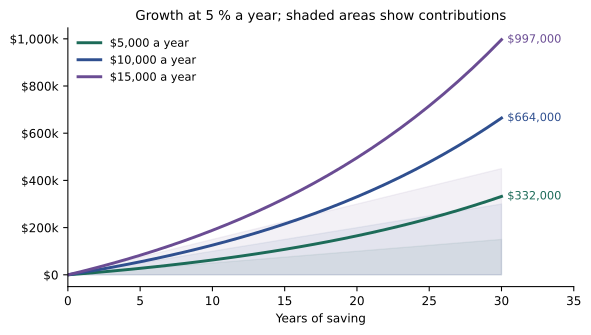
Here P is the annual contribution, r the annual return and n the number of years. At 5 % for 30 years, the multiplier is about 66.4, so $10,000 a year grows to roughly $664,000, of which $300,000 is contributions and the rest growth. Starting ten years later cuts the result by more than half. Early, steady saving matters more than perfect investment choices.
Planning for the long term
Few creators make content at the same level forever. Audiences change, platforms rise and fall, and personal priorities shift. A long-term plan considers how the business could evolve: building assets that earn without constant new content, such as products, courses, licensing libraries and email lists; developing skills that transfer to other careers, such as production, marketing and consulting; and, for some, selling the business. Creator businesses with diversified revenue, documented systems and assets that do not depend entirely on the founder's face are the easiest to sell or hand over. CRE-350 and later courses look at scaling and exits in more depth.
Capstone: a creator business plan
A business plan pulls together everything in this course into one document you can use, update and share with an accountant, a lender or a future manager. It does not need to be long; it needs to be specific and honest.
| Section | What to include | Lessons |
|---|---|---|
| 1. Overview | Who you are, your audience, your content and your goals for the next three years | 1 |
| 2. Revenue model | Revenue streams, pricing, rate card and pipeline | 8, CRE-302, CRE-310 |
| 3. Structure | Current structure, the trigger for changing it and estimated benefit | 2 |
| 4. Contracts | Standard positions, red lines, templates and contract register | 3, 4, 5 |
| 5. Getting paid | Invoice template, payment terms, deposits, collections process | 6 |
| 6. Financial plan | Budget, scenarios, break-even, cash forecast and reserves | 7, 8 |
| 7. Tax plan | Set-aside rate, installment or estimated payment schedule, sales tax registrations | 9, 10 |
| 8. Team and representation | Advisers, freelancers, manager or agent terms | 1, 11 |
| 9. Risk and insurance | Risk register and coverage | 1, 11 |
| 10. IP | Copyright practices, trademarks, licenses and takedowns | 4, 11 |
| 11. Pay and retirement | Monthly pay, savings priorities and accounts | 12 |
Worked problem
Capstone: a business plan for a cooking creator
Maya runs a cooking channel from Ohio as a single-member LLC. For next year she forecasts $150,000 of revenue: $90,000 from brand deals (half signed, half in the pipeline at 60 % probability already applied), $35,000 from platform revenue, $10,000 from affiliates and $15,000 from an e-book. Variable costs are a 15 % manager commission on brand deals and 5 % fees on all revenue. Fixed costs are $30,000. She wants to know her pre-tax profit, whether to elect S corporation status, her tax set-aside, her monthly pay and a retirement contribution. She needs about $60,000 a year after tax to live on.
Show solution
- Commission: 15 % × $90,000 = $13,500. Fees: 5 % × $150,000 = $7,500.
- Pre-tax profit: $150,000 − $13,500 − $7,500 − $30,000 = $99,000.
- Break-even revenue: contribution margin is (150,000 − 21,000) ÷ 150,000 = 86 %, so $30,000 ÷ 0.86 ≈ $34,900, giving a wide safety margin.
- Tax: SE tax is about 15.3 % × 0.9235 × $99,000 ≈ $13,988; federal income tax after the standard deduction and QBI deduction is roughly $8,000 before retirement contributions, and Ohio tax at its flat 2.75 % rate on income above the exemption threshold roughly $1,800, so the total is about $23,900, an effective rate near 24 %. She sets aside 28 % of profit.
- S corporation: with a reasonable salary of $55,000, payroll taxes would be about $8,415, saving roughly $5,600 of SE tax before about $3,000 of extra costs. The net saving of about $2,600 is modest, so she decides to wait until profit is higher and revisit next year.
- Monthly pay: using a low case of $80,000 profit and 24 % tax, $80,000 × 0.76 ÷ 12 ≈ $5,070 a month.
- Retirement: she opens a Solo 401(k) and contributes about $20,000, saving roughly $4,400 of federal income tax at a 22 % rate, and $7,500 to a Roth IRA from the base-case surplus.
- Other actions: register to collect Ohio sales tax on e-book sales if taxable there and monitor other states, issue 1099-NECs to her editor, renegotiate her management agreement's sunset clause, buy media liability insurance, and file a USPTO trademark for her channel name in Class 41.
Answer: Maya expects about $99,000 of pre-tax profit, sets aside 28 % for tax, stays a single-member LLC taxed as a sole proprietor for now, pays herself about $5,070 a month, saves about $27,500 in a Solo 401(k) and Roth IRA, and completes a list of legal, sales tax and insurance actions. The plan gives her targets to review each month and a trigger for revisiting the S corporation election.
Your own plan will have different numbers, but the method is the same: forecast honestly, calculate profit and tax, choose structure and savings deliberately, and turn the analysis into a dated list of actions. Review the plan quarterly and update it at least once a year, ideally with your accountant.
Final thoughts
The business side of creating is learnable. A creator who understands their contracts, prices for profit, gets paid on time, keeps accurate books, plans for tax, protects their rights and saves for the future has a far better chance of building a lasting career than one who relies on talent and luck alone. None of these skills requires becoming a lawyer or an accountant; it requires knowing enough to ask the right questions, spot the risks and hire help when the stakes justify it.
Family and the business
Creator businesses often involve family: a partner who films, a parent who handles email, children who appear in videos. Each raises planning questions. Pay family members only for real work at reasonable rates and keep records, because tax authorities scrutinize income splitting. Make sure spouses or partners understand the business's finances and where key documents and passwords are kept, so the business can continue if you are ill. Children who appear in content raise privacy, consent and, in some places, legal earnings-protection issues covered in CRE-320.
Common mistakes
MistakePaying yourself whatever happens to be in the account.
InsteadSet a sustainable fixed pay based on the low-case scenario.
MistakePostponing retirement saving until income feels stable.
InsteadStart small and early; compounding rewards time.
MistakeChoosing between traditional and Roth contributions without comparing tax rates.
InsteadCompare your marginal rate now with your expected rate on withdrawal.
MistakeWriting a business plan once and filing it away.
InsteadReview it quarterly and update it yearly with your accountant.
MistakeBuilding a business that depends entirely on new content from you.
InsteadBuild assets and skills that keep earning and transfer if plans change.
Summary and key terms
- Pay yourself a fixed, sustainable amount based on low-case after-tax profit; keep surpluses as buffers or bonuses.
- Prioritize tax money, a business reserve, an emergency fund and high-interest debt before long-term investing.
- For 2026, a Solo 401(k) allows a $24,500 deferral plus employer contributions up to $72,000 in total; IRAs allow $7,500.
- Choose between traditional and Roth by comparing current and future marginal rates.
- Compound growth makes early, steady saving powerful.
- A business plan covers revenue, structure, contracts, payment, finances, tax, team, risk, IP and pay.
- Review the plan quarterly and revisit structure decisions as profit grows.
- Owner draw
- A transfer from the business to the owner, not itself taxed for a sole proprietor.
- Emergency fund
- Savings for unexpected personal expenses.
- Solo 401(k)
- A 401(k) plan for a business owner with no employees.
- Elective deferral
- The employee portion of a 401(k) contribution.
- SEP-IRA
- A simplified employer pension funded by employer contributions.
- Roth
- After-tax contributions with tax-free qualified withdrawals.
- Catch-up contribution
- Extra contributions allowed at older ages.
- Compound growth
- Growth on both contributions and past growth.
- Future value
- The value of savings at a future date.
- Business plan
- A document setting out goals, strategy and financial plans.
Practice problems
Work each problem on paper first, then reveal the answer to check.
Low-case profit $54,000 with 24 % tax. Sustainable monthly pay?
Show answer
54,000 × 0.76 ÷ 12 = $3,420.
Employer Solo 401(k) contribution on $60,000 of profit with $4,239 half-SE-tax deduction?
Show answer
20 % × 55,761 ≈ $11,152.
Maximum 2026 employee deferral for a 45-year-old?
Show answer
$24,500.
What is the 2026 IRA limit for someone under 50?
Show answer
$7,500.
Future value of $6,000 a year for 25 years at 5 % (multiplier about 47.7)?
Show answer
About $286,000.
Which wins if your marginal rate now is lower than in retirement?
Show answer
Usually Roth.
Do retirement contributions reduce self-employment tax?
Show answer
No; they reduce income tax.
Name the first three savings priorities.
Show answer
Tax account, business reserve, emergency fund.
Name five sections of a business plan.
Show answer
Overview, revenue, structure, contracts, payment, finances, tax, team, risk, IP, pay.
How often should the plan be reviewed?
Show answer
Quarterly, with a yearly update.
Lesson quiz · 5 questions
Score 60% or more to complete this lesson.
Create a free account to save your progress, take quizzes and earn a certificate.