
CRE-301 · Lesson 5 of 12 · 25 min
Cross-posting and platform diversification
Most creators build their first audience on one platform, and for good reason: focus helps you learn a format, understand an algorithm and build momentum. But depending entirely on one platform is risky. Policies, payouts and recommendation systems change; accounts can be suspended by mistake; whole platforms can decline or face regulatory uncertainty, as the long legal fight over TikTok in the United States showed. This lesson covers how to decide when and where to expand, the difference between cross-posting, adapting and creating natively, workflows for repurposing, timing and sequencing across platforms, handling different audiences and cultures, measuring each platform's contribution, and protecting yourself against platform risk.
Focus first, then expand
A common pattern for sustainable growth is to master one primary platform before expanding. On the primary platform you learn what your audience wants, build a recognizable style and develop a production workflow. Expansion makes sense when you have a repeatable process, spare capacity, and evidence that your content suits another platform's format and audience. Expanding too early can split your attention so that no platform gets your best work. Expanding too late leaves you exposed to a single point of failure. A practical sign that it is time to diversify is when your primary platform's growth is steady, your workflow produces material that could be adapted, and a meaningful share of your audience asks where else they can find you.
Cross-posting, adapting and native creation
There are three broad approaches to multi-platform publishing:
- Cross-posting: publishing the same piece unchanged on several platforms. It is fast but often underperforms, because each platform has different formats, aspect ratios, lengths, captions and cultures. Some platforms also reduce the reach of content that carries another platform's watermark or that has been posted elsewhere first, and some have publicly said they prioritize original content.
- Adapting or repurposing: reshaping a piece for each platform, such as cutting a long video into short clips with new hooks (CRE-210, CRE-211), turning a script into a newsletter issue, or turning a podcast segment into a carousel.
- Native creation: making work specifically for each platform, using its features and culture.
Most creators combine these: a core piece made once, adapted thoughtfully for two or three platforms, with occasional native posts that use each platform's strengths. The aim is to respect each audience rather than to spray identical content everywhere.
| Approach | Effort | Performance | Best for |
|---|---|---|---|
| Cross-posting unchanged | Lowest | Often weaker; watermarks may reduce reach | Announcements, simple posts |
| Adapting core work | Medium | Good when hooks and formats are adjusted | Most creators |
| Native creation | Highest | Strongest per platform | Priority platforms, experiments |
Choosing additional platforms
Choose platforms where your content type, audience and goals fit. Consider:
- Format fit: does the platform suit your strengths, such as long explanation, quick visual moments, conversation, audio or writing?
- Audience presence: are the people you serve active there? Age, profession, region and language vary across platforms.
- Discovery mechanics: does the platform recommend new creators to people who do not follow them, or does growth depend on existing networks?
- Monetization: does the platform offer revenue sharing, memberships, tipping or brand opportunities relevant to you?
- Effort: how much extra work does adapting for it require, and can your workflow support it?
A professional educator might pair YouTube with LinkedIn and a newsletter; a visual artist might pair Instagram with Pinterest and a shop; a gamer might pair Twitch with YouTube and TikTok. CRE-201 described platform differences in detail.
Repurposing workflows
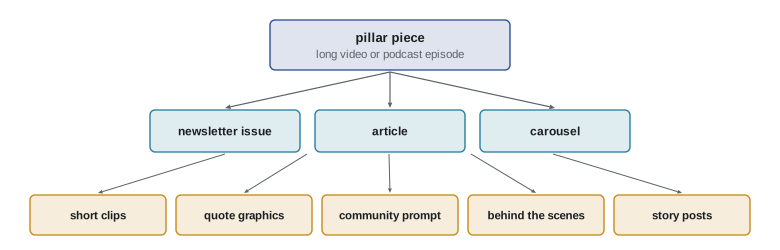
A repurposing workflow plans adaptations from the start rather than as an afterthought. A typical "content pyramid" or "pillar" workflow begins with one substantial piece, such as a long video, a podcast episode or an in-depth article, and derives smaller pieces: short clips with new hooks, quote graphics, a carousel summarizing key points, a newsletter issue with extra commentary, a community discussion prompt and a behind-the-scenes post. Planning shots and segments with repurposing in mind, for example filming vertical B-roll or marking quotable moments in the script, makes adaptation faster. Templates, naming conventions and a content calendar that lists each derivative and its platform keep the system manageable.
Worked problem
Planning derivatives from one video
A creator publishes a 20-minute video each week. Editing takes 10 hours. Each short clip with a new hook takes 40 minutes, a newsletter issue takes 90 minutes and a carousel takes 60 minutes. How much time does it take to produce four clips, one newsletter and one carousel, and what percentage does this add to the weekly workload?
Show solution
- Clips: 4 × 40 = 160 minutes.
- Newsletter and carousel: 90 + 60 = 150 minutes.
- Total derivatives: 310 minutes, about 5.2 hours.
- Added workload: 5.2 / 10 = 52 % of editing time, plus filming and planning.
Answer: About 5.2 hours per week, roughly half as much again as the editing time, which shows why repurposing needs to be planned and sustainable.
Timing and sequencing
When you publish across platforms, sequencing matters. Publishing the main piece first on your primary platform gives it the strongest start, while derivatives released over the following days extend its life and send viewers back to it. Some creators release short clips before a long video as teasers; others use them afterwards to reach people who missed it. Avoid posting identical clips on several platforms within minutes if each platform's algorithm benefits from original, early engagement; staggering by a few hours or days can help. Time zones also matter for international audiences, and platform analytics show when each audience is most active (CRE-202).
Different audiences, different cultures
Each platform has its own culture: tone, humor, length, visual style, comment behavior and expectations about authenticity. A joke that works in a fast-paced short video might seem odd in a LinkedIn post; a polished carousel might feel out of place in an informal community chat. Audiences on different platforms may also differ in age, expertise and what they want from you. Adapting means more than resizing: it means rewriting hooks, captions and calls to action, choosing appropriate examples, and engaging with comments in the platform's style. Reading the comments and studying successful creators on each platform reveals these norms.
Measuring each platform's contribution
Diversification adds complexity, so measure whether each platform earns its place. Useful measures include growth and engagement on the platform itself, traffic and sign-ups it sends to owned channels, revenue it generates directly or indirectly, and the time it costs. A simple comparison of outcomes per hour invested can be revealing: a platform with modest reach might send many engaged newsletter subscribers, while a large one might produce little beyond views. Review your platform mix every few months, and be willing to reduce or drop platforms that cost more than they return, as long as you keep a presence where your audience expects to find you.
Platform risk and how to manage it
Platform risk includes policy changes that reduce reach for your content type, demonetization, copyright or community guideline strikes (CRE-420), account hacks, mistaken suspensions, changes to revenue sharing, and the decline or regulation of whole platforms. Strategies to manage it include:
- Diversifying discovery across at least two platforms with different owners.
- Building owned channels, especially an email list and a website, and regularly inviting followers to join them (Lessons 6 and 7).
- Securing accounts with strong, unique passwords, two-factor authentication using an authenticator app or security key, and limited access for team members.
- Keeping backups of your content, contact lists and community data.
- Following platform rules carefully and keeping records that help with appeals.
- Diversifying income so that no single platform provides most of your revenue (CRE-302).
Handles, identity and consistency
Across platforms, use consistent names, handles, profile images and descriptions so that people can find and recognize you (CRE-110). Secure your handle on major platforms even if you are not active there, to prevent impersonation. Link your profiles to each other and to your website, and keep a single "link in bio" page that lists your current channels. Consistency builds recognition and trust, and makes it easier for collaborators and press to find you.
Adapting a piece for different platforms
Consider how a single idea might be adapted. A creator publishes a 15-minute video explaining how to plan a week of budget meals. For short-form vertical video, they cut a 45-second clip showing one recipe from start to finish, with a new hook in the first two seconds and on-screen captions, since many viewers watch without sound. For a photo-carousel platform, they make a seven-slide carousel with the shopping list and costs, designed to be saved. For a professional network, they write a short post about what they learned about food costs, with one image. For the newsletter, they share the full plan as a printable document with extra notes on substitutions. For the community, they post a prompt asking members to share their own cheapest meal. Each version suits its platform and audience, and each points back to the full video or the newsletter for people who want more.
Working with a team or tools
As multi-platform publishing grows, many creators bring in help. A freelance editor might handle short clips, a social media manager might adapt captions and schedule posts, and a virtual assistant might manage uploads and descriptions. Scheduling tools can publish posts across platforms at planned times and gather analytics in one place, though native uploads sometimes perform better than scheduled ones. AI-assisted tools can suggest clip moments, generate captions and resize video, but they still need human judgment for hooks, accuracy and tone. When delegating, write a simple style guide covering voice, formatting, hashtags, captions, links and what never to post, and review work regularly at first.
Platform-specific rules and rights
Each platform has its own terms of service, community guidelines and rules on branded content, music and copyright. A song licensed for use on one platform may not be cleared for another, and music libraries offered inside one app usually cannot be used when the same video is uploaded elsewhere. Sponsorship disclosures must appear in each version of sponsored content, using each platform's tools and clear wording (CRE-320). If you use clips from collaborators or other creators, check that your agreement covers all the platforms where you plan to post. Keeping a simple record of which assets are cleared for which platforms prevents takedowns and disputes.
Moving an audience between platforms
Sometimes creators need to move their audience, for example when a platform declines, changes its rules or becomes unavailable in a country. Moving an audience is hard: many followers will not follow you to a new place, especially if it requires a new app or account. Prepare before you need to by building owned channels and a presence on at least one other platform. When moving, give your audience clear reasons, simple instructions and repeated reminders over several weeks, and offer something valuable in the new place. Expect only a fraction of followers to move, and focus on those who care most.
When choosing a new home for an audience, favor places where you control more of the relationship, such as an email list or a website, rather than simply swapping one rented platform for another. Explain the move as an invitation rather than an emergency, and keep posting where your audience still is until most of those who care have followed you.
Common mistakes
MistakeExpanding to many platforms before mastering one.
InsteadBuild a repeatable process on a primary platform first.
MistakeCross-posting identical content with watermarks.
InsteadAdapt hooks, formats and captions for each platform.
MistakeTreating repurposing as an afterthought.
InsteadPlan derivatives when planning the main piece.
MistakeIgnoring each platform's culture.
InsteadStudy norms and engage in the platform's style.
MistakeKeeping platforms that cost more than they return.
InsteadMeasure value per hour and review your mix.
Summary and key terms
- Master a primary platform, then expand when you have capacity and evidence.
- Cross-posting is fast but weaker; adapting and native creation perform better.
- Choose platforms by format fit, audience, discovery, monetization and effort.
- Content pyramids plan many derivatives from one substantial piece.
- Sequence releases to strengthen the main piece and extend its life.
- Measure each platform's outcomes per hour invested.
- Manage platform risk with diversification, owned channels, security and backups.
- Cross-posting
- Publishing the same piece unchanged on several platforms.
- Repurposing
- Adapting a piece for different formats or platforms.
- Native content
- Work made specifically for one platform.
- Content pyramid
- Workflow deriving many pieces from one pillar piece.
- Primary platform
- The platform where a creator focuses most effort.
- Platform risk
- Exposure to changes or failures of a platform.
- Watermark
- Logo or mark identifying content from another platform.
- Sequencing
- Ordering releases across platforms.
- Two-factor authentication
- Second verification step for account security.
- Link in bio
- Single page listing a creator's channels and offers.
Practice problems
Work each problem on paper first, then reveal the answer to check.
Why master one platform first?
Show answer
To learn the format, build style and develop a workflow.
Why can cross-posting underperform?
Show answer
Formats and cultures differ, and watermarks may reduce reach.
Name three factors in choosing a platform.
Show answer
Format fit, audience, discovery, monetization, effort.
What is a pillar piece?
Show answer
A substantial piece from which derivatives are made.
Time for six clips at 30 minutes each plus a 2-hour newsletter?
Show answer
5 hours.
Why stagger posts across platforms?
Show answer
To give each platform original early engagement.
What does adapting involve beyond resizing?
Show answer
Rewriting hooks, captions and CTAs for each culture.
Value per hour for 120 sign-ups from 8 hours?
Show answer
15 sign-ups per hour.
Name three ways to manage platform risk.
Show answer
Diversify, owned channels, security, backups, rule compliance, diversified income.
Why secure handles on platforms you do not use?
Show answer
To prevent impersonation.
Lesson quiz · 5 questions
Score 60% or more to complete this lesson.
Create a free account to save your progress, take quizzes and earn a certificate.