
CRE-301 · Lesson 4 of 12 · 25 min
Collaborations and cross-promotion
Collaboration is one of the most reliable ways for creators to reach new audiences, because it borrows trust: viewers who like one creator are inclined to try someone that creator introduces. Collaborations also produce better work, spread the effort of ambitious projects and build friendships in an often isolating job. CRE-220 covered on-camera chemistry and co-hosting; this lesson focuses on the strategic side: choosing partners, the many forms collaborations take, estimating audience overlap, structuring the exchange, agreements, cross-promotion between newsletters and communities, collaborating with brands and organizations, measuring results and managing collaborations that go wrong.
Why collaboration works
Recommendation from a trusted source is powerful. When a creator a viewer already likes says "you should check out this person", the introduction carries some of the trust built up over many videos or newsletters. Platforms also reward collaborations: a video featuring two creators may be recommended to both audiences, and features such as duets, stitches, collaborative posts and co-streams spread work across networks (CRE-210, CRE-250). Collaboration works best when it creates value for both audiences: a project neither creator could make alone, a conversation that teaches something, or an entertaining combination of styles. Collaborations that feel like transparent audience swaps, with little value for viewers, perform poorly and can irritate both audiences.
Choosing collaborators
Good collaborators share some of your audience's interests but not so many that you simply reach the same people. Useful criteria include:
- Audience fit: their viewers are likely to enjoy your work, and vice versa.
- Complementary skills: they bring something you lack, such as expertise, humor, production skills or a different perspective.
- Values and reputation: their conduct, honesty and treatment of their audience are compatible with yours; a collaboration associates your name with theirs.
- Reliability: they deliver what they promise, on time.
- Comparable commitment: both sides invest similar effort, even if audience sizes differ.
Creators of different sizes can collaborate successfully when the smaller creator brings something valuable, such as expertise, a fresh idea or production effort. Approach potential collaborators with a specific, well-researched idea that shows you know their work and explains the value for their audience, rather than a generic "let's collab" message.
Forms of collaboration
Collaborations range from light to deep:
| Form | Effort | Typical benefit |
|---|---|---|
| Shout-out or recommendation | Low | Quick introduction to an audience |
| Guest appearance | Medium | Exposure and fresh content for the host |
| Co-created video, episode or post | Medium to high | Shared audience and stronger work |
| Series or joint project | High | Lasting association and recurring discovery |
| Newsletter swap or recommendation | Low | Direct sign-ups to an owned channel |
| Community event or joint server | Medium | Members meet across communities |
| Collective or network | High | Ongoing mutual support and promotion |
Estimating audience overlap
Collaboration only reaches new people to the extent that the other audience is different from yours. Some platforms show audience overlap tools, and surveys and comments give clues; otherwise you can estimate. If creator A has an audience of \(N_A\), creator B has \(N_B\), and a fraction \(o\) of B's audience already follows A, then the number of genuinely new people A can reach through B is:
where \(r\) is the share of B's audience who actually see the collaboration. The number who follow A afterwards depends on how compelling the collaboration is, the conversion rate \(k\).
Worked problem
Comparing two collaboration offers
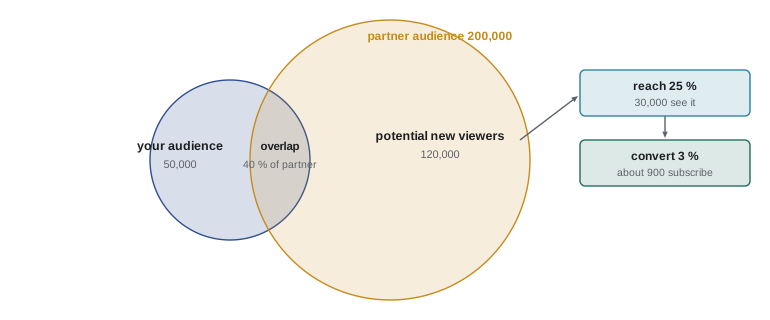
A creator with 50,000 subscribers is considering two partners. Partner X has 200,000 subscribers, 40 % of whom already watch the creator, and a collaboration typically reaches 25 % of a channel's audience. Partner Y has 80,000 subscribers, 5 % overlap, and also reaches 25 %. If 3 % of new viewers subscribe, which partner brings more new subscribers?
Show solution
- Partner X new viewers: 200,000 × (1 − 0.40) × 0.25 = 30,000; new subscribers: 30,000 × 0.03 = 900.
- Partner Y new viewers: 80,000 × (1 − 0.05) × 0.25 = 19,000; new subscribers: 19,000 × 0.03 = 570.
- Partner X brings more new subscribers despite the overlap, but Y's audience is almost entirely new and may also be a better long-term fit.
Answer: Partner X brings about 900 new subscribers and Partner Y about 570; size still wins here, but overlap reduced X's advantage from 2.5× to about 1.6×.
Structuring the exchange
Clarity prevents misunderstandings. Before starting, agree on:
- The concept and format: what you are making, where it will be published and in what versions.
- Responsibilities: who writes, films, edits, pays for travel, props or locations, and who approves the final cut.
- Promotion: what each side will post, when, and with what links, tags and calls to action.
- Ownership and reuse: who owns the footage, whether each side can use clips in future work, and for how long.
- Revenue: how any ad revenue, sponsorship or product income is shared, if at all.
- Disclosure: any sponsors involved and how they will be disclosed (CRE-320).
For simple guest appearances, an email confirming these points is usually enough. For joint projects with revenue or significant investment, a written agreement is wise. Collaborations involving brands, payment or rights to valuable footage may warrant legal advice.
Cross-promotion between owned channels
Collaborations do not have to be videos. Newsletter creators often recommend each other in issues or through platform recommendation features, exchanging sign-ups directly to owned lists. Podcasters swap trailers or appear as guests. Communities co-host events, such as joint watch parties, workshops or game nights, letting members discover adjacent spaces. Because these exchanges move people into owned channels, they can be especially valuable. Track sign-ups from each partner using referral links or platform reports, and agree on reciprocity expectations in advance so that neither side feels exploited.
Collaborations with organizations
Creators also collaborate with non-profits, museums, universities, local businesses, sports teams and community organizations. These partnerships can provide access, expertise and credibility, and connect creators with audiences beyond social media. They also bring different expectations: organizations may have approval processes, brand guidelines, legal reviews and slower timelines. Clarify early who has final say over content, how the organization's name and logo may be used, and whether any payment or in-kind support creates a material connection that must be disclosed. Brand partnerships, where money changes hands for promotion, are covered in CRE-310.
Measuring results
Measure collaborations against goals set in advance. Useful metrics include new subscribers or followers attributed to the collaboration, traffic from the partner's links (CRE-202 covered UTM tags), sign-ups to your newsletter or community, retention of viewers who arrived through the collaboration, and qualitative signals such as comments from new viewers. Compare cohorts (Lesson 2): if viewers from one partner churn quickly while those from another stay, the second partnership is more valuable even if it brought fewer people. Share results with collaborators; transparency builds trust for future projects.
Networks, collectives and long-term relationships
Some of the most effective creator growth comes from long-term relationships rather than one-off swaps. Groups of creators in related niches who regularly appear in each other's work, share advice, recommend each other and organize joint events form networks or collectives that grow together. Long-term relationships build deeper trust with audiences, who come to see the group as a scene. They also provide professional support: sharing rates, warning each other about problematic brands, and covering for each other during breaks. Invest in relationships generously, celebrate others' successes and give credit freely.
When collaborations go wrong
Collaborations can fail: a partner misses deadlines, the content underperforms, creative differences emerge, or a collaborator becomes involved in a scandal that affects you by association. Protect yourself by vetting partners, keeping agreements in writing, retaining the right to remove or edit content associated with you where possible, and communicating promptly when problems arise. If a collaborator's conduct conflicts with your values, you may need to distance yourself publicly, a situation covered in CRE-420 on crisis management. Most collaboration problems, though, are ordinary: a project that did not work. Treat them as experiments, thank your partner and learn.
Finding collaborators
Potential collaborators are often closer than creators think. Start with creators whose work you already enjoy and whose audiences overlap partly with yours, such as those mentioned in your comments, those appearing in the same recommendation sidebars, or those active in the same communities and events. Creator events, conferences, online groups for creators in your niche and platform programs offer chances to meet peers. Engage genuinely with their work before proposing anything: comment thoughtfully, share their work when it fits, and build a relationship. Many successful collaborations start as friendships rather than pitches. Keep a simple list of potential partners with notes on their audience, style and possible project ideas, and revisit it when planning your content calendar.
Writing a collaboration pitch
A good pitch is short and specific. It explains who you are in a sentence, shows that you know the other creator's work, proposes a concrete idea, explains why it would interest their audience, and makes saying yes easy by suggesting a format, timing and what you will handle. For example: "I loved your series on restoring old tools. I make videos about traditional woodworking joints, and I think your audience would enjoy a joint video where you restore a vintage plane and I use it to cut a dovetail. I can handle filming and editing on my end, and we could each publish a version from our perspective. Would a call next week work?" Avoid attaching long decks to a first message, demanding promotion or emphasizing your follower count; focus on the idea and the value for viewers. Follow up once politely if you do not hear back, then move on.
Collaborating across sizes
Smaller creators often hesitate to approach larger ones, and larger creators receive many requests. Collaborations across sizes work when the smaller creator brings something the larger one values: specialist knowledge, a unique location or skill, a fresh perspective, or significant production effort. Larger creators who collaborate generously with smaller ones build goodwill and discover new talent. Be realistic about expectations: a large creator may offer a guest spot or shout-out rather than a full joint project, and that can still be valuable. Whatever the sizes, treat collaborators as equals, credit them clearly and share results.
Crediting and linking
Clear credit is both courteous and effective. Mention collaborators by name in the content, tag their accounts, link their channels in descriptions and posts, and pin a comment pointing to their work. Make it easy for interested viewers to follow the collaborator, since the exchange works best when both audiences can move freely between creators. If the collaboration involves any payment, free products or other material connection, disclose it clearly according to advertising rules in both countries (CRE-320).
Collaboration calendars
Creators who collaborate often benefit from planning collaborations in advance, as part of their content calendar. Plan around each partner's schedule, release dates and seasonal events, and leave time for the extra coordination that joint projects require, such as scheduling filming, exchanging footage and approving edits. Coordinate publishing times so that both versions appear close together, which helps viewers move between channels while interest is high. After each collaboration, record what worked, what you would change and whether the partner would be a good fit for future projects. Over time, these notes help you build a reliable network of collaborators and avoid repeating mistakes.
Collaborating across languages and countries
Collaborations can also carry creators into new regions and languages. A Canadian creator might work with a francophone creator in Quebec or France, or with creators in the United States whose audiences share interests but rarely meet. Cross-language collaborations work best with subtitles or dubbed versions, clear roles for each creator, and attention to cultural references that may not translate. They can open entirely new audiences, but measure carefully, since viewers from a different language community may need content in their own language to stay. Check also whether sponsorship, contest and disclosure rules differ in the partner's country before publishing anything commercial together.
Common mistakes
MistakeSending generic collaboration requests.
InsteadPitch a specific idea showing value for their audience.
MistakeChoosing partners only by size.
InsteadConsider overlap, fit, values and reliability.
MistakeLeaving responsibilities unstated.
InsteadAgree on roles, promotion, ownership and revenue.
MistakeMeasuring only immediate follower gains.
InsteadTrack retention of viewers from each partner.
MistakeTreating collaborations as one-off swaps.
InsteadBuild long-term relationships and networks.
Summary and key terms
- Collaboration borrows trust and reaches new audiences.
- Choose partners for fit, complementary skills, values and reliability.
- Forms range from shout-outs to joint series and collectives.
- New reach depends on audience overlap and conversion.
- Agree on concept, roles, promotion, ownership, revenue and disclosure.
- Cross-promotion between newsletters and communities builds owned channels.
- Measure retention by partner and invest in long-term relationships.
- Collaboration
- Creators making or promoting work together.
- Audience overlap
- Share of one audience already following another creator.
- Shout-out
- Recommendation of another creator.
- Guest appearance
- Appearing in another creator's work.
- Newsletter swap
- Mutual recommendation between newsletters.
- Reciprocity
- Balanced exchange of promotion.
- Collective
- Group of creators supporting each other long-term.
- Material connection
- Relationship that may affect how audiences judge a recommendation.
- Referral link
- Link that tracks sign-ups from a partner.
- Vetting
- Checking a partner's conduct and reputation.
Practice problems
Work each problem on paper first, then reveal the answer to check.
Why does collaboration work?
Show answer
It borrows trust from a creator the audience already likes.
Name three criteria for choosing collaborators.
Show answer
Audience fit, complementary skills, values, reliability, commitment.
New viewers from a 100,000 audience with 20 % overlap and 30 % reach?
Show answer
24,000.
New subscribers if 2 % of those convert?
Show answer
480.
Name four things to agree before collaborating.
Show answer
Concept, roles, promotion, ownership, revenue, disclosure.
Why are newsletter swaps valuable?
Show answer
They bring sign-ups to owned channels.
What do organizations often require?
Show answer
Approvals, brand guidelines, legal review.
How do you compare collaboration partners over time?
Show answer
By retention of the cohorts they bring.
What is a creator collective?
Show answer
A long-term group that supports and promotes each other.
How can you protect yourself if a collaborator causes a scandal?
Show answer
Vet partners, written agreements, rights to edit or remove content.
Lesson quiz · 5 questions
Score 60% or more to complete this lesson.
Create a free account to save your progress, take quizzes and earn a certificate.