
CRE-211 · Lesson 4 of 12 · 25 min
Structure and outlining for long-form
A long video is a journey, and structure is its map. Without one, videos wander, repeat themselves, bury their best moments and lose viewers in the middle. With one, every section has a purpose, the video builds toward a satisfying payoff, and the editor knows exactly what goes where. CRE-120 covered writing scripts for long-form video and podcasts; this lesson focuses on the architecture behind them: the core structures used in long-form video, choosing a structure for the concept, building a segment outline, estimating length, planning the opening and the ending, structuring unscripted and documentary videos, and using the outline to plan production.
Why structure matters more in long-form
In a short video, a single idea carries the viewer from start to finish. In a twenty-minute video, viewers need a sense of direction: what they are learning or experiencing, where they are in the journey, and why the next section matters. Structure provides this. It also makes production efficient: an outline reveals what needs to be filmed, researched or created, prevents shooting unnecessary material, and gives the editor a blueprint. Finally, structure is how long-form videos create satisfaction: a clear question answered, a problem solved, a story resolved, or an argument concluded leaves viewers feeling the time was well spent, which encourages them to watch more from the channel.
Core long-form structures
Most long-form videos use one of a small number of structures, or a combination:
- Problem and solution: introduce a problem the viewer cares about, explore why it happens and what has been tried, then present and demonstrate the solution. Common in tutorials, home improvement and productivity videos.
- List or countdown: a series of items, tips or examples, usually ordered for momentum, often with the strongest last. Easy to structure and chapter, but needs variety and a reason to stay to the end.
- Step-by-step process: a sequence of stages leading to a finished result, as in recipes, builds and software tutorials. The result is often shown at the start to establish the goal.
- Narrative arc: a story with a setup, rising tension, a climax and a resolution, used in documentaries, vlogs, challenges and video essays.
- Investigation or mystery: a question is posed, evidence is gathered and examined, false leads are explored and an answer is reached, used in explainers, true crime, history and science videos.
- Argument or essay: a thesis is stated, evidence and examples support it, counterarguments are addressed, and a conclusion follows.
- Comparison or test: two or more options are introduced, tested against criteria and judged, used in reviews and experiments.
- Chronological: events in time order, used in histories, biographies and trip vlogs, often reorganized with a striking opening from later in the story.
| Structure | Best for | Main risk |
|---|---|---|
| Problem and solution | Tutorials, advice | Slow build before the solution |
| List or countdown | Tips, recommendations | Repetitive rhythm, viewers skipping |
| Step-by-step | Recipes, builds, software | Monotony in long middle steps |
| Narrative arc | Stories, vlogs, challenges | Weak stakes or missing climax |
| Investigation | Explainers, history, science | Losing the thread among evidence |
| Argument | Essays, commentary | One-sidedness, lack of examples |
| Comparison or test | Reviews, experiments | Unfair tests, vague verdicts |
| Chronological | Histories, trips | Lack of tension |
Choosing a structure for the concept
The concept statement and packaging (Lessons 2 and 3) usually suggest the structure. A title asking a question suggests investigation or comparison; a title promising a result suggests step-by-step or problem and solution; a title promising a story suggests a narrative arc. Ask what would most satisfy a viewer who clicked on the packaging, and which order of information builds the most tension or momentum. Many strong videos combine structures: a comparison video may use a narrative arc, following the creator's experience over a month of testing; a tutorial may be framed as a problem and solution with a step-by-step core; a history video may be an investigation told mostly in chronological order. The structure should be invisible to viewers, who should simply feel that the video flows.
Building a segment outline
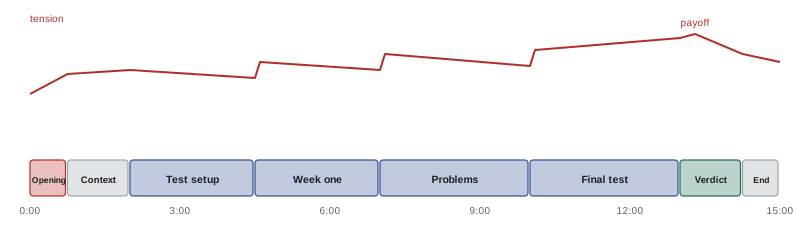
A segment outline divides the video into sections, each with a clear purpose. For each segment, note its purpose, the key point or event, how it connects to the next, approximate length, and what visuals and material it needs. A typical long-form outline includes:
- Opening (hook and promise): the first 30 to 60 seconds, establishing the subject, the stakes and why the viewer should stay (Lesson 5).
- Context or setup: what the viewer needs to understand the rest, kept as brief as possible.
- Main segments: the body of the video, usually three to eight segments, each advancing the journey.
- Climax or payoff: the answer, result, verdict or resolution.
- Ending: a short conclusion and a pointer to what to watch next.
Segments become chapters in the published video (Lesson 10), so giving each a clear title in the outline makes chaptering easy.
Estimating length
Length can be estimated from the outline. Scripted narration is typically delivered at about 140 to 160 words per minute, so a 1,500-word script runs about ten minutes of narration, before adding pauses, demonstrations and B-roll-only sections. Unscripted segments, demonstrations and interviews are harder to estimate; timing a rehearsal or a previous similar video gives a better guide. Estimating length early helps decide whether the concept is the right scope: if the outline suggests forty minutes but the promise is a quick answer, cut segments or split the concept into a series. Remember that length is not a goal in itself; a tighter video that holds attention is better than a longer one that sags.
Worked problem
Estimating runtime from an outline
An explainer has a narration script of 2,100 words, delivered at 150 words per minute, plus four animated sequences without narration of about 30 seconds each and a two-minute demonstration with little speech. Estimate the total runtime.
Show solution
- Narration: 2,100 / 150 = 14 minutes.
- Animated sequences: 4 × 0.5 = 2 minutes.
- Demonstration: 2 minutes.
- Total: 14 + 2 + 2 = 18 minutes, before trimming in the edit.
Answer: About 18 minutes; if the promise suggests a shorter video, trim the script or cut a segment.
The middle of the video
The middle is where most long-form videos lose viewers, because the opening's energy has faded and the payoff is still far away. Structural techniques that keep the middle strong include ordering segments so that each raises a new question or stakes; placing the most surprising or visual segments in the middle rather than all at the start; alternating types of content, such as explanation, demonstration, interview and story; adding mini-payoffs, small answers and results within each segment; and cutting or shortening any segment whose purpose is unclear. Lesson 5 covers retention techniques in more detail.
Planning the opening and the ending
The opening and the ending deserve particular planning in the outline. The opening must confirm the packaging's promise, establish the stakes and give a reason to keep watching, usually within the first 30 seconds; some videos open with a preview of the payoff or the most dramatic moment, then step back to the beginning. Avoid long introductions, channel intros, greetings and requests to subscribe before the content begins. The ending should deliver the payoff clearly and end promptly after it: viewers tend to leave as soon as they sense the video is over, so lengthy outros lose them before end screens appear. A short conclusion that ties back to the opening, followed by a natural recommendation of a related video, encourages viewers to continue watching on the channel.
Structuring unscripted and documentary videos
Not every long-form video is scripted. Vlogs, challenges, interviews and documentaries capture real events, and their structure is often found in the edit. Planning still helps: before filming, outline the intended story, the questions to answer and the moments likely to matter, and plan to capture material for each part of the structure, such as an introduction to the challenge, attempts and setbacks, and a final result. During filming, record "pick-up" pieces to camera explaining what is happening and what is at stake, which can bridge gaps in the edit. After filming, review footage and build a paper edit, a written outline of the story using timecodes of the best moments, before cutting. Documentary editors often restructure footage substantially, but they must keep the story truthful to what happened.
From outline to production plan
A finished outline drives production. From it, create lists of what to film (A-roll pieces to camera, demonstrations, interviews), B-roll needed for each segment (Lesson 7), graphics and animations to create, research and sources to cite, music and sound needs, locations, props and guests, and a schedule. Sharing the outline with collaborators, such as editors, designers and co-hosts, keeps everyone aligned. Keep the outline flexible: filming often reveals better moments or problems that change the structure, and the edit will refine it further.
Structure in practice: a tutorial example
Consider a 12-minute tutorial on replacing a bathroom faucet. A strong structure might open with the finished faucet and a promise ("Replace a faucet in under an hour with basic tools, no plumber"); give brief context on tools and parts, with a list on screen; then proceed through steps grouped into segments: shutting off water and removing the old faucet, preparing the sink, installing the new faucet, connecting supply lines, and testing for leaks. Each segment opens with what will be achieved and the common mistake to avoid, giving a mini-payoff when completed. The climax is turning on the water with no leaks. The ending summarizes the key safety points and points to a related video on fixing a running toilet. Chapters match the segments, making the video easy to navigate for viewers who only need one step.
Structure in practice: a documentary example
A 25-minute documentary about a closed local factory might open cold with archival footage of the factory's busiest day and a former worker saying, "We thought it would never close." Context then introduces the town and the factory's history. The middle follows the story chronologically, rising through growth, warning signs, the closure decision and its aftermath, with interviews providing perspectives and archival material providing evidence. An investigative thread, why the closure happened, runs throughout as an open loop, answered near the end with documents and an interview with a former manager. The resolution shows the site today and what the town has become, and the ending reflects on what the story means for similar towns.
Common structural problems
Reviewing outlines before filming catches structural problems early. Watch for segments that repeat each other; context sections that are too long before anything happens; a payoff placed too early, leaving nothing to stay for; a missing payoff, where the video never clearly answers its question; segments in an order that makes viewers wait for the most interesting part; and tangents that interest the creator but not the audience. Asking someone else to read the outline and say what they would want to know next is a quick test.
Structure and chapters together
Because chapters display the structure to viewers, they also expose weak structure. A video whose chapters read "Intro", "Part 1", "Part 2" and "Outro" tells viewers nothing; a video whose chapters read "Why the bridge failed", "The warning signs everyone missed", "The night of the collapse" and "What changed afterward" shows a clear, compelling journey. Writing chapter titles at the outline stage is therefore a useful test: if the segments cannot be given interesting, descriptive titles, the structure may need rethinking. Descriptive chapter titles also help viewers find the part they need and can appear in search results, linking directly to relevant sections.
Flexibility in structure
Outlines are plans, not contracts. During filming and editing, segments may grow, shrink, merge or move. Unexpected moments may become highlights; planned segments may fall flat. Revisit the outline after filming, comparing it with the footage, and build the edit around what actually works. A structure that serves the strongest material is better than one that follows the original plan faithfully.
Common mistakes
MistakeStarting to film without an outline.
InsteadPlan segments with purposes and needed material.
MistakeLong introductions before the content.
InsteadConfirm the promise within the first 30 seconds.
MistakeFront-loading all the best material.
InsteadPlace strong moments throughout, especially the middle.
MistakeLengthy outros after the payoff.
InsteadEnd promptly with a natural next-video pointer.
MistakePadding to reach a target length.
InsteadCut segments without a clear purpose.
Summary and key terms
- Structure gives viewers direction and makes production efficient.
- Common structures include problem and solution, list, process, narrative, investigation, argument, comparison and chronology.
- Choose a structure that best fulfills the packaging's promise.
- Segment outlines give each section a purpose, length and material list.
- Narration runs about 140–160 words per minute.
- The middle needs new questions, variety and mini-payoffs.
- Unscripted videos need planned stories, pick-ups and paper edits.
- Structure
- The organization of a video's parts.
- Segment
- A section of a video with a clear purpose.
- Segment outline
- Plan listing segments, purposes and materials.
- Narrative arc
- Setup, rising tension, climax and resolution.
- Investigation structure
- Question, evidence and answer.
- Mini-payoff
- A small answer or result within a segment.
- Pick-up
- Piece to camera recorded to bridge gaps.
- Paper edit
- Written outline of an edit using timecodes.
- Runtime estimate
- Predicted length from an outline or script.
- Outro
- Closing section after the main content.
Practice problems
Work each problem on paper first, then reveal the answer to check.
Name four long-form structures.
Show answer
Problem/solution, list, process, narrative, investigation, argument, comparison, chronological.
Which structure suits a review?
Show answer
Comparison or test.
What does a segment outline note?
Show answer
Purpose, key point, transition, length and material needed.
Runtime of 1,800 words at 150 words per minute?
Show answer
12 minutes.
Why is the middle risky?
Show answer
Energy fades and the payoff is far away.
Name two techniques for the middle.
Show answer
New questions, variety, mini-payoffs, strong moments.
What should the opening achieve?
Show answer
Confirm the promise and establish stakes quickly.
Why avoid long outros?
Show answer
Viewers leave once they sense the end.
What is a paper edit?
Show answer
A written outline of the edit using timecodes.
Name three production lists from an outline.
Show answer
A-roll, B-roll, graphics, research, music, locations, schedule.
Lesson quiz · 5 questions
Score 60% or more to complete this lesson.
Create a free account to save your progress, take quizzes and earn a certificate.