
CRE-211 · Lesson 11 of 12 · 25 min
Channel strategy and growth
A single good video can attract viewers; a channel turns them into an audience. Channel strategy is the set of decisions that shapes a channel over months and years: what it is about and for whom, what kinds of videos it makes and how often, how it presents itself, how it grows, and how it adapts as the creator, the audience and the platform change. CRE-110 covered niches and personal brands, CRE-201 how recommendation systems work, and CRE-202 how to read analytics; this lesson brings these together for long-form channels. It covers channel positioning, content pillars and formats, cadence and consistency, series and franchises, the channel page, collaborations, audience development over time, using analytics for strategy, evolving and pivoting, and sustainability.
Channel positioning
Positioning is what a channel stands for in viewers' minds: the subject, the audience, the perspective and the experience it offers. A clearly positioned channel is easier to recommend, because the platform and viewers can predict who will enjoy it, and easier to grow, because each video reinforces the same identity. A useful positioning statement completes the sentence "This channel is where [audience] comes for [value], delivered with [distinctive approach]." For example: "This channel is where home cooks with busy weeknights come for reliable, tested shortcuts to restaurant-style dishes, delivered with honest side-by-side tests." Positioning does not mean every video must be identical, but videos far outside it often underperform with the existing audience and confuse recommendations.
Content pillars and formats
Content pillars are the main topics or themes a channel covers, typically two to five, each serving the positioning. Within them, a channel uses a small number of formats, such as tutorials, reviews, deep dives, vlogs or interviews, each with a recognizable structure and packaging style. Planning a mix of pillars and formats balances different goals:
- Search-driven evergreen videos, such as tutorials and explainers, bring steady new viewers over years.
- Browse-driven videos, such as stories, experiments and opinion pieces, can reach large audiences quickly through recommendations.
- Community videos, such as updates, behind-the-scenes, question-and-answer sessions and live streams, deepen relationships with existing viewers.
- Tentpole projects, ambitious videos that take longer to make, can define a channel and attract new audiences.
| Video type | Main traffic source | Strategic role |
|---|---|---|
| Evergreen tutorial | Search | Steady discovery over years |
| Story or experiment | Browse and suggested | Reach and growth |
| Community update | Subscribers, notifications | Loyalty and relationship |
| Tentpole project | Browse, external shares | Identity and breakout reach |
| Topical video | Browse, search spikes | Timely relevance, short lifespan |
Cadence and consistency
Cadence is how often a channel publishes. Regular publishing helps viewers form habits and gives a channel more opportunities to be recommended, but quality matters more than frequency for long-form, and recommendation systems do not reward publishing for its own sake. Choose a cadence you can sustain with good quality, such as weekly, fortnightly or monthly, and keep to it consistently; a channel that publishes an excellent video every two weeks reliably often outperforms one that publishes weekly for a month and then disappears for three. Batching production (CRE-130), building a buffer of finished videos, and planning a content calendar make consistency achievable. Communicate breaks honestly with the audience rather than disappearing.
Worked problem
Choosing a sustainable cadence
A solo creator has about 20 hours per week for the channel. A typical video takes 6 hours of research and writing, 4 hours filming, 14 hours editing and 2 hours of packaging and publishing. What cadence is sustainable, and what would hiring an editor change?
Show solution
- Total per video: 6 + 4 + 14 + 2 = 26 hours.
- At 20 hours per week, one video takes about 1.3 weeks, so a fortnightly cadence leaves a small buffer for community work and rest.
- If an editor takes over 12 of the 14 editing hours, the creator spends about 14 hours per video.
- That allows roughly one video per week within 20 hours, if the budget covers the editor.
Answer: Fortnightly is sustainable alone; delegating most of the editing makes a weekly cadence feasible.
Series and franchises
Series are recurring videos with a shared format, title pattern and packaging style, such as a monthly "testing the cheapest" episode or an annual review. Successful series give viewers something to anticipate, simplify planning, and let packaging build recognition. A franchise is a series strong enough to become a defining feature of the channel. When a video performs unusually well (an outlier, Lesson 2), consider whether its format could become a series. Avoid repeating a formula so often that it becomes stale; refresh series with new twists, guests or higher stakes.
The channel page
The channel page is a channel's storefront for viewers who want to know more before subscribing. Key elements include a clear channel name and handle; a profile picture recognizable at small sizes; a banner that communicates the channel's subject and, if relevant, upload schedule; a short description stating the positioning and value; featured sections organizing playlists and popular videos; a channel trailer or featured video for new visitors; and links to other platforms. Keep the page up to date as the channel evolves, and check how it appears on phones and televisions as well as computers.
Collaborations
Collaborations with other creators introduce each channel to the other's audience and can produce videos neither could make alone. The best collaborations involve creators with overlapping but not identical audiences, a concept that genuinely benefits from both participants, and clear agreements about who does what, where the video is published, how revenue and sponsorships are shared, and how each channel promotes it. Formats include guest appearances, joint projects, interviews, challenges and series. Collaborations should feel natural to both audiences; forced crossovers with unrelated channels rarely help. Build relationships with other creators in your field over time, through communities, events and mutual support, rather than approaching strangers only when you want something.
Audience development over time
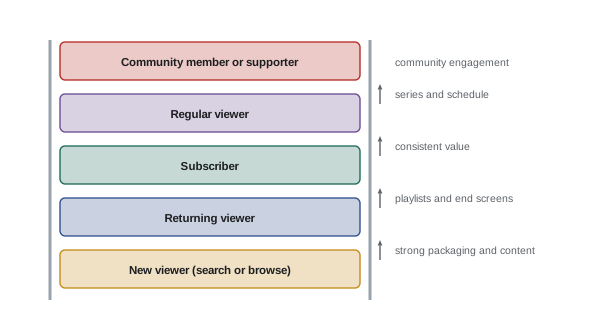
A channel's audience changes as it grows. Early on, most viewers may come from search and a small group of loyal fans; as videos reach broader audiences through recommendations, new viewers arrive with different expectations; and long-term subscribers may grow older or change interests. Strategies for developing an audience include welcoming newcomers with "start here" playlists and accessible entry points; serving loyal viewers with deeper content, community posts, memberships and live sessions (CRE-301); listening to comments and surveys for what viewers want; and expanding gradually into adjacent topics that existing viewers will follow. Subscriber counts measure accumulated interest, but returning viewers and watch time from them are better indicators of a healthy audience (CRE-202).
Using analytics for strategy
Analytics guide strategy when used to answer specific questions rather than to chase daily numbers. Useful strategic questions include: which pillars and formats earn the most watch time and returning viewers? Which traffic sources are growing? Which videos bring new viewers who then watch more? Where do viewers drop off across many videos, suggesting structural habits to change? Which topics produce outliers? Review analytics monthly or quarterly at the channel level, alongside per-video reviews, and compare performance with the channel's own medians rather than other channels (CRE-202). Combine numbers with qualitative signals such as comments, messages and audience surveys. Make deliberate experiments, such as a new format or series, and judge them over several videos rather than one.
Evolving and pivoting
Channels change. A creator's interests, skills and circumstances evolve; audiences shift; platforms change their features and recommendation behavior; and topics rise and fall. Evolution, gradual change within or adjacent to the positioning, is usually smoother than an abrupt pivot. When a larger change is necessary, such as moving from gaming to technology reviews or from solo vlogs to a documentary format, communicate it openly with the audience, bridge the change with videos that connect old and new interests, accept that some viewers will leave and others will arrive, and consider whether a second channel suits the new direction better. Many long-running channels look very different from their beginnings.
Sustainability
Long-form creation is demanding, and burnout is common among creators who feel pressure to publish constantly, chase metrics and be always available to their audience. Sustainable strategies include a cadence that fits real capacity; building a team or delegating tasks as revenue allows; batching and buffering content; setting boundaries around working hours and online availability; diversifying income so that a single bad month is not a crisis (Lesson 12); and measuring success by long-term goals rather than daily views. CRE-350 covers creator wellbeing in depth. A channel that lasts for years usually creates more value for its audience and its creator than one that burns brightly for a few months.
Setting goals
Strategy needs goals. Useful channel goals are specific and measurable, such as reaching the Partner Program threshold within a year, publishing 24 videos this year, growing returning viewers by 30 %, earning a set monthly income from diversified sources, or completing a flagship documentary. Goals should balance growth, quality, income and wellbeing. Break annual goals into quarterly plans and monthly content calendars, and review progress regularly, adjusting as you learn what works. Goals based only on subscriber counts can encourage short-term tactics that harm long-term trust.
Learning from other channels
Studying channels in and around your niche is a powerful strategic tool. Track a handful of channels you admire or compete with: their formats, cadence, packaging styles, outliers, series and how they have evolved. Note gaps, topics or approaches no one covers well, which may become your opportunity. Learn from channels in other niches too, since a format or packaging style that works in cooking may transfer to woodworking or finance. Learning from others is different from copying; viewers value originality, and copying another creator's distinctive format, script or style can damage reputations and relationships.
Multiple channels and formats
As channels grow, some creators start additional channels: a second channel for behind-the-scenes or more casual content, a podcast channel, a channel in another language, or a channel for a different subject. Additional channels let the main channel stay focused while serving different audiences or formats, but they multiply workload and split attention. Start a new channel only when the main channel is stable and there is a clear audience and plan for the new one. Shorts can also support long-form channels, acting as trailers or entry points that lead viewers to long videos (CRE-210), though Shorts viewers do not always convert into long-form viewers.
Brand partnerships and strategy
Sponsorships (Lesson 12) affect strategy too. Brands value channels with clear positioning, engaged audiences and consistent production, so a well-defined strategy supports sponsorship income. At the same time, accepting sponsors that do not fit the audience, or shaping content around sponsors rather than viewers, can erode trust. Many creators plan sponsor slots into the content calendar and keep a list of preferred brands that fit their positioning.
Responding to platform changes
Platforms change their features, recommendation behavior, monetization rules and policies regularly. Channels that depend heavily on one traffic source or one format are most exposed to these changes. Strategies for resilience include diversifying traffic sources, such as search, browse, external links and subscribers; building owned channels such as email newsletters; diversifying revenue (Lesson 12); following official platform announcements rather than rumors; and focusing on fundamentals, valuable content and honest packaging, which tend to survive changes in the system (CRE-201). When a change affects the channel, test responses deliberately rather than reacting to every fluctuation.
Writing a one-page channel strategy
A one-page strategy keeps decisions consistent. Include the positioning statement, the audience, two to five content pillars, the formats and series, the cadence, the main traffic sources targeted, the revenue streams, goals for the next year and the measures that will show progress. Review it every quarter. When an idea or opportunity arises, check it against the page: does it serve the positioning and goals, or distract from them? Updating the page as the channel learns keeps it a living guide rather than a forgotten document.
Common mistakes
MistakeUnclear positioning.
InsteadWrite a positioning statement and use it to judge ideas.
MistakePublishing more often than quality allows.
InsteadChoose a sustainable cadence and keep it consistently.
MistakeIgnoring outliers.
InsteadConsider turning outlier formats into series.
MistakeForced collaborations with unrelated channels.
InsteadCollaborate where audiences overlap and concepts benefit.
MistakeAbrupt, unexplained pivots.
InsteadEvolve gradually and communicate changes.
Summary and key terms
- Positioning defines audience, value and approach.
- Pillars and formats balance search, browse, community and tentpole videos.
- A sustainable, consistent cadence beats unsustainable frequency.
- Series and franchises build anticipation and recognition.
- The channel page and collaborations support growth.
- Audiences develop over time; serve newcomers and loyal viewers.
- Use analytics for strategy, evolve deliberately and protect sustainability.
- Positioning
- What a channel stands for in viewers' minds.
- Content pillar
- Main topic or theme of a channel.
- Cadence
- How often a channel publishes.
- Buffer
- Finished videos ready for future publishing.
- Series
- Recurring videos with a shared format.
- Franchise
- Defining series of a channel.
- Channel trailer
- Featured video for new visitors.
- Collaboration
- Video made jointly with another creator.
- Pivot
- Major change in a channel's direction.
- Returning viewer
- Viewer who has watched the channel before.
Practice problems
Work each problem on paper first, then reveal the answer to check.
Complete a positioning statement template.
Show answer
This channel is where [audience] comes for [value], delivered with [approach].
How many content pillars are typical?
Show answer
Two to five.
Which video type brings steady discovery over years?
Show answer
Evergreen tutorials.
Why does consistency beat bursts?
Show answer
It builds habits and avoids disappearing.
Hours per video: 5 research, 3 filming, 10 editing, 2 publishing?
Show answer
20 hours.
What is a franchise?
Show answer
A series that defines the channel.
Name three channel page elements.
Show answer
Name, picture, banner, description, sections, trailer, links.
What makes a good collaboration?
Show answer
Overlapping audiences, a beneficial concept, clear agreements.
Which metric indicates audience health better than subscribers?
Show answer
Returning viewers and their watch time.
How should a pivot be handled?
Show answer
Gradually, openly, with bridging videos.
Lesson quiz · 5 questions
Score 60% or more to complete this lesson.
Create a free account to save your progress, take quizzes and earn a certificate.