
CRE-211 · Lesson 3 of 12 · 25 min
Packaging first: designing the click before the video
On YouTube, a video's title and thumbnail, together called its packaging, are what most potential viewers see before deciding whether to watch. A brilliant video with weak packaging may never find its audience, while strong packaging on a video that fails to deliver its promise disappoints viewers and harms the channel. Many successful creators therefore design packaging before they film: they write the title and sketch the thumbnail at the concept stage, and use them to decide whether the idea is worth making and what the video must deliver. This lesson covers why packaging comes first, the promise that packaging makes, curiosity and clarity, sketching thumbnails and titles early, testing ideas with packaging, aligning the video with its packaging, and the ethics of the click. Lesson 9 covers the craft of designing titles and thumbnails in detail.
Why packaging comes first
Packaging is not decoration added at the end; it is a compressed statement of what the video offers. If you cannot write a compelling title or imagine a striking thumbnail for an idea, the idea may be too vague, too similar to existing videos, or not interesting enough to the audience. Designing the packaging first forces clarity about the promise, the angle and the stakes defined in the concept statement (Lesson 2). It also shapes production: if the thumbnail will show a broken laptop beside a repaired one, you must capture that image; if the title asks "Is it worth it?", the video must answer clearly. Creators who work this way often say that the hardest part of a video is finding the packaging, and that once the packaging is right, the rest of the video follows.
The promise
Every title and thumbnail makes a promise about what the viewer will experience. Common promises include:
- An answer: "Is the cheapest 3D printer any good?"
- A skill or result: "Make sourdough without a starter in 24 hours."
- A story: "The town that disappeared under a lake."
- An experience or spectacle: "I spent 48 hours in a glass igloo at −30 °C."
- A transformation: "Restoring a rusted 1960s bicycle."
- A judgment or comparison: "iPhone versus Pixel cameras after six months."
- Insider knowledge: "What I learned running a café for five years."
The promise should be specific enough to attract the right viewers, appealing enough to stand out among alternatives, and achievable by the video. A video that keeps its promise builds trust; one that breaks it teaches viewers to ignore the channel's future packaging.
| Promise type | Example title | What the video must deliver |
|---|---|---|
| Answer | Is a 30-dollar grinder good enough for espresso? | A clear, evidence-based verdict |
| Skill | Build a website in an afternoon, no code | A working result the viewer can follow |
| Story | Why Montreal's Olympic Stadium took 30 years to pay off | A satisfying narrative with an explanation |
| Spectacle | I tried every ice cream in one city | The experience, with escalating interest |
| Transformation | Restoring a flood-damaged piano | Visible before and after |
Curiosity and clarity
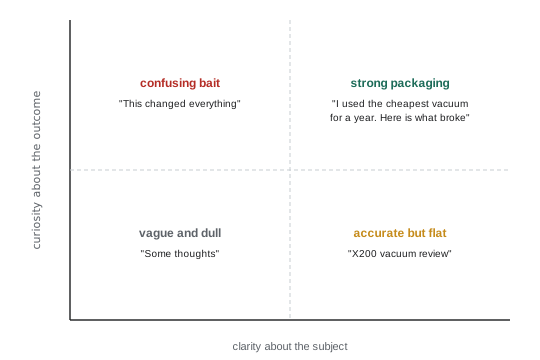
Effective packaging balances two forces. Clarity tells the viewer what the video is about and whether it is for them; curiosity gives them a reason to click now rather than later. Too much clarity and too little curiosity produces titles like "Review of the X200 vacuum cleaner", accurate but unexciting. Too much curiosity and too little clarity produces vague bait like "This changed everything", which attracts some clicks but confuses viewers and fails search. Strong packaging often states the subject clearly and opens a question about it: "I used the cheapest vacuum for a year. Here's what broke." The viewer knows exactly what the video is about and wants to know the answer. Thumbnails and titles should work together, each adding information rather than repeating the same words: the thumbnail might show the broken vacuum, while the title provides the context.
Sketching titles and thumbnails early
At the concept stage, write ten or more possible titles for the idea, varying the promise, angle and wording, and sketch several thumbnail concepts, even as rough drawings on paper or simple mock-ups with stock images. Ask which combination would make you click if you saw it among other videos on the subject. Look at the search results and recommendations around the topic to see what your packaging would compete with, and aim to stand out: if every thumbnail shows a person pointing at a product, a clean, striking image of the product doing something unexpected may stand out more. Keep the strongest title and thumbnail concept as the working packaging, which guides production and will be refined before publishing.
Worked problem
Developing packaging for a concept
A creator plans a video comparing home insulation methods for an older house in a cold climate. Their working title is "Insulation options for old houses". How could packaging be developed before filming?
Show solution
- Write alternatives: "I insulated my 1920s house three ways. Here's what cut my heating bill"; "Spray foam vs blown cellulose: one winter, two rooms"; "The cheapest insulation upgrade that actually worked".
- Sketch thumbnails: a thermal camera image of a wall showing cold spots before and after; two rooms side by side with temperature readings.
- Choose a combination: the thermal image thumbnail with the title "I insulated my 1920s house three ways. Here's what cut my heating bill".
- Note production needs: a thermal camera, before-and-after readings, heating bills, and a clear verdict at the end.
Answer: A specific, curiosity-driven title paired with a thermal-image thumbnail, which also defines what the video must capture and conclude.
Testing ideas with packaging
Packaging can be used to test ideas before investing in production. Methods include showing title and thumbnail concepts to trusted viewers, collaborators or a small group of audience members and asking which they would click; posting a poll on the channel's community tab asking which of several videos viewers would like to see next; noting which packaging concepts excite your team; and comparing your concepts with the packaging of outliers on similar topics (Lesson 2). These tests are imperfect, since people often say they would watch things they would not, and small samples are noisy (CRE-202), but they help eliminate weak ideas and reveal which angles resonate.
Aligning the video with its packaging
Once the packaging is set, the video must deliver it. Several principles help:
- Address the promise early: the opening should confirm that the viewer has found what the packaging promised, often by restating the question or showing the subject from the thumbnail within the first seconds (Lesson 5).
- Include what the thumbnail shows: viewers who click on a thumbnail showing a specific image or moment expect to see it, and feel misled if it never appears.
- Deliver the payoff clearly: if the title asks a question, answer it explicitly; if it promises a result, show it.
- Avoid bait and switch: changing the subject, delaying the payoff excessively, or delivering something weaker than promised drives viewers away and lowers the video's performance in recommendations, which favor viewer satisfaction as well as clicks.
Some creators keep the packaging sketch on the wall during filming and editing as a constant reminder of what the video must achieve.
Packaging for different traffic sources
Packaging works differently depending on where viewers find a video. In search results, viewers have a specific need, so titles that clearly match the query and thumbnails that show the answer or result tend to perform well. In browse features, such as the home page, and in suggested videos beside or after other videos, viewers are not searching for anything in particular, so curiosity, emotion and strong visuals matter more. Many videos receive most of their views from browse and suggested traffic, while tutorials and evergreen explainers may depend more on search. Knowing which traffic source a video is designed for helps balance search keywords against curiosity. YouTube also shows packaging on televisions, where thumbnails appear large and titles are often truncated, so both must work at different sizes.
The ethics of the click
Packaging competes for attention, and the temptation to exaggerate is constant. Misleading packaging, such as fake shocking images, claims the video does not support, invented conflict, or fearmongering about health or safety, may attract clicks in the short term, but it erodes trust, invites dislikes and negative comments, reduces satisfaction signals and can breach platform policies on misleading metadata. Honest, compelling packaging is a skill: it finds the genuinely interesting aspect of a video and presents it clearly and attractively. A useful test is to imagine a viewer who has just finished the video looking back at the title and thumbnail. If they would feel that the packaging was fair, it is honest; if they would feel tricked, it is not.
Packaging patterns that recur
Studying successful packaging reveals recurring patterns, which can inspire, though not replace, original ideas:
- The test: "I tried X for 30 days", "Testing the cheapest Y".
- The comparison: "X vs Y", "Budget vs premium".
- The outcome: "How I paid off my mortgage in seven years".
- The question: "Why do airplanes have tiny windows?"
- The challenge or constraint: "Cooking for a week on 50 dollars".
- The transformation: before and after, restoration, renovation.
- The insider or behind the scenes: "What it is really like to work on an oil rig".
- The mistake or warning: "Do not buy this until you watch this", used honestly.
These patterns work because they communicate a clear promise and a source of tension. Overused, they become clichés, so the best packaging uses the pattern with a specific, fresh subject or a twist.
Packaging and the audience you want
Packaging attracts a particular kind of viewer. Packaging aimed at beginners ("your first", "explained simply") brings different viewers from packaging aimed at experts ("advanced", "what the manuals don't tell you"). Packaging aimed at existing fans (in-jokes, series names) works for subscribers but may confuse newcomers. Because the viewers a video attracts shape what the platform recommends next, packaging also shapes a channel's future audience. Choose packaging that attracts the viewers you want to keep, not just the most viewers possible.
Working with a thumbnail designer early
Channels that use thumbnail designers often involve them at the concept stage, because the designer may need specific photographs: a particular expression from the host, an object photographed against a plain background, a before-and-after shot, or props. Planning these "thumbnail shots" into the filming day saves reshoots and produces better packaging than grabbing frames from footage afterward. Share the working title, the concept statement and reference thumbnails with the designer, and review sketches before production.
When packaging and content conflict
Sometimes, after filming, the video turns out differently from the packaging planned at the concept stage: a test produces an unexpected result, an interview reveals a better story, or the original promise cannot be fulfilled. In these cases, change the packaging to fit the video rather than forcing the video to fit misleading packaging. An unexpected result is often more interesting than the planned one and may lead to stronger packaging: "I expected the cheap grinder to fail. It didn't." Keeping packaging flexible until the edit is finished allows the best story to lead.
Measuring packaging success
Click-through rate is the most direct measure of packaging performance, but it must be read in context (CRE-202). Click-through rates usually fall as a video is shown to wider audiences who know less about the channel, so a high early rate followed by a lower one is normal. Compare with the channel's typical results for similar videos and traffic sources, and look at whether viewers who click stay: packaging that raises clicks but lowers average view duration may be overpromising.
Common mistakes
MistakeWriting the title after editing.
InsteadDesign packaging at the concept stage.
MistakeAccurate but flat titles.
InsteadCombine clarity with curiosity.
MistakeThumbnails showing moments not in the video.
InsteadCapture and include what the thumbnail shows.
MistakeDelaying the payoff excessively.
InsteadConfirm the promise early and deliver it clearly.
MistakeExaggerating claims to win clicks.
InsteadFind the genuinely interesting angle and present it honestly.
Summary and key terms
- Packaging is a compressed statement of a video's offer.
- Designing packaging first clarifies the promise and shapes production.
- Promises include answers, skills, stories, spectacle and transformations.
- Strong packaging balances clarity about the subject with curiosity.
- Sketch many titles and thumbnails early and test them.
- The video must deliver what the packaging promises.
- Honest packaging builds trust; misleading packaging erodes it.
- Packaging
- A video's title and thumbnail together.
- Promise
- What the packaging tells viewers they will get.
- Clarity
- How clearly packaging conveys the subject.
- Curiosity
- The open question that motivates a click.
- Working packaging
- Draft title and thumbnail used to guide production.
- Bait and switch
- Packaging that promises something the video does not deliver.
- Browse features
- Home page and similar recommendation surfaces.
- Suggested videos
- Recommendations beside or after other videos.
- Community poll
- Channel post asking viewers to choose options.
- Payoff
- The moment the video delivers its promise.
Practice problems
Work each problem on paper first, then reveal the answer to check.
Why design packaging first?
Show answer
It clarifies the promise and guides production.
Name four types of promise.
Show answer
Answer, skill, story, spectacle, transformation, judgment, insider knowledge.
What is wrong with "This changed everything"?
Show answer
No clarity about the subject.
Improve "Review of the X200 vacuum".
Show answer
For example, "I used the cheapest vacuum for a year. Here's what broke."
How many title options should you write early?
Show answer
Ten or more.
Name a way to test packaging.
Show answer
Ask trusted viewers or run a community poll.
What must the opening do?
Show answer
Confirm the promise the packaging made.
How does search packaging differ from browse packaging?
Show answer
Search needs clear query matches; browse needs curiosity and visuals.
Why do televisions matter for packaging?
Show answer
Thumbnails appear large and titles may be truncated.
What is the ethics test for packaging?
Show answer
Would a viewer who finished the video feel it was fair?
Lesson quiz · 5 questions
Score 60% or more to complete this lesson.
Create a free account to save your progress, take quizzes and earn a certificate.