
CRE-201 · Lesson 9 of 12 · 25 min
New accounts, growth and the dynamics of reach
Every creator starts with no audience, and recommendation systems start with no information about a new account. How do new creators get their first viewers, why do some posts take off while most do not, and what does the distribution of success look like across creators? This lesson examines the cold start problem, how systems learn about new accounts, the statistics of virality and power laws, why reach is so variable from post to post, consistency and posting frequency, niche focus and audience signals, collaborations and borrowed audiences, and realistic expectations for growth.
The cold start problem
Recommendation systems rely on behavioral data, but a new account or new post has none. This is called the cold start problem. Platforms address it in several ways. They analyze the content itself, its images, audio, text and topic, to estimate who might be interested before anyone has watched. They show new content to small test audiences, a form of exploration, and learn quickly from the responses. They use information about the account, such as the topics of its earlier posts and the interests of its early followers. And they seed new content to the creator's existing followers and to people with related interests. For a brand-new account, the first few posts help the system learn what the account is about and who might like it.
How systems learn about a new account
The early content of an account shapes how a platform categorizes it. If a new account posts consistently about one topic, such as baking, the system learns to show its content to people interested in baking, and the early followers it gains are baking enthusiasts, whose engagement reinforces the pattern. If an account posts about many unrelated topics, the system receives mixed signals, and the followers it gains may not be interested in later posts, reducing engagement. This is one reason why advice to "pick a niche" is common (CRE-110): a focused account helps both people and algorithms understand what to expect. Accounts can broaden over time, once they have an engaged audience, and some successful creators deliberately span several topics united by their personality or perspective.
Virality and power laws
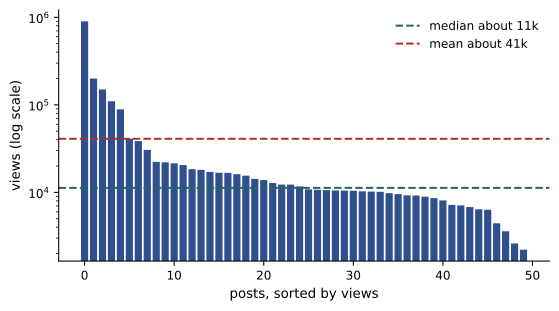
The distribution of views across posts and creators is extremely unequal. On most platforms, a small fraction of posts receive the vast majority of views, and a small fraction of creators receive most of the followers and income. Such distributions are often described as power laws or long-tailed distributions: there is no "typical" result, and averages are misleading because a few huge successes dominate them. For an individual creator, view counts on posts follow a similar pattern: most posts perform near the creator's usual range, a few do much better, and occasionally one goes viral, reaching many times more people than usual. Understanding this helps creators interpret results calmly: a single viral post is unlikely to repeat exactly, and most posts will not be breakthroughs.
Worked problem
Mean versus median views
A creator's last ten videos received 4,000, 6,000, 5,500, 7,000, 3,500, 250,000, 6,500, 5,000, 8,000 and 4,500 views. What are the mean and median, and which better describes typical performance?
Show solution
- Total: 4,000 + 6,000 + 5,500 + 7,000 + 3,500 + 250,000 + 6,500 + 5,000 + 8,000 + 4,500 = 300,000.
- Mean: 300,000 / 10 = 30,000 views.
- Sorted: 3,500, 4,000, 4,500, 5,000, 5,500, 6,000, 6,500, 7,000, 8,000, 250,000; median = (5,500 + 6,000) / 2 = 5,750.
- The median describes typical performance; the mean is distorted by one viral video.
Answer: Mean 30,000, median 5,750; the median better describes a typical video, while the hit is an outlier.
Why reach varies so much
Several factors make reach unpredictable. Small differences in early performance are amplified by staged distribution: a video that slightly outperforms expectations in its first test is shown to more people, while one that slightly underperforms stalls. Timing and context matter: a video may coincide with a trend, a news event or a lull in competing content. The specific test audience may happen to be more or less receptive. Platforms change their systems constantly, so the same content may perform differently from month to month. And the content itself varies in ways creators may not notice, such as a slightly weaker hook or a less relatable topic. Because of this randomness, judging content or strategy from a single post is unreliable; patterns across many posts are more informative (Lesson 10).
Consistency and posting frequency
Posting regularly helps in several ways: each post is another chance to be discovered; the system gathers more data about the account; audiences develop habits; and creators improve faster through practice and feedback. However, there is no universal ideal frequency. Platforms have generally said that posting more does not directly increase the reach of each post, and that quality matters more than volume; some have advised posting a few times a week on Instagram and regularly on TikTok, while YouTube emphasizes consistency suited to the creator's capacity. Posting so often that quality falls, or that the creator burns out, is counterproductive. A sustainable schedule, maintained over months, generally beats bursts of activity followed by silence.
| Factor | Effect on growth | Practical advice |
|---|---|---|
| Niche focus | Clear signals to system and viewers | Start focused; broaden once established |
| Consistency | More chances and habits | Choose a sustainable schedule |
| Quality | Better retention and satisfaction | Prioritize hooks, value and pacing |
| Series and formats | Recognition and returning viewers | Develop repeatable formats |
| Collaboration | Access to new audiences | Partner with aligned creators |
| Community | Engaged followers who signal early | Reply, involve and recognize viewers |
Series, formats and returning viewers
Recurring series and formats, such as "Day 47 of learning piano", a weekly review show, or a consistent style of explainer, help both audiences and algorithms. Viewers who enjoy one episode can easily find and anticipate the next, platforms can identify returning interest, and creators save effort by reusing structures. Series also encourage follows, because viewers want to see what happens next. Many breakthrough creators found a format that worked and refined it over dozens or hundreds of episodes.
Collaborations and borrowed audiences
Collaborations let creators reach each other's audiences. On YouTube, guest appearances and joint videos introduce creators to new viewers; on Instagram, collaborative posts appear on both accounts; on TikTok, duets and stitches respond to other creators' videos; on podcasts, guest appearances are a primary growth method. Collaborations work best when audiences overlap in interests but are not identical, and when both creators bring value. Shout-outs, features on larger accounts, press coverage and appearances on other media can also bring bursts of new followers, though retaining them depends on whether the creator's regular content satisfies them.
Followers and their value
In recommendation-driven platforms, follower counts matter less for reach than they once did, but followers remain valuable. Engaged followers provide early signals for new posts, see content in following feeds and notifications, and form the core of a creator's community and income, through memberships, purchases and brand partnerships. Followers gained from a single viral post on an unrelated topic may not engage with later content, sometimes reducing average engagement. Brands increasingly evaluate creators by engagement, audience quality and fit rather than raw follower numbers (CRE-310). Buying followers or engagement violates platform rules, damages engagement rates and credibility, and is often detected and removed.
Realistic expectations
Most creators grow slowly, with occasional jumps. Surveys of creators consistently find that a minority earn a full-time income, and that success often takes years of consistent work, combined with luck (CRE-101). Recommendation systems make overnight success possible but not predictable. Healthy expectations include measuring progress over months rather than days, focusing on improving content and building a loyal audience, celebrating learning as well as numbers, and avoiding constant comparison with outliers. Recognizing the role of chance also helps creators avoid both overconfidence after a hit and despair after a quiet period.
Breakouts and what follows
When a post breaks out, reaching far more people than usual, creators face decisions. A breakout brings new viewers who may not know the creator, and many will not return. Creators can capitalize by quickly following up with related content that new viewers will enjoy, pinning a post that introduces the account, replying to comments, and making the profile clear about what the account offers. Trying to replicate the exact viral post rarely works, but understanding why it resonated, such as a topic, format or emotional hook, can inform future work. Equally important is not abandoning the account's core audience and identity in pursuit of another hit.
Plateaus and slowdowns
Most creators experience plateaus, periods when growth stalls despite consistent effort. Causes include audience saturation within a niche, changes in platform systems, content that has become predictable, or competition from new creators. Responses include experimenting with new formats or topics adjacent to the niche, improving production quality and hooks, collaborating to reach new audiences, expanding to another platform, and studying analytics to find what still works. Plateaus are normal, and many successful creators describe long periods of slow growth before breakthroughs.
Network effects and the rich-get-richer dynamic
Recommendation systems can amplify existing popularity: content and creators that already have strong signals are more likely to be recommended, gaining more signals in turn. This rich-get-richer dynamic, sometimes called preferential attachment or the Matthew effect, contributes to the concentration of attention among top creators. Platforms counteract it partly through exploration and by testing new content fairly, but advantages accumulate. For smaller creators, this means focusing on specific niches and communities where they can stand out, rather than competing head-on with the largest creators on broad topics.
Measuring growth meaningfully
Meaningful growth measures go beyond follower counts: growth in engaged viewers who return, in watch time, in newsletter subscribers, in community members, and in income. Tracking these monthly, with medians and trends rather than single numbers, gives a realistic picture. Setting goals around inputs that creators control, such as publishing a certain number of quality posts, running experiments and learning skills, is healthier than setting goals purely around outcomes like viral views, which depend partly on chance.
Luck and preparation
Luck plays a real role in reach: the right post at the right moment can change a creator's trajectory. But luck favors those who are prepared, with a body of good content, a clear identity and the ability to respond when opportunities arise. Creators who keep improving and publishing give themselves more chances for lucky breaks and are better able to benefit from them.
Growth across platforms
Growth on one platform can help others. A viral TikTok can drive new subscribers to YouTube or a newsletter if the creator makes the connection clear; a YouTube video embedded on a blog can attract search traffic; and a podcast guest appearance can send listeners to a creator's Instagram. Tracking where new followers come from, through platform analytics and simple questions to the audience, helps creators see how their platforms reinforce each other and where to invest effort.
Growth stories in context
Stories of creators who grew from nothing to millions of followers in weeks are memorable precisely because they are rare. Behind most of them lie months or years of practice, earlier accounts that did not succeed, or particular timing that cannot be repeated. Comparing your progress with such stories can be discouraging and misleading. A more useful comparison is with your own past performance: whether your median results, audience engagement and skills are improving over time. Measured this way, steady progress is visible even when growth feels slow, and it builds the foundation on which any breakthrough can be sustained.
Common mistakes
MistakePosting about unrelated topics from day one.
InsteadStart with a focus that helps systems and viewers understand you.
MistakeJudging strategy from one viral post.
InsteadLook at medians and patterns across many posts.
MistakePosting as often as possible regardless of quality.
InsteadChoose a sustainable schedule with consistent quality.
MistakeBuying followers or engagement.
InsteadGrow genuine, engaged audiences.
MistakeExpecting predictable overnight success.
InsteadPlan for gradual growth with occasional jumps.
Summary and key terms
- The cold start problem is solved with content analysis, test audiences and account signals.
- Early content shapes how systems categorize an account and who follows it.
- Views follow long-tailed distributions; medians describe typical results better than means.
- Staged distribution amplifies small differences, making reach variable.
- Consistency, quality, series and collaboration support growth.
- Engaged followers remain valuable even in recommendation-driven feeds.
- Growth is usually gradual, with luck playing a significant role.
- Cold start problem
- Recommending items or accounts with no data.
- Test audience
- Small group shown new content first.
- Niche
- Focused topic area for an account.
- Power law
- Distribution where a few items dominate.
- Long tail
- Many items with small values in a skewed distribution.
- Median
- Middle value when results are sorted.
- Virality
- Rapid, wide spread of content.
- Series
- Recurring content with a shared format.
- Collaboration
- Creators working together to share audiences.
- Engagement rate
- Interactions relative to reach or followers.
Practice problems
Work each problem on paper first, then reveal the answer to check.
What is the cold start problem?
Show answer
Recommending new items or accounts without behavioral data.
Name two ways platforms address it.
Show answer
Content analysis, test audiences, account signals, followers.
Why does early content matter for a new account?
Show answer
It shapes categorization and the followers gained.
What is a power-law distribution?
Show answer
A few items receive most of the total.
Median of 2,000, 3,000, 4,000, 100,000 views?
Show answer
3,500.
Why is reach so variable?
Show answer
Staged amplification, timing, audiences, system changes, content differences.
Does posting more increase each post's reach?
Show answer
Not directly; quality matters more.
Why do series help?
Show answer
Recognition, returning viewers and follows.
When do collaborations work best?
Show answer
Overlapping but not identical audiences, mutual value.
Why avoid buying followers?
Show answer
Breaks rules, harms engagement and credibility.
Lesson quiz · 5 questions
Score 60% or more to complete this lesson.
Create a free account to save your progress, take quizzes and earn a certificate.