
CRE-201 · Lesson 12 of 12 · 25 min
Cross-platform strategy and capstone
Understanding how recommendation systems work is useful only if it informs better decisions. This final lesson turns the course's knowledge into strategy: choosing which platforms to prioritize, designing content that suits each platform's system while sharing a core, managing platform risk, building owned channels, using analytics to learn across platforms, working with rather than against algorithms ethically, and preparing for future changes such as AI-generated feeds and new platforms. It ends with the capstone, a platform audit and distribution plan for a creator or brand.
Choosing platforms
No creator can master every platform at once. Choosing where to focus depends on several factors:
- Audience: where the people you want to reach spend time, by age, interests, profession and region.
- Format fit: whether your content naturally suits short video, long video, images, text, audio or live.
- Discovery dynamics: whether the platform offers strong recommendation reach for new creators, search-driven evergreen traffic, or mainly follower-based distribution.
- Monetization: advertising revenue sharing, creator funds, subscriptions, tipping, commerce and brand demand on each platform.
- Capacity: how much time and skill each platform requires.
- Risk: the platform's stability, policies and regulatory situation.
A common approach is to choose one primary platform where you invest most effort and build depth, and one or two secondary platforms for discovery or community, adding others as resources allow.
| Platform type | Strengths for creators | Limitations |
|---|---|---|
| Short-form video | Fast discovery, viral potential | Volatile reach, low revenue per view |
| YouTube long-form | Evergreen search and recommendations, ad revenue | High production effort, slower growth |
| Instagram and Facebook | Visual community, commerce, brand deals | Shifting priorities, originality rules |
| Text platforms | Low production cost, expertise, conversation | Smaller reach, link limits on some |
| Long-lived search traffic to websites | Narrower content categories | |
| Podcasts and audio | Loyal, habitual audiences | Slow discovery |
| Newsletters and websites | Ownership, direct access, search traffic | Must build audience from elsewhere |
A core-and-adapt content system
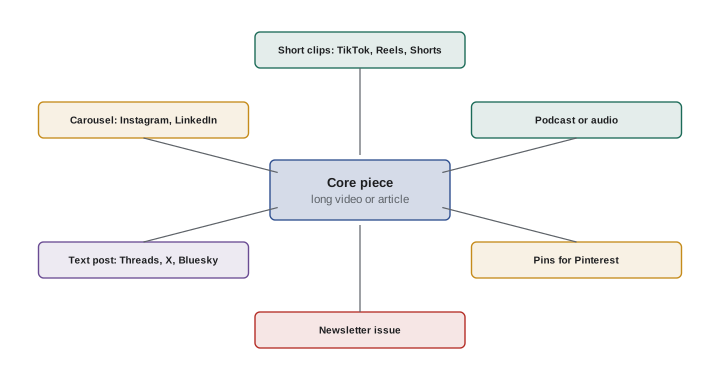
Many creators build a content system around a core piece of work, adapted for each platform. For example, a long YouTube video might be the core, supporting several short clips for TikTok, Reels and Shorts, a carousel summarizing key points for Instagram and LinkedIn, a thread or text post with insights, a newsletter issue with deeper commentary and links, and pins linking to a blog post. Each adaptation respects the platform's format, culture and signals: short clips with strong hooks and captions, carousels designed for saves, text posts with compelling first lines, pins with searchable descriptions. This approach multiplies reach without multiplying effort, but it requires real adaptation rather than copying.
Managing platform risk
Building on platforms means building on land you do not own. Risks include algorithm changes that cut reach; policy changes that restrict content or monetization; account suspensions, sometimes mistaken; platform decline, as with Vine's closure in 2017; regulatory disruption, such as the TikTok divestiture law in the United States or news blocking in Canada; and changes to creator payment programs. Strategies to manage risk include diversifying across at least two platforms; building owned channels; keeping backups of all content; understanding and following each platform's rules; keeping records of sponsored content disclosures; maintaining contact information for brand partners outside platforms; and avoiding dependence on a single income source.
Owned channels
Owned channels are those a creator controls directly, such as an email newsletter, a website or blog, a podcast RSS feed, or a community platform with exportable membership data. They let creators reach their audience without algorithmic filtering, move audiences between platforms, and sell products, memberships and services directly. Email in particular remains one of the most reliable ways to reach people, with open and click rates that, while varying, are not subject to social feed ranking. Converting a portion of platform followers into newsletter subscribers or community members, through valuable incentives such as guides, early access or exclusive content, is a key long-term strategy. Owned channels also support search visibility through websites and transcripts (Lesson 8).
Worked problem
Planning audience conversion
A creator has 200,000 followers across TikTok and Instagram and 1,500 newsletter subscribers. Each month, about 600,000 people view their content. If 0.2 % of monthly viewers visit the newsletter sign-up page and 30 % of those subscribe, how many new subscribers will join each month, and how could the rate be improved?
Show solution
- Visitors: 0.2 % × 600,000 = 1,200 people per month.
- Subscribers: 30 % × 1,200 = 360 new subscribers per month.
- Over a year, about 4,300 new subscribers, nearly quadrupling the list.
- To improve: offer a specific, valuable incentive related to popular content, mention it in videos where viewers are most engaged, make the link easy to find, and simplify the sign-up page.
Answer: About 360 new subscribers per month; clearer offers, better placement and simpler sign-up can raise conversion.
Learning across platforms
Analytics on each platform reveal what resonates, and patterns across platforms reveal deeper truths about an audience. A topic that performs well on TikTok, Instagram and YouTube is likely a genuine interest; one that performs on only one platform may reflect that platform's particular audience or system. Creators can maintain a simple cross-platform tracker of key metrics per post, such as reach, retention, shares, saves and follows, normalized against each platform's typical results, and review it monthly to choose topics, formats and hooks. CRE-202 develops these analytical skills. Qualitative feedback, such as comments, messages and conversations with audience members, adds understanding that numbers cannot.
Working with algorithms ethically
Recommendation systems reward attention, and some tactics that capture attention, such as outrage, misinformation, sensationalism, exploitation of vulnerable people and manipulative design, can succeed in the short term while harming audiences and society. Creators have choices about how they use these systems. Ethical approaches include delivering what packaging promises; avoiding misinformation and checking facts; respecting the privacy and dignity of people featured; disclosing sponsorships and synthetic content; considering effects on young viewers; resisting rage bait; and building trust that lasts beyond any single algorithm change. Platforms increasingly reward satisfaction and penalize manipulation, so ethical strategies are often also sustainable ones (CRE-101 and CRE-320).
The future of feeds
Recommendation systems continue to evolve. Trends visible in 2026 include larger AI models that understand content more deeply and personalize feeds further; generative AI content flooding platforms, prompting stronger originality and labeling measures; AI assistants and chatbots that answer questions and recommend content, changing search; more user control over feeds, including custom and non-personalized options, partly driven by regulation; decentralized platforms with portable identities and audiences; age assurance and youth protections; and growing commerce integration, with shopping inside feeds. Creators cannot predict exactly how these developments will unfold, but the durable principles of this course, genuine value, clear presentation, community, originality, honest practices and diversification, are likely to remain relevant.
Capstone: platform audit and distribution plan
The capstone asks you to audit the platform presence of a creator, brand or organization, real or hypothetical, and design a distribution plan. Your submission should include:
- A summary of the creator's goals, audience and content.
- An audit of current performance on two or more platforms: traffic sources, median and outlier results, retention, shares and saves, search visibility, account status, and dependence on each platform.
- An analysis of how each platform's recommendation and search systems are likely to treat the content, using concepts from this course.
- A distribution plan: primary and secondary platforms, a core-and-adapt content system, posting cadence, search strategy, and owned channels.
- An experiment plan with at least three tests, each with a hypothesis, metric, method and baseline.
- A risk and ethics section covering platform risk, policy and regulatory considerations, disclosure and audience wellbeing.
Present the plan as a concise report with charts, as you would to a creator or marketing team.
Building a team and systems
As creators grow, managing multiple platforms often requires help. Editors, social media managers, community managers and assistants can adapt core content for each platform, schedule posts, respond to comments and track analytics. Scheduling tools, content calendars and shared folders keep work organized. Clear guidelines, such as a brand voice document, platform-specific checklists and approval processes, ensure consistency when several people work on the same accounts. CRE-401 discusses building a media company and team.
Brands and platform strategy
Brands that work with creators also think in terms of platforms and algorithms. They may prefer creators whose audiences match their targets on specific platforms, request content suited to particular formats, and use creator content in paid advertising, such as Spark Ads on TikTok or partnership ads on Instagram, which extend reach beyond organic distribution. Creators who understand how each platform distributes content can advise brands on realistic outcomes, propose suitable formats, and price their work appropriately (CRE-310).
Paid promotion and organic reach
Most platforms let creators pay to promote posts, boosting distribution to chosen audiences. Paid promotion can test content, reach specific demographics or support launches, but it does not replace organic performance: promoted content that viewers dislike still performs poorly and can waste money. Some creators worry that paying for promotion harms organic reach; platforms have generally said this is not the case, but paid and organic distribution follow different rules. Clear goals, small tests and careful measurement help creators decide whether promotion is worthwhile.
Exit plans and portability
Because platforms can change or disappear, creators should plan for portability: keeping backups of all original content, exporting follower or subscriber data where possible, maintaining an email list and website, and documenting their brand assets. Decentralized platforms that allow followers to move between services offer some portability, but most audiences remain tied to their platforms. A creator who could move their core audience to a new platform within weeks, through a newsletter and community, is far more resilient than one who depends on a single account.
Reviewing the strategy regularly
A distribution strategy should be reviewed periodically, for example every quarter. Review which platforms are delivering on goals, how algorithm and policy changes have affected results, what experiments have revealed, how owned channels are growing, and whether the workload is sustainable. Adjust priorities based on evidence, while avoiding constant shifts. A written strategy, updated regularly, keeps a creator or team focused on long-term goals amid the daily noise of metrics and platform news.
Bringing the course together
This course has examined recommendation systems from their technical foundations to their regulation. The common thread is that these systems try to predict what people will value, using signals that creators can influence through the quality, clarity and honesty of their work. Creators who understand the systems can work with them intelligently, interpret results calmly, test ideas sensibly and protect themselves from risk, while keeping their focus on the audiences they serve.
Sample plan outline
A capstone plan for a small cooking creator might name YouTube as the primary platform for weekly recipe videos, with TikTok and Reels as discovery platforms for short clips, Pinterest for searchable recipe pins linking to a blog, and a weekly newsletter with recipes and shopping lists as the owned channel. It might propose three experiments: hook styles for short clips, thumbnail styles using Test and Compare, and newsletter incentives such as a free meal-planning guide. Risk planning would cover backups, diversification and disclosure of sponsored ingredients. Such a plan is concrete, measurable and adaptable.
Measuring the plan
A distribution plan needs measures of success that match its goals. If the goal is discovery, measure reach to non-followers and follower growth; if it is depth, measure watch time, returning viewers and newsletter growth; if it is income, measure revenue per platform and conversion from content to sales. Setting baselines before the plan begins, and reviewing results monthly and quarterly, shows whether the plan is working and where to adjust.
With a clear strategy grounded in how platforms work, creators can spend less energy worrying about algorithms and more energy making work that their audiences value, which remains the most reliable route to lasting success.
Common mistakes
MistakeTrying to master every platform at once.
InsteadChoose a primary platform and one or two secondary ones.
MistakeCopying identical posts across platforms.
InsteadAdapt a core piece to each platform's format and culture.
MistakeDepending entirely on one platform.
InsteadDiversify and build owned channels.
MistakeUsing outrage or misinformation for reach.
InsteadBuild trust with honest, valuable content.
MistakeIgnoring cross-platform patterns.
InsteadTrack and compare normalized results regularly.
Summary and key terms
- Choose platforms by audience, format fit, discovery, monetization, capacity and risk.
- A core-and-adapt system multiplies reach with genuine adaptation.
- Platform risk includes algorithm, policy, account, regulatory and business changes.
- Owned channels such as newsletters give direct, durable access to audiences.
- Cross-platform analytics reveal what truly resonates.
- Ethical strategies are often the most sustainable.
- The capstone audits platforms and designs a distribution plan.
- Primary platform
- Main platform where a creator invests most effort.
- Core-and-adapt
- Creating a core piece and adapting it per platform.
- Platform risk
- Exposure to changes on platforms a creator does not control.
- Owned channel
- Channel a creator controls directly.
- Conversion rate
- Share of people who take a desired action.
- Lead magnet
- Incentive offered for newsletter sign-up.
- Normalized metric
- Result compared with a platform's typical value.
- Rage bait
- Content designed to provoke anger for engagement.
- Platform audit
- Review of performance and risks across platforms.
- Distribution plan
- Strategy for where and how content is published.
Practice problems
Work each problem on paper first, then reveal the answer to check.
Name four factors in choosing platforms.
Show answer
Audience, format fit, discovery, monetization, capacity, risk.
What is a core-and-adapt system?
Show answer
A core piece adapted for each platform.
Give an example of platform decline.
Show answer
Vine's closure in 2017.
Name three platform risks.
Show answer
Algorithm, policy, suspension, decline, regulation, payment changes.
Why are newsletters valuable?
Show answer
Direct access without feed ranking.
New subscribers from 1,000 visitors at 25 % conversion?
Show answer
250.
Why normalize metrics across platforms?
Show answer
Typical results differ by platform.
Name two ethical practices.
Show answer
Honest packaging, fact-checking, disclosure, privacy, avoiding rage bait.
Name two trends in feeds.
Show answer
Deeper AI, generative content, user control, decentralization, commerce.
Name three capstone components.
Show answer
Goals, audit, system analysis, plan, experiments, risk and ethics.
Lesson quiz · 5 questions
Score 60% or more to complete this lesson.
Create a free account to save your progress, take quizzes and earn a certificate.