
CRE-201 · Lesson 1 of 12 · 25 min
How recommendation feeds work
Most of what people see online is chosen for them. On TikTok, Instagram, YouTube, Facebook, Pinterest, LinkedIn, Spotify and many other services, a recommendation system decides which posts, videos, songs and accounts appear, in what order, for each person, every time they open the app. For creators, these systems are the gatekeepers of reach: a video can be seen by a hundred people or ten million depending on how the system responds to it. CRE-101 introduced recommendation systems in broad terms. This course looks at them in depth: how they work technically, which signals they use, how platforms differ, how search fits in, what the evidence says about common myths, how regulation is changing them, and how creators can build strategies that use them without being controlled by them. This first lesson explains the evolution from chronological feeds to ranked feeds, the stages of a modern recommendation pipeline, the goals platforms optimize for, and why understanding the system matters.
From chronological to ranked feeds
Early social platforms showed posts in reverse chronological order: the newest post from anyone you followed appeared at the top. This was simple and transparent, but as people followed hundreds of accounts and posting volume grew, most posts were never seen, and the feed favored whoever posted most often. Facebook introduced a ranked News Feed in the late 2000s, choosing which friends' posts to show based on predicted interest. Twitter, Instagram and others followed in the mid-2010s, despite user complaints, because ranked feeds increased engagement. The next shift came with recommendation feeds that show content from accounts people do not follow. TikTok's For You feed, launched internationally in 2017 and 2018, made this the default experience: what you see depends mostly on what the system predicts you will watch, not whom you follow. Instagram Reels, YouTube Shorts, Facebook and even LinkedIn and X have since increased the share of recommended, or unconnected, content in their feeds.
This shift has profound consequences for creators. In a follow-based world, building an audience meant accumulating followers who would then see your posts. In a recommendation-based world, each piece of content competes for distribution largely on its own merits, as judged by the system's predictions, and followers matter less. A new account with few followers can reach millions with one video, while an established account may see a post reach only a small fraction of its followers.
| Feed type | What decides what you see | Examples |
|---|---|---|
| Chronological | Time of posting from accounts you follow | Early Twitter and Instagram, following tabs, RSS |
| Ranked social | Predicted interest among accounts you follow | Facebook News Feed in the 2010s |
| Recommendation | Predicted interest from all available content | TikTok For You, Reels, Shorts, YouTube home |
| Search | Relevance to a query plus quality signals | YouTube search, Pinterest, TikTok search |
| Custom or user-chosen | Feeds designed by users or third parties | Bluesky custom feeds, Mastodon lists |
The scale problem
Recommendation systems exist because there is far too much content for anyone to choose from manually. Hundreds of hours of video are uploaded to YouTube every minute, and short-form platforms receive many millions of new videos each day. A recommendation system must choose, in a fraction of a second, a handful of items for each of hundreds of millions or billions of people from this enormous pool. No system can carefully evaluate every item for every person, so recommendation systems work in stages, quickly narrowing the pool before spending more computation on the most promising items.
The stages of a recommendation pipeline
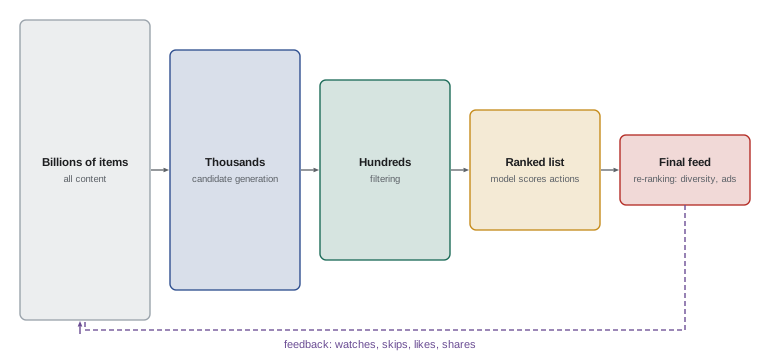
Although each platform's system is different and evolving, most large-scale recommenders share a broadly similar structure, described in engineering papers and public explanations by YouTube, Meta, TikTok, Pinterest, LinkedIn, X and others:
- Candidate generation (retrieval): from millions or billions of items, several retrieval methods quickly select a few thousand candidates that might interest this person, for example items similar to things they recently engaged with, items popular among similar users, new posts from accounts they follow, and trending items in their region or language.
- Filtering: candidates that violate policies, that the person has already seen, that come from blocked accounts, or that fail quality or safety thresholds are removed.
- Ranking: a machine-learning model, often a large neural network, estimates for each remaining candidate the probability of various actions, such as watching to the end, liking, commenting, sharing, following, or reporting, and combines these predictions into a score.
- Re-ranking and blending: the top-scoring items are adjusted for diversity, so that the feed does not show ten similar videos in a row; for freshness; for the mix of followed and recommended content; for ads; and for business or integrity rules.
- Serving and feedback: the final list is shown, and the person's reactions, including what they watched, skipped, liked or hid, are recorded and fed back into the models, often within minutes.
What the models learn
Ranking models are trained on enormous logs of past behavior: which items were shown to which people, and what they did. The models learn representations, often called embeddings, of people and content: lists of numbers that place each person and each item in a high-dimensional space where similar things sit close together. A cooking video and a viewer who often watches cooking videos end up near each other; so do two videos that are often watched by the same people. Content features, such as the visual and audio content of a video, the text in captions and titles, speech transcripts, hashtags and sounds, help the system understand new items before much behavioral data exists. Context, such as the time of day, device, location, network and what the person has just watched, also shapes predictions. The models do not "understand" content as people do; they learn statistical patterns that predict behavior.
What platforms optimize for
A recommender ranks items according to an objective, a combination of predicted outcomes that the platform wants to maximize. Early systems often optimized simple metrics such as clicks, which rewarded clickbait, or total watch time, which rewarded long and sometimes sensational content. Platforms have since moved toward multi-objective ranking that combines many predicted actions with different weights: watch time and completion, likes, comments, shares and saves, follows, and negative signals such as skips, "not interested" taps, hiding, unfollowing and reports. YouTube has said for years that it also uses viewer satisfaction surveys, asking samples of viewers how they felt about videos, to train models that predict satisfaction rather than just watch time. Meta has described weighting "meaningful" interactions and using surveys about whether posts were worth people's time. Platforms also optimize long-term outcomes, such as whether people return the next day, not only immediate engagement.
The exact weights are secret, change constantly and vary by surface, region and user. What creators can rely on is the general direction: platforms want people to enjoy what they see, keep using the service, and avoid content that makes them leave, complain or distrust the platform.
Exploration and exploitation
A system that only showed people more of what they already liked would become repetitive and could never learn about new interests or new creators. Recommendation systems therefore balance exploitation, showing items predicted to perform well, with exploration, showing some items whose performance is uncertain, such as new videos, new creators or topics outside a person's usual interests. Exploration is how new content gets its first audience: a fresh video is shown to a small group of people likely to be interested, and their responses determine whether it is shown more widely. This is one reason why posting consistently gives creators more chances: each post is a new opportunity for the system to explore.
Worked problem
A video's first hour
A creator posts a 40-second cooking video on a short-form platform. In its first hour, it is shown to about 500 people, of whom 55 % watch to the end, 4 % like it and 1 % share it. A similar video the previous week had 35 % completion and 0.2 % shares. What is likely to happen next, and why?
Show solution
- The system compares early responses with what it expected for similar videos and similar audiences.
- Completion and shares are much stronger than the creator's previous comparable video and likely above typical values for the topic.
- The system is likely to expand distribution to a larger group of similar viewers, then test adjacent audiences.
- If performance holds as the audience broadens, distribution continues to grow; if responses weaken with less interested viewers, it levels off.
Answer: Strong early completion and shares relative to expectations usually trigger wider distribution in stages, continuing as long as broader audiences respond well.
Personalization and feedback loops
Because recommendations depend on behavior and behavior depends on recommendations, feeds create feedback loops. A person who watches a few fitness videos soon sees many more, which they may watch, reinforcing the pattern. This makes feeds feel uncannily personal and helps niche creators find audiences, but it also raises concerns: about filter bubbles, in which people see a narrow range of views; about rabbit holes, in which recommendations escalate toward more extreme or harmful content; and about effects on young people's wellbeing. Research findings on filter bubbles and radicalization are mixed and depend on the platform and period studied, and platforms have changed their systems in response to criticism, but the concerns have shaped regulation (Lesson 11). For creators, feedback loops mean that the audience a platform builds for you depends on your early content: a channel that starts with one kind of video will be shown to people interested in that kind of video.
Why creators should understand the system
Understanding recommendation systems helps creators in several ways. It explains why reach varies so much between posts, reducing the temptation to blame mysterious penalties. It shows which aspects of content matter most, such as the first seconds, completion, rewatch value and shareability, so that effort goes where it counts. It helps creators interpret analytics (CRE-202) and design sensible experiments rather than chasing myths (Lesson 10). And it reveals the risks of depending on any one platform's system, which can change without notice, motivating diversification and owned channels (Lesson 12). The goal is not to "beat the algorithm", which is constantly changing and designed to resist manipulation, but to make content that the people a creator wants to reach genuinely value, and to present it in ways that help the system find those people.
Course overview
Lesson 2 examines the signals recommendation systems use; Lessons 3 to 7 explore how specific platforms work: short-form video, YouTube, Meta's apps, text and community platforms, and audio and live streaming. Lesson 8 covers search and discoverability; Lesson 9, how new accounts and posts gain traction; Lesson 10, myths, testing and platform changes; Lesson 11, moderation, transparency and regulation; and Lesson 12, cross-platform strategy and a capstone platform audit.
Recommendation beyond social media
Recommendation systems are not unique to social platforms. Netflix recommends films and series, Amazon recommends products, Spotify recommends music, news apps recommend articles, and dating apps recommend people. Many of the techniques used by social platforms, such as collaborative filtering and deep ranking models, were developed or refined in these contexts; the Netflix Prize competition, run from 2006 to 2009, offered a million dollars for improving the accuracy of film recommendations and spurred much research. Understanding recommendation in general helps creators see that the systems they work with are part of a broad shift in how people discover everything online.
Recommendation systems therefore shape culture as well as careers: which songs become hits, which products sell, which ideas spread and which creators can make a living. Studying them is part of understanding modern media.
Common mistakes
MistakeAssuming followers will see every post.
InsteadExpect each post to compete for distribution on its own merits.
MistakeTrying to "beat the algorithm" with tricks.
InsteadMake content the intended audience values and present it clearly.
MistakeBelieving platforms optimize only for watch time.
InsteadUnderstand multi-objective ranking with satisfaction and negative signals.
MistakeIgnoring how early content shapes your audience.
InsteadStart with content that matches the audience you want.
MistakeTreating one platform's system as permanent.
InsteadExpect change and diversify.
Summary and key terms
- Feeds evolved from chronological to ranked to recommendation-based.
- Recommendation feeds make each post compete largely on its own performance.
- Pipelines move through candidate generation, filtering, ranking, re-ranking and feedback.
- Models learn embeddings of people and content from behavior and content features.
- Platforms optimize multiple objectives, including satisfaction and negative signals.
- Exploration gives new content and creators a chance to find audiences.
- Feedback loops personalize feeds and shape which audiences creators reach.
- Recommendation system
- Software that chooses which items each person sees.
- Chronological feed
- Posts shown in order of time.
- Ranked feed
- Posts ordered by predicted interest.
- Candidate generation
- Selecting a small set of possible items from a huge pool.
- Ranking model
- Model scoring candidates by predicted actions.
- Re-ranking
- Adjusting rankings for diversity, freshness and rules.
- Embedding
- Numeric representation placing similar items close together.
- Objective
- Combination of outcomes a system maximizes.
- Exploration
- Showing uncertain items to learn about them.
- Feedback loop
- Recommendations shaping behavior that shapes recommendations.
Practice problems
Work each problem on paper first, then reveal the answer to check.
Why did platforms move away from chronological feeds?
Show answer
Too much content; ranked feeds increased engagement.
What made TikTok's For You feed different?
Show answer
It showed mostly content from accounts people did not follow.
Name the five stages of a recommendation pipeline.
Show answer
Candidate generation, filtering, ranking, re-ranking, feedback.
What does a ranking model predict?
Show answer
Probabilities of actions such as watching, liking, sharing or reporting.
What is an embedding?
Show answer
A numeric representation placing similar items close together.
Why do platforms use satisfaction surveys?
Show answer
To predict satisfaction rather than only watch time.
Name two negative signals.
Show answer
Skips, not interested, hides, unfollows, reports.
What is exploration?
Show answer
Showing uncertain items, such as new videos, to learn about them.
How do feedback loops affect new channels?
Show answer
Early content shapes which audience the system builds.
Why understand recommendation systems?
Show answer
To interpret reach, focus effort, test sensibly and manage risk.
Lesson quiz · 5 questions
Score 60% or more to complete this lesson.
Create a free account to save your progress, take quizzes and earn a certificate.