
CRE-201 · Lesson 7 of 12 · 25 min
Audio, podcasts and live streaming
Recommendation systems shape not only what people watch but what they hear and which live streams they join. Music and podcast platforms such as Spotify, Apple Podcasts, YouTube and YouTube Music recommend episodes, shows and songs; live platforms such as Twitch, YouTube Live, TikTok LIVE and Kick recommend streams in real time. These systems face different challenges from short-video feeds: audio is often consumed in the background, podcast episodes last an hour or more, and live content exists only while it happens. This lesson covers how audio platforms discover and recommend content, podcast discovery and the role of charts and directories, video podcasts, music recommendation and playlists, live streaming discovery, signals in live content, clips and repurposing, and strategies for audio and live creators.
How audio recommendation differs
Audio presents particular challenges for recommendation. Listening is often passive: people play podcasts while driving, exercising or working, so skips and completion carry different meanings than in video. Episodes are long, so a single listen provides relatively little data compared with dozens of swipes in a short-video session. Content understanding is harder because systems must analyze speech, music and sound rather than images. And listeners form strong habits, subscribing to shows they return to every week. As a result, audio platforms rely heavily on subscriptions, listening history, collaborative filtering (people who listen to this show also listen to that one), editorial curation, charts and, increasingly, transcripts and AI analysis of topics.
Podcast discovery
Podcasts are distributed through an open system: creators publish an RSS feed through a hosting service, and directories and apps such as Apple Podcasts, Spotify, YouTube, Amazon Music, Pocket Casts and Overcast read it. Discovery happens through several routes:
- Search within apps, based on show titles, episode titles, descriptions, creator names and increasingly transcripts.
- Charts and rankings, such as Apple Podcasts and Spotify charts, which reflect recent growth in followers and listening; their exact methods are not published.
- Editorial features, where platform staff highlight shows.
- Recommendations within apps, based on listening history and similar listeners.
- Word of mouth, guest appearances on other podcasts, social media clips, newsletters and cross-promotion between shows, which remain among the most effective growth methods.
Because podcast apps have historically offered limited algorithmic discovery, many podcasters grow mainly through their existing audiences and other platforms, and use short video clips on TikTok, Reels and Shorts to reach new listeners.
| Discovery route | How it works | What creators can do |
|---|---|---|
| App search | Titles, descriptions, transcripts | Clear titles and descriptive episode names |
| Charts | Recent growth in followers and listens | Launch with several episodes and promotion |
| Editorial | Staff selections | Quality, consistency, pitching where possible |
| Recommendations | Listening history and similar listeners | Consistent niche and format |
| Cross-promotion | Guests, ad swaps, clips, newsletters | Collaborate and repurpose |
Video podcasts and YouTube
Video podcasts, recorded with cameras and published on YouTube, Spotify and other platforms, have grown rapidly. YouTube has become one of the most used platforms for podcast listening in the United States, according to several surveys, and it treats podcasts like other long-form videos, recommending them through home, suggested and search surfaces, with designated podcast playlists and a podcasts section. Spotify also supports video podcasts and pays some video podcast creators through its partner program. Video podcasts benefit from YouTube's recommendation system and from clips that work on short-form platforms, but they require more production effort: cameras, lighting and editing (CRE-130). Thumbnails and titles matter for video podcasts just as for other YouTube videos, which often means framing episodes around specific topics or guests rather than generic episode numbers.
Music recommendation and playlists
Music streaming services such as Spotify, Apple Music, YouTube Music, Amazon Music and Deezer recommend songs and artists through personalized playlists, such as Spotify's Discover Weekly and Release Radar, autoplay after an album or playlist ends, radio stations based on a song or artist, editorial playlists curated by staff, and algorithmic playlists for moods and activities. Signals include saves to library and playlists, repeat listens, completion, skips (especially in the first 30 seconds), follows, and shares, combined with audio analysis and collaborative filtering. For independent musicians, getting into editorial or algorithmic playlists can bring large audiences; services such as Spotify for Artists allow artists to pitch unreleased songs for editorial consideration. Short-form video has become a major driver of music discovery, as songs trending on TikTok and Reels often climb streaming charts.
Worked problem
Why early skips matter for a song
An independent artist releases a song that appears in the Release Radar playlists of many of the artist's 20,000 followers. Analytics show that 45 % of plays are skipped within 30 seconds, compared with 25 % for the artist's previous single. What might this mean, and what could the artist learn?
Show solution
- A high early skip rate signals that listeners were not engaged by the opening.
- Recommendation systems may show the song to fewer new listeners if skip rates stay high.
- The artist can examine the intro: a long or slow opening may lose listeners before the hook.
- For future releases, testing shorter intros or bringing the hook earlier, and promoting with clips of the strongest section, may help.
Answer: The opening is losing listeners; high early skips may limit recommendations, so the artist should consider bringing the hook earlier in future songs.
Live streaming discovery
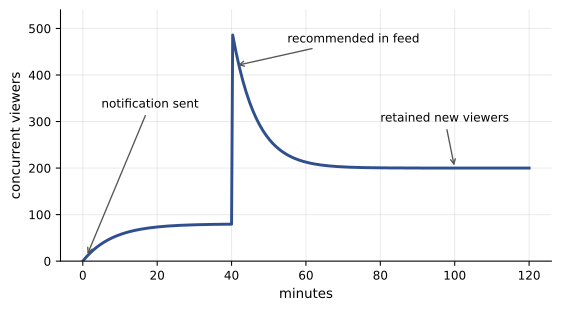
Live streams present a unique recommendation problem: content appears, changes and disappears in real time, and the system must decide which streams to show to which people right now. Live platforms use signals such as current viewer count, chat activity, the streamer's category and tags, viewers' watch history and followed channels, and how long viewers stay when they join. Twitch's browse pages historically sorted streams by viewer count within categories, which made discovery hard for small streamers; Twitch and other platforms have added recommendation features, clips and short video feeds to help viewers find smaller channels. TikTok LIVE and YouTube Live recommend streams within their main feeds, which can bring sudden waves of new viewers. Notifications to followers when a stream starts remain important on all live platforms.
Signals in live content
Live platforms weigh signals specific to real-time content. Watch duration per viewer shows whether people stay after joining; chat participation shows engagement; follows, subscriptions and gifts during a stream show strong interest; and viewer retention after a stream is recommended to new people indicates whether recommendations are working. Consistency matters: streaming on a regular schedule builds audience habits, and platforms often notify followers more effectively for channels that stream regularly. Live content is also subject to real-time moderation, with automated systems detecting policy violations and moderators managing chat (CRE-240 and CRE-301 cover live streaming and community management).
Clips and repurposing
Long audio and live content can be repurposed into clips for recommendation-driven platforms. A podcast episode can produce several short video clips highlighting the most interesting moments, quotes or debates; a live stream can produce highlight clips, funny moments and compilations. Clips introduce people to the longer content and creator, and some platforms, such as Twitch and YouTube, let viewers create clips themselves, multiplying reach. Effective clips have strong standalone value, a clear hook in the first seconds, captions (since many people watch without sound), and a visible link or prompt to the full episode or channel. AI tools that identify clip-worthy moments and add captions have made repurposing much faster, though human judgment still improves selection.
Strategies for audio and live creators
Audio and live creators face slower, more habit-driven discovery than short-video creators, but their audiences are often more loyal and engaged. Strategies include publishing consistently on a predictable schedule; using clear, searchable titles and descriptions; launching podcasts with several episodes to give new listeners more to explore; appearing as guests on other shows and collaborating with other streamers; repurposing highlights into short clips; building community through chat, Discord servers and newsletters; and using video versions on YouTube to tap into its recommendation system. Measuring downloads, consumption rates, retention and follower growth over time (CRE-202) guides improvement.
Podcast metrics and their limits
Podcast metrics are less precise than video metrics. Downloads, the traditional measure, count when an episode file is requested, which does not guarantee that anyone listened; industry standards from the IAB help make download counts comparable by filtering duplicates and bots. Platform-specific analytics from Spotify, Apple Podcasts and YouTube provide more detail, such as followers, consumption rates and drop-off points, but only for listening on those platforms. Because podcast audiences are spread across many apps, creators combine data from several sources and look for trends rather than precise totals.
Audio on social platforms
Audio also plays a role on social platforms beyond podcasts. Voice notes, audio-only posts, live audio rooms, and sound-based trends on short-form video all depend on recommendation systems. Original sounds from creators can spread widely when others reuse them, carrying the creator's name with the sound. Music discovery increasingly happens on social platforms first, with streaming services following. For musicians and audio creators, understanding how sounds travel across short-form platforms is as important as understanding streaming algorithms.
Building habits with live content
Live streaming rewards habit. Viewers who know that a creator streams every Tuesday and Thursday evening plan to attend, and platforms notify followers when streams begin. Consistent schedules, recognizable segments, and community rituals, such as greeting regular viewers or recurring games, make streams feel like events. Streamers often promote upcoming streams on short-form platforms and repost highlights afterward, using each platform's recommendation system to bring new viewers to the next live session.
Raids, hosts and collaborative streams
Live platforms offer features that help streamers share audiences. On Twitch, a raid sends a streamer's viewers to another channel at the end of a stream, introducing them to a new creator; collaborative streams let several creators broadcast together, combining chats and audiences. Similar features exist on other platforms. These tools build networks of creators who support each other, a form of discovery that complements algorithmic recommendation. Streamers who participate generously in their community of creators often benefit in return.
Accessibility in audio and live content
Transcripts for podcasts, captions for video podcasts and clips, and live captions for streams make content accessible to deaf and hard-of-hearing audiences and to people who prefer reading. Transcripts also improve search visibility, since platforms and search engines can index the spoken content. Many podcast hosts and platforms now generate transcripts automatically; reviewing them for accuracy, especially names and technical terms, improves their value.
Audiobooks and spoken content
Spoken-word formats beyond podcasts, such as audiobooks, audio courses and narrated articles, are also recommended by platforms such as Audible, Spotify and Apple Books, using listening history, ratings and editorial curation. Creators who write books or courses can reach audio audiences through these channels, and some podcasters adapt popular series into audio products. As AI narration tools improve, platforms are developing policies on disclosure and quality for synthetic voices, which creators using them should follow carefully.
Choosing between audio and video
Creators deciding whether to publish audio-only or video podcasts weigh several factors. Audio-only podcasts are cheaper and easier to produce and suit listeners who multitask, while video podcasts reach audiences on YouTube and short-form platforms and give viewers faces and expressions to connect with. Many creators record video and publish both versions, using the audio for podcast apps and the video for YouTube and clips. The best choice depends on the creator's resources, comfort on camera and target audience, and can change as a show grows. Measuring where listeners and viewers come from, and how long they stay on each platform, helps creators decide where to invest further.
Common mistakes
MistakeUsing only episode numbers as podcast titles.
InsteadTitle episodes by topic or guest for search and recommendation.
MistakeLong, slow song intros.
InsteadBring the hook earlier to reduce early skips.
MistakeStreaming irregularly.
InsteadStream on a consistent schedule.
MistakePosting full episodes only.
InsteadRepurpose standalone clips for short-form platforms.
MistakeExpecting podcast apps to provide most growth.
InsteadGrow through collaborations, clips and owned channels.
Summary and key terms
- Audio is often passive and long, making recommendation data sparser.
- Podcasts are discovered through search, charts, editorial, recommendations and cross-promotion.
- Video podcasts on YouTube benefit from its recommendation system.
- Music services recommend via personalized and editorial playlists; early skips matter.
- Live discovery depends on real-time signals, notifications and in-feed recommendations.
- Clips repurpose long and live content for discovery.
- Consistency, collaboration and community drive audio and live growth.
- RSS feed
- Open feed format used to distribute podcasts.
- Collaborative filtering
- Recommending based on similar users' behavior.
- Podcast chart
- Ranking of shows by recent growth.
- Video podcast
- Podcast recorded and published with video.
- Editorial playlist
- Playlist curated by platform staff.
- Algorithmic playlist
- Personalized playlist generated automatically.
- Skip rate
- Share of plays skipped early.
- Concurrent viewers
- Number of people watching a live stream at once.
- Clip
- Short excerpt from longer or live content.
- Repurposing
- Adapting content into other formats.
Practice problems
Work each problem on paper first, then reveal the answer to check.
Why is audio recommendation harder?
Show answer
Passive listening, long episodes, harder content analysis.
How are podcasts distributed?
Show answer
Through RSS feeds read by apps and directories.
Name three podcast discovery routes.
Show answer
Search, charts, editorial, recommendations, cross-promotion.
Why title episodes by topic?
Show answer
Better search and click appeal.
Name two personalized Spotify playlists.
Show answer
Discover Weekly and Release Radar.
Which skips matter most for songs?
Show answer
Skips in the first 30 seconds.
Why was Twitch discovery hard for small streamers?
Show answer
Browse pages sorted by viewer count.
Name two live signals.
Show answer
Watch duration, chat activity, follows, gifts, retention.
What makes a good clip?
Show answer
Standalone value, hook, captions, link to full content.
Name two strategies for podcasters.
Show answer
Consistency, guesting, clips, launch with several episodes.
Lesson quiz · 5 questions
Score 60% or more to complete this lesson.
Create a free account to save your progress, take quizzes and earn a certificate.