
CON-420 · Lesson 6 of 12 · 30 min
Quantifying delay damages
Once a contractor has shown that it is entitled to time and that the delay is compensable, it must prove what the delay cost. Delay damages are different from the cost of changed work. A change adds work, and its cost is the cost of that work. A delay stretches the project, and its cost is the cost of being on site, and committed to the project, for longer than planned. This lesson explains the main heads of delay damages, works through the calculations on the Ashford project and discusses how owners quantify their own delay losses.
CON-220 introduced head office overhead and acceleration in legal terms, and CON-310 showed how the indirect costs of changes appear in cost reports. Here the emphasis is on building a quantum that a reviewer will accept: tied to the compensable delay period, supported by records and free of double counting.
The heads of delay damages
A contractor's delay claim is usually built from several heads, each with its own evidence.
| Head | What it covers | Main evidence |
|---|---|---|
| Extended field overhead | Time-related site costs: supervision, site office, temporary facilities, equipment on standby for the whole job, utilities, security | Job cost reports, payroll, rental invoices, the bid build-up of general conditions |
| Idle or standby equipment | Equipment kept on site but unable to work because of the delay | Equipment logs, daily reports, rental agreements, ownership cost records |
| Idle labor | Crews kept on site and paid while waiting | Payroll and daily reports, showing why crews could not be redeployed |
| Escalation | Increases in wages and material prices because work was pushed into a later, more expensive period | Collective agreements, supplier price lists, invoices compared with bid prices |
| Unabsorbed head office overhead | The share of company overhead that the delayed project should have contributed to but could not | Audited financial statements, overhead pools, billing records |
| Financing costs | Interest on money tied up because payments were delayed | Cash flow records, interest rates paid |
| Subcontractor delay claims | The subcontractors' own delay costs passed through | Subcontractor claims with their own support |
| Bond and insurance extensions | Premiums for extending builder's risk and bonds | Broker and surety invoices |
Not every head is recoverable on every contract. Many contracts exclude consequential damages, which can include lost profit on other work and, in some forms, head office overhead. A201-2017's mutual waiver of consequential damages, for example, waives the contractor's claims for 'principal office expenses' and lost profit, while leaving site overhead recoverable. CCDC 2 has no equivalent printed waiver, but supplementary conditions often add one. Always check what the contract allows before building the quantum.
Extended field overhead
Field overhead, also called site overhead or general conditions, includes the costs of running the site that do not vary directly with the quantity of work: the superintendent and project manager, the site office and trailers, temporary power and heat, the hoist and tower crane if they serve the whole job, security, safety staff and so on. When completion is delayed, many of these costs continue for the extra period. The usual method is to calculate a daily or weekly rate for time-related field overhead during the delay period and multiply it by the compensable delay.
The important word is 'time-related'. Some general conditions are fixed (mobilization, permits, the site sign) and are not extended by delay. Others vary with work (consumables, some small tools) and should not be in a daily rate. And the rate should be the rate during the delay period, not the average over the job: during the truss redesign, Kestrel Ridge still had its superintendent, project manager, site office and crane on site, but it may have demobilized some temporary facilities.
# Time-related field overhead on Ashford during the delay period (illustrative weekly costs)
weekly = {
    "Superintendent":            3_850,
    "Project manager (60 %)":    2_640,
    "Project coordinator":       1_950,
    "Site safety officer":       2_300,
    "Site office and trailers":    950,
    "Temporary power and heat":  1_480,
    "Tower crane (rent, standby)": 3_200,
    "Hoist and scaffold rental":   780,
    "Security":                    900,
    "Site services and cleanup":   450,
}
week = sum(weekly.values())
day = week / 5
print(f"Time-related field overhead: ${week:,.0f} per week, ${day:,.0f} per working day")
compensable_days = {"contaminated fill": 9, "truss redesign": 30}
for event, d in compensable_days.items():
    print(f"  {event:<18} {d:>3} working days  ${d * day:>10,.0f}")
total = sum(compensable_days.values()) * day
print(f"Extended field overhead for {sum(compensable_days.values())} compensable days: ${total:,.0f}")Time-related field overhead: $18,500 per week, $3,700 per working day contaminated fill 9 working days $ 33,300 truss redesign 30 working days $ 111,000 Extended field overhead for 39 compensable days: $144,300
The calculation uses the 39 working days of compensable owner delay from the windows analysis in lesson 5: 9 days for the contaminated fill and 30 for the truss redesign. Abnormal rain is excusable but not compensable, so it earns time but no overhead. Kestrel Ridge's own 2 days of formwork delay earn nothing. If a tribunal found the crane breakdown concurrent with part of the redesign, the compensable days would fall, as lesson 4 showed.
Reviewers will check that the daily rate matches the records, that the items are genuinely time-related, that people charged to the job were actually on it and not shared with other projects without allocation, and that the same costs are not also included in change order prices. The truss redesign change order for extra steel (PCN-021 in lesson 2) must not include supervision for the delay period, or the overhead will be paid twice.
Idle equipment and labor
Equipment that is kept on site but cannot work because of a compensable delay may be claimed at a standby rate. For rented equipment, the rate is usually the rental actually paid. For owned equipment, it is usually the ownership cost (depreciation, interest, insurance and storage) without operating costs, often expressed as a fraction of the full rate. US federal contracts commonly use the Corps of Engineers' Construction Equipment Ownership and Operating Expense Schedule, with standby at half the ownership rate; other owners specify rate books or allow the contractor's own costs. In Canada, provincial rate guides and the contractor's own records are commonly used, and the contract may specify the source. Idle labor is recoverable only if the contractor shows that the crew could not reasonably be sent home or redeployed; a well-run contractor mitigates by redeploying crews, and a claim for weeks of idle time invites the question why it did not.
| Equipment | Basis | Rate | Standby days | Claim |
|---|---|---|---|---|
| Rented 60-metric ton mobile crane for truss erection | Rental paid | $2,400 per day | 6 | $14,400 |
| Owned telehandler | 50 % of ownership rate | $95 per day | 30 | $2,850 |
| Owned welding machines (2) | 50 % of ownership rate | $18 per day each | 30 | $1,080 |
The rented crane appears here only for the six days it was on site before the redesign was discovered and Kestrel Ridge could send it back. Once the problem was known, keeping it on site for the whole redesign would have been a failure to mitigate.
Escalation
If delay pushes work into a period when wages or prices are higher, the contractor may claim the difference. A collective agreement wage increase that takes effect during the extended period, on hours that would otherwise have been worked before it, is a typical example. So is a material price increase where the contractor could not lock in the price because the owner's delay prevented ordering. The claim must show both the increase and that the delayed work would otherwise have been done at the earlier price. A contractor that would have bought the material late anyway, or whose own delays pushed the work into the higher-wage period, cannot recover.
Unabsorbed head office overhead
A contractor's head office costs, such as executives, accounting, estimating, office rent and IT, are paid from the contributions of all its projects. When a project is delayed, its billings slow, so it contributes less to head office per week than planned; if the contractor cannot replace that work with other projects, part of the overhead goes unabsorbed. Because head office costs cannot be traced to a project directly, formulas are used to estimate the loss.
The Eichleay formula, from a 1960 US Armed Services Board of Contract Appeals decision, allocates head office overhead to the contract in proportion to its share of company billings during the period of performance, divides by the days of performance to get a daily rate and multiplies by the days of compensable delay. Two other formulas, Hudson and Emden, come from English practice and use the overhead and profit percentage in the tender (Hudson) or the contractor's actual overhead percentage from its accounts (Emden) applied to the contract value per unit of time.
# Unabsorbed head office overhead on Ashford by three formulas (illustrative)
contract_billings = 43_900_000    # billed on Ashford during actual performance, including changes
company_billings = 312_000_000    # all company billings over the same period
head_office = 14_350_000          # total head office overhead over the period
performance_days = 735            # calendar days of actual performance
delay_days = 55                   # calendar days equivalent to 39 compensable working days

allocable = contract_billings / company_billings * head_office
eichleay_daily = allocable / performance_days
print(f"Eichleay: allocable ${allocable:,.0f}, daily ${eichleay_daily:,.0f}, claim ${eichleay_daily * delay_days:,.0f}")

contract_sum = 42_000_000
contract_period = 669             # calendar days in the original 22 months
tender_oh_pct = 6.5               # head office overhead and profit percentage in the tender
actual_oh_pct = 4.6               # head office overhead percentage from audited accounts
hudson = tender_oh_pct / 100 * contract_sum / contract_period * delay_days
emden = actual_oh_pct / 100 * contract_sum / contract_period * delay_days
print(f"Hudson (tender percentage {tender_oh_pct} %): ${hudson:,.0f}")
print(f"Emden (actual percentage {actual_oh_pct} %): ${emden:,.0f}")Eichleay: allocable $2,019,119, daily $2,747, claim $151,091 Hudson (tender percentage 6.5 %): $224,439 Emden (actual percentage 4.6 %): $158,834
The three formulas give different answers because they rest on different assumptions. Hudson uses a percentage that includes profit and assumes the tender was a reliable measure, which tends to overstate the loss. Emden uses the contractor's actual overhead percentage and is generally regarded as more realistic in English practice. Eichleay uses actual billings and overhead over the contract period and is the formula US federal tribunals apply.
US federal law treats Eichleay as the exclusive method for unabsorbed home office overhead on government contracts, but only where the contractor was on standby (unable to work and required to remain ready to resume on short notice) and could not take on replacement work, under the test developed in P.J. Dick Inc. v. Principi (Fed. Cir. 2003) and later cases. State courts vary: some accept Eichleay, some reject it, and some require proof of actual loss. A201-2017's waiver of consequential damages waives 'principal office expenses', so on an unmodified AIA contract a home office overhead claim may be barred altogether. Check the contract and the governing law first.
Acceleration
Acceleration is working faster than planned, with overtime, extra shifts, extra crews or premium deliveries, to finish earlier than the delays would otherwise allow. If the owner directs acceleration, it pays for it as a change. If the owner refuses a justified extension and insists on the original completion date, a contractor that accelerates to avoid liquidated damages may claim constructive acceleration. The cost of acceleration includes premium time, extra supervision, the productivity loss that comes with long hours and crowded work areas, and extra equipment.
# Cost of accelerating the Ashford roofing and envelope to recover 10 working days (illustrative)
base_hours = 9_600          # remaining roofing and envelope hours at normal productivity
rate = 64.0                 # straight-time rate including burden
ot_share = 0.35             # share of hours worked at overtime
ot_premium = 0.5            # overtime premium over straight time
productivity_loss = 0.12    # extra hours needed because of fatigue and congestion
extra_supervision = 9_800   # second-shift foreman and safety coverage
extra_equipment = 6_400     # second telehandler and lighting

hours = base_hours * (1 + productivity_loss)
premium = hours * ot_share * rate * ot_premium
lost_productivity = base_hours * productivity_loss * rate
total = premium + lost_productivity + extra_supervision + extra_equipment
print(f"Overtime premium:         ${premium:,.0f}")
print(f"Lost productivity hours:  {base_hours * productivity_loss:,.0f} h = ${lost_productivity:,.0f}")
print(f"Supervision and equipment: ${extra_supervision + extra_equipment:,.0f}")
print(f"Acceleration cost: ${total:,.0f} (about ${total / 10:,.0f} per day recovered)")Overtime premium: $120,422 Lost productivity hours: 1,152 h = $73,728 Supervision and equipment: $16,200 Acceleration cost: $210,350 (about $21,035 per day recovered)
Compared with $3,700 per day of extended field overhead, recovering a day by acceleration costs about $21,000. That is typical: acceleration is expensive, and an owner considering whether to direct it should compare its cost with the value of earlier completion to the owner, including avoided liquidated damages and earlier revenue. A contractor claiming constructive acceleration must show that it was entitled to an extension, that it asked for one, that the owner refused or failed to grant it, that it was required or effectively forced to meet the original date, and that it actually incurred the costs.
The owner's delay losses
Owners also suffer from delay. Where the contract has liquidated damages, the owner usually recovers only those, whatever its actual loss, unless the clause is unenforceable. Where there are no liquidated damages, or the delay is outside their scope, the owner must prove its actual losses: extended consultant and project management fees, extra financing, lost revenue or rent, temporary accommodation, higher operating costs of old facilities. For a public owner like the City of Ashford, the losses from late opening of a pool may be real but hard to quantify in money, which is one reason public owners use liquidated damages.
| Owner loss | Example on Ashford | Recovery route |
|---|---|---|
| Extended consultant fees | Halloway Partners' contract administration during the delay period | Against the contractor only for contractor-caused delay; against the designer for the truss error |
| Extended project management | City project manager and inspectors | Usually within liquidated damages |
| Lost revenue | Pool memberships and rentals not earned | Usually within liquidated damages |
| Old facility operating costs | Keeping the old pool open longer | Usually within liquidated damages |
The owner's losses from the truss redesign raise a different question: the redesign was caused by the owner's consultant. The city must pay Kestrel Ridge for the delay, but it may recover those payments, and its own losses, from Halloway Partners under the consultant agreement, subject to that agreement's limits of liability. Owners should give their consultants notice of such claims promptly, as CON-350 discussed for insurance.
Worked problem
Building the Ashford delay quantum
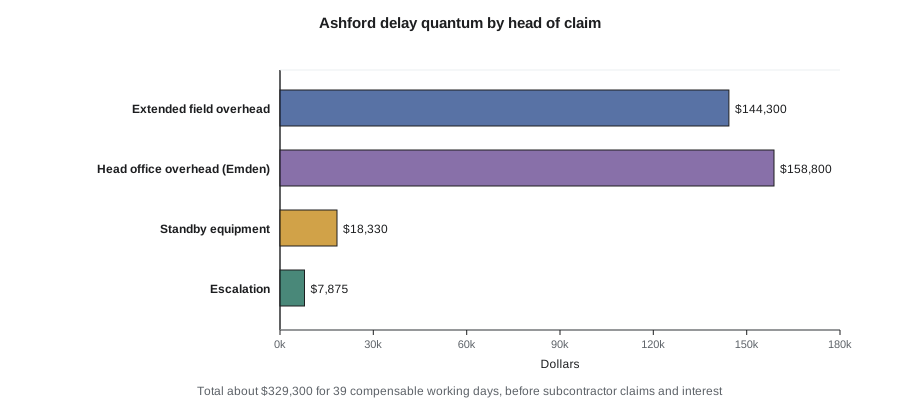
Assemble Kestrel Ridge's delay quantum for the 39 compensable working days (55 calendar days), using the figures in this lesson. Assume head office overhead is recoverable and the tribunal prefers the Emden formula.
Show solution
- Extended field overhead: 39 × $3,700 = $144,300.
- Standby equipment: $14,400 + $2,850 + $1,080 = $18,330.
- Head office overhead (Emden): about $158,800.
- Escalation: a 3 % wage increase on 4,200 hours pushed into the new contract year at $62.50 per hour ≈ $7,875.
- Add markup only if the contract allows it on delay costs; here it does not.
Answer: The delay quantum is about $329,300 before subcontractor pass-through claims and interest. The largest heads are field and head office overhead, so the daily field rate and the overhead formula will be the focus of the city's review.
Common mistakes
MistakeUsing the average field overhead rate over the whole job.
InsteadUse time-related costs actually incurred during the delay period.
MistakeCharging supervision in both the change order and the delay claim.
InsteadCheck every change order price to avoid double recovery.
MistakeClaiming standby for equipment that could have been sent away.
InsteadShow that the equipment had to stay; mitigate by demobilizing when possible.
MistakeApplying a head office formula without proof of actual loss where the law requires it.
InsteadShow that the delay prevented the contractor from taking replacement work.
MistakeClaiming acceleration without first requesting an extension.
InsteadRequest the extension in writing; constructive acceleration needs a refusal.
Summary and key terms
- Delay damages compensate for being on the project longer, not for doing more work.
- Main heads are extended field overhead, standby equipment and labor, escalation, head office overhead, financing, subcontractor claims and bond and insurance extensions.
- Contract waivers of consequential damages may bar head office overhead and lost profit.
- Extended field overhead uses a daily rate of time-related site costs during the delay period, multiplied by compensable days.
- Eichleay, Hudson and Emden estimate unabsorbed head office overhead; the accepted formula and proof required depend on jurisdiction.
- Acceleration is expensive; constructive acceleration requires a refused extension and real costs.
- Owners usually recover delay losses through liquidated damages and may pass design-caused delay costs to their consultants.
- Field overhead
- Time-related site costs such as supervision, site office, temporary facilities and site-wide equipment.
- Standby rate
- The rate for equipment kept on site but idle, usually ownership cost without operating cost.
- Escalation
- Increases in wage or price levels that affect work pushed into a later period.
- Unabsorbed head office overhead
- Company overhead a delayed project should have contributed to but did not.
- Eichleay formula
- A method allocating head office overhead to a contract by its share of billings, used in US federal claims.
- Hudson formula
- A method applying the tender overhead and profit percentage to contract value per unit of time.
- Emden formula
- A method applying the contractor's actual overhead percentage to contract value per unit of time.
- Acceleration
- Working faster than planned to recover or avoid delay.
- Constructive acceleration
- Acceleration forced on a contractor when a justified extension is refused.
- Consequential damages
- Indirect losses such as lost profit or principal office expenses, often waived by contract.
Practice problems
Work each problem on paper first, then reveal the answer to check.
Time-related field overhead is $20,000 per week. What is the claim for 15 compensable working days?
Show answer
$60,000.
Why should excusable but non-compensable days be excluded from the overhead claim?
Show answer
They earn time only, not money.
Contract billings are 10 % of company billings and head office overhead is $8 million over 500 days of performance. What is the Eichleay daily rate?
Show answer
$1,600 per day.
What must a US federal contractor show to use Eichleay?
Show answer
That it was on standby and could not take replacement work.
Name two components of the cost of acceleration.
Show answer
Overtime premium and productivity loss (also supervision and equipment).
What must a contractor show for constructive acceleration?
Show answer
Entitlement to an extension, a request, refusal, being required to meet the original date and actual costs.
Why might a 60-metric ton crane be claimed for only 6 days of a 30-day delay?
Show answer
Once the problem was known, keeping it would have been a failure to mitigate.
How might the City of Ashford recover its costs of the truss delay?
Show answer
From Halloway Partners under the consultant agreement, subject to limits.
What does A201-2017's consequential damages waiver do to home office overhead?
Show answer
It waives the contractor's claim for principal office expenses.
What is the main check a reviewer applies to escalation claims?
Show answer
That the work would otherwise have been done at the lower price.
Lesson quiz · 5 questions
Score 60% or more to complete this lesson.
Create a free account to save your progress, take quizzes and earn a certificate.