
CON-420 · Lesson 11 of 12 · 25 min
Litigation, experts and public-sector disputes
Many construction disputes in the US that are not settled or arbitrated end up in court. Court proceedings are slow and expensive, but they are public, they allow related parties to be joined, and they provide appeals. This lesson covers the main features of construction litigation in the US, limitation periods, expert evidence and the special rules for claims against the federal government under the Contract Disputes Act. It builds on CON-220 lesson 12.
Construction litigation
Construction claims in the US are brought in state court unless the parties are from different states and the amount exceeds the federal threshold, or a federal question arises, in which case federal court may be available. Mechanic's lien claims have their own procedures and short deadlines set by state law, and missing a deadline loses the lien. On federal projects, liens are not available against government property; subcontractors and suppliers are protected instead by payment bonds under the Miller Act, with their own notice and suit deadlines, and many states have similar 'Little Miller Acts' for state projects.
A typical action passes through pleadings, document discovery, oral examinations or depositions, expert reports, mediation (mandatory in some courts), pretrial conferences and trial. A large construction case can take several years to reach trial. Discovery is often the most expensive stage, because construction projects generate enormous volumes of email, drawings, schedules and photographs, and both parties must produce what is relevant. Good document management during the project, the subject of lesson 12, directly reduces the cost of litigation.
| Stage | What happens | Project records that matter |
|---|---|---|
| Pleadings | Each party sets out its claims and defenses | The contract, notices, the claim document |
| Documents | Parties exchange relevant documents | Email, correspondence, minutes, daily reports, schedules, cost records |
| Depositions | Witnesses are questioned under oath before trial | Witnesses' own notes and diaries |
| Experts | Experts exchange reports on delay, quantum and technical issues | Native schedule files, cost data, photographs |
| Settlement processes | Mediation or settlement conferences | A current decision tree |
| Trial | Witnesses and experts give evidence; the judge decides | Everything above, organized and indexed |
Joining all the parties is one of litigation's real advantages. On Ashford, a court action by Kestrel Ridge against the City of Ashford could be joined with the city's claim against Halloway Partners for the truss design error and Kestrel Ridge's claims against its subcontractors, so that one court decides who bears the cost. In arbitration, that is possible only if all the parties have agreed to the same arbitration.
Limitation periods
A statute of limitations is the time within which a claim must be started in court or arbitration; after it expires, the claim is barred. In the US, limitation periods for breach of written contract are set by state law and commonly range from about three to ten years, with four to six years typical. Many states also have statutes of repose for construction defect claims, which bar claims a fixed number of years after substantial completion regardless of discovery. Contracts may shorten the period, within limits set by state law; A201-2017 §15.1.2 requires claims to be started within the period specified by applicable law but not more than 10 years after substantial completion.
Negotiations do not stop the clock unless the parties sign a standstill or tolling agreement. Many claims are lost because the parties were 'still talking' when the period expired. A claimant should diary the limitation date for each claim from the day it is rejected or the loss is known, and either start proceedings or obtain a written standstill before it passes.
# Contract Disputes Act diary for a federal version of the Ashford claim (simplified; check the statute)
from datetime import date, timedelta

accrual = date(2025, 7, 14)              # claim accrues when the contractor knew or should have known
claim_filed = date(2025, 12, 1)          # certified claim received by the contracting officer
amount = 860_700

deadline_to_file = accrual.replace(year=accrual.year + 6)
print(f"Claim must be submitted by {deadline_to_file} (6 years from accrual)")
print(f"Certification required: {'yes' if amount > 100_000 else 'no'} (claim over $100,000)")
decision_due = claim_filed + timedelta(days=60)
print(f"CO decision or notice of decision date due by {decision_due}")
co_decision = date(2026, 1, 28)
print(f"Appeal to a board of contract appeals by {co_decision + timedelta(days=90)}")
print(f"Or suit in the Court of Federal Claims by {co_decision.replace(year=co_decision.year + 1)}")
print(f"Interest runs from {claim_filed} until payment")Claim must be submitted by 2031-07-14 (6 years from accrual) Certification required: yes (claim over $100,000) CO decision or notice of decision date due by 2026-01-30 Appeal to a board of contract appeals by 2026-04-28 Or suit in the Court of Federal Claims by 2027-01-28 Interest runs from 2025-12-01 until payment
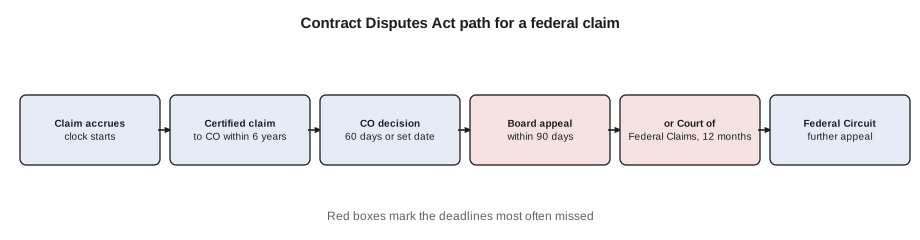
The Contract Disputes Act deadlines are strict. A contractor that misses the 90-day period for appealing to a board, or the 12-month period for suing in the Court of Federal Claims, loses the right to challenge the contracting officer's decision, which then becomes final. The 6-year period for submitting the claim runs from accrual, which the government may argue is earlier than the contractor thinks.
Claims against the federal government
Claims against the US federal government on procurement contracts are governed by the Contract Disputes Act of 1978, codified at 41 U.S.C. §§7101–7109, and the disputes clause in FAR 52.233-1. The process is mandatory and exclusive: a contractor cannot sue the government on a contract claim without first going through it.
The contractor submits a written claim to the contracting officer within six years of accrual. A claim over $100,000 must be certified: the contractor states that the claim is made in good faith, the supporting data are accurate and complete, the amount accurately reflects the adjustment for which the contractor believes the government is liable, and the certifier is authorized. The contracting officer must issue a decision on a certified claim within 60 days or notify the contractor when a decision will be issued. If the decision is adverse, or the officer fails to decide in time (a deemed denial), the contractor may appeal to the Armed Services or Civilian Board of Contract Appeals within 90 days or sue in the Court of Federal Claims within 12 months. Interest runs from the date the contracting officer receives the claim. Further appeal lies to the Court of Appeals for the Federal Circuit.
| Step | Deadline or rule |
|---|---|
| Submit claim to contracting officer | Within 6 years of accrual |
| Certification | Required for claims over $100,000 |
| Contracting officer decision | Within 60 days of a certified claim, or notice of when it will be issued |
| Appeal to a board of contract appeals | Within 90 days of the decision |
| Suit in the Court of Federal Claims | Within 12 months of the decision |
| Interest | From the contracting officer's receipt of the claim |
| Fraudulent or unsupported claims | Penalties under the CDA anti-fraud provision and the False Claims Act |
Certification deserves emphasis. A contractor that overstates a certified claim risks more than losing it: the CDA allows the government to recover the unsupported part of a claim attributable to misrepresentation of fact or fraud, and the False Claims Act imposes treble damages and penalties for knowingly false claims. Every figure in a federal claim must be supported. State and local public owners have their own claim procedures, notice-of-claim statutes and sovereign immunity rules, which vary widely.
Expert evidence
Most construction disputes of any size need experts: schedule experts for delay, quantum experts for cost, and technical experts for design, workmanship or geotechnical issues. The tribunal relies on them to explain matters outside its expertise. Their duty is to the tribunal, not to the party that pays them.
In the US, the admissibility of expert testimony in federal court is governed by Federal Rule of Evidence 702, as interpreted in Daubert v. Merrell Dow Pharmaceuticals (1993) and later cases. FRE 702 was amended effective December 1, 2023, to make clear that the proponent must show the court that it is more likely than not that the testimony meets the rule's requirements, including that the opinion reflects a reliable application of reliable methods to the facts. Many states follow Daubert; some still apply the older Frye general-acceptance test. Arbitrators have more latitude but are influenced by the same concerns.
| Good practice | Why |
|---|---|
| Instruct experts early | They can shape record collection and identify weaknesses before positions harden |
| Give experts all the records | An expert who saw only selected documents is easily discredited |
| State assumptions and alternatives | A report that shows how the answer changes with different assumptions is more credible |
| Keep advocacy out of the report | Argument belongs to counsel; experts who argue lose credibility |
| Use the agreed method | If the contract or protocol specifies a delay method, explain any departure |
| Meet the other expert | Joint meetings and statements of agreed and disputed issues narrow the dispute |
| Consider concurrent evidence | Experts giving evidence together ("hot-tubbing") lets the tribunal compare views directly |
On Ashford, the schedule experts would likely agree on the windows analysis method from lesson 5 and on most of the windows, and disagree on the crane breakdown and on whether the consultant's redesign period was reasonable. A joint statement narrowing the dispute to those two issues could save weeks of hearing time and is the kind of step that tribunals in both countries increasingly require.
Worked problem
Choosing a forum and diarizing deadlines
Negotiation and mediation of the Ashford claim fail in March 2026. Assume a federal agency version of the project, with a certified claim received by the contracting officer on December 1, 2025 and an adverse decision on January 28, 2026. List Kestrel Ridge's next steps.
Show solution
- Decide between the board of contract appeals and the Court of Federal Claims, considering cost, speed and procedure.
- Board appeal deadline: 90 days from January 28, 2026, which is April 28, 2026.
- Court of Federal Claims deadline: January 28, 2027.
- Confirm that the certification was correctly made, since a defective certification must be corrected.
- Track interest from December 1, 2025.
Answer: Kestrel Ridge must choose its forum and file within the deadline, with April 28, 2026 the earliest; missing both would make the contracting officer's decision final.
Costs of litigation
In US courts each party usually pays its own legal fees under the American rule, unless a contract clause or statute shifts them. Many construction contracts include prevailing-party fee clauses, and some state prompt payment statutes award fees to the party that prevails on a payment claim. Federal Rule of Civil Procedure 68 allows a defendant to make an offer of judgment, which can shift post-offer costs, though not usually attorney fees, if the plaintiff does worse at trial. These rules belong in the decision tree.
Common mistakes
MistakeContinuing negotiations past the limitation date.
InsteadDiary the date and start proceedings or sign a standstill agreement in time.
MistakeMissing the CDA appeal deadlines.
InsteadDiary 90 days for a board appeal and 12 months for the Court of Federal Claims.
MistakeTreating an expert as an advocate.
InsteadInstruct experts to be independent; their duty is to the tribunal.
MistakeGiving experts selected documents.
InsteadGive them all relevant records so their opinions survive cross-examination.
MistakeOverstating a certified claim.
InsteadSupport every figure; overstatement risks fraud remedies and penalties.
Summary and key terms
- Litigation is slow and expensive but public, appealable and able to join all related parties.
- Good project records reduce the cost of document discovery.
- US limitation periods for written contracts are set by state law, typically four to six years, with statutes of repose for defects.
- Negotiation does not stop the limitation clock; use standstill or tolling agreements.
- Federal contract claims follow the Contract Disputes Act: certification over $100,000, a contracting officer decision, then a board within 90 days or the Court of Federal Claims within 12 months.
- Expert testimony must meet FRE 702, amended in December 2023 to stress the proponent's burden on reliability.
- Limitation period
- The time within which a claim must be started, after which it is barred.
- Discovery date
- The day a claimant knew or ought to have known of its claim, which starts many limitation periods.
- Standstill agreement
- An agreement suspending a limitation period while parties negotiate.
- Statute of repose
- A law barring claims a fixed time after completion, regardless of discovery.
- Contract Disputes Act
- The US federal statute governing contractors' claims against federal agencies.
- Certification
- A contractor's statement that a federal claim over $100,000 is made in good faith and accurately supported.
- Board of contract appeals
- A US federal tribunal that hears appeals from contracting officers' decisions.
- Expert witness
- A person with specialized knowledge who gives opinion evidence to assist the tribunal.
- Concurrent evidence
- Experts giving evidence together so the tribunal can compare their views directly.
- Third-party claim
- A claim by a defendant against another party who may be liable for the claim against it.
Practice problems
Work each problem on paper first, then reveal the answer to check.
Which statute governs contractor claims against federal agencies?
Show answer
The Contract Disputes Act.
When must a CDA claim be certified?
Show answer
When it exceeds $100,000.
How long does a contractor have to appeal a contracting officer's decision to a board?
Show answer
90 days.
How long to sue in the Court of Federal Claims instead?
Show answer
12 months.
When does CDA interest start?
Show answer
When the contracting officer receives the claim.
Do negotiations stop the limitation clock?
Show answer
No, unless the parties sign a tolling agreement.
What protects subcontractors on federal projects in place of liens?
Show answer
Miller Act payment bonds.
What did the December 2023 amendment to FRE 702 emphasize?
Show answer
The proponent must show it is more likely than not that the testimony meets the rule.
What is a statute of repose?
Show answer
A bar on claims a fixed time after completion, regardless of discovery.
Why must every figure in a certified claim be supported?
Show answer
Overstatement risks recovery by the government and False Claims Act penalties.
Lesson quiz · 5 questions
Score 60% or more to complete this lesson.
Create a free account to save your progress, take quizzes and earn a certificate.