
CON-420 · Lesson 10 of 12 · 25 min
Mediation, arbitration and dispute boards in the US
When negotiation fails, the parties need another way to resolve the dispute. In the US the main options are the contract's internal decision step, mediation, dispute boards, arbitration and the courts. There is no general statutory adjudication of the kind now used in Canada, the UK and Australia. This lesson covers mediation, arbitration and dispute boards; lesson 11 covers litigation, expert evidence and federal Contract Disputes Act claims. CON-220 lesson 12 introduced these processes in outline; here the focus is on how they work in practice on a claim like Ashford's, and how to choose between them.
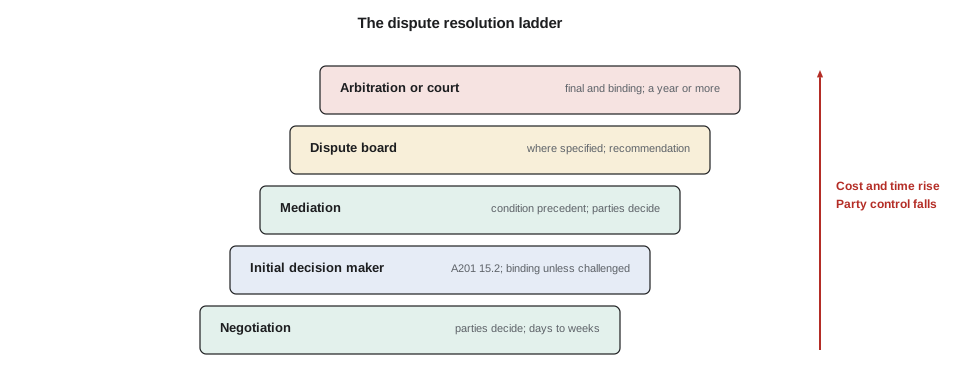
Modern standard contracts arrange the processes as a ladder: the parties try the cheaper, faster and more cooperative steps first and move to binding, adversarial processes only if those fail. Knowing the ladder in the contract, and its deadlines, is part of claim management.
No statutory adjudication: why it matters
Several other countries have introduced statutory adjudication, a fast decision within weeks that must be complied with at once but can be revisited later in arbitration or court. Canada now has it in Ontario, Saskatchewan, Alberta, Manitoba and federal construction. The US has prompt payment statutes for public and, in many states, private work, which set payment deadlines and interest on late payments, but they do not create a fast adjudication process. US parties who want a quick interim decision must build it into the contract, typically through a dispute board or an expedited arbitration procedure.
| Mechanism | What it provides | Interim decision? |
|---|---|---|
| Federal Prompt Payment Act | Payment deadlines and interest on federal contracts | No |
| State prompt payment statutes | Payment deadlines and interest, sometimes fee-shifting, on public and in many states private work | No |
| A201-2017 Initial Decision Maker | A decision by the architect or another named person on claims | Yes, but not binding if challenged in time |
| Standing dispute board | Recommendations or decisions by a board that follows the project | Depends on the contract |
| Expedited arbitration | A faster final award under institutional rules | Final, not interim |
Dispute boards are the closest US equivalent. A dispute review board (DRB) is a panel, usually of three experienced neutrals, appointed at the start of a project, which visits the site regularly, receives progress reports and hears disputes as they arise. Its recommendations are usually not binding, but they are often admissible in later proceedings, and parties accept most of them. DRBs are common on large public transit, tunneling and highway projects; the Dispute Resolution Board Foundation (DRBF) publishes guidance and promotes their use. The cost of a board, usually shared by the parties, is justified mainly on large projects.
# Rough comparison of dispute resolution routes for a $860,700 claim (illustrative costs per party)
claim = 860_700
routes = [  # (route, months to outcome, cost per party, outcome binding?)
    ("Senior-level negotiation", 1, 8_000, "if agreed"),
    ("Mediation", 3, 25_000, "if agreed"),
    ("Standing dispute board recommendation", 2, 15_000, "no, unless accepted"),
    ("Arbitration (AAA construction rules)", 14, 210_000, "yes"),
    ("Litigation through trial", 30, 320_000, "yes, subject to appeal"),
]
for name, months, cost, binding in routes:
print(f"{name:<40} {months:>3} months ${cost:>8,} {cost / claim:>5.1%} of claim binding: {binding}")Senior-level negotiation 1 months $ 8,000 0.9% of claim binding: if agreed Mediation 3 months $ 25,000 2.9% of claim binding: if agreed Standing dispute board recommendation 2 months $ 15,000 1.7% of claim binding: no, unless accepted Arbitration (AAA construction rules) 14 months $ 210,000 24.4% of claim binding: yes Litigation through trial 30 months $ 320,000 37.2% of claim binding: yes, subject to appeal
The comparison shows why negotiation and mediation are tried first: each costs a few percent of the claim and takes months, while arbitration and litigation consume a quarter or more of the claim and take a year or more. A dispute board falls between: its cost is mostly the standing cost of the board, which is incurred whether or not disputes arise, so its value is in preventing disputes and resolving them while the project is still under way.
Kestrel Ridge's contract with the City of Ashford, a municipal project of $42 million, does not have a standing dispute board, so its route is the A201 ladder: the Initial Decision Maker, then mediation, then arbitration if the parties chose it in the agreement. On a larger project, such as a $300 million transit station, the city might well have specified a DRB.
The contract's internal steps
A201-2017 Article 15 sets out a stepped process. A Claim is first referred to the Initial Decision Maker, by default the Architect, under §15.2. The IDM may request information, reject or approve the Claim, or suggest a compromise, and its decision is final and binding unless challenged by mediation and binding dispute resolution within the time limits in §15.2. Mediation under §15.3 is a condition precedent to binding dispute resolution, administered by the AAA under its construction mediation procedures unless the parties agree otherwise. Binding dispute resolution is arbitration under §15.4 if the parties selected it in the agreement, otherwise litigation. ConsensusDocs 200 uses a similar ladder: direct discussions, mediation, an optional dispute mitigation step such as a project neutral or DRB, then arbitration or litigation.
These steps are often time-limited. Missing a deadline to dispute a decision may make it final. A party should diary every deadline as soon as a decision is received, as lesson 3 recommended for notices.
Mediation
Mediation is facilitated negotiation. A neutral mediator, chosen by the parties, helps them reach their own settlement. The mediator has no power to decide. Mediation works because it brings decision makers together for a fixed day or two, with a neutral who can carry offers between rooms, test each side's assumptions privately and suggest options neither side would propose openly.
| Stage | What happens |
|---|---|
| Preparation | Parties exchange short position papers and key documents; the mediator may hold private pre-mediation calls |
| Opening | Joint session, sometimes skipped, where each side presents its case briefly |
| Caucuses | The mediator meets each side privately, explores interests and risks, and carries offers |
| Bridging | The mediator may propose a figure or a structure when the parties are close |
| Settlement | Heads of agreement are signed on the day, followed by a formal settlement agreement |
Construction mediators are often experienced construction lawyers, retired judges or senior industry figures. An evaluative mediator gives views on the merits; a facilitative mediator concentrates on the process. Most construction mediations combine both. A party should go to mediation with its decision tree done, a negotiating range authorized and a decision maker present. Settlement rates in construction mediation are high, though published figures vary.
Construction mediations in the US are commonly administered by the AAA under its construction mediation procedures, by JAMS, or arranged privately. Many states have mediation confidentiality statutes, and the Uniform Mediation Act has been adopted in a number of states; confidentiality agreements are standard.
Arbitration
Arbitration is a private, binding process in which one or three arbitrators chosen by or for the parties hear evidence and make an award that can be enforced like a court judgment. Its advantages over court are choice of decision maker (construction-literate arbitrators), privacy, flexibility of procedure and, internationally, ease of enforcement. Its disadvantages are cost (the parties pay the arbitrators and the venue), limited appeal and the difficulty of joining other parties such as subcontractors and consultants unless all have agreed.
In the US, arbitration agreements are enforced under the Federal Arbitration Act and state law, and courts may vacate awards only on narrow grounds such as fraud, evident partiality or arbitrators exceeding their powers. The AAA's Construction Industry Arbitration Rules, updated effective March 1, 2024, are the most common institutional rules for domestic construction disputes, with procedures scaled to the size of the claim; JAMS also offers construction arbitration rules. Under A201-2017, arbitration applies only if the parties checked it in the agreement; otherwise the default is litigation. Consolidation and joinder of related parties are possible under §15.4.4 and the AAA rules, subject to conditions.
Arbitration is not automatically cheaper or faster than court. A large construction arbitration with three arbitrators, document production, multiple experts and a hearing of several weeks can cost each party hundreds of thousands of dollars or more and take well over a year. Its value lies more in the expertise of the tribunal and confidentiality than in savings. Managing cost is the parties' responsibility: limit document production, agree on joint or concurrent expert evidence, and use written witness statements.
Choosing the route
| Factor | Points toward |
|---|---|
| Small payment dispute, project ongoing | Negotiation, IDM decision, then mediation |
| Large, complex delay claim | Mediation first, then arbitration or court with experts |
| Need for a quick interim answer to keep work going | A standing dispute board, or an expedited arbitration procedure |
| Confidentiality important | Mediation and arbitration |
| Many parties, including consultant and subcontractors | Court, unless all have agreed to arbitrate together |
| Need for precedent or public accountability | Court |
| Relationship must continue | Negotiation, mediation, dispute board |
Worked problem
Choosing routes for the Ashford claims
Kestrel Ridge has three issues with the City of Ashford in late 2025: the $62,400 fill change balance, the delay and disruption claim of about $800,000, and the city's threatened liquidated damages. The contract is A201-2017 with arbitration selected. Suggest a route for each.
Show solution
- Fill change balance: submit as a Claim to the IDM with the cost records; if rejected, include in mediation.
- Delay and disruption claim: submit as a Claim under §15.1 with notice already given, then to the IDM; mediate under §15.3; arbitrate under §15.4 if mediation fails.
- Liquidated damages: dispute in writing; include in the same mediation, since they depend on the same schedule analysis.
Answer: Run all three through the A201 ladder together, so the mediation can produce a global settlement.
Preparing for a hearing
Whichever process is chosen, preparation follows the same pattern: a clear statement of the issues, a chronology tied to records, witness statements from the people who were there, expert reports where needed, and a short written argument. Before a dispute board, the parties usually submit short position papers and the board holds an informal hearing at the site, asking questions directly of the project staff; lawyers often play a limited role. In arbitration, the package is built over months under a procedural order agreed at a preliminary management hearing, which sets dates for document exchange, witness statements, expert reports and the hearing itself. The AAA construction rules encourage the tribunal to manage the case actively, for example by limiting document production to what is relevant and material, and parties that agree early on the scope of discovery and the number of experts save a great deal of cost. A party that has kept its records in order, as lesson 12 describes, can assemble the package in weeks rather than months, and its witnesses can refresh their memories from their own daily reports rather than from recollection.
Common mistakes
MistakeIgnoring the contract's dispute steps and deadlines.
InsteadDiary every step and time limit as soon as a decision or rejection is received.
MistakeAssuming the IDM decision does not matter.
InsteadChallenge an IDM decision within the contract's time limits, or it may become final.
MistakeGoing to mediation without authority or a decision tree.
InsteadBring a decision maker and an authorized range.
MistakeAssuming arbitration is cheap and fast.
InsteadPlan and control procedure; the savings come from expertise and focus, not by default.
MistakeChoosing one route for every dispute.
InsteadMatch the route to the size, complexity and urgency of each issue.
Summary and key terms
- Standard contracts arrange dispute resolution as a ladder from negotiation to binding decisions.
- The US has no statutory adjudication; dispute boards and expedited arbitration are the main ways to get fast decisions.
- A201-2017 uses the Initial Decision Maker, then mediation as a condition precedent, then arbitration or litigation.
- Mediation is facilitated negotiation; it succeeds when parties bring authority and a valued alternative.
- Arbitration gives a binding award from chosen experts, with limited appeal, privacy and significant cost.
- Choose the route to suit each dispute's size, complexity, urgency and parties.
- Adjudication
- A fast decision by a neutral that must be complied with now but can be revisited in arbitration or court.
- Interim binding
- Binding until the dispute is finally decided by another process.
- Mediation
- Facilitated negotiation in which a neutral helps the parties reach their own settlement.
- Caucus
- A private meeting between the mediator and one party.
- Arbitration
- A private, binding process in which chosen arbitrators make an enforceable award.
- Dispute review board
- A standing panel of neutrals that follows a project and hears disputes as they arise.
- Initial Decision Maker
- The person named in A201-2017 to decide claims before mediation, by default the Architect.
- Authorized nominating authority
- The body that maintains the adjudicator roster and appoints adjudicators, such as ODACC in Ontario.
- Condition precedent
- A step that must be completed before another step can be taken.
Practice problems
Work each problem on paper first, then reveal the answer to check.
Does the US have statutory construction adjudication?
Show answer
No; prompt payment statutes set deadlines and interest but no adjudication process.
Who is the default Initial Decision Maker under A201-2017?
Show answer
The Architect.
What is the status of mediation under A201-2017 §15.3?
Show answer
A condition precedent to binding dispute resolution.
When does A201-2017 send disputes to arbitration?
Show answer
Only if the parties selected arbitration in the agreement; otherwise litigation.
What is a dispute review board?
Show answer
A standing panel of neutrals that follows the project and hears disputes as they arise.
Why are DRBs mostly used on large projects?
Show answer
Their standing cost is justified mainly on large projects.
What is the role of a mediator?
Show answer
To help the parties reach their own settlement; the mediator does not decide.
On what grounds can a US court vacate an arbitration award?
Show answer
Narrow grounds such as fraud, evident partiality or exceeding powers.
When did the current AAA Construction Industry Arbitration Rules take effect?
Show answer
March 1, 2024.
Name a disadvantage of arbitration.
Show answer
Cost, limited appeal or difficulty joining other parties.
Lesson quiz · 5 questions
Score 60% or more to complete this lesson.
Create a free account to save your progress, take quizzes and earn a certificate.