
CON-420 · Lesson 12 of 12 · 26 min
Documentation that wins disputes
Every lesson in this course has come back to records. Timely notice is proved by a dated letter. Entitlement is proved by the contract, the drawings and the correspondence. Delay is proved by schedule updates that were maintained honestly at the time. Disruption is proved by quantities and hours recorded by activity. Quantum is proved by cost records. Negotiators, adjudicators, arbitrators and judges all decide on the evidence, and in construction the evidence is mostly the project's own records. The party with better records usually wins, or settles on better terms.
This final lesson sets out what records to keep, how to keep them so they are believed, how to preserve them when a dispute arises and how to avoid creating documents that hurt. It ends with a capstone that follows the Ashford truss claim from the day the problem appeared to its resolution, drawing together the methods of the whole course.
Contemporaneous records
A contemporaneous record is one made at the time of the event by someone with knowledge of it, in the ordinary course of business. Tribunals give such records much more weight than recollections or reconstructions prepared later for a claim, because they were made before anyone knew they would matter. A daily report written on June 18, 2025 saying 'crane down, hydraulic failure, no trusses on site to lift' is worth more than any witness statement written a year later.
| Record | What it proves | Good practice |
|---|---|---|
| Daily reports | Crews, equipment, weather, work done, areas, delays and visitors each day | Complete every working day; record delays and their causes factually |
| Schedule updates | Progress, forecast completion and the effect of events at the time | Update regularly with actual dates; keep native files and narratives |
| Meeting minutes | Issues raised, decisions made, actions assigned | Circulate promptly; correct inaccurate minutes in writing |
| RFI and submittal logs | When information was requested and supplied, and turnaround times | Log dates sent, due and answered; link to schedule activities |
| Change logs | Status and value of every potential change | Update weekly; cross-reference notices |
| Correspondence | Notices, instructions, reservations of rights, admissions | File by subject and date; send notices in the contract's required form |
| Cost records | Labor, equipment, material and subcontract costs by activity | Separate cost codes for changes and claimed events |
| Quantity records | Installed quantities by activity and period | Record with hours so productivity can be measured |
| Photographs and video | Conditions, progress, congestion and defects | Date-stamped, located and indexed; regular photo tours |
| Inspection and test reports | Quality, compliance and defects | Keep signed originals and results |
Quality matters as much as quantity. A daily report that says only 'work progressing' every day is almost useless. One that names the crews and their sizes, the areas they worked in, what stopped them and what they were waiting for is evidence. Training superintendents and foremen to write factual, specific reports, and checking them weekly, is one of the cheapest forms of claim protection available.
Auditing records before they are needed
A contractor that intends to claim should check its records while the project is still running, when gaps can still be filled by other evidence such as photographs, emails or the owner's own records. An audit compares what exists with what will be needed.
# Audit of Kestrel Ridge's daily reports for the truss redesign window (seeded illustrative data)
import random
from datetime import date, timedelta
random.seed(42)
start = date(2025, 6, 2)
days = [start + timedelta(days=i) for i in range(70) if (start + timedelta(days=i)).weekday() < 5]
reports = {}
for d in days:
    if random.random() < 0.9:
        reports[d] = {"crew": random.random() < 0.85, "areas": random.random() < 0.8,
                      "delays": random.random() < 0.7, "photos": random.random() < 0.75}
print(f"Working days in window: {len(days)}; daily reports found: {len(reports)} ({len(reports)/len(days):.0%})")
for field in ("crew", "areas", "delays", "photos"):
    n = sum(r[field] for r in reports.values())
    print(f"  reports recording {field:<7} {n:>3} ({n/len(days):.0%} of working days)")
gaps, run = [], []
for d in days:
    if d not in reports or not reports[d]["delays"]:
        run.append(d)
    else:
        if len(run) >= 2: gaps.append((run[0], run[-1], len(run)))
        run = []
if len(run) >= 2: gaps.append((run[0], run[-1], len(run)))
print("Runs of 2+ days with no delay record:")
for a, b, n in gaps:
print(f" {a} to {b} ({n} working days)")Working days in window: 50; daily reports found: 44 (88%) reports recording crew 37 (74% of working days) reports recording areas 39 (78% of working days) reports recording delays 31 (62% of working days) reports recording photos 30 (60% of working days) Runs of 2+ days with no delay record: 2025-06-09 to 2025-06-11 (3 working days) 2025-06-18 to 2025-06-19 (2 working days) 2025-07-03 to 2025-07-07 (3 working days) 2025-07-11 to 2025-07-14 (2 working days)
The audit shows that daily reports exist for 88 % of working days in the window, but only 62 % record delays and only 60 % have photographs. One of the gaps, June 18 to 19, falls inside the crane breakdown, which is exactly the period where Kestrel Ridge needs to prove that no trusses were available to lift (lesson 5). Kestrel Ridge should now look for other evidence for those days, such as delivery records showing no trusses arrived, emails with the steel fabricator and the city inspector's own reports, and should tighten its reporting for the rest of the job.
Making records credible
Records are believed when they look like normal business records made at the time. Several practices help.
- Consistency: the same format, completed every day by the same role, signed or logged in the system with a timestamp.
- Facts, not argument: 'Tile crew of 8 could not start natatorium deck; mechanical crew of 6 occupying area' rather than 'Owner's incompetent scheduling caused chaos again.'
- Corrections in the open: a mistaken record is corrected by a dated note, not by editing the original. Electronic systems should keep audit trails.
- Cross-checks: daily reports, payroll, delivery tickets and photographs should agree. Inconsistencies invite challenge.
- Native files: schedules should be kept in their native format with every update, so experts can test the logic; PDF prints are not enough.
Records created after the event for a claim, such as 'as-built' schedules reconstructed months later, are not worthless, but they need support from contemporaneous sources, and their author must be ready to explain how they were prepared.
Documents that hurt
Projects also create records that damage their authors. Internal emails speculating that 'we underbid the concrete badly', a superintendent's text joking about the crew's slowness, or a project manager's note that 'the owner has a point on the formwork' are all likely to be produced in a dispute. The answer is not to stop writing, and certainly not to destroy documents, but to write internal communications as if the other side will read them, keep speculation out of email, and route sensitive assessments through counsel where privilege may apply.
In the US, attorney-client privilege protects confidential communications between a client and its lawyer for the purpose of legal advice, and the work-product doctrine protects materials prepared in anticipation of litigation. Neither protects underlying facts, and copying a lawyer on a business email does not make it privileged. Claim consultants' work may or may not be protected depending on how they are retained and for what purpose.
Preserving records when a dispute arises
Once litigation is reasonably anticipated, parties have a duty to preserve relevant documents, including electronically stored information such as email, text messages and schedule files. Federal Rule of Civil Procedure 37(e) allows courts to order measures to cure prejudice from lost electronic information and, where a party acted with intent to deprive, to instruct the jury that the lost information was unfavorable or to enter judgment. A party should issue a written litigation hold to everyone who may have relevant records, suspend routine deletion and preserve phones and devices of key people.
Project records must also survive the project. Contracts and statutes require records to be kept for set periods, often several years after completion, and limitation periods for latent defects can be longer. Records should be archived in a searchable form with the native files intact, not left on a departing project manager's laptop.
Capstone: the Ashford truss claim from event to resolution
The truss claim has appeared in almost every lesson. Following it from start to finish shows how the pieces fit.
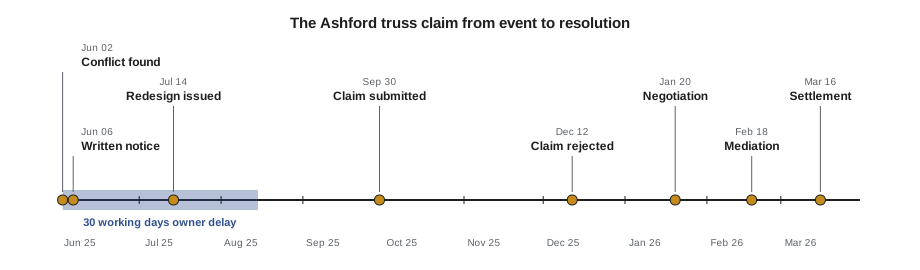
| Step | What happened on Ashford | Lesson |
|---|---|---|
| Event | On June 2, 2025, the steel erector found that the roof trusses clashed with the mechanical ductwork; the design had to change | 1, 2 |
| Giving notice | Kestrel Ridge gave written notice of a claim on June 6, within the 21-day period in A201 §15.1.3, and reserved its rights | 3 |
| Change | The consultant issued the redesign on July 14; Kestrel Ridge priced the extra steel as a change and excluded delay costs from that price | 2 |
| Time | The windows analysis showed 30 working days of owner delay; the crane breakdown was not concurrent because no trusses were available to lift | 4, 5 |
| Money | Extended field overhead, standby equipment and head office overhead were quantified, with the tiling disruption claimed separately | 6, 7 |
| Claim | A structured claim was submitted on September 30, event by event, with records cross-referenced | 8 |
| Rejection | The Initial Decision Maker rejected the delay costs on December 12; Kestrel Ridge diarized the deadlines | 10, 11 |
| Negotiation | Senior representatives met in January 2026 with decision trees prepared | 9 |
| Mediation | A one-day mediation in February narrowed the gap; the city's liquidated damages claim was traded against the contractor-caused days | 9, 10 |
| Settlement | A settlement of $450,000 for all listed claims, with an extension of 44 working days (39 compensable and 5 for abnormal rain), liquidated damages waived, staged payment and mutual releases preserving the city's claim against Halloway Partners | 9 |
| Records | Every step relied on daily reports, schedule updates, notices, cost codes and photographs; the gaps in the daily reports were filled from delivery records and emails | 12 |
Several features of this story are worth drawing out. The claim succeeded because notice was given on time; without it, the best schedule analysis in the world might not have mattered. The schedule analysis was credible because the updates had been kept honestly through the project, including the contractor's own two days of delay. The quantum was accepted largely because it conceded what it should and avoided double counting. The settlement worked because both sides had valued their alternatives and found that a deal was better. And the whole process took about nine months, not five years, because the parties used the cheaper rungs of the ladder before the expensive ones.
Worked problem
Final review: what if the records had been poor?
Suppose Kestrel Ridge had kept daily reports that said only "work progressing", had not updated its schedule after May, and had given notice of the truss delay only in September. Assess how each part of the claim would have fared.
Show solution
- Timing of notice: late notice might bar the claim or reduce it to the extent the city was prejudiced, depending on the contract and law (lesson 3).
- Time: without updates, a windows analysis would have to be reconstructed; the city's expert would attack it and might argue the crane breakdown was concurrent.
- Disruption: without quantities by activity, no measured mile; the claim would fall back on factors or modified total cost.
- Quantum: weak support for daily overhead and standby rates; reviewers would discount heavily.
- Negotiation: Kestrel Ridge's decision tree would show low probabilities of success, so its walk-away value and its settlement would both fall.
Answer: With poor records, the same event and the same owner responsibility would produce a much smaller settlement, or none. The value of records is realized in every later stage of a dispute.
Common mistakes
MistakeDaily reports that say only 'work progressing'.
InsteadRecord crews, areas, delays and causes specifically and factually.
MistakeKeeping only PDF prints of schedules.
InsteadKeep native schedule files for every update.
MistakeEditing records after the event.
InsteadCorrect openly with dated notes; keep audit trails.
MistakeSpeculating about liability in internal email.
InsteadWrite as if the other side will read it; seek advice on sensitive assessments.
MistakeContinuing routine deletion after a dispute arises.
InsteadIssue a written hold and suspend deletion as soon as litigation is anticipated.
Summary and key terms
- Disputes are decided on evidence, and the best evidence is contemporaneous project records.
- Key records are daily reports, schedule updates, minutes, logs, correspondence, cost and quantity records and photographs.
- Audit records during the project, while gaps can still be filled.
- Records are credible when consistent, factual, openly corrected, cross-checked and kept in native form.
- Privilege protects legal advice and litigation documents, not facts or business emails copied to a lawyer.
- Once a dispute is anticipated, preserve all relevant records, including electronic ones, under a written hold.
- The Ashford truss claim shows how notice, schedule analysis, quantum, negotiation and records combine to resolve a claim.
- Contemporaneous record
- A record made at the time of an event by someone with knowledge of it, in the ordinary course of business.
- Daily report
- A record of each working day's crews, equipment, weather, work, areas and delays.
- Native file
- A file kept in the format of the software that created it, such as a scheduling database.
- Audit trail
- A record of who changed a document or entry and when.
- Spoliation
- The destruction or loss of relevant evidence.
- Legal hold
- An instruction to preserve documents relevant to an anticipated dispute.
- Litigation privilege
- Protection for documents created for the dominant purpose of litigation (called work product in the US).
- Records audit
- A check of whether existing records will support a claim, done while gaps can still be filled.
Practice problems
Work each problem on paper first, then reveal the answer to check.
Why do tribunals prefer contemporaneous records?
Show answer
They were made before anyone knew they would matter.
Name four things a good daily report records.
Show answer
Crews, equipment, weather, work done, areas, delays and causes.
Why keep native schedule files?
Show answer
Experts need them to test the logic; PDFs are not enough.
How should a mistaken record be corrected?
Show answer
With a dated correction, not by editing the original.
Does copying a lawyer make an email privileged?
Show answer
No.
When does the duty to preserve documents arise?
Show answer
When litigation is reasonably anticipated.
What is spoliation?
Show answer
The destruction or loss of relevant evidence.
Daily reports exist for 44 of 50 working days. What is the coverage?
Show answer
88 %.
Why did the gap on June 18 to 19 matter on Ashford?
Show answer
It fell in the crane breakdown, when Kestrel Ridge had to prove no trusses were available.
Which single step most protected the truss claim?
Show answer
Giving written notice on time.
Lesson quiz · 5 questions
Score 60% or more to complete this lesson.
Create a free account to save your progress, take quizzes and earn a certificate.