
CON-385 · Lesson 10 of 12 · 20 min
Punch lists, substantial completion and final completion
Three weeks before the clinic was due to open, Simone Dufresne walked level 1 with Ruth Pell of Pell & Strand Architects, Kwame Asante, Helen Achterberg and a clipboard that soon became a tablet full of photographs. They found a door that did not latch, scuffs on corridor walls, a missing cover plate, a sink with no hot water, a ceiling tile stained by a leak that had since been fixed, and a nurse call station that showed the wrong room number. None of these stopped the clinic from working; all of them had to be fixed. The walk produced a list of 287 items. Two weeks later, after Harborline and its subcontractors had worked through most of them, the list was down to 41, and the project reached one of the most important legal and financial milestones in any construction contract.
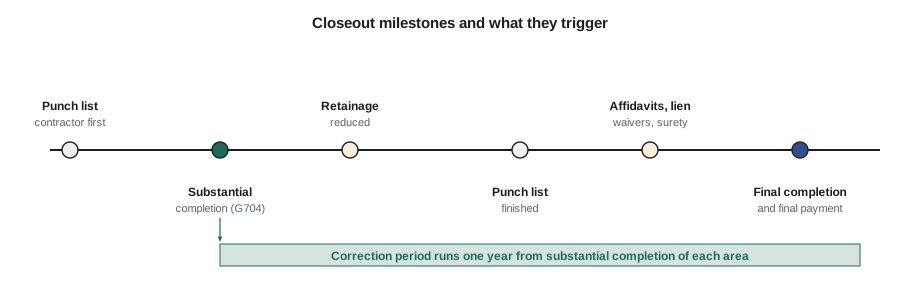
That milestone is called substantial completion in the AIA A201 and most US contracts. It marks the point at which the work, or a designated portion of it, is sufficiently complete according to the contract documents that the owner can occupy or use it for its intended purpose. Substantial completion usually starts the warranty and correction period, often triggers release of most retainage, ends the contractor's exposure to delay damages and shifts responsibility for the space toward the owner. Getting it right matters to everyone's money.
The punch list
A punch list is a list of work that is incomplete or does not meet the contract documents. Under the A201, when the contractor considers the work substantially complete, it prepares and submits a comprehensive list of items to be completed or corrected. The Architect then inspects, adds items it finds and decides whether the work is substantially complete. Good contractors walk the work themselves first, trade by trade, and fix what they find before the Architect arrives; a contractor that relies on the Architect to find its punch list items is paying the Architect to do its quality control, and usually gets a much longer list.
Harborline ran its own walk two weeks before the formal one, room by room, with each trade foreman present. It used a completion-list app on tablets: each item had a photograph, a location pinned on the floor plan, the responsible trade, a target date and a status. Trades received their items on their phones the same evening and marked them complete with a photograph. When the formal walk came, the list was shorter and better organized, and the design team spent its time on items that mattered.
| Category | Examples from level 1 | Usual timing |
|---|---|---|
| Safety or code items | Door not latching on a fire separation, missing exit sign | Before occupancy |
| Function items | Sink with no hot water, nurse call showing wrong room | Before occupancy or within days |
| Commissioning issues | Open items on the issues log affecting the OPR | Before acceptance of the system |
| Finish items | Scuffs, stains, missing cover plates, touch-up paint | Within weeks, often after hours |
| Seasonal or deferred items | Landscaping, testing that needs summer conditions | Agreed later date |
Substantial completion under the A201
The A201-2017 defines substantial completion by function: the stage when the work or a designated portion is sufficiently complete in accordance with the contract documents so that the owner can occupy or use it for its intended use. When the contractor submits its punch list and the Architect's inspection confirms substantial completion, the Architect prepares a Certificate of Substantial Completion, commonly AIA G704. It states the date of substantial completion, the responsibilities of the owner and contractor for security, maintenance, heat, utilities, damage to the work and insurance, and the time within which the contractor must finish the remaining items. The A201 has no fixed percentage test, so owners and architects judge whether the remaining work prevents intended use.
Worked problem
How much retainage can be released at substantial completion?
Ashgrove's contract sum, including approved changes, is now $16,080,000, and the owner has withheld 5 % retainage on all payments to date, about $804,000. After the second walk, the Architect values the remaining punch list items and incomplete work at $139,000. Ashgrove's supplementary conditions allow the retainage to be reduced at substantial completion to twice the value of the remaining work, plus any amounts in dispute (none here). How much retainage can be released?
Show solution
- Retainage held: 5 % × $16,080,000 = $804,000.
- Retainage to keep: 2 × $139,000 = $278,000.
- Release at substantial completion: $804,000 − $278,000 = $526,000.
- The remaining $278,000 is released at final completion, once the punch list is finished and the final payment documents are received.
Answer: $526,000 can be released at substantial completion, with $278,000 held until final completion.
# Retainage release at substantial completion
contract = 16_080_000
rate = 0.05
remaining = 139_000          # value of punch list and incomplete work
disputed = 0
held = rate * contract
keep = 2 * remaining + disputed
print(f'Retainage held:   ${held:,.0f}')
print(f'Retainage kept:   ${keep:,.0f}')
print(f'Release now: ${held - keep:,.0f}')Retainage held: $804,000 Retainage kept: $278,000 Release now: $526,000
Because the A201 has no statutory formula, disputes about substantial completion usually turn on facts: can the owner actually use the space for its intended purpose, with occupancy permits in hand and life safety systems accepted? Ashgrove's supplementary conditions added a list of prerequisites, described below, to make the answer less arguable.
Prerequisites the owner insists on
Many owners add prerequisites to the A201 definition through supplementary conditions, so that the owner is not asked to take over a building it cannot actually operate. Ashgrove's supplementary conditions listed them.
- Occupancy permission from the building official for the area.
- Fire alarm verification, sprinkler certificates and integrated test results accepted.
- All commissioning issues affecting safety or the OPR closed.
- Infection control sign-off from Dr. Moreau's team after terminal cleaning.
- Operating and maintenance information and training for the systems serving the area delivered (lesson 11).
- Keys, access cards and the security system turned over.
These prerequisites turned out to be the real path to handover. The clinic's 287-item list was finished on time, but the building official's inspection waited on the integrated test report, which waited on the elevator recall fix described in lesson 9. Simone's closeout schedule tracked the prerequisites, not just the list.
What changes hands at the milestone
When a part of the work reaches the milestone, responsibilities move from the contractor to the owner, and the move needs to be explicit. Before the milestone, the contractor controls the space, insures the work under its builder's risk or property policy, pays for temporary heat and power, keeps it secure and repairs any damage. After it, the owner normally insures the space under its own property policy, pays utilities, provides security and cleaning, operates the systems and takes responsibility for damage it causes. If the handover is vague, gaps appear: a flood in the first week can leave both insurers pointing at each other.
| Responsibility | Before the milestone | After the milestone |
|---|---|---|
| Property insurance for the work | Contractor's project policy | Owner's property policy |
| Utilities and temporary services | Contractor | Owner |
| Security and access control | Contractor, with hospital badge rules | Owner |
| Operation and routine maintenance of systems | Contractor and trades | Owner's operators |
| Damage to finished work | Contractor repairs | Party that caused it |
| Completing listed items | Contractor | Contractor, on agreed dates and access |
On Ashgrove, the change of responsibility for the clinic took effect at 07:00 on the Monday after the certificate was signed. That morning, Helen's operators took control of the clinic's systems at the automation workstation, hospital security took over the doors, and Harborline's builder's risk coverage for the clinic ended. Harborline's workers still needed access to finish the remaining items, so the handover agreement set rules for that access: badges from hospital security, work only between 18:00 and 06:00 in patient areas, and an escort in the medication room. Every item completed after handover was signed off by Helen's coordinator rather than the trade foreman, because the space was now hers.
Disagreements about readiness
Owners and contractors sometimes disagree about whether the milestone has been reached. The contractor wants the milestone as early as possible, because it stops exposure to delay damages, starts the warranty and releases money. The owner wants the space finished, because once it accepts the space it loses leverage over the remaining work and takes on the costs of running it. Disagreements are reduced when the contract defines the milestone clearly, when prerequisites are listed, and when the parties walk the work together early and agree what remains. When disagreements do arise, they are usually about a few large items, such as a system that has not passed its functional test, rather than hundreds of small ones. Ashgrove's experience was typical: Simone and Helen disagreed about whether the level 3 offices could be accepted while a cooling problem in two rooms was being solved, and resolved it by accepting the floor with those two rooms excluded and a dated plan for the fix.
Partial occupancy and phased handover
On a phased renovation, the owner takes over parts of the work at different times. The A201-2017 allows the owner to occupy or use any completed or partially completed portion of the work, with the consent of the contractor and of the insurer, and with the responsibilities for that portion agreed. On Ashgrove, the dialysis unit was handed over at the end of phase 2 while the rest of the wing was still under construction. The Architect issued a Certificate of Substantial Completion for that designated portion, which set out who was responsible for the dialysis unit's security, maintenance, utilities, insurance and damage, when its warranty started, and how the contractor would reach the rest of the work without passing through the unit.
Phased handovers create overlapping clocks. Each part of the work has its own substantial date, its own warranty start and sometimes its own release of retainage. Simone kept a closeout register with a row for each handover area and columns for every date and document, because by the end of the project three different warranty periods were running on the East Wing at once.
Retainage, liens and final payment
In the United States, retainage is set by the contract and, for public projects and in some states for private ones, limited by statute. Lien rights are governed by each state's mechanics' lien law, with deadlines measured from the last day work or materials were furnished; Minnesota's statute, for example, generally requires lien statements to be filed within 120 days of the last furnishing. Before final payment under the A201-2017, the contractor submits an affidavit that payrolls, bills and debts have been paid (commonly AIA G706), releases or waivers of liens (commonly G706A), consent of surety to final payment (G707) where there is a bond, and other data the owner requires. On Ashgrove, the Architect certified final payment once the punch list was finished, the closeout documents were delivered and all lien waivers were in.
Avoiding a closeout that drags
The last 2 % of a project often takes 20 % of the time. Subcontractors move their best crews to new jobs, small items languish, documents are late and the owner's patience runs out. Harborline used three habits to keep closeout moving: it kept a closeout coordinator on site full-time for the last eight weeks; it reviewed the punch list with every subcontractor weekly, with photographs of each item; and it withheld part of each subcontractor's payment until its items and documents were complete. The final punch list for the whole East Wing was closed 46 days after the last substantial completion date, inside the 60 days Harborline had promised.
Common mistakes
MistakeRelying on the Architect to find punch list items.
InsteadWalk the work first, trade by trade, and fix what you find before the formal inspection.
MistakeAsking for substantial completion when the owner cannot yet use the space.
InsteadConfirm the prerequisites, such as occupancy permission and life safety acceptance, before asking.
MistakeTracking only the list and ignoring prerequisites.
InsteadTrack occupancy permission, life safety reports, commissioning, training and documents as closely as the list.
MistakeLosing track of dates on phased handovers.
InsteadKeep a closeout register with every handover area's dates and documents.
MistakeLetting closeout drift while crews move on.
InsteadKeep a closeout coordinator, review the list weekly and tie subcontractor payments to completion.
Summary and key terms
- Substantial completion marks the point when the owner can use the work for its intended purpose and starts warranty and retainage events.
- The A201 has no statutory percentage test; the Architect issues a Certificate of Substantial Completion setting the date and responsibilities.
- Final completion follows finishing the punch list and delivering affidavits, lien releases and consent of surety.
- Contractors should walk the work themselves before the formal inspection and manage items with photographs, locations and dates.
- Owners add prerequisites such as occupancy permission, life safety acceptance, commissioning, training and documents.
- Phased handovers need agreements on responsibilities and a register of dates for each area.
- Retainage and lien deadlines depend on the contract and state law, and final payment follows lien waivers and affidavits.
- Punch list
- A list of work that is incomplete or does not meet the contract documents.
- Substantial completion
- The stage when the owner can occupy or use the work for its intended purpose.
- Certificate of Substantial Completion
- The Architect's certificate stating the date and responsibilities, commonly AIA G704.
- Retainage
- Money withheld from progress payments as security until completion.
- Final completion
- The point when all work, including the punch list, is finished and final payment is due.
- Lien waiver
- A document giving up lien rights, usually in exchange for payment.
Practice problems
Work each problem on paper first, then reveal the answer to check.
What does substantial completion start?
Show answer
The warranty and correction period, and often the release of most retainage.
Retainage of $600,000 is held and remaining work is valued at $100,000. With a two-times rule, how much is released?
Show answer
$600,000 − $200,000 = $400,000.
What document commonly certifies substantial completion?
Show answer
AIA G704, the Certificate of Substantial Completion.
Why did the clinic's handover wait after the punch list was finished?
Show answer
Prerequisites: the building official's inspection waited on the integrated test report.
Name three documents needed before final payment under the A201.
Show answer
An affidavit of payment of debts and claims, lien releases or waivers, and consent of surety.
Lesson quiz · 5 questions
Score 60% or more to complete this lesson.
Create a free account to save your progress, take quizzes and earn a certificate.