
CON-325 · Lesson 2 of 12 · 24 min
Access, traffic, laydown and deliveries
Everything that becomes part of the building arrives by truck, and most of it arrives through one or two gates. The way trucks, workers and the public move into, through and past the site shapes the whole logistics plan. This lesson covers site access and egress, traffic on and around the site, the permits that govern use of streets and sidewalks, and the management of deliveries and laydown. Traffic control on public roads, including flagging and work zone layouts, is a safety specialty covered in HSE-373; this lesson focuses on the superintendent's planning decisions.
Gates and access points
The number and location of gates are among the first decisions in a logistics plan. A gate needs a safe connection to the public road, enough width for the largest vehicle, sight lines for drivers entering and leaving, and space inside so that a truck can get completely off the street before stopping. Each gate also needs control: a gate person or a locked gate, a sign-in point for workers and visitors, and signs telling drivers what to do.
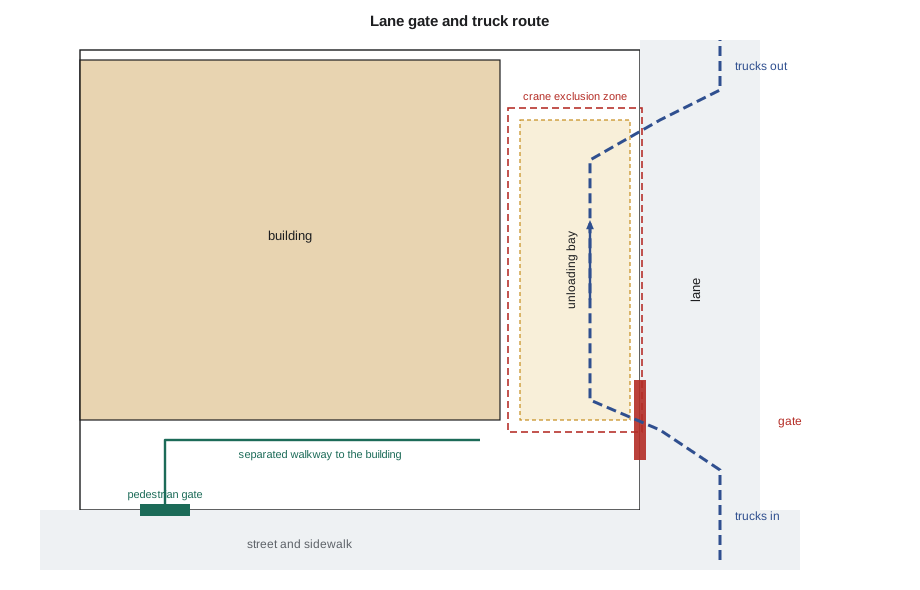
Larkspur Commons has two gates. The main gate is on the lane on the east side, where trucks can pull in, unload in the east strip and leave by driving north along the lane. A second, smaller gate on the street side serves the hoist and pedestrian access for workers, and a temporary lane closure on the street is used on concrete pour days. The city allowed the lane gate easily, because the lane carries little traffic, but required that the lane remain passable for garbage trucks and emergency vehicles at all times, which limits the time a truck may stand in it to about 30 minutes.
Gates are where vehicles and pedestrians are most likely to meet. Good practice separates the two: a pedestrian gate with its own path, a barrier between the pedestrian path and the vehicle gate, and a spotter or gate attendant who controls trucks entering and leaving. Trucks leaving a site across a sidewalk are a particular hazard to the public, because drivers looking for gaps in road traffic may not see a pedestrian or a cyclist. Many cities require a flag person at every truck crossing of a sidewalk.
Moving vehicles on site
Inside the site, vehicles share space with workers, materials and equipment. The site traffic plan sets the routes, speed limits, parking places for equipment and the areas where pedestrians must not go. The guiding principles are the same as for any workplace traffic plan (HSE-218 covered warehouse traffic plans in detail).
- Plan one-way routes so that trucks enter forward and leave forward, with turnaround areas sized for the largest truck.
- Avoid reversing wherever possible; where reversing is unavoidable, use a trained signaler and keep the reversing area clear of people.
- Mark pedestrian routes and keep them away from truck routes and crane loads; use barriers, not just paint.
- Set a site speed limit and enforce it.
- Provide firm, drained surfaces for haul roads and unloading areas, especially where trucks or cranes will stand.
- Keep emergency vehicle routes open and signed.
Haul roads and unloading areas deserve engineering attention. A loaded concrete truck weighs well over 25 US tons, and a ready-mix truck or a lumber truck standing on soft ground can sink, tip or damage buried services. Temporary roads are usually built with a layer of crushed stone over a geotextile, and their thickness depends on the soil and the traffic. On Larkspur Commons, the east strip is surfaced with crushed stone over the backfilled shoring zone, and the geotechnical engineer reviewed the thickness because the backfill is still settling.
Mud, dust and the public road
Trucks leaving an excavation carry mud on their tires, and that mud ends up on the public street, where it becomes a slipping hazard, a stormwater pollutant and a source of complaints and fines. Most cities require contractors to keep streets clean. The usual controls are a stabilized construction entrance (a pad of coarse crushed stone that knocks mud off tires), a wheel wash for heavy mud, and street sweeping as needed. CON-430 discussed erosion and sediment control as part of sustainable site practice; the superintendent's concern is to keep the controls working every day, not just on the day of the inspection.
Dust is the dry-weather counterpart of mud. Haul roads, stockpiles and demolition generate dust that drifts onto neighbors and the street. Water trucks, covering stockpiles, reducing speeds and paving the most-used routes help. Dust is also a health hazard for workers, especially when it contains crystalline silica from concrete cutting or crushing, which the occupational hygiene courses cover.
Using the street: permits and agreements
Few urban sites can operate without using some part of the public road. A lane closure for concrete pours, a sidewalk closure under the crane's swing, a parking ban to make room for a mobile crane, or a covered way over the sidewalk all need permission from the road authority, usually through a street use or road occupancy permit.
In Boise, public streets are managed by the Ada County Highway District rather than by the city, so street use and right-of-way permits come from that district, with conditions on hours, traffic control, pedestrian routes and fees. Applications typically require a traffic control plan prepared to the federal Manual on Uniform Traffic Control Devices (MUTCD) as adopted in the state, and closures on busy streets may be limited to off-peak hours. State highways need permits from the state transportation department.
Permits take time, and their conditions can shape the schedule. A city that allows lane closures only between 9:00 and 15:00 limits the length of a concrete pour that depends on the closure. A permit that bans work in the street during a festival or a holiday period can delay a crane erection. Dana's team prepared a permit calendar for Larkspur Commons listing every expected street use, its permit lead time, the hours allowed and the cost, so that applications are made early and the schedule reflects the conditions.
Pedestrians must always have a safe route past the site. If a sidewalk is closed, the permit will usually require a protected temporary walkway in the parking lane or on the far side of the street, accessible to people using wheelchairs, walkers and strollers, with ramps where needed, detectable edges for people with low vision and lighting at night. Telling pedestrians to cross to the other side may be acceptable for a short closure, but a long-term closure needs a real alternative. Lesson 10 covers hoarding and covered ways.
Delivery management
On a busy site, deliveries are one of the main causes of lost time and incidents. Trucks arrive unannounced, wait in the street, block the gate, unload in the wrong place or arrive when the crane is busy. The cure is to manage deliveries actively: every delivery is booked, every booking has a time slot, an unloading location and a means of unloading, and the gate turns away trucks without bookings.
On Larkspur Commons, Omar runs a delivery booking system. Subcontractors book deliveries at least 48 hours ahead through a shared calendar, stating the material, the truck type, the expected unloading time, whether the crane, hoist or a forklift is needed, and where the load will go. Omar checks each booking against the crane schedule, the hoist schedule and the laydown space, and confirms or proposes another slot. The gate attendant has the day's list and calls Omar when a truck arrives without a booking.
Mei modeled the lane gate to show the subcontractors why the system matters. Twelve trucks a day share the one unloading bay; each takes between 20 and 45 minutes to unload.
# One unloading bay on the lane: random arrivals versus booked delivery slots (minutes, illustrative)
import random
random.seed(325)
DAY = 9 * 60                 # gate open 7:00 to 16:00
UNLOAD = (20, 45)            # unloading takes 20 to 45 minutes

def simulate(arrivals):
    bay_free, waits = 0, []
    for t in sorted(arrivals):
        start = max(t, bay_free)
        waits.append(start - t)
        bay_free = start + random.uniform(*UNLOAD)
    return waits

trucks = 12
results = {}
for name in ("Random arrivals", "Booked 45-minute slots"):
    all_waits = []
    for day in range(200):                     # 200 simulated days
        if name == "Random arrivals":
            arr = [random.uniform(0, DAY - 60) for _ in range(trucks)]
        else:                                  # slot start plus a little lateness
            arr = [i * 45 + random.uniform(-5, 15) for i in range(trucks)]
        all_waits += simulate(arr)
    results[name] = all_waits

for name, w in results.items():
    w.sort()
    over15 = sum(x > 15 for x in w) / len(w)
    print(f"{name:<24} mean wait {sum(w) / len(w):5.1f} min, 90th percentile {w[int(0.9 * len(w))]:5.1f} min, "
f"trucks waiting over 15 min {over15:.0%}")Random arrivals mean wait 26.7 min, 90th percentile 69.4 min, trucks waiting over 15 min 55% Booked 45-minute slots mean wait 0.7 min, 90th percentile 2.3 min, trucks waiting over 15 min 0%
With random arrivals, the average truck waits almost half an hour and one in ten waits more than an hour, far more than the city's limit on standing in the lane. With booked slots, the same twelve trucks barely wait at all, even allowing for drivers who arrive a little early or late. The capacity of the bay did not change; only the timing did. This is the core argument for delivery management: it costs nothing in equipment and saves a great deal of waiting, congestion and conflict with the neighbors.
Just-in-time delivery and lean logistics
Lean construction (CON-410) treats inventory as waste. Materials stored on site tie up money, take space, get damaged by weather and handling, and are often moved several times before they are installed. Just-in-time delivery aims to bring materials to the site shortly before they are needed, in the quantities needed and in the order of installation. The approach needs reliable schedules and reliable suppliers; when either fails, the crew waits.
A practical compromise is to define a buffer for each type of material: enough on site to protect the crews against normal supply variability, but not more. For Larkspur Commons, Dana set targets such as two days of wall framing material on the floor below the work, one week of windows on site, and no more than three days of drywall stocked on any floor. These targets are reviewed at the weekly meeting along with the delivery forecast.
Packaging matters too. Suppliers can deliver lumber packages labeled and sequenced by floor and by wall panel, windows in the order of installation, and drywall in loads sized for each unit. A supplier who loads the truck in the right order saves hours of sorting on site. These requirements belong in the purchase orders and subcontracts, not in a phone call on the day.
Laydown areas
Laydown areas store materials between delivery and installation. A good laydown area is flat, drained and firm enough for forklifts and trucks; within reach of the crane or close to the hoist; away from excavations, edges and power lines; and organized so that materials can be found and taken out in the order they are needed.
The amount of space needed depends on the material, how it is packaged and how long it stays. A simple sizing method takes the volume or number of units, the stacking height allowed, and an allowance for aisles and access, often 30 to 60 percent of the net storage area. Stacking height is limited by stability, by the material's strength and by safety rules: stacked materials must be stable and must not exceed heights at which they could fall on workers.
| Material | Typical storage | Special requirements |
|---|---|---|
| Reinforcing steel | On dunnage, sorted by bar mark and pour | Off the ground; tagged; clear access for the crane |
| Formwork and shoring | Stacked by type, near the crane | Inspection area for damaged components |
| Lumber packages | On dunnage, covered, by floor | Protect from rain; keep wrapped until use |
| Windows and doors | Racks or crates, upright | Protect from impact and weather; secure against wind |
| Drywall | Indoors, flat, on the floor where used | Must stay dry; check floor capacity for stacked boards |
| Mechanical and electrical equipment | Indoors or in containers | Security; protection from dust and moisture |
| Flammable liquids and gas cylinders | Separate, ventilated, secured | Fire code limits and separation; signage |
Storing materials on finished floors needs a capacity check. Stacked drywall can impose a heavy load on a small area; a pallet of tiles or a stack of reinforcing steel on a slab that has just been stripped can exceed the load the slab can carry at that age. CON-240 discussed construction loads; on Larkspur Commons, the structural engineer provided a construction loading plan showing the allowable stacked loads on each podium level and the wood floors, and Omar's crews mark the allowable zones with paint.
Moving materials on site
Once on site, materials move by crane, hoist, forklift, telehandler, pallet jack, buggy or hand. Each method has a capacity and a cost, and the logistics plan should match the method to the material. Forklifts and telehandlers need firm, level surfaces and trained operators (HSE-218); cranes need booked time and riggers (lessons 4 to 6); hoists need scheduled slots (lesson 5). Moving materials by hand up stairs is slow and causes injuries; once a building is more than a couple of stories high, a hoist or crane should do the vertical transport.
The superintendent should know the vertical transport demand. On Larkspur Commons, Omar estimated the number of crane picks and hoist trips for each week of the wood frame and envelope from the quantities in the estimate, and compared them with the available crane and hoist hours. Weeks where demand exceeds capacity show up early, while there is still time to add a second hoist shift, rent a telehandler or resequence deliveries.
Common mistakes
MistakeLetting trucks arrive whenever suppliers choose.
InsteadBook every delivery with a time slot, unloading location and means of unloading, and turn away unbooked trucks.
MistakePlanning for trucks to reverse into the site from the street.
InsteadPlan forward-in, forward-out routes with turnaround space, and use signalers where reversing cannot be avoided.
MistakeApplying for street use permits a few days before they are needed.
InsteadKeep a permit calendar with lead times, hours and costs, and apply early.
MistakeClosing a sidewalk and telling pedestrians to cross the street.
InsteadProvide a protected, accessible temporary walkway unless the closure is very short.
MistakeStacking materials on a recently stripped slab without checking capacity.
InsteadFollow the construction loading plan and mark allowable storage zones.
Summary and key terms
- Gates need safe road connections, width, sight lines, space to get trucks off the street and separation of pedestrians from vehicles.
- Site traffic plans use one-way routes, avoid reversing, separate pedestrians and keep emergency routes open.
- Haul roads and unloading areas need firm, drained surfaces designed for the loads.
- Mud and dust controls must work every day, not only at inspections.
- Use of streets and sidewalks needs permits with conditions on hours, traffic control and pedestrian routes; a permit calendar keeps them on time.
- Booked delivery slots dramatically reduce truck waiting without any change in unloading capacity.
- Just-in-time delivery with defined buffers reduces storage, handling and damage.
- Laydown areas must be firm, accessible and organized, and stored loads on floors must respect the construction loading plan.
- Stabilized construction entrance
- A pad of coarse crushed stone at a site exit that removes mud from vehicle tires.
- Wheel wash
- Equipment that washes mud from truck wheels before they enter the public road.
- Street use permit
- Permission from the road authority to occupy part of a street, lane or sidewalk temporarily.
- Traffic management plan
- A plan showing how traffic and pedestrians will be controlled around work affecting a road.
- Delivery booking
- A reserved time slot, unloading location and handling method for a delivery.
- Buffer stock
- A planned amount of material kept on site to protect crews against supply variability.
- Dunnage
- Timbers or other supports that keep stored materials off the ground.
- Construction loading plan
- An engineer's plan showing allowable construction loads on floors during the work.
Practice problems
Work each problem on paper first, then reveal the answer to check.
Why does a gate need space inside the site for a whole truck?
Show answer
So the truck can get completely off the street before stopping, avoiding blocking traffic or the sidewalk.
What was the main condition attached to the Larkspur lane gate?
Show answer
The lane must remain passable for garbage trucks and emergency vehicles, limiting standing time.
In the gate simulation, what changed between the two cases?
Show answer
Only the timing of arrivals; unloading capacity was the same.
Name three items a delivery booking should state.
Show answer
Any three of: material, truck type, time slot, unloading time, crane or hoist need, destination.
What is a buffer target? Give an example.
Show answer
A planned maximum amount of material on site, such as two days of framing material or no more than three days of drywall per floor.
Why must stored loads on floors be checked?
Show answer
Stacked materials can exceed the capacity of a slab or floor, especially a young or newly stripped slab.
Name two controls for mud on public streets.
Show answer
A stabilized construction entrance, a wheel wash, street sweeping.
What must a temporary pedestrian route provide?
Show answer
Protection from traffic and the work, accessibility for wheelchairs and strollers, detectable edges and lighting.
Lesson quiz · 5 questions
Score 60% or more to complete this lesson.
Create a free account to save your progress, take quizzes and earn a certificate.