
CON-260 · Lesson 4 of 12 · 30 min
BIM execution planning and common data environments
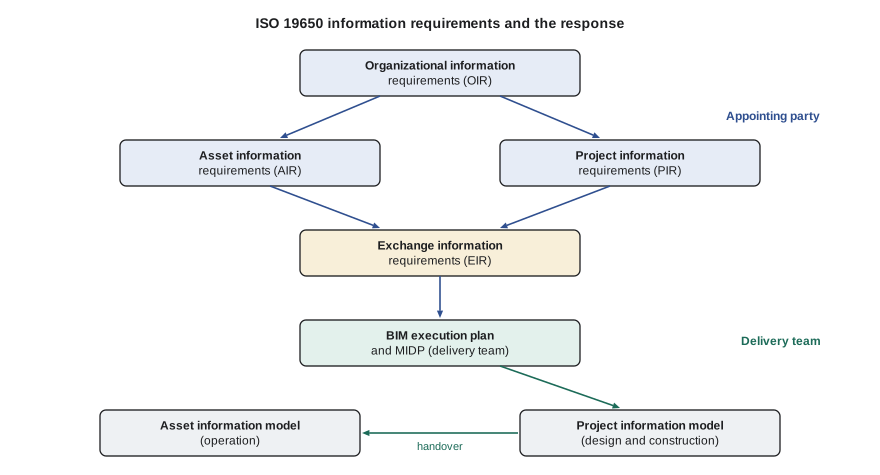
A model produced without a plan tends to be either too thin to use or too detailed to afford. Two documents prevent this. The owner's information requirements say what information the owner needs, when and why. The BIM execution plan (BEP) is the delivery team's response: how it will produce, exchange, check and deliver that information. The common data environment (CDE) is where the information lives while it is produced. CON-120 introduced the CDE and BEP briefly. This lesson works through them in detail, using the ISO 19650 framework and the North American documents that sit alongside it.
ISO 19650 in brief
ISO 19650 is a series of international standards on organizing and digitizing information about buildings and civil engineering works using BIM. Part 1 sets out concepts and principles; Part 2 covers the delivery phase (design and construction); Part 3 covers the operational phase; Part 4 covers information exchange; Part 5 covers security-minded information management; and Part 6, published in 2025, covers health and safety information. The series uses its own vocabulary, which is worth learning because it is increasingly written into contracts.
| ISO 19650 term | Meaning | Typical North American equivalent |
|---|---|---|
| Appointing party | The client or the party issuing an appointment | Owner |
| Lead appointed party | The party leading a delivery team and appointed by the appointing party | Prime consultant, design-builder or general contractor |
| Appointed party | A party appointed by the lead appointed party | Subconsultant or subcontractor |
| Task team | A group performing a specific task | Discipline or trade team |
| Organizational information requirements (OIR) | Information the organization needs for its goals | Owner's strategic data needs |
| Asset information requirements (AIR) | Information needed to operate a particular asset | Owner's asset data standard, COBie requirements |
| Project information requirements (PIR) | Information needed for decisions during the project | Owner's design review and approval needs |
| Exchange information requirements (EIR) | Requirements written into an appointment for each exchange | BIM requirements in the RFP or contract |
| Master information delivery plan (MIDP) | The plan of all information containers to be delivered, with dates and authors | Model and deliverable schedule |
| Task information delivery plan (TIDP) | A task team's own delivery plan, rolled up into the MIDP | Trade or discipline deliverable list |
In the United States, ISO 19650 is used by some owners and by many international firms, while others rely on the National BIM Standard–United States (NBIMS-US), maintained by the National Institute of Building Sciences. NBIMS-US version 4 is modular, with Project BIM Requirements, Project BIM Execution Planning, BIM Use Definitions and COBie modules. Federal owners such as the General Services Administration and the U.S. Army Corps of Engineers publish their own BIM guides and contract requirements, and many states, universities and health-care systems do the same, so the requirements on each project must be read carefully.
Owner information requirements
Good owner requirements start from decisions and operations, not from software. A hospital owner might need room data to check clinical adjacencies at design stage, equipment data to plan maintenance staffing, and space data to allocate costs to departments. A school board might need little more than accurate floor plans and a list of maintainable equipment. The requirements should state the purpose, the information needed for each purpose, the format, the milestone at which it is needed, and how it will be checked.
Weak requirements are common: "The contractor shall provide a BIM model at LOD 500 in native and IFC format." This says nothing about which elements, which properties, which purposes or how acceptance will be judged, and LOD 500 is not even a level of detail (Lesson 2). A construction manager who receives such a requirement should raise questions during bidding, because the cost of meeting it could range from trivial to very large.
Worked problem
Turning a vague requirement into a usable one
An owner's request for proposals says: "Provide BIM for facility management at handover." The contractor's BIM manager asks the owner's facilities department what it actually uses. The answer: the owner's maintenance system needs a list of maintainable equipment with location, type, manufacturer, model, serial number, installation date, warranty end date and maintenance tasks; and its space system needs room numbers, names, areas and departments. Rewrite the requirement.
Show solution
- Purpose: populate the owner's maintenance and space management systems at handover.
- Scope: all maintainable equipment in Divisions 21, 22, 23, 26, 27 and 28, plus all rooms.
- Information: for equipment, location (floor and room), type, manufacturer, model, serial number, installation date, warranty end date and maintenance tasks; for rooms, number, name, net area and department.
- Format: COBie spreadsheet plus IFC 4 Reference View model; property names as listed in the owner's asset data standard.
- Milestones: draft at 50 % construction, complete at substantial completion; acceptance by automated check against an IDS file and a 5 % field audit.
Answer: The rewritten requirement is specific, checkable and priceable, and avoids paying for information the owner will never use.
The BIM execution plan
The BIM execution plan is the delivery team's plan for meeting the requirements. A pre-appointment BEP is submitted with a proposal to show capability; a post-appointment BEP is developed in detail after award and maintained during the project. A typical BEP covers the following.
- Project information, goals and the BIM uses chosen, with the reason for each.
- Roles and responsibilities: BIM manager, coordinators, model authors for each discipline and trade.
- Model element table (LOD or level of information need by element and milestone, with authors).
- Software, versions and exchange formats, including IFC version and property sets.
- Coordinate system, origin, units, levels and grids, tied to site control.
- CDE structure, naming conventions, status codes and approval workflow.
- Coordination process: frequency, clash tolerances, meetings and issue tracking.
- Quality checks before each exchange and at each milestone.
- Deliverables and handover, including record models and asset data.
- Security requirements, access control and confidentiality.
The BEP must be realistic. A plan that promises weekly federated clash detection with eight trades, but has no coordinator budgeted and no trades contracted to model, is not a plan. The construction manager should check that every BIM use in the BEP has a named person, time in the schedule and money in the budget.
| BIM use | Why chosen | Lead | Frequency or milestone |
|---|---|---|---|
| 3D coordination | Dense MEP in corridors and ceiling spaces | GC BIM coordinator with trades | Weekly during coordination phase |
| Quantity takeoff | Check estimates and buy-out quantities | GC estimator | Each design milestone and buy-out |
| 4D phase planning | Occupied site; phasing of tie-ins | GC scheduler | Monthly look-ahead |
| Digital fabrication | Prefabricated MEP racks and risers | Mechanical and electrical trades | Before each release to shop |
| Field layout | Hangers and sleeves from the model | Trade field engineers | Each floor before deck pours |
| Record model and COBie | Owner's FM system | GC with trades | Draft at 50 %, final at handover |
The common data environment
A common data environment is the agreed source of information for a project, used to collect, manage and share information through a managed process. It is usually a cloud platform, but the CDE is defined by its process and rules rather than by the software. ISO 19650 describes information containers (any named file or set of information, such as a model, drawing, schedule or report) moving through four states.
| State | Meaning | Who can see it |
|---|---|---|
| Work in progress (WIP) | Being developed by a task team; not checked | The task team only |
| Shared | Checked and approved by the task team for sharing with others for coordination | The delivery team and, if agreed, the client |
| Published | Authorized for use, for example for construction or contract purposes | The project team and those who need it |
| Archived | Superseded or completed; kept as a record | Read-only for record and audit |
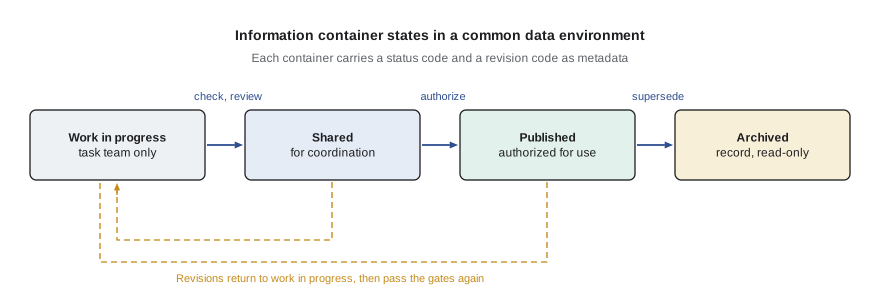
Each container carries metadata: a status code (indicating what it may be used for, such as coordination, information, construction or as-built) and a revision code. A drawing shared for coordination must not be used for construction. A clear status code prevents the classic mistake of a trade building from a superseded or unapproved drawing.
Naming conventions
Consistent file and container naming lets people find information and lets software sort and filter it. ISO 19650-2 and its national annexes describe a name built from fields separated by hyphens: project, originator, functional breakdown or volume, spatial breakdown or level, information type, role (discipline) and a number. Many North American owners have their own conventions, such as the PSPC National CADD Standard in Canada or agency CAD and BIM standards in the United States. Whatever the convention, it must be written down, applied from the start and checked automatically where possible.
Worked problem
Decoding a container name
A model file is named "NMP-ABC-Z1-02-M3-M-0001" under the project's naming convention: project code - originator - volume or zone - level - type - role - number. Decode it, and identify what is wrong with a second file named "NMP_ABC_mech level2 FINAL v3".
Show solution
- NMP = Northgate Medical Pavilion; ABC = originator (the mechanical engineer); Z1 = zone 1; 02 = level 2; M3 = three-dimensional model; M = mechanical; 0001 = sequence number.
- The second name uses underscores and spaces instead of hyphens, omits the zone and type fields, and embeds status and revision ("FINAL v3") in the name.
- Status and revision belong in metadata, not in the file name, so the name stays constant as the container is revised.
Answer: The first name is sortable and unambiguous; the second breaks automated filtering and will soon be followed by "FINAL v4" and "FINAL FINAL".
The master information delivery plan
The master information delivery plan (MIDP) lists every information container the delivery team will produce, with its author, the milestone it supports, its expected status and its due date. Task teams prepare task information delivery plans (TIDPs) that roll up into the MIDP. In North American practice the same function is often served by a model and deliverable schedule linked to the project schedule. The point is that information delivery is scheduled work, just like concrete pours, and should be tracked the same way.
Worked problem
Checking information delivery progress
The MIDP for the coordination phase lists 180 information containers due by the end of month 4. At the end of month 3, 96 have reached shared status, 30 are in work in progress and late, and the rest are not yet due. The plan expected 120 to be shared by now. What is the delivery performance and what action is needed?
Show solution
- Planned by now = 120; delivered = 96.
- Delivery performance = 96 ÷ 120 = 0.80, or 80 % of plan.
- Late containers = 30 in WIP past due; these should be listed by author in the next coordination meeting.
- If the trend continues, about 0.80 × 180 = 144 containers will be shared by month 4, 36 short, which could delay fabrication releases.
Answer: Information delivery is at 80 % of plan; the late items need recovery actions before they delay fabrication.
Roles in information management
Titles vary, but the functions are consistent. The owner may appoint an information manager or BIM manager to write requirements and review deliverables. The lead appointed party (often the general contractor or design-builder during construction) appoints a BIM manager responsible for the BEP, the CDE and quality. Each task team has a coordinator or lead modeler. On larger projects, a dedicated BIM coordinator runs clash detection and coordination meetings (Lesson 5). These roles are budgeted and staffed like any other project role; if nobody owns information management, it will not happen.
ISO 19650-5 adds a security dimension: owners of sensitive assets, such as hospitals, prisons, utilities and defense facilities, should assess what information could be harmful if disclosed and set rules for who can access it. Lesson 11 returns to security.
Common mistakes
MistakeAccepting a vague requirement such as "BIM at LOD 500" without questions.
InsteadAsk what the information is for, which elements and properties are needed, the format and how acceptance will be checked.
MistakeWriting a BIM execution plan that nobody is budgeted to carry out.
InsteadCheck that each BIM use has a named lead, time in the schedule and money in the budget.
MistakeUsing shared information for construction.
InsteadBuild only from published containers with the right status code.
MistakePutting status and revision in file names.
InsteadKeep names constant and record status and revision as metadata.
MistakeTreating information delivery as separate from the schedule.
InsteadTrack the MIDP like any other scheduled work and act on slippage.
Summary and key terms
- ISO 19650 organizes information management with parts on concepts, delivery, operation, exchange, security and health and safety.
- Requirements cascade from organizational to asset and project requirements and into exchange requirements in each appointment.
- Canada is adopting ISO 19650 as CAN/CGSB/CSA standards; the US uses NBIMS-US v4 alongside agency guides and ISO 19650.
- Good owner requirements state purpose, information, format, milestone and acceptance method.
- The BIM execution plan covers uses, roles, LOD, software, coordinates, CDE rules, coordination, quality, deliverables and security.
- A CDE moves information containers through work in progress, shared, published and archived states.
- Naming conventions and status codes prevent use of wrong or superseded information.
- The MIDP schedules information delivery and should be tracked like construction work.
- Appointing party
- In ISO 19650, the client or party issuing an appointment.
- Lead appointed party
- The party leading a delivery team, such as a prime consultant or general contractor.
- Exchange information requirements (EIR)
- Information requirements written into an appointment.
- BIM execution plan (BEP)
- The delivery team's plan for producing and delivering information.
- Common data environment (CDE)
- The agreed source of project information managed through a defined process.
- Information container
- A named, persistent set of information such as a model, drawing or document.
- Status code
- Metadata stating what an information container may be used for.
- MIDP
- Master information delivery plan listing all containers, authors and dates.
- TIDP
- Task information delivery plan for one task team.
- Asset information model
- The information model supporting operation of the completed asset.
Practice problems
Work each problem on paper first, then reveal the answer to check.
Which part of ISO 19650 covers the delivery phase?
Show answer
Part 2.
What ISO 19650 term corresponds roughly to the owner?
Show answer
Appointing party.
Name the four CDE states.
Show answer
Work in progress, shared, published and archived.
Why should status not be written into a file name?
Show answer
The name should stay constant across revisions; status belongs in metadata.
List five things a BIM execution plan should include.
Show answer
Uses, roles, model element table, software and formats, coordinates, CDE rules, coordination process, quality checks, deliverables, security (any five).
An MIDP expects 80 containers shared by now; 64 are shared. What is delivery performance?
Show answer
80 %.
What is the difference between a pre-appointment and a post-appointment BEP?
Show answer
The pre-appointment BEP shows capability in a proposal; the post-appointment BEP is the detailed working plan after award.
What should a construction manager ask about a requirement for 'BIM for facility management'?
Show answer
Which systems it feeds, which elements and properties, what format, when, and how it will be checked.
Which part of ISO 19650 deals with security-minded information management?
Show answer
Part 5.
Who prepares task information delivery plans?
Show answer
Each task team; they roll up into the MIDP.
Lesson quiz · 5 questions
Score 60% or more to complete this lesson.
Create a free account to save your progress, take quizzes and earn a certificate.