
CON-250 · Lesson 10 of 12 · 29 min
Construction equipment types and selection
Heavy equipment turns earthwork quantities into finished grades. On a typical site project, equipment is one of the largest costs and the factor that most often sets the pace of the work. Choosing the wrong machine, or the wrong combination of machines, can double the cost of moving a cubic meter of soil. This lesson surveys the main types of construction equipment, what each does well, and the physical factors that limit what a machine can do on a given site: rolling resistance, grade resistance, traction and ground conditions. The next lesson turns to productivity and cost.
Excavators
The hydraulic excavator is the most versatile machine on most sites. It digs below its tracks, loads trucks, digs trenches, handles pipe, breaks rock with a hammer and grades slopes. Sizes range from mini excavators of 1 to 6 metric tons for utility work and tight sites, through mid-size machines of 20 to 35 metric tons that do most site work, to mass excavation machines of 50 metric tons and more. Bucket capacity rises with size, from a fraction of a cubic meter to several cubic meters.
- Strengths: digs below grade, loads trucks efficiently, works on rough ground, accurate trenching, many attachments (hammers, thumbs, compaction wheels, tilt-rotators).
- Limitations: slow to move between work areas, needs trucks to haul, swing radius creates a struck-by hazard zone, limited reach.
Backhoe loaders combine a small excavator arm with a front loader on a wheeled tractor. They are mobile on roads and useful on small sites, but less productive than dedicated machines. Long-reach and high-reach excavators handle deep excavation and demolition.
Dozers
Crawler dozers push material with a blade, rip hard ground with a rear ripper, spread fill and do rough grading. They have excellent traction on tracks and can work on poor ground and steep slopes. Blade types include the straight blade for grading and spreading, the universal (U) blade with wings for pushing large volumes over longer distances, and the semi-U blade as a compromise. Many dozers now have GNSS machine control for finish grading.
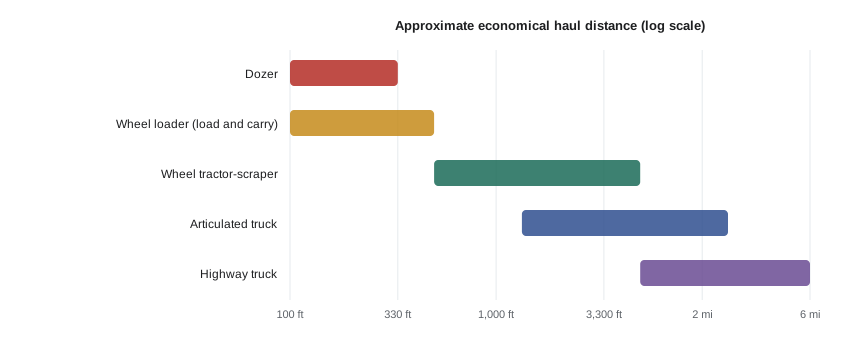
Dozers are efficient only over short distances. A dozer pushing material loses productivity rapidly beyond about 50 to 100 meters, because it must reverse empty and part of the load spills from the blade ends. Dozers are also used to push-load scrapers and to clear land.
Loaders
Wheel loaders scoop material with a front bucket and load it into trucks or move it short distances. They are fast and mobile, and they excel at loading from stockpiles, handling aggregates and working in plants. They cannot dig below their wheels and struggle with hard or undisturbed ground. Track loaders dig better and have better flotation, but they are slower. Compact track loaders and skid steer loaders are small, highly versatile machines used for site cleanup, landscaping, grading and material handling, with dozens of attachments.
Scrapers
Wheel tractor-scrapers load, haul and spread material in one machine. A scraper lowers its bowl and cuts a thin layer of soil as it moves forward, hauls the load at speed, and spreads it in a controlled layer at the fill. Single-engine scrapers usually need a push dozer to load; tandem-powered and push-pull scrapers can load themselves in good conditions; elevating scrapers use a conveyor-like elevator to load without assistance.
Scrapers are the most economical machines for moving large volumes of common earth over haul distances of a few hundred meters to well over a kilometer, on sites with room to maneuver. They are less suited to rock, very wet ground, small sites and areas near structures.
Haul units
Trucks move material over longer distances. Articulated dump trucks, with a pivot between the cab and the dump body and all-wheel drive, handle rough haul roads and soft ground on construction sites, typically carrying 25 to 45 metric tons. Rigid-frame off-highway trucks carry much larger loads on well-built haul roads in mines and quarries. Highway dump trucks and tractor-trailers move material on public roads and are limited by legal axle loads.
Highway trucks are subject to federal and state weight limits, generally 80,000 lb gross on the Interstate system with axle group limits under the federal bridge formula, unless operating under permits. Many northern states impose spring frost laws that reduce allowable weights on local roads during the thaw.
A truck's capacity is stated both by weight (payload) and by volume (struck and heaped body capacity). Which one limits a load depends on the density of the material: a load of light, fluffy topsoil fills the body before reaching the weight limit, while wet clay or rock reaches the weight limit before the body is full.
Worked problem
Volume or weight limit?
An articulated truck has a payload of 62,000 lb and a heaped body capacity of 23 cu yd. It hauls wet clay with a loose unit weight of 2,950 lb per cubic yard. Which limit governs, and what is the actual load?
Show solution
- If filled by volume: 23 × 2,950 = 67,850 lb, more than the 62,000 lb payload.
- So weight governs: maximum volume = 62,000 ÷ 2,950 = 21.0 LCY.
- Load the truck to 21 LCY (62,000 lb), not heaped full.
Answer: Weight governs: about 21.0 LCY per load.
Graders and compactors
Motor graders shape and trim surfaces to close tolerances using a long blade mounted between the front and rear axles. They cut ditches, shape road crowns and cross slopes, spread and trim granular base, and maintain haul roads. GNSS or laser machine control on graders achieves finish grade tolerances of about 10 to 15 millimeters.
Compactors increase the density of soil and granular materials so that fills and subgrades support loads without settling. The right compactor depends on the material.
| Compactor | How it works | Best suited to |
|---|---|---|
| Smooth drum vibratory roller | Static weight plus vibration rearranges particles | Granular soils, sand, gravel, crushed base, asphalt (static or vibratory) |
| Padfoot (sheepsfoot) roller | Pads knead and penetrate cohesive soil from the bottom of the lift up | Clay and silt |
| Pneumatic tired roller | Rubber tires knead and seal the surface | Asphalt, fine-grained soils, sealing lifts |
| Vibratory plate compactor | Small plate vibrates at high frequency | Granular backfill in trenches and around structures |
| Rammer (jumping jack) | Impact blows | Cohesive backfill in confined areas |
Compaction is specified as a percentage of a laboratory maximum density, typically 95 percent of Standard Proctor for general fill and 98 or 100 percent under structures and pavements, at a moisture content near optimum. It is checked with nuclear density gauges or other field tests. Lift thickness matters: most rollers can compact only 150 to 300 millimeters per lift, so placing thick lifts gives a dense surface over loose soil.
Lifting and material handling
Cranes and lifting equipment are covered in more detail in other courses, but they are part of equipment planning on every building project.
- Mobile cranes, including truck-mounted and rough-terrain hydraulic cranes and crawler cranes, lift steel, precast, equipment and formwork. Their capacity depends on boom length, radius and configuration and must be read from the load chart.
- Tower cranes serve high-rise and congested sites for the duration of the structure.
- Telehandlers (telescopic handlers) lift and place materials on scaffolds, roofs and upper floors.
- Forklifts and material hoists move materials around the site and up the building.
- Concrete pumps, boom and line types, place concrete where trucks and buckets cannot reach.
Crane operation is regulated by OSHA 29 CFR 1926 Subpart CC, which requires certified operators, qualified riggers and signal persons, inspections and assessment of ground conditions. ASME B30 standards cover crane design and operation.
Resistance to motion: rolling and grade resistance
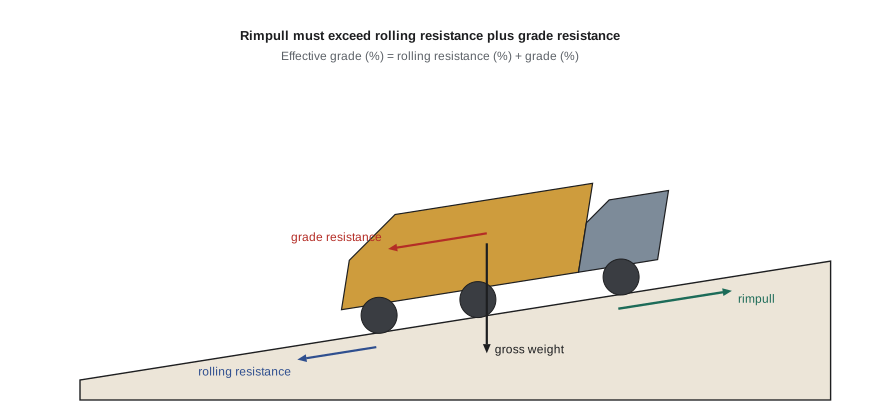
Whether a machine can move a load at a useful speed depends on the forces resisting it. Two resistances act on every wheeled or tracked machine.
- Rolling resistance is the force needed to overcome tire flexing and the sinking of wheels into the haul road surface. It is expressed in kilograms per metric ton of gross weight, or as an equivalent percentage grade. A well-maintained hard haul road might have a rolling resistance of about 2 percent; a rutted, soft road 8 to 10 percent or more. For tracked machines, rolling resistance is largely built into the machine's rated performance.
- Grade resistance is the component of the machine's weight acting down a slope. It equals about 1 percent of gross weight for each 1 percent of grade uphill. Going downhill, grade becomes grade assistance.
Adding them gives the total resistance, often expressed as an effective grade: rolling resistance in percent plus grade in percent. A loaded truck climbing a 5 percent ramp on a road with 4 percent rolling resistance faces the same resistance as climbing a 9 percent ramp on a perfect road.
Worked problem
Total resistance on a haul road
A loaded articulated truck has a gross weight of 110,000 lb. It climbs a 5 percent ramp on a haul road with a rolling resistance of 80 lb per ton (4 percent). What total resistance must it overcome?
Show solution
- Effective grade = 4 + 5 = 9 percent.
- Total resistance = 0.09 × 110,000 = 9,900 lb.
- Reducing rolling resistance to 2 percent by grading and watering the road cuts the effective grade to 7 percent, a 22 percent reduction in resistance.
Answer: About 9,900 lb (an effective grade of 9 percent).
Manufacturers publish rimpull and speed charts showing, for each gear, the maximum pull a machine can deliver at its drive wheels and the corresponding speed. Entering the chart with the gross weight and effective grade gives the maximum speed the truck can sustain on that section of road, which is the key input for cycle time calculations in the next lesson. Downhill, retarder charts give the safe speed under braking.
Traction and ground conditions
A machine can only use as much pull as its drive wheels or tracks can transmit to the ground without slipping. The usable pull is the weight on the driving wheels or tracks multiplied by the coefficient of traction, which depends on the surface. Tracks grip far better than tires on soft or loose ground.
| Surface | Rubber tires | Steel tracks |
|---|---|---|
| Dry concrete | 0.90 | 0.45 |
| Dry clay loam | 0.55 | 0.90 |
| Wet clay loam | 0.45 | 0.70 |
| Loose sand | 0.20 to 0.30 | 0.30 |
| Packed snow | 0.20 | 0.25 |
| Ice | 0.10 | 0.12 |
Worked problem
Traction limit
A wheel tractor has 40,000 lb on its drive wheels. On wet clay loam with a coefficient of traction of 0.45, what is the maximum usable pull? Can it overcome a resistance of 21,000 lb?
Show solution
- Usable pull = 0.45 × 40,000 = 18,000 lb.
- 18,000 is less than 21,000, so the wheels will slip whatever the engine power.
- Options: push-assist with a dozer, improve the surface, reduce the load, or use tracked equipment.
Answer: No: only 18,000 lb can be used, less than the 21,000 lb required.
Ground bearing capacity matters too. Soft ground limits the size of machine that can work without bogging down, and outrigger and track pressures for cranes must be checked against the ground's capacity. Wet weather can turn a productive site into one where only tracked machines can move, so the equipment plan should consider the season and drainage.
Altitude and temperature also affect performance. Naturally aspirated diesel engines lose power at high altitude because of thinner air; turbocharged engines are less affected but still derate above a certain elevation. Cold weather affects starting, hydraulics and tire performance.
Selecting equipment
Equipment selection balances the job requirements against the capabilities and costs of available machines.
- The material: soil type, rock, moisture, and whether it must be ripped, blasted or broken.
- The haul distance and route: short pushes for dozers, middle distances for scrapers, long hauls for trucks.
- The volume and schedule: large volumes justify larger machines and larger fleets.
- The site: space to maneuver, overhead lines, nearby structures, public roads, noise and vibration limits.
- Ground conditions and weather: traction, bearing capacity and the season.
- Precision: finish grading needs graders or dozers with machine control.
- Availability, cost and the contractor's own fleet: what is owned, what can be rented and what operators are available.
Safety around heavy equipment
Struck-by and caught-between incidents involving heavy equipment are among the leading causes of serious injury and death in construction. Machines have large blind spots, and operators may not see a worker standing close behind or beside them. Excavator swing radii, reversing trucks and rollers on slopes are particular hazards.
- Plan traffic routes that separate pedestrians from equipment, and use spotters where separation is not possible.
- Require high-visibility clothing, backup alarms or proximity detection, and cameras on large machines.
- Barricade excavator swing radii and crane counterweight swing areas.
- Use seat belts with rollover protective structures (ROPS); never jump from a tipping machine.
- Call 811 to locate underground utilities before digging, and hand-expose within the tolerance zone defined by state law.
- Keep machines and loads clear of overhead power lines by the minimum approach distances in the regulations.
Common mistakes
MistakeLoading trucks heaped full with heavy material.
InsteadCheck whether weight or volume governs; overloading damages trucks and roads and is illegal on public roads.
MistakeUsing dozers for long pushes.
InsteadDozer productivity drops sharply beyond 50 to 100 meters; use scrapers or trucks for longer hauls.
MistakeIgnoring rolling resistance on haul roads.
InsteadA rutted road can double the effective grade; maintain haul roads with a grader and water truck.
MistakeAssuming more horsepower solves a traction problem.
InsteadUsable pull is limited by traction; use tracks, push assist or a better surface.
MistakeChoosing one compactor for every material.
InsteadUse padfoot rollers on clay, smooth drums on granular material and plates in trenches, in specified lift thicknesses.
MistakeDigging before utilities are located.
InsteadUse the one-call service and hand-expose within the tolerance zone.
Summary and key terms
- Excavators dig and load; dozers push and rip; loaders load from stockpiles; scrapers load, haul and spread; trucks haul long distances.
- Graders trim to close tolerances; compactors must match the material and lift thickness.
- Truck loads are limited by weight or volume, whichever is reached first.
- Effective grade equals rolling resistance plus grade; total resistance is about effective grade times gross weight.
- Usable pull is limited by the coefficient of traction times weight on the drivers.
- Selection balances material, haul distance, volume, site, ground conditions, precision and cost.
- Struck-by hazards, utilities and overhead lines demand planned controls around equipment.
- Hydraulic excavator
- A tracked or wheeled machine with a boom, stick and bucket that digs and loads.
- Dozer
- A tracked tractor with a front blade for pushing material and often a rear ripper.
- Wheel tractor-scraper
- A machine that loads, hauls and spreads soil in one operation.
- Articulated dump truck
- An all-wheel-drive off-road truck with a pivot between cab and body.
- Motor grader
- A machine with a long central blade for fine grading.
- Rolling resistance
- Resistance to motion from tire flexing and penetration into the road surface.
- Grade resistance
- The component of a vehicle's weight acting down a slope.
- Effective grade
- Rolling resistance plus grade, expressed as a percentage.
- Rimpull
- The pull a machine delivers at its drive wheels.
- Coefficient of traction
- The ratio of usable pull to weight on the driving wheels or tracks.
Practice problems
Work each problem on paper first, then reveal the answer to check.
Which machine is best for loading trucks from a deep excavation?
Show answer
A hydraulic excavator.
Which compactor suits a clay embankment?
Show answer
A padfoot (sheepsfoot) roller.
A truck carries 50,000 lb or 20 cu yd heaped. Gravel weighs 2,900 lb per loose cubic yard. Which governs?
Show answer
20 × 2,900 = 58,000 lb > 50,000 lb, so weight governs: 50,000 ÷ 2,900 = 17.2 cu yd.
A truck climbs a 3 percent grade on a road with 5 percent rolling resistance. What is the effective grade?
Show answer
8 percent.
The same truck returns empty down the 3 percent grade. What is the effective grade?
Show answer
5 − 3 = 2 percent.
An 80,000 lb loaded truck faces an effective grade of 7 percent. What is the resistance?
Show answer
0.07 × 80,000 = 5,600 lb.
A crawler weighing 44,000 lb works on dry clay loam (coefficient 0.90). What is its usable pull?
Show answer
39,600 lb.
Name three controls for struck-by hazards around equipment.
Show answer
Separated traffic routes, spotters, high-visibility clothing, backup alarms or cameras, barricaded swing radii.
Lesson quiz · 5 questions
Score 60% or more to complete this lesson.
Create a free account to save your progress, take quizzes and earn a certificate.