
CON-130 · Lesson 2 of 12 · 36 min
Ratios, proportions, percentages and markups
Much of construction arithmetic is comparison. A mortar is mixed one part cement to three parts sand; a crew of four takes nine days, so how long would six take; a supplier offers 8 % off; the estimator adds 10 % for waste and 12 % for overhead and profit. Ratios, proportions and percentages are the tools for these comparisons, and they appear in mix designs, scales, schedules, estimates, progress billing and change orders. They are simple in principle, but percentages in particular are easy to misuse: a 10 % waste allowance applied the wrong way, or a markup confused with a margin, can quietly move thousands of dollars.
This lesson works through ratios and proportions, direct and inverse relationships, percentages and percent change, waste factors, markups and margins, discounts and the percent-complete calculations used for progress billing.
Ratios
A ratio compares two or more quantities of the same kind. It can be written with a colon (1:3), as a fraction (1/3) or in words (one to three). A ratio has no units when both parts share the same unit, which is why it can be applied to any batch size. Ratios in construction include:
- Mix proportions, such as a mortar of 1 part cement, 1 part lime and 6 parts sand by volume.
- Slopes, such as a ramp of 1:12, meaning 1 unit of rise for every 12 units of horizontal run (Lesson 6).
- Drawing scales, such as 1:100, meaning 1 unit on the drawing represents 100 units in reality.
- Water–cement ratio, the mass of water divided by the mass of cement in a concrete mix, a key control on strength and durability.
A ratio with more than two parts, such as 1:2:3, is shared out by adding the parts to find the total number of parts, then dividing the total quantity by that number. Each part is then multiplied by its share. This is the same arithmetic whether the batch is a bucket or a truckload.
Worked problem
Sharing a batch by a ratio
A mason mixes Type N mortar in the proportion 1 part portland cement, 1 part hydrated lime and 6 parts sand by volume. The mixer holds 0.24 m³ (about 8.5 ft³) of dry material. How much of each ingredient goes into one batch?
Show solution
- Total parts = 1 + 1 + 6 = 8.
- Volume of one part = 0.24 ÷ 8 = 0.03 m³.
- Cement = 1 × 0.03 = 0.03 m³; lime = 0.03 m³; sand = 6 × 0.03 = 0.18 m³.
- Check: 0.03 + 0.03 + 0.18 = 0.24 m³. In imperial terms, one part is 8.5 ÷ 8 ≈ 1.06 ft³, so cement and lime are about 1 ft³ each and sand about 6.4 ft³.
Answer: One batch takes 0.03 m³ of cement, 0.03 m³ of lime and 0.18 m³ of sand (about 1, 1 and 6.4 ft³).
Mortar proportions for real projects come from the project specification and the governing standard, which also allow mortar to be specified by its properties rather than its proportions. Proportions by volume are only valid if the materials are measured consistently, for example in calibrated boxes rather than shovels, and if the sand moisture is reasonably constant, because damp sand bulks and takes up more volume.
Proportions
A proportion is a statement that two ratios are equal. If a quantity grows in step with another, the two are in direct proportion: double one and the other doubles. Material quantities are usually directly proportional to area or volume, and cost is often directly proportional to quantity. A proportion can be solved by cross-multiplying.
For example, if 2.5 L of primer covers 30 m², then the primer needed for 84 m² satisfies 2.5/30 = x/84, so x = 2.5 × 84 ÷ 30 = 7.0 L. The same method converts a quantity measured on one floor to a similar floor, scales a crew output to a longer day, or estimates an expected quantity from a known sample.
Two quantities are in inverse proportion when one goes up as the other goes down, so that their product stays constant. The classic case is crew size and duration: if the total work is fixed, more workers means fewer days. In symbols, workers × days = constant, measured in worker-days.
Worked problem
Crew size and duration
Four drywall installers can board a floor in 9 working days. (a) How long would six installers take, assuming equal productivity? (b) The superintendent needs the floor done in 5 days. How many installers are needed? (c) Why might the real answers differ?
Show solution
- Total work = 4 × 9 = 36 worker-days.
- With six installers: 36 ÷ 6 = 6 days.
- For 5 days: 36 ÷ 5 = 7.2 installers, so 8 are needed (round workers up).
- In reality, adding people to a fixed area causes congestion, waiting for material and supervision overhead, so productivity per worker usually falls. The calculation gives a lower limit on time, not a guarantee.
Answer: Six installers take about 6 days; finishing in 5 days needs 8 installers; actual results depend on space, supply and coordination.
Percentages
A percentage is a ratio with a denominator of 100. It is written with the % sign: 12 % means 12 per 100, or 0.12 as a decimal. Converting between percentages and decimals is the source of many errors, so it is worth writing every percentage as a decimal before multiplying. The three basic percentage questions are:
- Finding a percentage of a quantity: 12 % of $45,000 = 0.12 × 45,000 = $5,400.
- Finding what percentage one quantity is of another: 5,400 is what percent of 45,000? 5,400 ÷ 45,000 = 0.12 = 12 %.
- Finding the whole from a part: 5,400 is 12 % of what? 5,400 ÷ 0.12 = 45,000.
Percent change compares a new value with an original one. The change is divided by the original, not the new value. If a unit price rises from $180 to $198, the change is $18 and the increase is 18 ÷ 180 = 10 %. If it then falls back from $198 to $180, the decrease is 18 ÷ 198 = 9.1 %, not 10 %, because the base is now larger.
Percentage points are different from percentages. If an interest rate rises from 5 % to 6 %, it has risen by one percentage point, which is a 20 % increase in the rate. Being clear about the difference avoids misunderstandings in contract and finance discussions.
Waste factors
Real material quantities exceed the net quantities measured from drawings. Concrete is lost in pumps and over-excavated subgrade; lumber is cut and some is defective; tile, flooring and drywall are cut around openings and edges. Estimators therefore apply a waste factor. There are two ways to apply it, and they give different answers.
- Waste as a percentage of the net quantity: Order = Net × (1 + w). A 10 % allowance on 200 m² gives 220 m².
- Waste as a percentage of the ordered quantity, also called yield: Order = Net ÷ (1 − w). If 10 % of what is bought is wasted, 200 m² of finished work needs 200 ÷ 0.9 = 222.2 m² bought.
For small percentages the difference is modest, but it grows quickly at higher rates: at 25 % the two methods give 1.25 and 1.33 times the net quantity. Company practice and the source of the waste figure decide which applies. A waste factor taken from records of materials bought versus materials installed is a yield figure; a factor described as 'add 10 %' is a percentage of the net quantity.
| Material | Typical waste allowance | Main causes |
|---|---|---|
| Ready-mix concrete, slabs on grade | 3 to 8 % | Uneven subgrade, pump and chute losses, spillage |
| Framing lumber | 5 to 15 % | Cutting, defects, design complexity |
| Drywall | 8 to 15 % | Openings, ceilings, cut-offs that cannot be reused |
| Ceramic tile | 10 to 15 % (more for diagonal layouts) | Cuts at edges, breakage, attic stock |
| Brick and block | 3 to 10 % | Breakage, cuts at openings and corners |
| Roofing shingles | 10 to 15 % | Hips, valleys, starter courses |
Worked problem
Applying a waste factor to a concrete order
The slab in Lesson 1 needs 17.66 yd³ net. The superintendent allows 5 % for waste because the subgrade is uneven. How much should be ordered in 1/4 yd³ increments?
Show solution
- Order = 17.66 × 1.05 = 18.54 yd³.
- Round up to the next 1/4 yd³: 18.75 yd³.
- The allowance adds about 0.9 yd³; at a delivered price of about $190/yd³ that is roughly $170, much cheaper than a short load.
Answer: Order 18.75 yd³.
Worked problem
Waste versus yield
A floor needs 186 m² (2,002 ft²) of tile net. Company records show that 12 % of tile purchased is cut off or broken. How much tile should be bought, and how much would the 'add 12 %' method give?
Show solution
- The records describe waste as a share of tile purchased, so this is a yield figure: bought = 186 ÷ (1 − 0.12) = 186 ÷ 0.88 = 211.4 m².
- The add-on method would give 186 × 1.12 = 208.3 m², about 3 m² short of the expected need.
- In imperial units: 2,002 ÷ 0.88 = 2,275 ft², versus 2,002 × 1.12 = 2,242 ft².
- Tile is bought by the box, so the final order is rounded up to whole boxes (Lesson 9).
Answer: Buy about 211 m² (2,275 ft²); the add-on method underestimates by about 1.5 %.
Markup and margin
Contractors add overhead and profit to the direct cost of work to arrive at a selling price. There are two ways to express that addition, and confusing them is one of the most common financial errors in construction.
- Markup is the addition expressed as a percentage of cost: Price = Cost × (1 + markup).
- Margin, also called gross margin, is the addition expressed as a percentage of the selling price: Margin = (Price − Cost) ÷ Price.
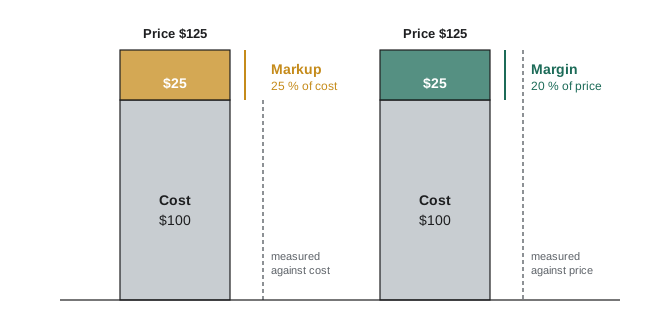
A 20 % markup does not produce a 20 % margin. On a $100 cost, a 20 % markup gives a $120 price; the $20 addition is 20 ÷ 120 = 16.7 % of the price. To achieve a target margin, divide the cost by one minus the margin: Price = Cost ÷ (1 − margin). A 20 % margin on $100 needs a $125 price, which is a 25 % markup.
| Markup on cost | Equivalent margin on price |
|---|---|
| 5 % | 4.8 % |
| 10 % | 9.1 % |
| 15 % | 13.0 % |
| 20 % | 16.7 % |
| 25 % | 20.0 % |
| 33.3 % | 25.0 % |
| 50 % | 33.3 % |
Worked problem
Pricing with markup and margin
A subcontractor's estimate shows direct costs of $84,000. (a) What is the price with a 15 % markup, and what margin does that give? (b) Company policy requires a 15 % margin. What price is needed? (c) What is the difference?
Show solution
- (a) Price = 84,000 × 1.15 = $96,600. The addition is $12,600, so the margin is 12,600 ÷ 96,600 = 13.0 %.
- (b) Price = 84,000 ÷ (1 − 0.15) = 84,000 ÷ 0.85 = $98,823.53. Check: 98,823.53 − 84,000 = 14,823.53, and 14,823.53 ÷ 98,823.53 = 15.0 %.
- (c) The difference is $2,223.53. An estimator who applied 15 % as a markup when the policy meant 15 % margin would leave that amount on the table on every job of this size.
Answer: Markup gives $96,600 (13.0 % margin); a 15 % margin needs $98,823.53.
Overhead and profit are often applied in layers. A general contractor may add a percentage for site overhead, another for head-office overhead and another for profit, and contracts often fix the percentage a contractor may add to change orders. Read the contract carefully: some apply each percentage to the original cost, others compound them, applying profit to cost plus overhead.
Discounts and successive percentages
Successive percentage changes multiply rather than add. A supplier offering a trade discount of 10 % followed by a further 5 % for prompt payment gives a total discount of 1 − (0.90 × 0.95) = 14.5 %, not 15 %. Escalation works the same way: prices that rise 4 % one year and 6 % the next have risen by 1.04 × 1.06 − 1 = 10.24 % over two years.
The same rule warns against undoing a percentage by applying the same percentage in reverse. A price raised by 10 % and then reduced by 10 % ends at 99 % of the original. To remove a percentage that was added, divide by the factor: a price of $1,130 that includes 13 % tax had a pre-tax value of 1,130 ÷ 1.13 = $1,000, not 1,130 × 0.87 = $983.10.
Worked problem
Successive discounts and removing a percentage
A rebar supplier lists material at $1,860 per metric ton. The contractor receives a 7 % volume discount and a further 2 % for payment within 10 days. (a) What is the net price per metric ton? (b) A later invoice shows $2,101.80 including 13 % sales tax. What was the price before tax?
Show solution
- (a) Net price = 1,860 × 0.93 × 0.98 = $1,695.20 per metric ton. The total discount is 1 − 0.93 × 0.98 = 8.86 %, not 9 %.
- (b) Pre-tax price = 2,101.80 ÷ 1.13 = $1,860.00. Multiplying by 0.87 instead would wrongly give $1,828.57.
Answer: Net price $1,695.20 per metric ton; the pre-tax invoice amount is $1,860.00.
Percent complete and progress billing
Most construction contracts are paid monthly according to the percentage of work completed. Each item in the schedule of values, the breakdown of the contract price agreed at the start, is assessed for its percentage complete, and the earned value is the sum of item values times their percentages. The overall percent complete is the earned value divided by the contract sum, which is a weighted average rather than a simple average of the item percentages.
| Item | Scheduled value | Percent complete | Earned to date |
|---|---|---|---|
| Excavation and backfill | $60,000 | 100 % | $60,000 |
| Concrete foundations | $140,000 | 80 % | $112,000 |
| Structural steel | $220,000 | 25 % | $55,000 |
| Roofing | $80,000 | 0 % | $0 |
| Total | $500,000 | 45.4 % | $227,000 |
The amount actually paid each month is the earned value less previous payments and less a percentage held back as security until the work is complete. That holdback or retainage, and the rules on prompt payment that govern when money must flow, are covered in Lesson 11.
Common mistakes
MistakeConfusing markup with margin.
InsteadMarkup is on cost; margin is on price. Price = cost ÷ (1 − margin) for a target margin.
MistakeApplying a yield-based waste figure as an add-on.
InsteadCheck how the waste figure was measured; divide by (1 − w) when waste is a share of purchases.
MistakeAdding successive percentages.
InsteadMultiply the factors: 10 % then 5 % off is 0.90 × 0.95 = 0.855, a 14.5 % discount.
MistakeRemoving a percentage by subtracting it.
InsteadDivide by the factor: a price including 13 % tax is divided by 1.13.
MistakeAveraging item percentages to find overall progress.
InsteadWeight each item by its value; overall percent complete = earned value ÷ contract sum.
Summary and key terms
- Ratios compare quantities of the same kind and can be shared out by adding the parts.
- Direct proportions scale together; inverse proportions, such as crew size and time, keep a constant product.
- Percent change is measured against the original value.
- Waste can be added to the net quantity or treated as yield; the methods differ at higher rates.
- Markup is a percentage of cost; margin is a percentage of price.
- Successive percentages multiply; a percentage is removed by dividing by its factor.
- Overall percent complete is a value-weighted average of item progress.
- Ratio
- Comparison of quantities of the same kind.
- Proportion
- Statement that two ratios are equal.
- Inverse proportion
- Relationship where the product of two quantities is constant.
- Worker-day
- One worker working for one day.
- Waste factor
- Allowance for material lost or cut.
- Yield
- Share of purchased material that ends up in place.
- Markup
- Addition to cost expressed as a percentage of cost.
- Margin
- Profit and overhead expressed as a percentage of price.
- Schedule of values
- Breakdown of the contract sum by work item.
- Earned value
- Value of work completed to date.
Practice problems
Work each problem on paper first, then reveal the answer to check.
Share 2.4 m³ of dry material in the ratio 1:2:3.
Show answer
6 parts; 0.4, 0.8 and 1.2 m³.
If 3 L of sealer covers 40 m², how much is needed for 130 m²?
Show answer
3 × 130 ÷ 40 = 9.75 L.
A crew of 5 takes 12 days. How long would 8 take at equal productivity?
Show answer
60 ÷ 8 = 7.5 days.
A price rose from $72 to $81. What is the percent increase?
Show answer
9 ÷ 72 = 12.5 %.
Net quantity 480 ft² with a 15 % add-on waste factor. Order?
Show answer
552 ft².
Net quantity 480 ft² with 15 % of purchases wasted. Order?
Show answer
480 ÷ 0.85 = 564.7 ft².
What margin does a 30 % markup give?
Show answer
0.30 ÷ 1.30 = 23.1 %.
What price gives a 12 % margin on a cost of $250,000?
Show answer
250,000 ÷ 0.88 = $284,090.91.
What is the total of successive discounts of 6 % and 3 %?
Show answer
1 − 0.94 × 0.97 = 8.82 %.
A total of $3,390 includes 13 % sales tax. What is the pre-tax amount?
Show answer
3,390 ÷ 1.13 = $3,000.
Lesson quiz · 5 questions
Score 60% or more to complete this lesson.
Create a free account to save your progress, take quizzes and earn a certificate.