
CMPUT-401 · Lesson 8 of 12 · 31 min
Quality strategy and release readiness
Quality is a product decision, not only an engineering one. How good must the Driftwood app be? A schedule page that shows the wrong sailing can strand someone on an island overnight; a misaligned logo on an old tablet harms nobody. A product team cannot test everything equally, so it needs a quality strategy: an agreed view of which qualities matter most, where the risks are, how much testing each area deserves, how bugs are triaged and when a release is good enough to ship. CMPUT-301 covered testing techniques such as unit, integration and system testing, test design and continuous integration. This lesson takes the product manager's view: deciding where quality effort goes and making the release decision.
What quality means for a product
The international standard ISO/IEC 25010 describes product quality through characteristics such as functional suitability, performance efficiency, compatibility, interaction capability (usability), reliability, security, maintainability, portability and, since the 2023 revision, safety. For a given product, a few of these dominate. For Driftwood, functional correctness of schedule data and reliability during morning peaks dominate; accessibility matters because many travelers are older or have disabilities and because public-facing services face legal accessibility duties; security matters once personal phone numbers are stored for SMS alerts. Naming the top qualities with the client early lets the team spend effort on the right things.
Risk-based testing
Risk-based testing allocates test effort in proportion to risk, usually estimated as likelihood of failure times impact of failure. Likelihood rises with complexity, novelty, change frequency and dependence on external systems; impact rises with how many users are affected and how badly. Driftwood's schedule import, which reads timetable files from the client's office system, is both complex and high impact, so it deserves the most attention. Dark mode is neither. The code below divides a 60-hour test budget across areas in proportion to their risk scores.
# Risk-based test planning: spend test effort where likelihood x impact is highest.
areas = {
    # area:                      (likelihood 1-5, impact 1-5)
    "Schedule data import":       (4, 5),
    "Delay banner":               (3, 5),
    "Capacity alert SMS":         (4, 4),
    "Deckhand count entry":       (3, 4),
    "First-visit guide page":     (2, 2),
    "Dark mode":                  (2, 1),
}
budget_hours = 60
scores = {a: l * i for a, (l, i) in areas.items()}
total = sum(scores.values())
print(f"{'area':26s}{'risk':>5s}{'hours':>7s}")
for a, s in sorted(scores.items(), key=lambda kv: -kv[1]):
print(f"{a:26s}{s:5d}{budget_hours * s / total:7.1f}")area risk hours Schedule data import 20 17.4 Capacity alert SMS 16 13.9 Delay banner 15 13.0 Deckhand count entry 12 10.4 First-visit guide page 4 3.5 Dark mode 2 1.7
Risk ratings should be agreed with the client, who knows impact better than the team: the owner pointed out that the delay banner is high impact because storms cause sudden cancellations and people rely on the app to decide whether to drive. The resulting plan also decides which test types to use. High-risk areas get automated checks in the pipeline, exploratory sessions before each release and monitoring in production; low-risk areas may get a quick check only. Proportion, not perfection, is the goal.
Exploratory testing
Scripted tests check what the team already knows to check. Exploratory testing, described by Cem Kaner, James Bach and Elisabeth Hendrickson, is simultaneous learning, test design and test execution: a skilled tester investigates the product, guided by a mission, using results to decide what to try next. It finds the bugs nobody thought to write a test for. Session-based test management, developed by Jonathan and James Bach, makes exploratory testing manageable: work happens in time-boxed sessions, typically 60 to 90 minutes, each guided by a charter and ending with a short debrief.
Elisabeth Hendrickson's book Explore It! gives a simple charter template: Explore [target] with [resources] to discover [information]. Good charters are focused enough to guide the session but open enough to allow discovery. They are typically derived from the risk list, from recent changes, and from what users and support staff report.
A session report records the charter, the tester, the time spent, what was tested, bugs found, questions raised and how much time went to setup versus testing. Over several sessions, these reports show coverage of risky areas and help the PM see where quality is uncertain.
Triage: severity and priority
Every bug report needs a triage decision. Two separate scales are used. Severity describes technical impact: critical (crash, data loss, security breach or no workaround for a core function), major (a core function is wrong or badly impaired), minor (a non-core problem or one with an easy workaround) and trivial (cosmetic). Priority describes business urgency: how soon it must be fixed, often P1 (fix now or block the release) to P4 (fix when convenient). The two are related but not the same, and the difference matters.
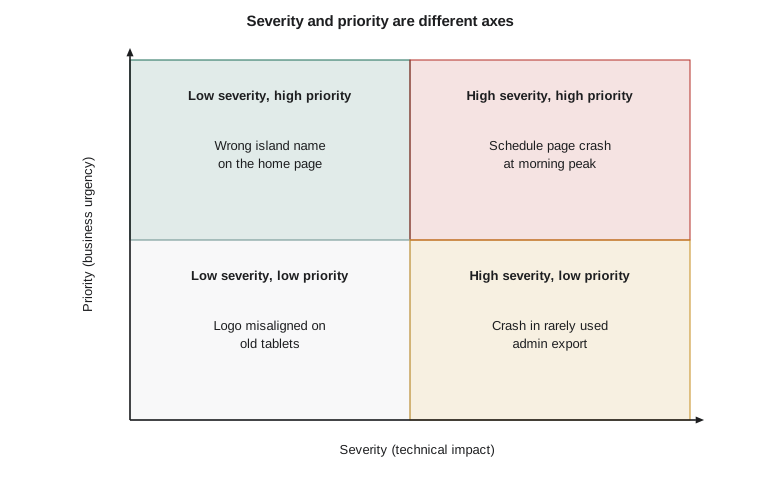
A crash in a rarely used admin export is high severity but may be low priority. A misspelled island name on the home page is trivial in severity but high priority because it embarrasses the client and confuses tourists. A screen reader skipping the delay banner might be rated major in severity but affects few users; it should still be high priority because it excludes a group from critical safety information and may breach accessibility obligations. The code encodes one team's triage rule; real triage combines a rule like this with discussion.
# Severity x priority triage: severity is technical impact, priority is business urgency.
SEV = {"critical": 4, "major": 3, "minor": 2, "trivial": 1}
def priority(sev, users_affected_share, workaround, near_release):
    score = SEV[sev] + (2 if users_affected_share > 0.25 else 0) - (1 if workaround else 0)
    if near_release:
        score += 1
    return "P1" if score >= 6 else "P2" if score >= 4 else "P3" if score >= 2 else "P4"
bugs = [
    ("Schedule shows yesterday's sailings after midnight", "major", 0.60, False, True),
    ("Crash when SMS number has spaces",                    "critical", 0.05, True, True),
    ("Logo misaligned on old tablets",                      "trivial", 0.02, True, False),
    ("Screen reader skips delay banner",                    "major", 0.03, False, True),
    ("Wrong French accent in island name",                  "minor", 0.30, True, False),
]
for title, sev, share, wk, near in bugs:
print(f"{priority(sev, share, wk, near)} {sev:8s} {title}")P1 major Schedule shows yesterday's sailings after midnight P2 critical Crash when SMS number has spaces P4 trivial Logo misaligned on old tablets P2 major Screen reader skips delay banner P3 minor Wrong French accent in island name
The rule assigns the screen reader bug only P2 because few users are affected. This is exactly where a rule needs human override: Team Lumen's triage meeting raised it to P1 because of its accessibility impact. Encoding a rule is useful for consistency, but the triage meeting, a short regular session where the PM, a developer and a tester review new bugs, exists for these judgment calls. Triage outcomes are fix now, fix in this release, schedule for later, or will not fix with a recorded reason.
Measuring quality
Quality metrics help the team see trends. Defect escape rate (also called defect leakage) is the share of defects found by users after release, out of all defects found for that release; a falling rate means testing is catching more before release. Other useful measures include the number of open bugs by severity, mean time to fix critical bugs, crash-free session rate, and accessibility issues found per release. DORA metrics, covered in CMPUT-301, include change failure rate, which complements the escape rate from a delivery perspective.
# Defect escape rate per release: bugs found by users / all bugs found for that release.
releases = [
    # release, found before release (testing), found after release (users)
    ("0.1 pilot",   18, 9),
    ("0.2",         25, 7),
    ("0.3",         31, 5),
    ("1.0 summer",  40, 4),
]
for name, before, after in releases:
    rate = after / (before + after)
    bar = "#" * round(rate * 50)
print(f"{name:11s} escape rate {rate:5.1%} {bar}")0.1 pilot escape rate 33.3% ################# 0.2 escape rate 21.9% ########### 0.3 escape rate 13.9% ####### 1.0 summer escape rate 9.1% #####
Metrics can be gamed. If testers are rewarded for bugs found, they file trivial duplicates; if developers are rewarded for low bug counts, bugs get relabeled as features or reported informally. Use quality metrics to learn and improve, not to rank people. And interpret escape rate together with usage: a release that few people use will have few escaped defects simply because nobody found them.
User acceptance testing and beta programs
In client work, user acceptance testing (UAT) is the client's confirmation that the release meets agreed acceptance criteria. Good UAT is planned: the PM prepares scenarios based on real tasks, the client's staff run them in a staging environment, and results are recorded with sign-off. For Driftwood, the office manager and two deckhands ran UAT on the delay banner and count entry screen. UAT is not the place to find most bugs, since those should be found earlier, but it confirms fitness for purpose and is often a contractual milestone (lesson 11).
A beta program releases to a group of real users who agree to try early versions and give feedback. Driftwood recruited forty regular commuters as beta testers through the island community association. Beta users find problems that no test environment reproduces, such as rural network dead zones on the drive to the terminal, and they become advocates at launch. Clear expectations, an easy feedback channel and visible responses keep beta testers engaged.
The release readiness decision
Before a release, the team asks: is this good enough to ship? A release readiness checklist makes the decision explicit. Some criteria are hard gates that must pass, such as no open P1 bugs, definition of done met, accessibility checks on changed screens, a tested rollback plan and client sign-off. Others are softer and weighed together. The PM chairs the go or no-go meeting, but the decision should be traceable to evidence. The code below implements a simple version.
# A release readiness check: hard gates must all pass; soft criteria are scored.
gates = {
    "No open P1 bugs": True,
    "Definition of done met for all items": True,
    "Accessibility check (WCAG 2.2 AA) on changed screens": True,
    "Rollback plan tested": False,
    "Client sign-off on acceptance tests": True,
}
soft = {  # criterion: (met, weight)
    "Release notes drafted": (True, 2),
    "Staff briefing held": (True, 3),
    "Monitoring dashboards updated": (False, 3),
    "Support FAQ updated": (True, 1),
    "Open P2 bugs under 5": (True, 2),
}
failed = [g for g, ok in gates.items() if not ok]
score = sum(w for ok, w in soft.values() if ok) / sum(w for _, w in soft.values())
print("hard gates:", "all pass" if not failed else "FAIL -> " + "; ".join(failed))
print(f"soft criteria: {score:.0%} of weighted items met")
print("decision:", "GO" if not failed and score >= 0.8 else "NO-GO")hard gates: FAIL -> Rollback plan tested soft criteria: 73% of weighted items met decision: NO-GO
Here the release is a no-go because the rollback plan has not been tested, even though most other criteria are met. That is the right call: an untested rollback plan is a plan that may not work when it is needed most. The team tests the rollback that afternoon and holds the go decision the next morning. Release readiness is also where the staged rollout plan from lesson 7 is confirmed, so the decision is go to 5 percent, not go to everyone.
Worked examples
Worked problem
Allocating test effort
Using the risk code output, how many hours should the capacity alert SMS get, and why?
Show solution
- Its risk score is 4 times 4 = 16.
- The total of all scores is 20 + 15 + 16 + 12 + 4 + 2 = 69.
- Hours = 60 times 16 / 69, about 13.9.
Answer: About 14 hours, the second-largest share, because failures are fairly likely and affect many commuters.
Worked problem
Writing a charter
Write an exploratory charter for the new first-visit guide.
Show solution
- Target: the first-visit guide page.
- Resources: a phone with French language settings, a tourist persona with no prior knowledge.
- Information: whether a new visitor can learn payment rules, lineup procedure and timing.
Answer: Explore the first-visit guide with a new-visitor persona and French language settings to discover gaps or confusing instructions.
Worked problem
Computing escape rate
Release 0.2 had 25 bugs found in testing and 7 found by users. Compute the escape rate.
Show solution
- Total defects = 25 + 7 = 32.
- Escape rate = 7 / 32 = 0.219.
Answer: About 21.9 percent, matching the code output.
Common mistakes
MistakeTest every feature equally thoroughly.
InsteadAllocate effort by risk: likelihood of failure times impact.
MistakeSeverity and priority are the same thing.
InsteadSeverity is technical impact; priority is business urgency, and they can differ.
MistakeExploratory testing is unplanned clicking around.
InsteadIt is structured by charters, time-boxed sessions and debriefs.
MistakeA triage rule can replace the triage meeting.
InsteadRules provide consistency; people must override them for cases like accessibility.
MistakeIf most checklist items pass, ship.
InsteadHard gates such as a tested rollback plan must all pass.
Summary and key terms
- A quality strategy names the qualities that matter most and allocates effort by risk.
- ISO/IEC 25010 provides a vocabulary of quality characteristics.
- Exploratory testing uses charters and time-boxed sessions to find unexpected bugs.
- Severity is technical impact; priority is business urgency.
- Defect escape rate tracks how many bugs reach users.
- UAT confirms fitness for purpose with the client; beta programs add real-world feedback.
- Release readiness combines hard gates with weighted soft criteria.
- Quality strategy
- An agreed plan for which qualities matter and how quality effort is spent.
- ISO/IEC 25010
- The international standard model of software product quality characteristics.
- Risk-based testing
- Allocating test effort by likelihood times impact of failure.
- Exploratory testing
- Simultaneous learning, test design and execution guided by a mission.
- Test charter
- A mission statement for an exploratory session: explore a target with resources to discover information.
- Severity
- The technical impact of a defect.
- Priority
- The business urgency of fixing a defect.
- Defect escape rate
- The share of a release's defects found by users after release.
- User acceptance testing
- Client or user confirmation that a release meets agreed criteria.
- Release readiness checklist
- Criteria, including hard gates, for deciding whether to release.
Practice problems
Work each problem on paper first, then reveal the answer to check.
Name two ISO/IEC 25010 characteristics that dominate for Driftwood.
Show answer
Functional suitability of schedule data and reliability at peak times.
What risk score did the schedule data import get in the code?
Show answer
20 (likelihood 4 times impact 5).
Write the charter template from Explore It!
Show answer
Explore [target] with [resources] to discover [information].
How long is a typical exploratory session?
Show answer
About 60 to 90 minutes.
Give an example of low severity but high priority.
Show answer
A misspelled island name on the home page.
Why did the team raise the screen reader bug to P1?
Show answer
It excludes users from critical safety information and may breach accessibility obligations.
What happened to escape rate across the four releases?
Show answer
It fell from about 33 percent to about 9 percent.
Why can escape rate be misleading for a little-used release?
Show answer
Few users means few defects found, not necessarily few defects.
Who runs UAT in a client project?
Show answer
The client's staff, using scenarios prepared with the PM.
Why was the release a no-go in the readiness code?
Show answer
The hard gate "Rollback plan tested" failed.
Lesson quiz · 5 questions
Score 60% or more to complete this lesson.
Create a free account to save your progress, take quizzes and earn a certificate.