
CIV-380 · Lesson 9 of 12 · 20 min
Activated sludge
In 1914, Edward Ardern and William Lockett in Manchester aerated sewage, let it settle, kept the settled sludge and added fresh sewage to it, and found that the sludge, now 'activated', treated each new batch faster than the last. Over a century later the activated sludge process, in many variations, treats most of the municipal wastewater in Canada and the United States. Its essence is unchanged: a suspended culture of microorganisms consumes organic matter in an aerated tank, a clarifier separates the organisms from the treated water, and most of them are returned to keep the culture concentrated. This lesson develops the kinetic and mass balance model of the process and applies it to the city plant's existing aeration tanks.
The process and its microorganisms
The mixed liquor in an aeration tank is a suspension of bacteria, protozoa and inert particles, gathered into flocs 50 to 200 µm across held together by extracellular polymers. Heterotrophic bacteria use organic carbon as their source of energy and carbon, and oxygen as the electron acceptor; autotrophic nitrifying bacteria, considered in lesson 10, oxidize ammonia. Protozoa graze on free bacteria and help produce a clear effluent. The concentration of mixed liquor suspended solids (MLSS) is typically 2,000 to 4,000 mg/L, of which about 70 to 80 % is volatile (MLVSS).
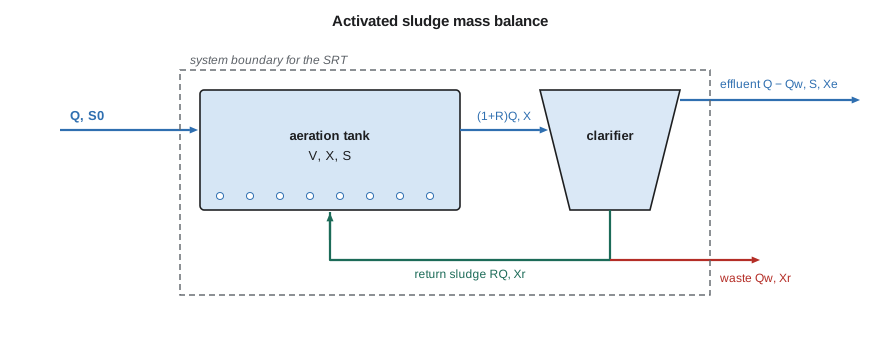
Two times characterize the process. The hydraulic retention time \(\tau = V/Q\), typically 4 to 8 hours for conventional plants, is how long the water stays. The solids retention time (SRT, or sludge age) is how long the organisms stay, and is the mass of solids in the system divided by the mass wasted each day:
Because the clarifier and the return line keep the organisms in the system, the SRT is many times the HRT, typically 3 to 15 days. The SRT is the operator's main control: it determines which organisms can grow, how completely the waste is treated and how much sludge is produced.
Growth kinetics
The specific growth rate of the bacteria depends on the concentration of the limiting substrate according to the Monod equation, and the organisms also decay at a rate \(k_d\) through endogenous respiration, death and predation:
where \(k = \mu_{max}/Y\) is the maximum substrate use rate, \(K_s\) the half-saturation constant and \(Y\) the yield, the mass of cells produced per mass of substrate consumed. At steady state in a completely mixed system, a biomass balance shows that the net specific growth rate equals the reciprocal of the SRT, which gives the effluent substrate concentration and the biomass in the tank:
The first result is striking: the effluent soluble substrate depends only on the SRT and the kinetic constants, not on the influent concentration or the tank volume. The tank volume follows from the second equation once a design MLVSS is chosen. Below a minimum SRT, the organisms are washed out faster than they grow and the process fails.
Kinetic coefficients vary with the wastewater and the organisms. Typical values for heterotrophs on municipal wastewater, on a BOD₅ basis at 20 °C, are \(k\) = 2 to 10 d⁻¹ (often 5), \(K_s\) = 25 to 100 mg/L, \(Y\) = 0.4 to 0.8 g VSS/g BOD₅ (often 0.6) and \(k_d\) = 0.025 to 0.075 d⁻¹. Rates fall with temperature, corrected with \(k_T = k_{20}\theta^{T-20}\), where \(\theta\) is about 1.07 for growth and 1.04 for decay. Modern design uses COD-based models such as the IWA Activated Sludge Models, with many more components, but the simple model shows the essential relationships.
Applying the model to the city plant
The city plant's aeration tanks total about 2.4 million gallons. The winter mixed liquor temperature is 12 °C (54 °F), the primary effluent BOD₅ is 150 mg/L, and the plant runs at an MLVSS of about 2,500 mg/L. The script computes the effluent soluble BOD₅, tank volume, HRT, food-to-microorganism ratio, sludge production and oxygen demand for several SRTs.
# Activated sludge design by solids retention time (complete-mix model)
UNITS = "US"
SI = UNITS == "SI"
Q = 30000.0                                    # m3/d
S0 = 150.0                                     # primary effluent soluble + particulate BOD5 treated, mg/L
T = 12.0                                       # winter temperature, C
# typical kinetic coefficients for heterotrophs at 20 C (BOD basis), corrected with theta
k20, Ks, Y, kd20 = 5.0, 60.0, 0.6, 0.06        # 1/d, mg/L, g VSS/g BOD, 1/d
k = k20 * 1.07 ** (T - 20); kd = kd20 * 1.04 ** (T - 20)
MLVSS = 2500.0                                 # mg/L design mixed liquor volatile solids
print(f"at {T:.0f} C: k = {k:.2f} 1/d, kd = {kd:.3f} 1/d")
for SRT in (3, 5, 8, 12):
    S = Ks * (1 + kd * SRT) / (SRT * (Y * k - kd) - 1)
    XV = Y * Q * (S0 - S) * SRT / (1 + kd * SRT)   # g VSS in the tank
    V = XV / MLVSS
    HRT = V / Q * 24
    Px = XV / SRT / 1000                         # kg VSS/d wasted
    FM = Q * S0 / (V * MLVSS)
    O2 = (Q * (S0 - S) / 0.68 - 1.42 * Px * 1000) / 1000   # kg O2/d for carbon removal (BODu = BOD5/0.68)
    if SI:
        print(f"SRT {SRT:2d} d: S = {S:4.1f} mg/L  V = {V:7,.0f} m3  HRT = {HRT:4.1f} h  F/M = {FM:.2f}  Px = {Px:5,.0f} kg/d  O2 = {O2:6,.0f} kg/d")
    else:
        print(f"SRT {SRT:2d} d: S = {S:4.1f} mg/L  V = {V*264.17/1e6:5.2f} MG  HRT = {HRT:4.1f} h  F/M = {FM:.2f}  Px = {Px*2.2046:6,.0f} lb/d  O2 = {O2*2.2046:7,.0f} lb/d")
# wasting from the mixed liquor (hydraulic control) for SRT 8 d, and return ratio from a solids balance
SRT = 8
S = Ks * (1 + kd * SRT) / (SRT * (Y * k - kd) - 1)
V = Y * Q * (S0 - S) * SRT / (1 + kd * SRT) / MLVSS
Qw = V / SRT
X, Xr = 3200.0, 8000.0                         # MLSS and return sludge TSS, mg/L
R = X / (Xr - X)
print(f"waste {Qw:,.0f} m3/d of mixed liquor; return ratio R = {R:.2f}" if SI else
      f"waste {Qw*264.17/1e6:.3f} MGD of mixed liquor; return ratio R = {R:.2f}")
# secondary clarifiers: surface overflow and solids loading at peak flow (peak factor 2.2)
A = 1650.0                                     # m2, three 26.5 m clarifiers
Qp = 2.2 * Q
SOR = Qp / A; SLR = (Qp + R * Q) * X / 1000 / A / 24
print(f"peak SOR {SOR:.0f} m3/(m2 d), solids loading {SLR:.1f} kg/(m2 h)" if SI else
f"peak SOR {SOR*24.54:,.0f} gpd/ft2, solids loading {SLR*0.2048*24:.0f} lb/(ft2 d)")at 12 C: k = 2.91 1/d, kd = 0.044 1/d SRT 3 d: S = 16.5 mg/L V = 0.67 MG HRT = 2.0 h F/M = 0.71 Px = 4,681 lb/d O2 = 6,335 lb/d SRT 5 d: S = 9.7 mg/L V = 1.09 MG HRT = 3.3 h F/M = 0.43 Px = 4,565 lb/d O2 = 7,159 lb/d SRT 8 d: S = 6.4 mg/L V = 1.62 MG HRT = 4.9 h F/M = 0.29 Px = 4,218 lb/d O2 = 7,975 lb/d SRT 12 d: S = 4.7 mg/L V = 2.17 MG HRT = 6.6 h F/M = 0.22 Px = 3,778 lb/d O2 = 8,766 lb/d waste 0.202 MGD of mixed liquor; return ratio R = 0.67 peak SOR 982 gpd/ft2, solids loading 34 lb/(ft2 d)
At an SRT of 8 days, the model gives an effluent soluble BOD₅ of about 6 mg/L, a tank volume of about 1.6 million gallons (4.9 hours HRT) and a sludge production of about 4,200 lb VSS/d of biomass. The model counts only the biomass grown; the influent also carries inert suspended solids that pass into the mixed liquor, so the real solids inventory, and the tank volume needed at a given MLSS, is larger. With that allowance, the existing 2.4 million gallons is about right for carbon removal at 8 days, which matches the plant's long record of meeting its BOD₅ and TSS limits. It is not enough for nitrification at a longer SRT, which is why lesson 12 adds volume.
Food-to-microorganism ratio and sludge production
An older design parameter, the food-to-microorganism ratio, relates the daily substrate load to the biomass in the tank:
Conventional plants run at F/M of 0.2 to 0.4 g BOD₅/(g VSS·d); extended aeration plants at 0.05 to 0.15. F/M and SRT are inversely related, and SRT is now preferred because it can be measured and controlled directly. The sludge produced is the net growth plus the inert solids; the observed yield, about 0.4 to 0.8 g TSS per g BOD₅ removed, decreases as SRT increases because the organisms decay more. Longer SRTs therefore produce less sludge but need more tank volume and more oxygen.
Worked problem
Controlling SRT by wasting from the mixed liquor
For an SRT of 8 days and a tank volume of 1.62 million gallons, what flow of mixed liquor should be wasted each day, if wasting is done directly from the aeration tank and effluent solids are neglected?
Show solution
- Wasting mixed liquor at concentration \(X\) gives \(\theta_c = VX/(Q_w X) = V/Q_w\):
- \[Q_w = \frac{V}{\theta_c} = \frac{1.62\ \text{MG}}{8} = 0.20\ \text{MGD}\]
Answer: This hydraulic control of SRT, wasting a fixed fraction of the tank each day, is simple and does not require frequent solids measurements, but it sends a dilute stream to the thickeners. Most plants waste from the return line, where the solids are more concentrated.
Oxygen and aeration
The oxygen required for carbon removal is the ultimate BOD of the substrate removed minus the oxygen equivalent of the cells wasted, about 1.42 g O₂ per g VSS:
where \(f\), the ratio of BOD₅ to ultimate BOD, is about 0.68. Nitrification adds 4.57 g O₂ per g of ammonia nitrogen oxidized. Aeration is the largest energy use at most plants, often half the total. Fine-bubble membrane diffusers on the tank floor, supplied by blowers, transfer oxygen with field efficiencies of 1.5 to 2.5 kg O₂ per kWh. The transfer in clean water must be corrected to process conditions with an alpha factor of 0.4 to 0.7 for fine-bubble systems, because surfactants in wastewater slow transfer, and for temperature, elevation and the dissolved oxygen maintained, usually 1.5 to 2 mg/L. Dissolved oxygen control, which trims blower output to hold the set point, saves 20 to 30 % of aeration energy.
The secondary clarifier
The activated sludge process is only as good as its clarifier. Secondary clarifiers must both clarify the overflow and thicken the underflow so that it can be returned at a useful concentration. A solids balance on the clarifier gives the return ratio needed to hold the mixed liquor concentration:
Clarifiers are designed on surface overflow rate, typically 16 to 32 m³/(m²·d) at average flow and up to about 40 to 48 at peak (400 to 800 and up to about 1,000 to 1,200 gpd/ft²), and on solids loading rate, the mass of solids applied per unit area, typically up to 5 to 7 kg/(m²·h) at peak flow (25 to 35 lb/(ft²·d)). State point analysis, which overlays the clarifier operating lines on a solids flux curve derived from settling tests, checks the combination for the actual sludge.
The plant's three secondary clarifiers, each 87 ft in diameter, give about 17,800 ft². At a peak flow of 2.2 times average and a return ratio of 0.67, the overflow rate is about 980 gpd/ft² and the solids loading about 34 lb/(ft²·d): both at the top of the acceptable range. Any increase in MLSS for nitrification will need more clarifier area or a process that keeps more biomass without raising the MLSS, which lesson 12 examines.
Settling problems
Sludge settleability is measured by the sludge volume index (SVI), the volume in milliliters occupied by one gram of sludge after 30 minutes of settling in a 1 L cylinder. Good sludge has an SVI of 80 to 150 mL/g. Filamentous bulking, caused by the overgrowth of thread-like bacteria under conditions such as low dissolved oxygen, low F/M, nutrient deficiency or septic influent, raises the SVI above 200 and can carry the sludge blanket over the weirs. Foaming, often by Nocardia-type organisms that thrive on grease and long SRTs, forms thick brown scum. Remedies address the cause: correcting oxygen or nutrient deficiencies, adding a selector zone at the inlet that favors floc-forming bacteria, removing scum from the system, and, as a short-term measure, chlorinating the return sludge.
Process variations
Many configurations share the same principles. Plug-flow tanks with step feed distribute the load along the tank; complete-mix tanks dilute shock loads; extended aeration and oxidation ditches run at long SRTs with little sludge and simple operation, popular for small communities; sequencing batch reactors perform aeration, settling and decanting in one tank in timed cycles; membrane bioreactors (lesson 10) replace the clarifier with membranes. Attached-growth processes, such as trickling filters and moving-bed biofilm reactors, hold the organisms on surfaces instead of in suspension.
Common mistakes
MistakeDesigning an activated sludge tank on HRT alone.
InsteadSRT controls treatment; the tank volume follows from SRT, yield and the design MLSS.
MistakeIgnoring inert solids in the solids inventory.
InsteadInfluent inert suspended solids accumulate in the mixed liquor and increase the volume needed.
MistakeRaising MLSS without checking the secondary clarifiers.
InsteadCheck overflow and solids loading rates and run a state point analysis.
Summary and key terms
- Activated sludge combines an aerated suspended culture, a clarifier and sludge return; SRT is far longer than HRT.
- At steady state, effluent soluble substrate depends only on SRT and the kinetic constants.
- Tank volume follows from \(XV = YQ(S_0 - S)\theta_c/(1 + k_d\theta_c)\) and the design MLVSS.
- Oxygen demand is ultimate BOD removed less 1.42 times the biomass wasted, plus 4.57 g per g of N nitrified.
- Secondary clarifiers are designed on overflow and solids loading rates; SVI indicates settleability.
- Mixed liquor
- The suspension of microorganisms and solids in an aeration tank.
- Solids retention time
- The average time solids remain in the activated sludge system.
- Monod equation
- An expression for growth rate as a saturating function of substrate concentration.
- Food-to-microorganism ratio
- The daily substrate load divided by the biomass in the tank.
- Return activated sludge
- Settled sludge pumped from the clarifier back to the aeration tank.
- Sludge volume index
- The volume occupied by one gram of sludge after 30 minutes of settling.
- Filamentous bulking
- Poor settling caused by excessive growth of thread-like bacteria.
Practice problems
Work each problem on paper first, then reveal the answer to check.
An aeration tank of 5,000 m³ holds MLSS of 3,000 mg/L. Waste sludge is removed at 60 m³/d and 9,000 mg/L. Neglecting effluent solids, find the SRT.
Show answer
\(\theta_c = 5000(3000)/(60 \times 9000) = 27.8\) d.
Find F/M for Q = 20,000 m³/d, S₀ = 160 mg/L, V = 6,000 m³ and MLVSS = 2,400 mg/L.
Show answer
\(20\,000(160)/(6000 \times 2400) = 0.22\) d⁻¹.
Find the return ratio to hold MLSS of 3,500 mg/L with return sludge at 9,000 mg/L.
Show answer
\(3500/(9000 - 3500) = 0.64\).
A 1 L sample of mixed liquor at 3,000 mg/L settles to 450 mL in 30 minutes. Find the SVI and comment.
Show answer
\(450/3.0 = 150\) mL/g, at the upper edge of good settling.
Lesson quiz · 5 questions
Score 60% or more to complete this lesson.
Create a free account to save your progress, take quizzes and earn a certificate.