
CIV-380 · Lesson 4 of 12 · 22 min
Sedimentation and flotation
After flocculation, the water carries flocs of a few hundred micrometers that contain most of the clay, algae and precipitated organic matter. Sedimentation lets them settle out in a quiet basin so that the filters receive water with a turbidity of perhaps 1 to 2 NTU instead of 50. The same principles govern grit chambers and primary and secondary clarifiers in wastewater treatment (lessons 8 and 9) and the thickeners of lesson 11. This lesson develops the theory of settling, applies it to the water plant's basins, and compares conventional sedimentation with two compact alternatives: inclined plate settling and dissolved air flotation.
Four types of settling
Settling behavior depends on the concentration of particles and on whether they stick together. Engineers recognize four types:
| Type | Description | Where it occurs |
|---|---|---|
| I: discrete | Particles settle individually at constant velocity | Grit chambers, presedimentation of sandy water |
| II: flocculent | Particles collide and grow, so they accelerate as they fall | Water treatment basins, primary clarifiers |
| III: hindered (zone) | Particles are so close that they settle as a blanket with a clear interface | Secondary clarifiers, gravity thickeners |
| IV: compression | Particles rest on one another and the bed consolidates | Sludge blankets and thickener bottoms |
Discrete particle settling
A particle falling through still water reaches a terminal velocity when its submerged weight equals the drag force. For a sphere of diameter \(d\) and density \(\rho_p\) in water of density \(\rho\),
The drag coefficient \(C_D\) depends on the particle Reynolds number \(Re = \rho v_s d/\mu\). For \(Re < 0.3\), the laminar regime, \(C_D = 24/Re\) and the equation reduces to Stokes' law:
For larger particles, an empirical correlation such as \(C_D = 24/Re + 3/\sqrt{Re} + 0.34\) is used, and the velocity is found by iteration. The script below does that for typical particles, using the viscosity of water at 5 °C.
# Settling velocities and an ideal rectangular basin for the river plant
from math import sqrt
UNITS = "US"
SI = UNITS == "SI"
g, rho, mu = 9.81, 1000.0, 1.52e-3           # water at 5 C
def vs(d, rho_p):                             # settling velocity with a drag correlation, m/s
    v = g * (rho_p - rho) * d**2 / (18 * mu)  # start from Stokes' law
    for _ in range(50):
        Re = rho * v * d / mu
        Cd = 24 / Re + 3 / sqrt(Re) + 0.34 if Re > 0.3 else 24 / Re
        v = sqrt(4 * g * (rho_p - rho) * d / (3 * Cd * rho))
    return v, rho * v * d / mu
for name, d, rp in [("fine sand", 100e-6, 2650), ("silt", 20e-6, 2650), ("clay", 2e-6, 2650),
                    ("alum floc", 500e-6, 1005), ("large floc", 1500e-6, 1005)]:
    v, Re = vs(d, rp)
    vh = v * 3600
    out = f"{vh:8.3f} m/h" if SI else f"{v*3.281*60:8.4f} ft/min"
    print(f"{name:10s} d = {d*1e6:6.0f} um  vs = {out}  Re = {Re:.3g}")
# ideal basin: removal of particles slower than the overflow rate is vs/vo
Qp = 60000.0 if SI else 16.0 * 3785.4         # m3/d peak
vo = 1.2                                       # m/h design overflow rate at peak flow
A = Qp / 24 / vo
n = 4; Wb = 10.0; Lb = A / n / Wb; depth = 4.0
print(f"overflow rate {vo} m/h -> plan area {A:,.0f} m2; {n} basins {Wb:.0f} m x {Lb:.0f} m x {depth:.0f} m deep" if SI else
      f"overflow rate {vo*589:.0f} gpd/ft2 -> plan area {A*10.764:,.0f} ft2; {n} basins {Wb*3.281:.0f} ft x {Lb*3.281:.0f} ft x {depth*3.281:.0f} ft deep")
print(f"detention time {n*Wb*Lb*depth/(Qp/24):.1f} h at peak flow")
for name, d, rp in [("alum floc", 500e-6, 1005), ("small floc", 150e-6, 1005)]:
    v, _ = vs(d, rp)
    frac = min(1.0, v * 3600 / vo)
print(f"{name}: vs/vo = {v*3600/vo:.2f}, fraction removed {100*frac:.0f} %")fine sand d = 100 um vs = 1.0782 ft/min Re = 0.36 silt d = 20 um vs = 0.0466 ft/min Re = 0.00311 clay d = 2 um vs = 0.0005 ft/min Re = 3.11e-06 alum floc d = 500 um vs = 0.0882 ft/min Re = 0.147 large floc d = 1500 um vs = 0.6271 ft/min Re = 3.14 overflow rate 707 gpd/ft2 -> plan area 22,637 ft2; 4 basins 33 ft x 172 ft x 13 ft deep detention time 3.3 h at peak flow alum floc: vs/vo = 1.34, fraction removed 100 % small floc: vs/vo = 0.12, fraction removed 12 %
The results show why coagulation is essential. A fine sand grain falls at about 1 ft/min and would leave any basin quickly; a silt particle falls at under 0.05 ft/min; a 2 µm clay particle falls at 0.0005 ft/min, so it would need about 18 days to settle 13 ft. A 500 µm alum floc, despite being only slightly denser than water, falls at about 0.09 ft/min because of its size.
The ideal settling basin
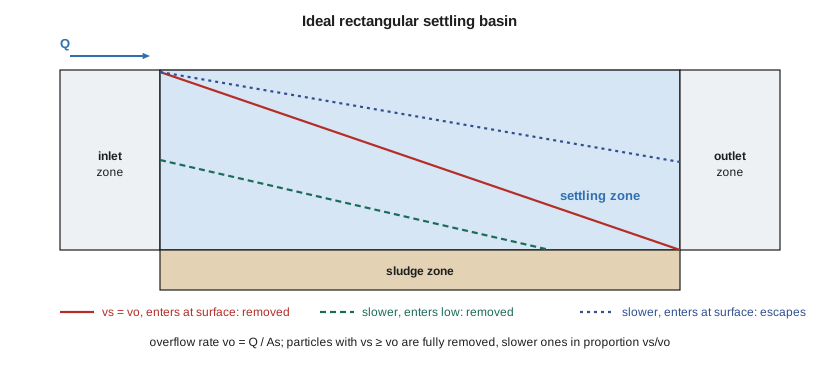
Hazen in 1904 and Camp in 1946 analyzed an ideal rectangular basin with uniform horizontal flow through a settling zone, a sludge zone below and inlet and outlet zones at each end. A particle that enters at the water surface and settles at \(v_s\) just reaches the bottom at the outlet if \(v_s\) equals the overflow rate
where \(A_s\) is the plan area of the basin. Every particle with \(v_s \ge v_o\) is removed. A slower particle is removed only if it enters low enough in the water column to reach the bottom before the outlet, and for a uniform entry distribution the fraction removed is \(v_s/v_o\). The remarkable result is that removal depends on the plan area, not the depth or the detention time. Depth is needed only to provide room for sludge, to keep velocities low enough to avoid scouring settled flocs, and to buffer against currents.
Worked problem
Removal of slow-settling flocs
The basins are designed for an overflow rate of 0.5 gpm/ft² (about 700 gpd/ft²) at peak flow. What fraction of flocs whose settling velocities correspond to 0.65 gpm/ft² and 0.06 gpm/ft² is removed in an ideal basin?
Show solution
- For the faster floc, \(v_s > v_o\):
- \[\text{removed} = 100\ \%\]
- For the slower floc:
- \[\frac{v_s}{v_o} = \frac{0.06}{0.5} = 0.12\]
Answer: All the 500 µm floc is removed, but only 12 % of the 150 µm floc. Good flocculation, which grows small flocs into large ones, matters more than basin size.
Real basins perform worse than the ideal because of inlet jets, density and wind currents, and turbulence. Designers allow for this by using conservative overflow rates and good inlet and outlet arrangements. Typical design values for conventional water treatment basins are about 500 to 1,500 gpd/ft², detention times of 2 to 4 hours, depths of 10 to 16 ft and length-to-width ratios of at least 4.
The script sized the basins at about 700 gpd/ft² for the peak flow of 16 MGD: about 22,600 ft² of plan area, four basins each 33 ft wide, 172 ft long and 13 ft deep, giving 3.3 hours of detention at peak flow. With one basin out of service the remaining three would run at about 940 gpd/ft², still within the normal range.
Inlets, outlets and sludge removal
Inlet structures distribute the flow uniformly across the basin and dissipate the momentum of the incoming water. A perforated baffle wall, with orifices sized for velocities of 0.15 to 0.3 m/s and a head loss of a few millimeters, is common in water plants. Outlets collect the clarified water over a long length of weir or through submerged orifices in launders, so that the approach velocity near the outlet is too low to lift settled flocs. Weir loading rates of 150 to 250 m³ per meter of weir per day (12,000 to 20,000 gpd/ft) are typical limits.
Settled sludge accumulates on the floor. In rectangular basins it is moved to a hopper by chain-and-flight scrapers, traveling bridges or hydraulic suction headers; in circular basins by rotating scrapers. Water plant sludge from alum coagulation contains 0.5 to 2 % solids and is sent to thickening and dewatering, as lesson 11 describes for wastewater sludge.
Flocculent and hindered settling
Flocculent particles grow as they settle, so their trajectories curve downward and removal increases with depth and time as well as with plan area. Their behavior is measured in a settling column: a tall cylinder with sampling ports at several depths, filled with flocculated water and sampled over time. Plotting the percent removal at each depth and time gives curves of equal removal, from which the removal at any overflow rate and detention time can be estimated. Settling column tests are the standard method for confirming the design of water basins and primary clarifiers.
At high concentrations, as in the secondary clarifiers of activated sludge plants, the particles settle as a blanket. The blanket's velocity depends on its concentration, and the clarifier must be sized for both the clarified overflow rate and the solids loading, the mass of solids applied per unit area per unit time. Lesson 9 applies this to secondary clarifiers.
High-rate settling with plates and tubes
Because ideal removal depends on plan area, stacking inclined plates or tubes in a basin multiplies the effective settling area. A particle needs to fall only the short distance between plates, perhaps 50 to 100 mm, before reaching a surface, where it slides down into the sludge zone. The effective area is the projected horizontal area of all the plates, roughly \(n A_p \cos\theta\) for \(n\) plates of area \(A_p\) inclined at \(\theta\) from the horizontal, usually 55 to 60° so that sludge slides off. Plate settlers allow loading rates on the basin footprint of 5 to 15 m/h or more, reducing the footprint several times over.
Worked problem
Footprint with plate settlers
A plate pack has plates 8 ft long and 4 ft wide, inclined at 55°. If the design loading on the projected plate area is 0.25 gpm/ft², how many plates carry the peak flow of 11,100 gpm?
Show solution
- Projected area of one plate:
- \[A_p \cos\theta = 8 \times 4 \times \cos 55^\circ = 18.4\ \text{ft}^2\]
- Required projected area:
- \[\frac{11\,100}{0.25} = 44\,400\ \text{ft}^2\]
- Number of plates:
- \[n = \frac{44\,400}{18.4} \approx 2\,410\]
Answer: Arranged in rows across the basins, the plates occupy roughly a quarter of the conventional footprint. The real number depends on the manufacturer's geometry and hydraulic efficiency factors.
Ballasted flocculation goes further by adding fine sand or magnetite and a polymer, so that the flocs are heavy and settle at 20 to 60 m/h. These units are very compact and start up quickly, which makes them useful for wet weather treatment at wastewater plants, but they add the cost and handling of the ballast.
Dissolved air flotation
Some particles are too light to settle well: algae, low-density flocs formed in cold, soft, colored water, and the organic flocs of enhanced coagulation. Dissolved air flotation (DAF) removes them by floating them instead. Part of the clarified water, the recycle stream of typically 6 to 12 % of the flow, is saturated with air at 400 to 600 kPa and released through nozzles into the flocculated water. The pressure drop releases a cloud of bubbles 10 to 100 µm across that attach to the flocs and carry them to the surface, where a scraper or hydraulic flooding removes them as a float containing 2 to 5 % solids.
DAF loading rates of 10 to 30 m/h on the flotation area are common, with flocculation times of only 10 to 20 minutes, so a DAF plant is far more compact than conventional settling. It works best on waters with turbidity below about 50 to 100 NTU. For the Assiniboine or Big Sioux, whose spring sediment loads can be much higher, DAF would need a presedimentation stage for the worst weeks.
Choosing the clarification process
Nadia prepares a comparison. Conventional basins are robust, simple to operate and tolerate extreme turbidity, but need the most land and concrete. Plate settlers reduce the footprint and capital cost and handle the spring sediment, but the plates need periodic cleaning and can foul with algae. DAF handles the summer algae and the light organic floc of enhanced coagulation best, and produces a thicker sludge, but needs power for the recycle pumps and saturators and a presedimentation step for spring floods.
The team selects plate-settled basins, sized as four trains so that one can be out of service, with space reserved for future DAF units should algae become a greater problem as the reservoir matures. The plate pack loading is set at 0.25 gpm/ft² on the projected area, with a basin footprint loading of about 3.3 gpm/ft². The decision is recorded in the design basis with its reasons, so that a future engineer can revisit it if conditions change.
Common mistakes
MistakeSizing a settling basin by detention time alone.
InsteadFor discrete settling, removal depends on overflow rate, Q divided by plan area.
MistakeApplying Stokes' law to large particles.
InsteadCheck the Reynolds number; above about 0.3 use a drag correlation.
MistakeAssuming DAF suits every river.
InsteadDAF suits light, low-turbidity flocs; high sediment loads need settling first.
Summary and key terms
- Settling is discrete, flocculent, hindered or compression, depending on concentration and particle interaction.
- Stokes' law \(v_s = g(\rho_p - \rho)d^2/(18\mu)\) applies at low Reynolds numbers.
- In an ideal basin, particles with \(v_s \ge Q/A\) are removed and slower ones in proportion \(v_s/v_o\).
- Plates and tubes multiply the settling area; DAF floats light flocs and algae.
- Overflow rate
- Flow divided by plan area, the critical settling velocity of an ideal basin.
- Terminal settling velocity
- The constant velocity at which a particle falls when weight balances drag.
- Settling column test
- A test that measures removal at several depths and times for flocculent suspensions.
- Weir loading rate
- Flow per unit length of outlet weir.
- Plate settler
- A pack of inclined plates that increases the effective settling area.
- Dissolved air flotation
- Removal of flocs by attaching fine air bubbles that carry them to the surface.
- Ballasted flocculation
- Flocculation with added sand or magnetite to make flocs settle rapidly.
Practice problems
Work each problem on paper first, then reveal the answer to check.
Find the Stokes settling velocity of a 50 µm silt particle (2,650 kg/m³) in water at 20 °C.
Show answer
\(v_s = 9.81(1650)(50\times10^{-6})^2/(18 \times 1.00\times10^{-3}) = 2.2\times10^{-3}\) m/s, about 8 m/h; \(Re\) = 0.11, so Stokes applies.
A basin 12 m wide and 48 m long receives 1,000 m³/h. Find the overflow rate and the removal of particles settling at 1.0 m/h.
Show answer
\(v_o = 1000/576 = 1.74\) m/h; removal \(1.0/1.74 = 57\) %.
Why do plate settlers use an inclination of 55 to 60°?
Show answer
Steep enough for sludge to slide off, while still giving a useful projected area.
Give one advantage of DAF over settling for algae-laden water.
Show answer
Algae and light flocs float readily but settle poorly; DAF removes them in a compact unit.
Lesson quiz · 5 questions
Score 60% or more to complete this lesson.
Create a free account to save your progress, take quizzes and earn a certificate.