
CIV-380 · Lesson 3 of 12 · 19 min
Coagulation and flocculation
The Big Sioux is a prairie river. In spring it runs high and muddy, with turbidity that can exceed 100 NTU; in late summer it is warmer, low and full of algae; in winter it runs clear and cold under ice. Throughout the year it carries 8 to 12 mg/L of total organic carbon (TOC), which gives the water color, reacts with chlorine to form disinfection by-products and feeds bacterial regrowth in the pipes. Very little of this material would settle on its own. Coagulation and flocculation turn it into particles large enough to settle and filter, and are therefore the heart of the conventional plant.
Why small particles stay suspended
Clay, silt, bacteria, algae and natural organic matter range in size from about 0.001 to 100 µm. Particles smaller than about 1 µm are colloids: they settle so slowly that, as lesson 4 will show, a 2 µm clay particle would take days to fall a meter. Gravity alone cannot remove them, and they do not stick together because almost all of them carry a negative surface charge in natural water. Each particle attracts a cloud of positive ions from the water, forming an electrical double layer, and when two particles approach, their double layers repel each other before the short-range van der Waals attraction can act. The measured electrical potential near the particle surface, the zeta potential, is typically \(-15\) to \(-40\) mV for river particles. A suspension in this state is called stable.
Coagulation destabilizes the particles so that they can stick together when they collide. Flocculation then provides gentle, prolonged mixing so that they do collide and grow into flocs hundreds of micrometers across. The two steps are physically distinct: coagulation is a fast chemical process that takes seconds, and flocculation is a slow physical process that takes tens of minutes.
Coagulation mechanisms
Four mechanisms are at work, often together. Double-layer compression, from adding ions, is important in seawater but needs impractically high doses in fresh water. Charge neutralization occurs when positively charged hydrolysis products of aluminum or iron, or cationic polymers, adsorb onto particle surfaces and cancel their charge; it is effective at low doses and is sensitive to overdosing, which can reverse the charge and restabilize the suspension. Sweep flocculation occurs at higher doses, when the coagulant precipitates as an amorphous hydroxide that enmeshes particles as it forms, like a net drawn through the water; it is the dominant mechanism in most conventional plants. Interparticle bridging occurs when long-chain polymers attach to several particles at once.
Natural organic matter adds a complication. Dissolved humic and fulvic acids are not particles, but they form complexes with aluminum and iron and are adsorbed on the precipitating hydroxide. Removing them requires a higher coagulant dose, and works best at a lower pH, around 5.5 to 6.5 for alum. This practice, called enhanced coagulation, is the main tool for controlling disinfection by-products in a conventional plant.
Coagulants and their chemistry
Aluminum sulfate (alum), ferric chloride, ferric sulfate and pre-hydrolyzed products such as polyaluminum chloride (PACl) are the main coagulants. When alum is added to water containing bicarbonate alkalinity, it hydrolyzes to aluminum hydroxide:
Each mole of alum (594 g) consumes six equivalents of alkalinity, or 300 g as CaCO₃, so 1 mg/L of alum consumes about 0.5 mg/L of alkalinity as CaCO₃ and produces about 0.26 mg/L of aluminum hydroxide precipitate. The carbon dioxide released lowers the pH. In a hard, well-buffered prairie river with 250 mg/L of alkalinity this is helpful, because it moves the pH toward the range where organic removal is best; in a soft lake water it may require lime or soda ash to keep enough alkalinity for the reaction and for corrosion control.
| Coagulant | Typical dose | Best pH range | Notes |
|---|---|---|---|
| Alum | 10 to 60 mg/L | 5.5 to 7.5 | Inexpensive, widely used; residual aluminum must be controlled |
| Ferric chloride | 10 to 80 mg/L | 4.5 to 8.5 | Wider pH range, better in cold water; corrosive, adds chloride |
| Polyaluminum chloride | 5 to 40 mg/L as product | 6.0 to 8.5 | Less alkalinity consumed, less sludge, works well in cold water |
| Cationic polymer | 1 to 5 mg/L | Wide | Primary coagulant or aid; overdosing restabilizes |
| Anionic or nonionic polymer | 0.05 to 0.5 mg/L | Wide | Flocculant or filter aid; strengthens flocs |
Residual aluminum in treated water is controlled for operational and aesthetic reasons: the secondary standard is a range of 0.05 to 0.2 mg/L. High residuals indicate poor pH control or carryover of floc, and aluminum deposits in mains reduce their capacity.
Jar tests
Because natural waters vary so much, coagulant doses are set by experiment. In a jar test, six beakers of raw water receive different doses of coagulant, are mixed rapidly for a minute, flocculated slowly for 20 to 30 minutes, then allowed to settle. The settled water turbidity, UV absorbance at 254 nm (a surrogate for organic matter), TOC, pH and floc appearance are recorded for each jar. Plotting settled turbidity against dose usually shows a minimum: too little coagulant leaves particles stable, the right dose gives clear water, and an excess of a charge-neutralizing coagulant can restabilize particles and turbidity rises again.
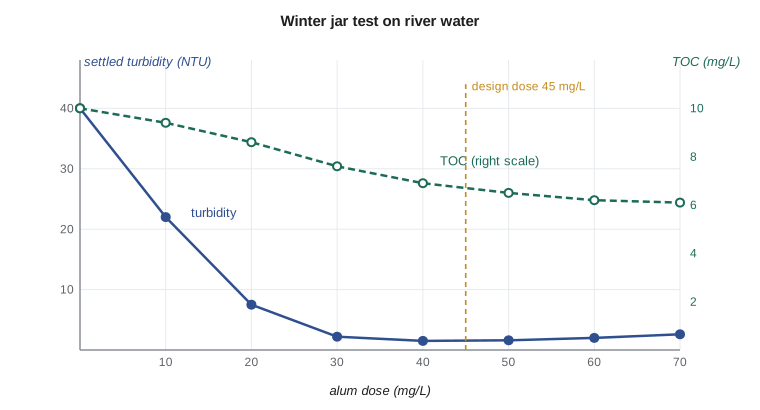
Joy runs jar tests on stored river samples from each season. In winter the water is cold and clear, but its organic carbon is near 10 mg/L. Turbidity reaches its minimum at about 35 mg/L of alum, but TOC removal keeps improving to about 45 mg/L, where it reaches 33 %, and the settled water's UV absorbance drops by half. The team adopts 45 mg/L as the winter design dose, with a range of 20 to 70 mg/L for the year.
The US Stage 1 Disinfectants and Disinfection Byproducts Rule makes enhanced coagulation a treatment technique for conventional plants. The required TOC removal depends on raw water TOC and alkalinity; for raw TOC above 8 mg/L and alkalinity above 120 mg/L as CaCO₃, the required removal is 30 %. The jar tests show that 45 mg/L of alum achieves 33 %, so the plant can comply with coagulation alone, but the treated water would still carry 6 to 7 mg/L of TOC, which is why lesson 7 adds a second barrier for organics.
Worked problem
Alkalinity consumed and sludge produced
The plant doses 45 mg/L of alum at an average flow of 10.5 MGD. Find the alkalinity consumed, the aluminum hydroxide formed, and the daily alum use.
Show solution
- Alkalinity consumed, at 300 g CaCO₃ per mole of alum:
- \[45 \times \frac{300}{594} = 22.7\ \text{mg/L as CaCO}_3\]
- Aluminum hydroxide formed, two moles of 78 g per mole of alum:
- \[45 \times \frac{2 \times 78}{594} = 11.8\ \text{mg/L}\]
- Daily use, with the factor 8.34 lb per million gallons per mg/L:
- \[45 \times 10.5 \times 8.34 = 3\,940\ \text{lb/d}\]
Answer: The river's alkalinity of about 250 mg/L easily supplies the 23 mg/L consumed. The plant uses about 2 tons of alum a day.
Mixing intensity and the velocity gradient
Camp and Stein proposed in 1943 that the rate of particle collisions in a mixed tank depends on the root-mean-square velocity gradient \(G\), which is related to the power dissipated in the water:
where \(P\) is the power input to the water in watts, \(\mu\) the dynamic viscosity (1.52 × 10⁻³ Pa·s at 5 °C, 1.00 × 10⁻³ Pa·s at 20 °C) and \(V\) the volume. Rapid mixing uses \(G\) of 600 to 1,000 s⁻¹ or more for a few seconds to a minute. Flocculation uses \(G\) of 10 to 80 s⁻¹ for 20 to 40 minutes. Because large flocs are fragile, flocculators are tapered: the first compartment has the highest \(G\) to build flocs quickly, and later compartments lower \(G\) so that the growing flocs are not broken up. The product \(Gt\), with \(t\) the detention time in seconds, measures the total opportunity for collisions; values of 20,000 to 150,000 are typical.
Cold water has a higher viscosity, which slows particle transport, settling and the coagulant reactions. For the same power, \(G\) is lower in winter. The flocculator drives are therefore sized for the coldest water, with variable-speed drives so that operators can trim \(G\) through the year.
# Alum coagulation chemistry and flocculator mixing for the river plant
from math import sqrt
UNITS = "US"
SI = UNITS == "SI"
# alum Al2(SO4)3.14H2O, 594 g/mol; each mole consumes 6 eq of alkalinity (as CaCO3, 50 g/eq)
dose = 45.0                                   # mg/L, from the winter jar tests
alk_used = dose * 6 * 50 / 594               # mg/L as CaCO3
sludge = dose * 2 * 78 / 594                 # mg/L of Al(OH)3 formed
Qd = 40000.0 if SI else 10.5 * 3785.4      # average flow, m3/d
Qp = 60000.0 if SI else 16.0 * 3785.4      # peak flow, m3/d
kg = dose * Qd / 1000
print(f"alkalinity consumed = {alk_used:.1f} mg/L as CaCO3")
print(f"Al(OH)3 precipitate = {sludge:.1f} mg/L")
if SI:
    print(f"alum used = {kg:,.0f} kg/d, about {kg*365/1000:,.0f} t a year")
else:
    print(f"alum used = {dose*10.5*8.34:,.0f} lb/d (dose x MGD x 8.34)")
# flocculation: velocity gradient from power, three tapered stages
mu = 1.52e-3                                  # Pa s, water at 5 C
stages_G = [60, 40, 20]                       # 1/s
td = 30 * 60                                  # total detention, s
Vtot = Qp / 86400 * td                        # m3 at peak flow, all trains
for i, G in enumerate(stages_G, 1):
    Vs = Vtot / 3
    P = G**2 * mu * Vs                        # W
    if SI:
        print(f"stage {i}: G = {G} 1/s, volume {Vs:,.0f} m3, power {P/1000:.2f} kW")
    else:
        print(f"stage {i}: G = {G} 1/s, volume {Vs*35.315:,.0f} ft3, power {P/745.7:.2f} hp")
Gt = sum(G * td / 3 for G in stages_G)
print(f"Gt = {Gt:,.0f} (dimensionless), average G = {sum(stages_G)/3:.0f} 1/s")
# rapid mix: G = 1000 1/s for 30 s at peak flow
Vr = Qp / 86400 * 30
Pr = 1000**2 * mu * Vr
print(f"rapid mix: {Vr:.1f} m3, power {Pr/1000:.1f} kW" if SI else f"rapid mix: {Vr*35.315:,.0f} ft3, power {Pr/745.7:.0f} hp")alkalinity consumed = 22.7 mg/L as CaCO3 Al(OH)3 precipitate = 11.8 mg/L alum used = 3,941 lb/d (dose x MGD x 8.34) stage 1: G = 60 1/s, volume 14,853 ft3, power 3.09 hp stage 2: G = 40 1/s, volume 14,853 ft3, power 1.37 hp stage 3: G = 20 1/s, volume 14,853 ft3, power 0.34 hp Gt = 72,000 (dimensionless), average G = 40 1/s rapid mix: 743 ft3, power 43 hp
The output shows how little power gentle flocculation needs: under 5 hp in total for about 44,000 ft³ of flocculation volume at peak flow, compared with about 43 hp for the rapid mix. These are powers delivered to the water; the motors must be larger to allow for gearbox and impeller efficiency, typically by a factor of 1.5 to 2. The volume will be divided among four parallel trains so that one can be taken out of service.
Flocculator types
Mechanical flocculators use horizontal paddle wheels or vertical turbines in each compartment. Hydraulic flocculators use the head loss of flow around baffles, through orifices or over and under walls; they have no moving parts but cannot be adjusted for flow or temperature. Some plants combine flocculation and settling in one unit, such as a solids contact clarifier, where previously formed sludge is recirculated to provide a large surface for new particles to attach to. This is common in softening plants and is considered for the new plant in lesson 7.
Flocs must reach the settling basin intact. Water should pass from the last flocculator compartment to the basin at low velocity, typically 0.15 to 0.45 m/s, through a perforated baffle wall rather than a pipe or a sharp drop, both of which shear the floc apart.
Monitoring and control
Raw water quality can change within hours when a storm reaches the river, so the plant cannot rely on yesterday's jar test. On-line turbidity, UV absorbance and pH meters on the raw water, and a streaming current detector after the rapid mix, help operators adjust the dose. The streaming current detector measures a signal related to particle surface charge; operators find the signal that gives good settled water and then adjust the dose to hold it. Some plants also use feed-forward control from raw water quality. Whatever the system, daily jar tests remain the reference check.
Common mistakes
MistakeChoosing the coagulant dose for minimum turbidity only.
InsteadAlso check TOC or UV absorbance removal, which often needs a higher dose.
MistakeUsing the same mixing intensity through all flocculation stages.
InsteadTaper the velocity gradient so that growing flocs are not broken.
MistakeForgetting the alkalinity consumed by the coagulant.
InsteadCheck that enough alkalinity remains for the reaction, stable pH and corrosion control.
Summary and key terms
- Natural particles are negatively charged and stable; coagulation destabilizes them and flocculation grows them into flocs.
- Mechanisms are double-layer compression, charge neutralization, sweep flocculation and bridging.
- Each mg/L of alum consumes about 0.5 mg/L of alkalinity as CaCO₃ and forms about 0.26 mg/L of Al(OH)₃.
- Enhanced coagulation removes organic carbon at higher doses and lower pH.
- \(G = \sqrt{P/(\mu V)}\); rapid mix uses high \(G\) for seconds, flocculation tapered low \(G\) for tens of minutes.
- Colloid
- A particle small enough, below about 1 µm, to stay suspended indefinitely.
- Zeta potential
- The electrical potential near a particle surface, a measure of its stability.
- Sweep flocculation
- Enmeshment of particles in a precipitating metal hydroxide.
- Enhanced coagulation
- Coagulation at higher doses or lower pH to remove natural organic matter.
- Jar test
- A bench test that compares coagulant doses on samples of raw water.
- Velocity gradient
- A measure of mixing intensity, the square root of power per unit volume divided by viscosity.
- Streaming current detector
- An on-line instrument that responds to particle charge after coagulant addition.
Practice problems
Work each problem on paper first, then reveal the answer to check.
A flocculation compartment of 400 m³ at 10 °C (\(\mu\) = 1.31 × 10⁻³ Pa·s) needs \(G\) = 50 s⁻¹. What power must reach the water?
Show answer
\(P = G^2 \mu V = 2500 \times 1.31 \times 10^{-3} \times 400 = 1\,310\) W.
Ferric chloride (FeCl₃, 162 g/mol) consumes three equivalents of alkalinity per mole. How much alkalinity does a 30 mg/L dose consume?
Show answer
\(30 \times 150/162 = 27.8\) mg/L as CaCO₃.
A jar test shows the turbidity minimum at 30 mg/L but turbidity rises at 60 mg/L with a cationic polymer. Why?
Show answer
Overdosing reverses the particle charge and restabilizes the suspension.
Why are flocculator drives sized for winter conditions?
Show answer
Higher viscosity in cold water lowers \(G\) for a given power.
Lesson quiz · 5 questions
Score 60% or more to complete this lesson.
Create a free account to save your progress, take quizzes and earn a certificate.