
CIV-380 · Lesson 7 of 12 · 20 min
Softening, metals, PFAS and corrosion control
Coagulation, settling, filtration and disinfection make water safe from pathogens and clear to the eye. Many waters need more. Prairie rivers and groundwaters are hard, many wells contain iron and manganese, organic carbon may remain too high for by-product control, and new contaminants such as PFAS call for processes that conventional plants do not include. Finally, the treated water must not attack the pipes it travels through. This lesson covers these specialty processes through three Willowbend tasks: deciding whether the new river plant should soften, treating the farming town's wells, and planning for PFAS and lead.
Hardness and lime softening
Hardness is the sum of the divalent cations, mainly calcium and magnesium, expressed as mg/L of CaCO₃. Water above about 180 mg/L is considered very hard; it forms scale in water heaters and boilers, consumes soap and leaves spots on fixtures. The portion of hardness balanced by bicarbonate alkalinity is carbonate hardness; the rest is noncarbonate hardness, balanced by sulfate and chloride.
Lime softening raises the pH so that calcium precipitates as calcium carbonate and magnesium as magnesium hydroxide. Lime first neutralizes free carbon dioxide, then converts bicarbonate to carbonate so that calcium carbonate precipitates at a pH near 10.3, and in excess raises the pH to about 11 so that magnesium hydroxide precipitates. Soda ash supplies the carbonate needed to remove noncarbonate calcium hardness. A short form of the stoichiometry, with all quantities in mg/L as CaCO₃, gives the lime and soda ash needed:
After softening, the water is supersaturated with calcium carbonate at a high pH. It is recarbonated with carbon dioxide to lower the pH to about 8.5 to 9 and stabilize it, so that carbonate does not deposit in the filters and mains. Softening plants often use solids contact clarifiers, in which recirculated precipitate provides seed crystals that speed the reaction.
The Big Sioux's hardness varies between about 250 and 450 mg/L as CaCO₃ through the year, and the city's existing plant has long softened it. Joy's design analysis for the river in late winter is: carbon dioxide 15, calcium 260, magnesium 110 and bicarbonate alkalinity 250 mg/L, all as CaCO₃.
# Lime-soda softening chemical needs, iron and manganese oxidant doses, and GAC bed life
UNITS = "US"
SI = UNITS == "SI"
# river water analysis, all in mg/L as CaCO3 (CO2 also expressed as CaCO3)
CO2, Ca, Mg, HCO3 = 15.0, 260.0, 110.0, 250.0
carb_Ca = min(Ca, HCO3)                       # calcium carbonate hardness
nonc_Ca = Ca - carb_Ca
carb_Mg = min(Mg, HCO3 - carb_Ca)
nonc_Mg = Mg - carb_Mg
excess = 35.0                                 # excess lime to raise pH for Mg removal
# straight-line method: lime = CO2 + HCO3 + Mg + excess; soda = noncarbonate hardness
lime = CO2 + HCO3 + Mg + excess
soda = nonc_Ca + nonc_Mg
print(f"total hardness {Ca+Mg:.0f}, carbonate {carb_Ca+carb_Mg:.0f}, noncarbonate {nonc_Ca+nonc_Mg:.0f} mg/L as CaCO3")
print(f"lime (as CaCO3) {lime:.0f} mg/L -> as CaO {lime*56/100:.0f} mg/L; soda ash (as CaCO3) {soda:.0f} mg/L -> as Na2CO3 {soda*106/100:.0f} mg/L")
Q = 40000.0 if SI else 10.5
cao = lime * 56 / 100
print(f"quicklime use {cao*Q/1e6:,.1f} t/d at average flow" if SI else f"quicklime use {cao*Q*8.34/2000:,.1f} tons/d at average flow")
# split treatment: soften part of the flow fully, bypass the rest to reach 120 mg/L as CaCO3 total hardness
Mg_soft, Mg_goal = 10.0, 40.0
x = (Mg_goal - Mg_soft) / (Mg - Mg_soft)
print(f"split treatment: bypass fraction for Mg {Mg_goal:.0f} mg/L as CaCO3 = {x:.2f}")
# farming-town wells: oxidant doses for iron and manganese (mg per mg of metal)
Fe, Mn = 2.4, 0.65
print(f"chlorine: {0.64*Fe + 1.29*Mn:.2f} mg/L; permanganate: {0.94*Fe + 1.92*Mn:.2f} mg/L; oxygen: {0.14*Fe + 0.27*Mn:.2f} mg/L")
# GAC for PFAS: empty-bed contact time and bed life from a pilot breakthrough
flow_lps = 25.0                               # well flow, L/s (about 400 gpm)
EBCT = 10.0                                   # min per vessel, two vessels in series
Vbed = flow_lps * 60 * EBCT / 1000            # m3 per vessel
bv_to_bt = 30000                              # bed volumes to 50 % of the treatment goal, from the pilot
days = bv_to_bt * Vbed / (flow_lps * 86.4)
print(f"GAC: {Vbed:.1f} m3 per vessel at {EBCT:.0f} min EBCT; lead vessel change about every {days:.0f} days" if SI else
f"GAC: {Vbed*35.315:.0f} ft3 per vessel at {EBCT:.0f} min EBCT; lead vessel change about every {days:.0f} days")total hardness 370, carbonate 250, noncarbonate 120 mg/L as CaCO3 lime (as CaCO3) 410 mg/L -> as CaO 230 mg/L; soda ash (as CaCO3) 120 mg/L -> as Na2CO3 127 mg/L quicklime use 10.1 tons/d at average flow split treatment: bypass fraction for Mg 40 mg/L as CaCO3 = 0.30 chlorine: 2.37 mg/L; permanganate: 3.50 mg/L; oxygen: 0.51 mg/L GAC: 530 ft3 per vessel at 10 min EBCT; lead vessel change about every 208 days
Worked problem
Lime and soda ash doses
For the analysis above, with 35 mg/L of excess lime, find the lime and soda ash doses.
Show solution
- Total hardness and its parts:
- \[TH = 260 + 110 = 370;\quad CH = \min(370, 250) = 250;\quad NCH = 120\ \text{mg/L as CaCO}_3\]
- Lime, as CaCO₃ and then as CaO (56/100):
- \[15 + 250 + 110 + 35 = 410\ \text{as CaCO}_3 = 230\ \text{mg/L as CaO}\]
- Soda ash, as CaCO₃ and then as Na₂CO₃ (106/100):
- \[120\ \text{as CaCO}_3 = 127\ \text{mg/L as Na}_2\text{CO}_3\]
Answer: At 10.5 MGD the plant would use about 10 tons of quicklime a day, and produce a lime sludge several times larger in mass. That is why softening is a major decision.
Softening all the water to the practical limit, about 35 mg/L as CaCO₃ of calcium hardness and 10 mg/L of magnesium hardness, is rarely necessary. In split treatment, part of the flow is softened with excess lime to remove magnesium and then blended with unsoftened water; the carbon dioxide and alkalinity in the bypass stream partly neutralize the excess lime, saving recarbonation. For a blended magnesium hardness of 40 mg/L as CaCO₃, the script finds a bypass fraction of 0.30.
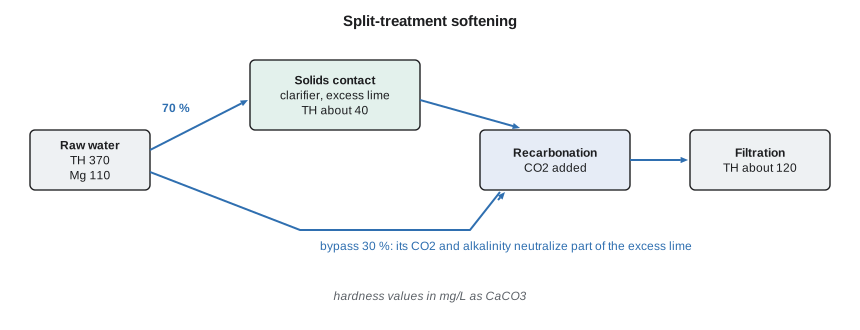
The city decides to soften to a total hardness of about 120 mg/L as CaCO₃, using split treatment in solids contact clarifiers ahead of the plate settlers. Softening also helps the plant in other ways: the high pH inactivates many organisms, the precipitate removes some organic carbon and metals, and lime raises alkalinity for corrosion control. Its costs are the chemicals, the lime sludge, which amounts to over 2 kg of dry solids per kg of lime, and the extra recarbonation step.
Iron and manganese
Groundwater without oxygen often contains dissolved ferrous iron (Fe²⁺) and manganous manganese (Mn²⁺). They are harmless at the tap in small amounts but oxidize in contact with air or chlorine to form red-brown and black deposits that stain laundry and fixtures and build up in mains, where they can be released as dirty water. Health Canada set a health-based MAC for manganese of 0.12 mg/L in 2019, based on neurological effects in infants, along with an aesthetic objective of 0.02 mg/L. In the United States manganese has a secondary standard of 0.05 mg/L and a health advisory.
Treatment oxidizes the metals to insoluble forms and filters them out. Iron oxidizes readily with air or chlorine. Manganese oxidizes slowly at neutral pH with air or chlorine and is usually treated with potassium permanganate, chlorine dioxide or ozone, or by filtering through media coated with manganese dioxide, often called greensand, which adsorbs and catalytically oxidizes it. Stoichiometric oxidant needs are listed below.
| Oxidant | mg per mg of Fe²⁺ | mg per mg of Mn²⁺ |
|---|---|---|
| Oxygen | 0.14 | 0.27 |
| Chlorine (as Cl₂) | 0.64 | 1.29 |
| Potassium permanganate | 0.94 | 1.92 |
| Chlorine dioxide | 1.21 | 2.45 |
| Ozone | 0.43 | 0.88 |
The farming town of CIV-280 draws from two wells with 2.4 mg/L of iron, 0.65 mg/L of manganese and nitrate near 8 mg/L as N. The script gives the chlorine need as 2.4 mg/L and the permanganate need as 3.5 mg/L, before any other demand. Willowbend recommends chlorine for iron oxidation followed by pressure filters with manganese dioxide coated media, which will remove both metals to below 0.02 mg/L, and continuous monitoring of nitrate, which is approaching the 10 mg/L limit; if it rises further, an ion exchange unit for nitrate would be added.
Activated carbon and organic contaminants
Activated carbon removes dissolved organic compounds by adsorption onto its enormous internal surface, about 500 to 1,500 m² per gram. Powdered activated carbon (PAC) is dosed into the raw water for seasonal problems such as taste and odor from the algal compounds geosmin and 2-methylisoborneol, which people can detect at a few nanograms per liter, and is removed with the sludge. Granular activated carbon (GAC) is used in fixed beds, either replacing the anthracite in the filters or in separate contactors after filtration, and is reactivated or replaced when exhausted.
GAC beds are designed by empty-bed contact time (EBCT), the bed volume divided by the flow, typically 10 to 20 minutes for organic carbon and PFAS. The bed is exhausted when the effluent concentration rises to the treatment goal, a point found from pilot tests or rapid small-scale column tests and expressed as the number of bed volumes treated. Two vessels in series, in lead-lag arrangement, let operators use the lead bed until breakthrough while the lag bed protects the effluent.
PFAS
Per- and polyfluoroalkyl substances are a family of thousands of synthetic chemicals with very strong carbon-fluorine bonds, used in firefighting foams, coatings and consumer products. They resist degradation, travel far in groundwater and accumulate in people. Conventional treatment and chlorination remove almost none of them. Three technologies are proven: GAC, which removes longer-chain compounds well but shorter chains less well; single-use or regenerable anion exchange resins, which remove a wider range at shorter contact times; and high-pressure membranes, nanofiltration and reverse osmosis, which remove nearly all PFAS but produce a concentrate that must be managed.
Monitoring of the river shows PFOS at 2 to 4 ng/L, close to the 4.0 ng/L MCL, and one of the farming town's wells, downgradient of a former airport fire training area, shows PFOS of 9 ng/L. For that well, the script estimates a lead-vessel change every 200 days or so for a pair of GAC vessels at 10 minutes EBCT each. Whatever the outcome of EPA's 2026 proposals, PFOA and PFOS limits of 4.0 ng/L remain in the rule, so the treatment is needed. The spent carbon must be reactivated at high temperature in a facility able to destroy PFAS.
For the river plant, the team adds post-filter GAC contactors to the design, with 15 minutes of EBCT at average flow. They serve three purposes: removing organic carbon to bring summer THMs toward the 60 µg/L target, removing taste and odor compounds during algal blooms, and providing a barrier against PFAS should river concentrations rise. Pilot tests are specified to confirm the bed life before the carbon is purchased.
Corrosion control and lead
Water that is undersaturated with calcium carbonate, low in alkalinity or low in pH can dissolve metals from pipes and plumbing. Lead from service lines, solder and brass fittings is the main health concern, and copper and iron cause staining and taste problems. Corrosion is controlled by adjusting pH and alkalinity, often to a pH of 7.5 to 8.5 or higher with alkalinity above about 30 to 50 mg/L as CaCO₃, by adding orthophosphate, which forms a protective lead phosphate scale on pipe walls, and, ultimately, by replacing lead service lines. The Flint crisis began when a change of source water, without corrosion control, destabilized scales that had protected the city's lead pipes for decades.
Any change in treatment, such as the new plant's softening and higher pH, can change the scales in old pipes. The Lead and Copper Rule requires systems to obtain state approval before a significant change in source or treatment, and under the LCRI the city must replace its remaining lead service lines within about ten years. Willowbend recommends pipe loop tests, using sections of harvested lead service lines exposed to the new water, before the plant starts, and designs a feed system for orthophosphate in case the tests show that pH control alone is not enough.
Corrosivity is often screened with the Langelier saturation index, the difference between the actual pH and the pH at which the water would be saturated with calcium carbonate. A positive index suggests a tendency to deposit carbonate scale and a negative one a tendency to dissolve it, though the index alone does not predict lead release, which depends also on chloride, sulfate and the pipe scales.
Common mistakes
MistakeSoftening all the flow to the practical limit.
InsteadUse split treatment to reach a target hardness at lower cost and with recarbonation savings.
MistakeRelying on chlorine alone to oxidize manganese at neutral pH.
InsteadUse permanganate, chlorine dioxide or ozone, or catalytic media.
MistakeChanging treatment chemistry without assessing lead release.
InsteadTest with pipe loops and plan corrosion control before the change.
Summary and key terms
- Lime removes carbonate hardness and, in excess, magnesium; soda ash removes noncarbonate hardness; recarbonation stabilizes the water.
- Iron and manganese are oxidized and filtered; manganese usually needs a strong oxidant or catalytic media.
- Activated carbon removes taste and odor, organic carbon and long-chain PFAS; beds are designed by EBCT and bed volumes to breakthrough.
- Corrosion control uses pH, alkalinity and orthophosphate, and lead service line replacement removes the source.
- Carbonate hardness
- Hardness balanced by bicarbonate and carbonate alkalinity.
- Split treatment
- Softening part of the flow with excess lime and blending with the rest.
- Recarbonation
- Adding carbon dioxide to lower pH after lime softening.
- Greensand
- Filter media coated with manganese dioxide that removes iron and manganese.
- Empty-bed contact time
- The volume of an adsorbent bed divided by the flow through it.
- Anion exchange
- Removal of negatively charged ions, including many PFAS and nitrate, by a resin.
- Langelier saturation index
- The difference between actual pH and calcium carbonate saturation pH.
Practice problems
Work each problem on paper first, then reveal the answer to check.
A water has Ca 180, Mg 60, HCO₃⁻ 200 and CO₂ 10 mg/L, all as CaCO₃. Find the lime (as CaCO₃) for excess-lime softening with 35 mg/L excess.
Show answer
\(10 + 200 + 60 + 35 = 305\) mg/L as CaCO₃.
How much potassium permanganate is needed to oxidize 0.4 mg/L of manganese?
Show answer
\(1.92 \times 0.4 = 0.77\) mg/L.
A GAC contactor holds 20 m³ of carbon and treats 0.02 m³/s. Find the EBCT.
Show answer
\(20/0.02 = 1\,000\) s, or 16.7 min.
Why might raising pH for softening affect lead at consumers' taps?
Show answer
It changes the chemistry of the scales lining old lead pipes, which can either protect or release lead.
Lesson quiz · 5 questions
Score 60% or more to complete this lesson.
Create a free account to save your progress, take quizzes and earn a certificate.