
CIV-380 · Lesson 6 of 12 · 19 min
Disinfection and disinfection by-products
Disinfection is the barrier that turned drinking water from the leading cause of epidemic disease into one of the safest things people consume. Chlorination of public supplies, begun in Jersey City in 1908 and in Canadian cities in the following years, cut typhoid deaths dramatically within a decade. Today the challenge is twofold: achieve enough inactivation of pathogens that resist chlorine, such as Cryptosporidium, while limiting the by-products that chlorine forms with natural organic matter. This lesson develops the CT concept, compares the main disinfectants, and checks the new plant's clearwell and ultraviolet reactors.
Log inactivation and treatment credits
Pathogen reduction is expressed in logs: 1-log is 90 % removal or inactivation, 2-log is 99 %, 3-log is 99.9 % and 4-log is 99.99 %.
The Surface Water Treatment Rules require at least 3-log removal or inactivation of Giardia and 4-log of viruses. Conventional treatment meeting the turbidity limits is credited with 2.5-log Giardia and 2-log virus removal, so disinfection must provide at least 0.5-log Giardia and 2-log virus. For Cryptosporidium, the Long Term 2 Enhanced Surface Water Treatment Rule assigns a plant to one of four bins based on monitoring of its source; conventional treatment earns 3-log credit, which satisfies bin 1, while bins 2 to 4 require 1 to 2.5 more logs from a toolbox of options such as ultraviolet disinfection. The new plant's source monitoring will determine its bin.
Because Cryptosporidium oocysts are almost unaffected by chlorine at practical doses, and because a river shared with cattle and upstream wastewater plants can carry them, the team adds a second, independent barrier: ultraviolet (UV) disinfection after filtration. UV inactivates Cryptosporidium and Giardia at low doses, so the plant does not depend on filtration alone for protozoa.
The CT concept
Chick in 1908 found that the rate of inactivation of bacteria is proportional to the number of surviving organisms, and Watson showed that the rate also depends on disinfectant concentration. The combined Chick-Watson law, with exponent \(n\) close to 1 for most disinfectants, gives
so that, to a good approximation, the inactivation achieved depends on the product of disinfectant residual \(C\) (mg/L) and contact time \(t\) (minutes). Regulators publish tables of the CT needed for each organism, disinfectant, temperature and pH. Because the effective contact time is the time that 90 % of the water exceeds, the calculation uses \(T_{10}\), from a tracer test or a baffling factor (lesson 2), and the residual measured at the outlet of each contact segment.
| Organism | Free chlorine | Chloramine | Chlorine dioxide | Ozone |
|---|---|---|---|---|
| Giardia, 3-log | about 100 to 200 | about 1,500 to 2,500 | about 25 to 40 | about 2 to 3 |
| Viruses, 4-log | about 6 to 8 | about 1,500 to 2,000 | about 25 to 35 | about 1 |
| Cryptosporidium, 2-log | Not practical | Not practical | Several hundred | About 15 to 30 |
Free chlorine is far more effective at low pH, because hypochlorous acid (HOCl), the strong disinfectant, dissociates to the much weaker hypochlorite ion (OCl⁻) above its pKa of about 7.5. Temperature matters as much: required CT roughly doubles for every 10 °C drop. The design case is therefore the coldest water at the highest pH and peak flow.
Checking the clearwell
The clearwell of lesson 2, rebuilt with serpentine baffles for an expected baffling factor of 0.6, holds about 1.06 million gallons. At the peak flow of 16 MGD the theoretical residence time is about 95 minutes. The operating target is a free chlorine residual of 1.0 mg/L at the outlet, and the design water is at 5 °C (41 °F) and pH 7.5.
# CT check for the clearwell and an ultraviolet dose check
UNITS = "US"
SI = UNITS == "SI"
# clearwell from lesson 2, after added baffles
V = 4000.0 if SI else 1.06e6                   # m3 or gal
Qp = 60000.0 / 1440 if SI else 16.0e6 / 1440    # per minute at peak flow
bf = 0.60                                      # baffling factor after the retrofit
T10 = bf * V / Qp
C = 1.0                                        # mg/L free chlorine leaving the clearwell
CT = C * T10
print(f"T10 = {bf} x {V/Qp:.1f} min = {T10:.1f} min; CT available = {CT:.0f} mg.min/L")
# required CT values (free chlorine, 5 C, pH 7.5, about 1 mg/L), typical of regulator tables
need = {"Giardia 0.5-log": 28.0, "viruses 2-log": 4.0, "viruses 4-log": 8.0}
for k, v in need.items():
    print(f"{k:16s} needs {v:5.1f} -> inactivation ratio {CT/v:.2f} {'ok' if CT >= v else 'short'}")
# Chick-Watson: log inactivation = k C T (first order in CT), illustrative k for Giardia
k = 0.0179                                     # (log per mg.min/L), fitted to the 0.5-log value above
print(f"Chick-Watson estimate of Giardia inactivation: {k*CT:.1f} log")
# UV reactors: dose needed for 3-log Cryptosporidium and Giardia, 4-log virus (typical tabulated values, mJ/cm2)
uv = {"Cryptosporidium 3-log": 12.0, "Giardia 3-log": 11.0, "viruses 4-log": 186.0}
design = 40.0
for k2, d in uv.items():
    print(f"UV {k2:22s} needs {d:5.0f} mJ/cm2: {'met' if design >= d else 'not met'} at {design:.0f} mJ/cm2")
# chlorine demand, dose and daily use
dose = 2.6                                     # mg/L applied ahead of the clearwell
Qd = 40000.0 if SI else 10.5
print(f"chlorine use {dose*Qd/1000:,.0f} kg/d at average flow" if SI else f"chlorine use {dose*Qd*8.34:,.0f} lb/d at average flow")T10 = 0.6 x 95.4 min = 57.2 min; CT available = 57 mg.min/L Giardia 0.5-log needs 28.0 -> inactivation ratio 2.04 ok viruses 2-log needs 4.0 -> inactivation ratio 14.31 ok viruses 4-log needs 8.0 -> inactivation ratio 7.16 ok Chick-Watson estimate of Giardia inactivation: 1.0 log UV Cryptosporidium 3-log needs 12 mJ/cm2: met at 40 mJ/cm2 UV Giardia 3-log needs 11 mJ/cm2: met at 40 mJ/cm2 UV viruses 4-log needs 186 mJ/cm2: not met at 40 mJ/cm2 chlorine use 228 lb/d at average flow
The clearwell provides a CT of about 58 mg·min/L, twice the roughly 28 needed for 0.5-log Giardia and many times the 8 needed for 4-log viruses. A Chick-Watson estimate puts Giardia inactivation near 1-log. The UV reactors, designed for a validated dose of 40 mJ/cm², easily provide 3-log Cryptosporidium and Giardia, but would need a dose of about 186 mJ/cm² for 4-log adenovirus, which is why chlorine remains the virus barrier.
Worked problem
Inactivation ratio
At peak flow, the clearwell has \(T_{10}\) = 57.6 minutes and an outlet free chlorine residual of 0.6 mg/L on a winter morning. Is the 0.5-log Giardia requirement, with a required CT of 28 mg·min/L, still met?
Show solution
- \[CT_{available} = 0.6 \times 57.6 = 34.6\ \text{mg·min/L}\]
- \[\frac{34.6}{28} = 1.24 \ge 1\]
Answer: Yes, but with little margin. If the residual fell to 0.45 mg/L, the ratio would drop below 1. The plant's control system must alarm well before then.
Chlorine chemistry
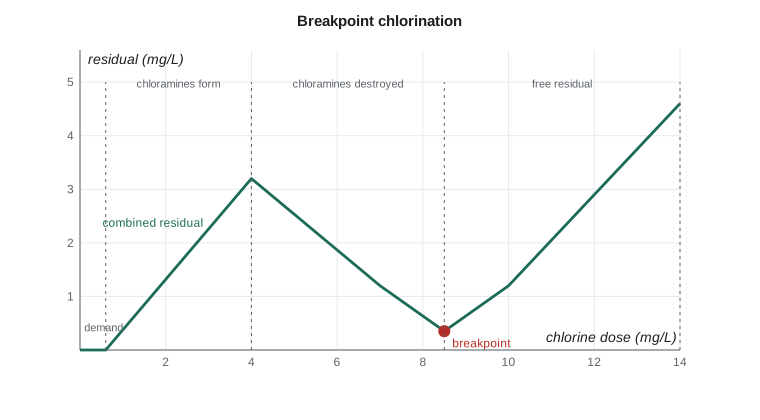
Chlorine is supplied as liquefied gas, as sodium hypochlorite solution or as calcium hypochlorite. In water it forms hypochlorous acid, which dissociates depending on pH. Chlorine reacts first with reducing agents such as iron, manganese and sulfide, and with ammonia to form chloramines. Adding chlorine to water containing ammonia produces the breakpoint curve: the residual first rises as monochloramine forms, then falls as further chlorine oxidizes the chloramines to nitrogen gas, and finally rises again, as free chlorine, beyond the breakpoint at a chlorine-to-ammonia-nitrogen mass ratio of about 7.6 to 10.
Chlorine gas is highly toxic and heavier than air. Plants that store it need separate, ventilated rooms with gas detectors, scrubbers and emergency plans, and many utilities have switched to sodium hypochlorite or generate it on site from salt to avoid the risk. The new plant will use bulk sodium hypochlorite, stored in a cool room to slow its decay and the formation of chlorate, and dosed by metering pumps paced to flow and trimmed by residual.
Chloramines, formed by adding ammonia after chlorine, are weaker disinfectants but last longer in the distribution system and form fewer regulated by-products. Many utilities with long pipe networks use free chlorine for primary disinfection in the plant and then convert to chloramine for secondary disinfection. The city's network is compact and its existing system uses free chlorine, so the design keeps free chlorine throughout, with a provision for adding ammonia later.
Ultraviolet, ozone and chlorine dioxide
UV light at 254 nm, produced by low-pressure mercury lamps, or a broader band from medium-pressure lamps, damages the DNA of microorganisms so they cannot reproduce. The dose, the product of intensity and exposure time in mJ/cm², is verified by testing each reactor model with a challenge organism in a validation test, and in operation by UV intensity sensors, flow and the UV transmittance of the water. UV leaves no residual and forms almost no by-products, but its performance falls when lamps age or sleeves foul, and the water must be well filtered so that particles do not shield organisms.
Ozone, generated on site from oxygen by electrical discharge, is the strongest common disinfectant and also oxidizes taste and odor compounds, color and some micropollutants. It inactivates Cryptosporidium at practical CT values in warm water but needs much more in cold water, and in water containing bromide it forms bromate, a regulated by-product. Chlorine dioxide is effective against Giardia and viruses, forms few organic by-products and is useful for manganese oxidation, but produces chlorite and chlorate, which are themselves limited.
The residual in the distribution system
Primary disinfection in the plant inactivates pathogens; secondary disinfection maintains a residual in the distribution system that limits bacterial regrowth and provides some protection if contamination enters through a main break or a cross-connection. Most regulators require a detectable residual throughout the system, and many utilities target 0.2 mg/L or more of free chlorine at the extremities. The residual decays with time, faster in warm water, in old unlined iron pipes and in water with high organic carbon, so the far ends of a large network may need booster chlorination. The lower organic carbon of the new plant's water should slow the decay, and Nadia's water age model of the network shows that the longest residence times, in the reservoirs at the city's edge, are about three days, within the range where a free chlorine residual can be held.
Disinfection by-products
When chlorine reacts with natural organic matter it forms hundreds of by-products, of which trihalomethanes (THMs) and haloacetic acids (HAAs) are regulated as indicators of the whole group. Long-term exposure has been associated with an increased risk of bladder cancer, and some studies suggest reproductive effects. Formation increases with chlorine dose, contact time, temperature, organic carbon and, for THMs, pH. Bromide in the source water shifts formation toward brominated species, which are considered more harmful.
The best control is to remove the precursors before chlorine is added: enhanced coagulation and, if needed, adsorption or biological filtration (lesson 7). Moving the chlorine application point from the raw water to after filtration, as the new plant does, also reduces formation, because by then much of the organic carbon has been removed. The design target of 60 µg/L for total THMs as a locational running annual average, set in lesson 1, sits below the 80 µg/L MCL of the Stage 2 rule.
Joy runs simulated distribution system tests in the laboratory, holding filtered water with chlorine at the expected residence time and temperature of the farthest parts of the network, and measuring THMs and HAAs. With TOC reduced from 10 to about 6.5 mg/L by enhanced coagulation, summer THMs reach about 75 µg/L: below the limit but above the target. This result is the reason for the additional organic removal considered in the next lesson.
Wastewater disinfection
Wastewater effluent is disinfected where the receiving water is used for recreation or drinking water supply downstream. NPDES permits for plants on the Big Sioux include E. coli limits in the recreation season. UV is now the most common choice, because chlorinated effluent must be dechlorinated to meet total residual chlorine limits that protect fish. Lesson 12 includes the city plant's UV system in the upgrade.
Common mistakes
MistakeUsing the theoretical detention time in the CT calculation.
InsteadUse \(T_{10}\) and the residual at the segment outlet.
MistakeAssuming chlorine controls Cryptosporidium.
InsteadUse filtration and UV or ozone for Cryptosporidium.
MistakeRaising the chlorine dose to fix a by-product problem.
InsteadRemove precursors or move the application point; more chlorine forms more by-products.
Summary and key terms
- Log reduction is \(\log_{10}(N_0/N)\); treatment goals are commonly 3-log protozoa and 4-log viruses.
- Inactivation depends on \(CT = C \times T_{10}\); required CT rises steeply in cold water and, for chlorine, at high pH.
- UV inactivates protozoa at low doses but needs high doses for adenovirus; chlorine provides virus inactivation and a residual.
- Trihalomethanes and haloacetic acids are controlled mainly by removing organic precursors.
- Log inactivation
- Reduction in viable organisms expressed as a power of ten.
- CT
- The product of disinfectant residual and effective contact time, in mg·min/L.
- Inactivation ratio
- Available CT divided by required CT.
- Breakpoint chlorination
- Adding chlorine beyond the point where chloramines are destroyed, giving a free residual.
- Chloramine
- A combined chlorine disinfectant formed from chlorine and ammonia.
- UV dose
- The product of UV intensity and exposure time, in mJ/cm².
- Disinfection by-product
- A compound formed by reaction of a disinfectant with substances in water.
Practice problems
Work each problem on paper first, then reveal the answer to check.
A treatment process reduces viruses from 10⁵ to 10 per liter. What log reduction is this?
Show answer
\(\log_{10}(10^5/10) = 4\)-log.
A pipeline 2 km long and 1.2 m in diameter carries 0.5 m³/s with a free chlorine residual of 0.8 mg/L. With a baffling factor of 1.0, what CT does it provide?
Show answer
\(V = 2000 \times \pi(0.6)^2 = 2\,262\) m³; \(t = 2262/0.5/60 = 75\) min; CT = 60 mg·min/L.
Why does required free chlorine CT increase at high pH?
Show answer
More of the chlorine is present as the weaker hypochlorite ion.
Give two ways to reduce THM formation without reducing disinfection.
Show answer
Remove organic precursors by enhanced coagulation or adsorption; move chlorine addition to after filtration.
Lesson quiz · 5 questions
Score 60% or more to complete this lesson.
Create a free account to save your progress, take quizzes and earn a certificate.