
CIV-380 · Lesson 10 of 12 · 19 min
Nutrient removal and other biological processes
Secondary treatment protects a river's oxygen. It does little for the algae downstream, which respond to nitrogen and phosphorus. The Big Sioux carries its nutrients to the Missouri and the Mississippi, whose load drives the hypoxic zone in the Gulf of Mexico each summer, and local reservoirs and lakes suffer blooms of their own. South Dakota's draft permit for the city plant adds a total phosphorus limit of 1.0 mg/L and seasonal ammonia limits. The city has also adopted a total nitrogen goal of 10 mg/L under the state's nutrient reduction strategy, and Willowbend has agreed to design for 10 mg/L of total nitrogen and 0.5 mg/L of total phosphorus so that the plant performs reliably in winter and has room for future tightening.
Nitrification
Nitrification is the two-step oxidation of ammonia to nitrite and then nitrate by autotrophic bacteria, ammonia-oxidizing bacteria and nitrite-oxidizing bacteria, which take their carbon from carbon dioxide and their energy from the oxidation:
Each gram of ammonia nitrogen oxidized consumes 4.57 g of oxygen and 7.14 g of alkalinity as CaCO₃. Nitrifiers grow slowly, with maximum specific growth rates of about 0.5 to 1 d⁻¹ at 20 °C against several d⁻¹ for heterotrophs, and their growth falls steeply in cold water, by about half for every 8 to 10 °C, and at low dissolved oxygen. They are also sensitive to low pH and to some industrial inhibitors. The aerobic SRT must therefore be long enough for nitrifiers to grow faster than they are wasted, at the coldest temperature, with a safety factor for load peaks:
# Nitrification SRT, MLE recycle for total nitrogen, and chemical phosphorus removal
UNITS = "US"
SI = UNITS == "SI"
T = 12.0
mu20, b20, KN = 0.90, 0.17, 0.5               # nitrifiers: 1/d, 1/d, mg N/L (typical values)
DO, KO = 2.0, 0.5
mu = mu20 * 1.072 ** (T - 20) * DO / (KO + DO)
b = b20 * 1.029 ** (T - 20)
SRTmin = 1 / (mu - b)
SF = 2.0
print(f"nitrifier growth at {T:.0f} C and {DO} mg/L DO: mu = {mu:.3f} 1/d, decay {b:.3f} 1/d")
print(f"minimum aerobic SRT {SRTmin:.1f} d; design aerobic SRT with safety factor {SF}: {SF*SRTmin:.1f} d")
# MLE process: nitrate returned to the anoxic zone by internal (IR) and return (R) flows
TKN_in, N_assim, NH4_eff = 40.5, 7.0, 1.0     # mg/L; nitrogen used for growth; residual ammonia
NOx = TKN_in - N_assim - NH4_eff - 1.5         # nitrate formed (1.5 mg/L organic N remains)
R = 0.67
target_TN = 10.0
for IR in (1, 2, 3, 4):
    frac = (IR + R) / (1 + IR + R)            # fraction of nitrate returned (and removed, ideally)
    no3_eff = NOx * (1 - frac)
    TN = no3_eff + NH4_eff + 1.5
    print(f"IR = {IR}Q: nitrate returned {100*frac:.0f} %, effluent nitrate {no3_eff:.1f}, TN {TN:.1f} mg/L {'meets' if TN <= target_TN else 'above'} {target_TN:.0f}")
# carbon check: about 4 g of readily used COD per g of nitrate-N denitrified
Q = 30000.0
den = NOx * (3 + R) / (1 + 3 + R)
print(f"denitrified at IR = 3Q: {den:.1f} mg/L -> COD needed about {4*den:.0f} mg/L")
# chemical P removal with alum: molar Al:P of 2.0 to reach about 0.5 mg/L before filtration
P_in = 6.2; P_bio = 1.5                       # mg/L; P taken up in normal biomass growth
P_rem = P_in - P_bio - 0.5
alum_per_P = 2.0 * 594 / 2 / 31               # g alum per g P at Al:P = 2
dose = P_rem * alum_per_P
print(f"P to precipitate {P_rem:.1f} mg/L; alum dose {dose:.0f} mg/L = {dose*Q/1000:,.0f} kg/d" if SI else
f"P to precipitate {P_rem:.1f} mg/L; alum dose {dose:.0f} mg/L = {dose*Q/1000*2.2046:,.0f} lb/d")nitrifier growth at 12 C and 2.0 mg/L DO: mu = 0.413 1/d, decay 0.135 1/d minimum aerobic SRT 3.6 d; design aerobic SRT with safety factor 2.0: 7.2 d IR = 1Q: nitrate returned 63 %, effluent nitrate 11.6, TN 14.1 mg/L above 10 IR = 2Q: nitrate returned 73 %, effluent nitrate 8.4, TN 10.9 mg/L above 10 IR = 3Q: nitrate returned 79 %, effluent nitrate 6.6, TN 9.1 mg/L meets 10 IR = 4Q: nitrate returned 82 %, effluent nitrate 5.5, TN 8.0 mg/L meets 10 denitrified at IR = 3Q: 24.4 mg/L -> COD needed about 97 mg/L P to precipitate 4.2 mg/L; alum dose 80 mg/L = 5,323 lb/d
With typical coefficients, the minimum aerobic SRT at 12 °C and 2 mg/L of dissolved oxygen is about 3.6 days, and a safety factor of 2 gives 7.2 days. Willowbend adopts 10 days of aerobic SRT, because the plant's winter TKN load peaks with the food processor's production schedule and because the design must still nitrify when one aeration tank is out of service.
Denitrification
Denitrification reduces nitrate to nitrogen gas, which escapes harmlessly to the atmosphere. It is carried out by ordinary heterotrophic bacteria that, in the absence of dissolved oxygen, use nitrate as their electron acceptor. They need a carbon source: about 4 to 5 g of readily biodegradable COD per g of nitrate nitrogen. Denitrification returns half of the alkalinity consumed by nitrification, 3.57 g per g of N, and recovers 2.86 g of oxygen equivalent per g of N, which reduces the aeration demand.
The most common process is the Modified Ludzack-Ettinger (MLE) process: an anoxic zone, unaerated but mixed, ahead of the aerobic zone, receiving the primary effluent and a large internal recycle of nitrified mixed liquor from the end of the aerobic zone. The influent provides the carbon, and the nitrate returned by the internal recycle and the return sludge is denitrified. If the anoxic zone has enough capacity and carbon, the fraction of the nitrate formed that is returned and removed is
where \(IR\) and \(R\) are the internal and return recycle ratios. Nitrate in the remaining fraction leaves in the effluent. Internal recycles of 2 to 4 times the influent flow are common; higher ratios give diminishing returns and carry dissolved oxygen into the anoxic zone, which wastes carbon.
Worked problem
Internal recycle for the nitrogen target
About 31 mg/L of nitrate nitrogen is formed in the aerobic zone. With return ratio 0.67, residual ammonia 1 mg/L and organic nitrogen 1.5 mg/L in the effluent, what internal recycle ratio achieves a total nitrogen of 10 mg/L?
Show solution
- For \(IR = 3\):
- \[\text{fraction returned} = \frac{3 + 0.67}{1 + 3 + 0.67} = 0.79\]
- \[NO_3^-\ \text{left} = 31(1 - 0.79) = 6.6\ \text{mg/L}\]
- \[TN = 6.6 + 1.0 + 1.5 = 9.1\ \text{mg/L}\]
Answer: An internal recycle of 3Q meets the target; 2Q gives 10.9 mg/L and does not. The anoxic zone must also have enough carbon: denitrifying 24 mg/L of nitrate needs about 100 mg/L of readily used COD, which the primary effluent supplies only if the primaries do not remove too much.
To approach total nitrogen of 3 to 5 mg/L, plants add a second anoxic zone after the aerobic zone (the four-stage Bardenpho process), dosing an external carbon source such as methanol, glycerol or acetic acid, or tertiary denitrification filters. Newer processes save oxygen and carbon by stopping at nitrite (nitritation-denitritation) or by using anaerobic ammonia-oxidizing bacteria (anammox), which convert ammonia and nitrite directly to nitrogen gas; anammox is now common for the ammonia-rich liquid returned from sludge dewatering.
Phosphorus removal
Ordinary biomass contains about 2 % phosphorus by dry mass, so normal sludge wasting removes 1 to 2 mg/L of phosphorus from typical sewage. Meeting 1 mg/L or less requires more. Chemical phosphorus removal adds aluminum or iron salts, which precipitate phosphate as metal phosphates and hydroxides that leave with the sludge. Dosing may be in the primary clarifiers, in the aeration tank (simultaneous precipitation) or before tertiary filters. Molar ratios of metal to phosphorus of 1.5 to 2.5 are typical for effluents near 0.5 mg/L, rising sharply for lower targets.
The script finds that removing 4.2 mg/L of phosphorus chemically with alum at an Al:P ratio of 2 needs about 80 mg/L of alum, about 5,300 lb a day. The chemical also consumes alkalinity and adds about 45 % of its mass as sludge solids, roughly 2,400 lb/d more sludge.
Enhanced biological phosphorus removal (EBPR) reduces or eliminates the chemical. It uses phosphorus-accumulating organisms (PAOs), bacteria that, in an anaerobic zone with neither oxygen nor nitrate, take up volatile fatty acids such as acetate and store them, releasing phosphate to get energy from their stored polyphosphate. In the following aerobic zone they use the stored carbon to grow and take up much more phosphate than they released, storing it again as polyphosphate. Wasting this phosphorus-rich biomass, which can contain 4 to 6 % phosphorus, removes it from the system. EBPR needs a supply of volatile fatty acids, which is why fermentation of primary sludge, mentioned in lesson 8, is often paired with it, and an anaerobic zone free of nitrate.
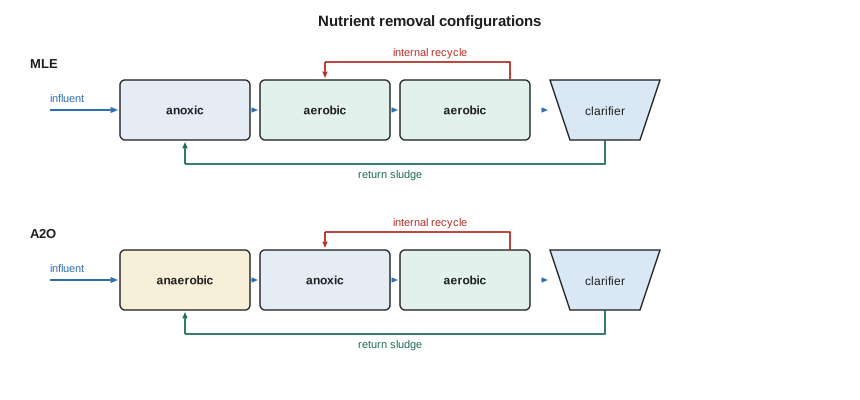
The A2O (anaerobic-anoxic-oxic) process combines EBPR with MLE nitrogen removal. Variations such as the University of Cape Town (UCT) and Johannesburg processes protect the anaerobic zone from the nitrate in the return sludge. Biological removal typically reaches 0.5 to 1 mg/L of total phosphorus; a small chemical dose and effluent filtration provide reliability below that. Willowbend proposes A2O with a fermenter and a trim alum dose, which the capstone checks.
Phosphorus taken up by organisms can be released again in the solids train. When EBPR sludge is digested anaerobically, the polyphosphate is released, and with ammonia and magnesium it can form struvite, magnesium ammonium phosphate, a hard scale that blocks pipes and pumps. Plants with EBPR increasingly recover it deliberately as a slow-release fertilizer in a crystallizer on the dewatering liquor, which also prevents the released phosphorus from cycling back to the head of the plant.
Other biological processes
Not every community needs or can afford activated sludge. Waste stabilization lagoons, used by hundreds of prairie towns, are large shallow ponds in which bacteria and algae treat the sewage over months; in Manitoba and South Dakota they typically store the winter's flow and discharge in spring and fall. They need much land but little energy or skill, and their effluent can be high in algae and ammonia at times. Aerated lagoons add mechanical aeration to reduce the area needed.
Trickling filters pass settled sewage over a bed of rock or plastic media on which a biofilm grows; they are robust and use little energy, but nitrify only at low loadings and do not remove nutrients well. Rotating biological contactors carry biofilm on discs that turn through the wastewater. Moving-bed biofilm reactors (MBBR) suspend small plastic carriers in an aerated tank, holding biofilm that does not need to settle; integrated fixed-film activated sludge (IFAS) adds such carriers to an existing activated sludge tank, increasing the nitrifying biomass without increasing the MLSS sent to the clarifiers. Membrane bioreactors (MBR) replace the secondary clarifier with submerged MF or UF membranes, allowing MLSS of 8,000 to 12,000 mg/L in a small tank and producing an effluent nearly free of suspended solids, at the cost of membrane replacement and higher energy.
| Process | Typical effluent | Strengths | Limitations |
|---|---|---|---|
| Facultative lagoon | BOD₅ 20 to 40 mg/L, variable TSS | Simple, low energy | Large area, algae, limited nutrient removal |
| Trickling filter | BOD₅ 20 to 30 mg/L | Robust, low energy | Limited nitrification and nutrient removal |
| MLE activated sludge | TN 8 to 12 mg/L | Proven, flexible | Needs carbon, large tanks |
| A2O with trim chemical | TN 8 to 12, TP 0.3 to 1 mg/L | Less chemical, less sludge | More complex operation |
| IFAS or MBBR | Nitrified effluent | Compact, uses existing tanks | Media screens, aeration energy |
| Membrane bioreactor | TSS near zero, TN with anoxic zones | Small footprint, reuse quality | Membrane cost and energy |
Common mistakes
MistakeSizing a nitrifying plant at summer temperature.
InsteadDesign the aerobic SRT for the coldest mixed liquor temperature with a safety factor.
MistakeAssuming more internal recycle always improves nitrogen removal.
InsteadReturns diminish, and recycled oxygen consumes the carbon needed for denitrification.
MistakeLetting nitrate reach the anaerobic zone of an EBPR process.
InsteadNitrate lets other bacteria consume the volatile fatty acids that PAOs need.
Summary and key terms
- Nitrification needs 4.57 g O₂ and 7.14 g alkalinity per g N and a long aerobic SRT in cold water.
- Denitrification in an anoxic zone needs about 4 to 5 g of readily used COD per g N and returns half the alkalinity.
- In the MLE process, the nitrate removed is roughly \((IR + R)/(1 + IR + R)\) of that formed.
- Phosphorus is removed chemically with metal salts or biologically by PAOs cycled through anaerobic and aerobic zones.
- Nitrification
- Oxidation of ammonia to nitrate by autotrophic bacteria.
- Denitrification
- Reduction of nitrate to nitrogen gas by heterotrophs without oxygen.
- Anoxic zone
- A mixed, unaerated zone where nitrate is the electron acceptor.
- Internal recycle
- Pumping of nitrified mixed liquor back to the anoxic zone.
- Phosphorus-accumulating organism
- A bacterium that stores polyphosphate and enables biological phosphorus removal.
- Anammox
- Anaerobic oxidation of ammonia with nitrite directly to nitrogen gas.
- Struvite
- Magnesium ammonium phosphate, a scale and recoverable fertilizer.
Practice problems
Work each problem on paper first, then reveal the answer to check.
How much alkalinity is consumed by nitrifying 30 mg/L of ammonia nitrogen, and how much is recovered if 20 mg/L of the nitrate is denitrified?
Show answer
Consumed \(7.14 \times 30 = 214\) mg/L; recovered \(3.57 \times 20 = 71\) mg/L as CaCO₃.
With R = 0.5 and IR = 2, what fraction of the nitrate formed is returned to the anoxic zone?
Show answer
\(2.5/3.5 = 0.71\).
Why does EBPR need an anaerobic zone?
Show answer
PAOs take up volatile fatty acids and release phosphate there, which lets them take up excess phosphate in the aerobic zone.
Give one advantage of IFAS for upgrading an existing plant to nitrify.
Show answer
It adds nitrifying biomass on carriers without raising the MLSS load on the clarifiers.
Lesson quiz · 5 questions
Score 60% or more to complete this lesson.
Create a free account to save your progress, take quizzes and earn a certificate.