
CINE-499 · Lesson 8 of 12 · 30 min
Production week one: running the set as DP
The first days of production set the rhythm for the whole shoot. A calm, organized first day builds confidence; a chaotic one sets everyone behind and erodes trust. As DP your job on set is to deliver the planned images efficiently, protect the look, lead the camera, lighting and grip crew, work closely with the director and the first assistant director, and make sure every frame is safely recorded and backed up. This lesson walks through a shoot day from call to wrap, the DP's daily workflow, coverage and continuity checks, data management and the production log.
Before the first day
The evening before day one, check that everything is ready.
- Read the call sheet and the shot list for day one again and mark any changes.
- Confirm that camera batteries are charged and media cards are formatted and labeled.
- Load the show LUT on every monitor and check it against a test image.
- Confirm the data plan: who offloads, to which drives, with which checksum tool and naming convention.
- Agree with the gaffer and key grip which set-up they will pre-rig first.
- Sleep. A tired DP makes poor decisions.
The shape of a shoot day
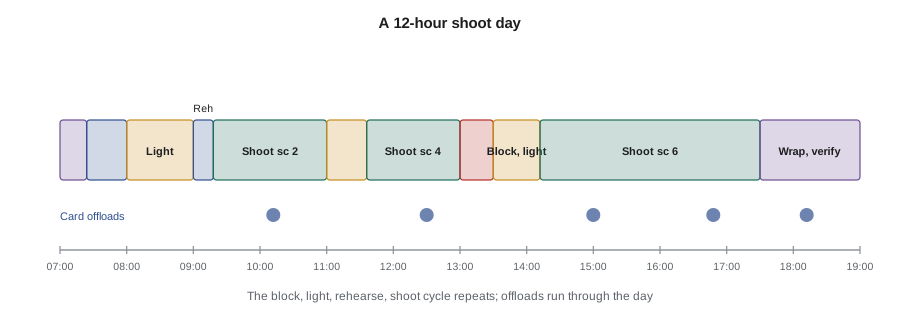
Most shoot days follow the same pattern, often called the block-light-rehearse-shoot cycle.
- Call: crew arrives, safety briefing, camera and lighting meeting.
- Blocking: the director and actors rehearse the scene on set while the DP, first AC and gaffer watch; marks are laid for actors and camera.
- Lighting: actors go to makeup and wardrobe while the crew lights the first set-up, using stand-ins.
- Rehearsal: actors return for a camera rehearsal; focus marks and moves are checked.
- Shooting: takes until the director and DP are satisfied; the second AC logs each take.
- Turnaround: the camera moves to the next set-up while lighting is adjusted.
- Meal: a full meal break about six hours after call.
- Wrap: equipment is packed, data is offloaded and verified, and the next day is confirmed.
Working with the director on set
The DP and director share the monitor and the decisions. A good working relationship on set depends on habits agreed in prep.
- Watch the blocking rehearsal together before lighting, and agree the set-ups for the scene.
- Propose changes quickly and explain them in terms of the story, not the equipment.
- Tell the director honestly how long a set-up will take, and offer a faster alternative if time is short.
- After each take, give camera notes briefly: focus, framing, operating or lighting problems.
- Leave performance notes to the director.
- Protect the agreed look, but be willing to adapt when the actors find something better.
Working with the first assistant director
The first AD runs the schedule. The DP's job is to give accurate time estimates and to warn early when a set-up will run long.
- Before each scene, tell the first AD how many set-ups you plan and how long each will take.
- Ask for the time you need to light, and use it efficiently.
- Warn the first AD as soon as you see a problem: a weather change, a broken light, a slow set-up.
- Agree which shots can be dropped if the day runs late, using the priority column of the shot list.
Worked problem
Tracking the day against the plan
The day plan has 12 set-ups in 10 hours of shooting time. At 13:00, after 5 hours of shooting, 4 set-ups are complete. If the pace continues, how many set-ups will be completed by the end of the day, and what should the DP do now?
Show solution
- Current pace = 4 ÷ 5 = 0.8 set-ups per hour.
- Remaining time = 10 − 5 = 5 hours.
- Expected additional set-ups = 0.8 × 5 = 4.
- Expected total = 4 + 4 = 8, which is 4 short of 12.
Answer: About 8 of 12 set-ups at the current pace. The DP should talk with the director and first AD now to combine or drop low-priority set-ups (Lesson 9) rather than discover the shortfall at wrap.
Coverage and continuity checks
At the end of each scene, before the camera moves on, check that the editor will have what they need.
- Is every line and action covered from at least one usable angle?
- Are there clean entries and exits, and cutaways or inserts for transitions?
- Do eyelines match across reverses, and are you on the correct side of the axis?
- Does lighting continuity hold across the coverage, especially for time of day?
- Is there a clean take of the master or key moments for safety?
- Has the script supervisor (or whoever is tracking continuity) noted any problems?
Ask the director to confirm before moving on. Returning to a struck set-up later costs far more than one more take now.
Worked problem
Checking eyeline across a two-hander
In the master of a kitchen scene, actor A sits frame left and actor B frame right. In A's close single, recorded after a lighting change, she looks frame left. Will the single cut with B's reverse?
Show solution
- In the master the axis runs between A and B, and every shot from this side shows A looking frame right toward B and B looking frame left toward A.
- A single in which A looks frame left must have been shot from the other side of the axis, unless she is meant to be looking at something else.
- Cut against B's reverse, both characters would appear to look in the same direction, as if not talking to each other.
Answer: It will not cut. Reshoot A's single from the correct side so she looks frame right, or plan a camera move that crosses the axis on screen so the audience sees the change.
Exposure and look on set
Keep the image consistent from set-up to set-up and day to day.
- Use false color, waveform and a light meter to hold exposure to the targets set in tests.
- Keep key-to-fill ratios consistent within a scene.
- Note the exposure index, shutter, stop and ND in the camera report for every set-up.
- Apply CDL adjustments on set if the pipeline uses them, and send them with the footage.
- Shoot a gray card or chart at the start of each new lighting set-up for the colorist.
Worked problem
Keeping a contrast ratio consistent
In the wide shot, the key light on actor A reads 400 lux and the fill side 100 lux. In the close-up, the gaffer moves the key closer and it now reads 800 lux, while the fill still reads 100 lux. What are the two ratios in stops, and how should the crew fix the close-up?
Show solution
- Wide ratio = 400 ÷ 100 = 4:1 = 2 stops.
- Close-up ratio = 800 ÷ 100 = 8:1 = 3 stops.
- To restore 2 stops, double the fill to 200 lux or reduce the key to 400 lux.
Answer: The wide is 2 stops and the close-up 3 stops. Restore 2 stops by adding fill (to 200 lux) or reducing the key (to 400 lux), then reset the exposure.
Data management
Data is the film. A lost card can mean a lost scene. The second AC or DIT follows a strict routine on every card.
- Only the designated person removes and offloads cards.
- Copy each card to at least two separate drives using software that verifies the copy with checksums.
- Check the copies by playing back a few clips from each card.
- Mark the card as offloaded and verified before it is formatted; never format a card until at least two verified copies exist.
- Fill in the data report: card, clips, size, checksum result, drives and time.
- At wrap, make a third copy and keep the drives in different places overnight.
Worked problem
Offload time for a day's cards
A shoot day produces 6 cards of 256 GB each, about 80 % full. The offload station copies at about 400 MB/s to two drives at once, and verification takes about the same time again. How long does offloading take per day?
Show solution
- Data per card = 0.8 × 256 = 204.8 GB; for 6 cards = 1,229 GB.
- Copy time = 1,229,000 MB ÷ 400 MB/s ≈ 3,072 s ≈ 51 minutes.
- With verification, total ≈ 102 minutes, about 1.7 hours.
Answer: About 1.7 hours per day, so offloads must run throughout the day, not all at wrap; plan enough cards that none needs to be reused before it is verified.
The production log
Keep a daily log. It is evidence for assessment and the raw material of your reflection.
- Set-ups planned and completed, and the reasons for any differences.
- Creative decisions and changes, and who agreed them.
- Technical problems and how they were solved.
- Safety issues and incidents.
- Data reports and drive locations.
- One thing that went well and one thing to change tomorrow.
Write the log at the end of each day while memories are fresh, even if it is only a few lines.
Dailies
Watch dailies each evening or the next morning, ideally with the director and on a calibrated monitor. Look for focus, exposure, framing, lighting continuity, flicker, reflections and anything in frame that should not be. Fix problems the next day while the set and actors are still available.
End-of-day routine
The last hour of a shoot day matters as much as the first. Before the crew leaves, confirm that every card has two verified copies, that the camera and lighting equipment is packed, counted and secured, and that the location is clean. Check the next day's call sheet with the first AD and confirm any changes to the shot list. Charge every battery overnight. Then write the production log while memories are fresh: set-ups achieved, problems, decisions and one thing to change tomorrow. This routine prevents the most common causes of lost time on day two: missing equipment, flat batteries and unclear plans.
- Verify data copies and record drive locations.
- Count and secure equipment, and note anything damaged.
- Confirm tomorrow's plan with the director and first AD.
- Charge batteries and prepare media.
- Write the production log before sleeping.
Over a five-day shoot, this routine saves several hours and prevents the mistakes that most often cost a day's footage.
Common mistakes
MistakeFormatting a card after one copy is fine if time is short.
InsteadNever format a card until at least two verified copies exist.
MistakeThe DP gives performance notes to actors.
InsteadPerformance notes belong to the director; the DP gives camera notes.
MistakeCoverage problems can be fixed in the edit.
InsteadCheck coverage before striking a set-up; missing angles are costly to recreate.
MistakeRunning late is best discovered at wrap.
InsteadTrack pace through the day and adjust early with the director and first AD.
MistakeDailies are optional on a short shoot.
InsteadDailies catch focus, exposure and continuity problems while they can still be fixed.
Summary and key terms
- Prepare equipment, LUTs and the data plan the night before day one.
- Most days repeat the block, light, rehearse and shoot cycle, with a meal about six hours after call.
- Share decisions with the director and give accurate time estimates to the first AD.
- Check coverage, eyelines and continuity before moving on from a scene.
- Hold exposure targets and contrast ratios, and record camera settings for every set-up.
- Copy each card to two drives with checksum verification before formatting, and keep a third copy at wrap.
- Keep a daily production log and watch dailies to catch problems early.
- Blocking
- Rehearsing actor positions and movements on set.
- Stand-in
- A person who takes an actor's place while a set-up is lit.
- Camera report
- A record of camera settings and takes for each set-up.
- Axis
- The imaginary line between characters that the camera should stay on one side of for consistent screen direction.
- Eyeline
- The direction in which a character looks, which must match across shots.
- Checksum
- A value computed from a file to verify that a copy is identical.
- Data report
- A record of each card's offload, verification and storage.
- Dailies
- Footage from the previous day viewed for review.
- Contrast ratio
- The ratio of key-side to fill-side light on a subject.
- Safety take
- An extra take recorded as insurance against hidden problems.
Practice problems
Work each problem on paper first, then reveal the answer to check.
What happens during blocking?
Show answer
The director and actors rehearse on set while the DP, first AC and gaffer watch and lay marks.
12 set-ups planned in 10 hours; 3 done after 4 hours. What is the projected total?
Show answer
0.75 per hour × 6 hours = 4.5 more, about 7.5 total.
Name three coverage checks before moving on.
Show answer
Any three of lines covered, entries and exits, cutaways, eyelines and axis, lighting continuity, safety take.
Key 600 lux, fill 150 lux: what is the ratio in stops?
Show answer
4:1, or 2 stops.
How many verified copies should exist before a card is formatted?
Show answer
At least two.
Five cards of 200 GB at 100 % full copy at 500 MB/s. How long is the copy?
Show answer
1,000,000 MB ÷ 500 = 2,000 s, about 33 minutes.
What should the DP tell the first AD before each scene?
Show answer
The number of set-ups and the time each will take.
What belongs in the daily production log?
Show answer
Set-ups planned and completed, decisions, problems, safety, data and lessons for tomorrow.
What should be shot at the start of each new lighting set-up?
Show answer
A gray card or chart for the colorist.
What do you look for in dailies?
Show answer
Focus, exposure, framing, lighting continuity, flicker, reflections and unwanted objects in frame.
Lesson quiz · 5 questions
Score 60% or more to complete this lesson.
Create a free account to save your progress, take quizzes and earn a certificate.