
CINE-499 · Lesson 6 of 12 · 29 min
Crew, safety and scheduling
A capstone crew is small, often six to twelve people, and most of them are classmates learning their jobs at the same time as you. As DP you lead the camera, grip and electric departments, and you share responsibility for a safe, well-run set with the director, producer and first assistant director. This lesson covers how to build a small crew, how to plan for safety, how to build a shooting schedule and call sheets, and how union agreements for performers and crew apply to low-budget and student films in Canada and the United States. CINE-340 covered set safety in depth and CINE-420 covered crew roles and careers; here you apply them to your own production.
Building a small crew
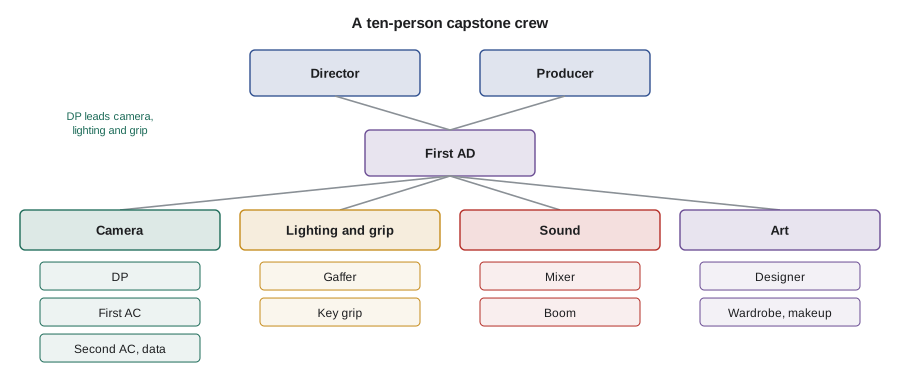
On a professional set, the camera department alone might have five or more people. A capstone combines roles. Decide who does what before the shoot, and write it down.
| Role | Main responsibilities | Often combined with |
|---|---|---|
| Director | Story, performance, final creative calls | Writer |
| Producer | Budget, schedule, paperwork, locations | Production manager |
| First assistant director | Schedule on the day, set safety coordination, calls | Script supervisor on very small crews |
| Director of photography | Look, camera, lighting, leading camera and lighting crew | Camera operator |
| First assistant camera | Focus, lenses, camera builds | — |
| Second assistant camera and data | Slate, reports, media and backups | DIT on small shoots |
| Gaffer | Lighting set-ups, power, electrical safety | Best electric |
| Key grip | Rigging, camera support, flags and safety of rigs | Dolly grip |
| Production sound mixer | Recording, boom, sound reports | Boom operator if two people |
| Production designer | Sets, props, dressing, wardrobe on tiny crews | Wardrobe, makeup |
Choose your first assistant camera and gaffer carefully. They are the people you depend on most. A reliable focus puller who has practiced with your lenses is worth more than any extra light.
Leading the camera and lighting team
Leadership on a small set is mostly communication. Your crew needs to know the plan for the day, the next set-up and what you expect.
- Hold a short camera and lighting meeting at call to walk through the day's shot list.
- Tell the gaffer and key grip the next set-up early, so they can pre-rig while you shoot the current one.
- Give clear, specific requests: "a 4-by-4 frame of diffusion between the window light and actor A" rather than "make it softer".
- Thank people publicly and correct them privately.
- Watch for fatigue and stop work that is becoming unsafe.
Safety planning
Every production needs a safety plan, however small. Most programs require a risk assessment before they approve a shoot, and some require a safety officer on set. CINE-340 covered electrical safety, rigging, heights, weather, vehicles, stunts, effects and fatigue in detail.
- Identify hazards for each location and scene: electrical loads, stands and rigging, heights, water, vehicles, weather, heat or cold, crowds, special effects and props such as replica weapons.
- Rate each hazard by likelihood and severity and decide controls.
- Name the person responsible for each control.
- Include emergency information on every call sheet: nearest hospital, emergency number, first aid kit location and the name of the trained first aider.
- Hold a short safety briefing at call and before any risky set-up.
- Never allow real firearms on a student set; follow the program's policy on replica props, which often bans them entirely or requires a trained armorer and notice to police.
- Stop work if anyone raises a safety concern, and resolve it before continuing.
Worked problem
A risk score for a rooftop scene
The rooftop dusk scene has a fall hazard near an edge without a parapet. Without controls, likelihood is rated 3 and severity 5 on 5-point scales. With a barrier set 2 m back from the edge, a spotter and no equipment within the barrier zone, likelihood drops to 1. What are the scores before and after, and is the residual risk acceptable if the program requires scores of 6 or less?
Show solution
- Before controls: 3 × 5 = 15.
- After controls: 1 × 5 = 5.
- 5 is at or below the program limit of 6.
Answer: The score falls from 15 to 5, which meets the limit. Severity stays at 5, so the barrier and spotter are essential, not optional.
Building the schedule
The first assistant director or producer builds the schedule from the script breakdown (Lesson 3). The DP's input matters because lighting time, sun position and equipment availability drive the order of work.
- Group scenes by location to avoid company moves.
- Within a location, group set-ups by camera direction and lighting, so you light once for several scenes.
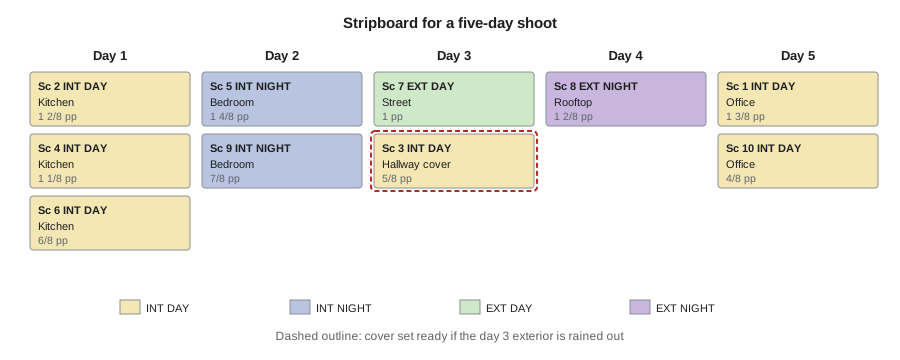
- Schedule exteriors for the right time of day, and plan a cover set (an interior you can shoot if weather fails).
- Schedule difficult or emotional scenes when actors are fresh, usually not at the end of a long day.
- Put the most important scenes early in the shoot, so there is time to reshoot if something goes wrong.
- Respect turnaround: the minimum rest time between the end of one day and the start of the next.
Worked problem
Pages per day and turnaround
A 9-page script is scheduled over 4 days. Day 1 is 12 hours, wrapping at 19:00. The program requires 10 hours of turnaround. What is the average page count per day, and what is the earliest call time on day 2?
Show solution
- Average = 9 ÷ 4 = 2.25 pages per day, or 2 2/8 pages.
- Earliest call = 19:00 + 10 hours = 05:00 the next day.
- Allow travel time on both ends; if the crew needs 1 hour to get home and 1 hour to return, real rest is only 8 hours, so a later call is wiser.
Answer: About 2 2/8 pages per day. The earliest legal call on day 2 is 05:00, but a call of 07:00 gives the crew more real rest.
Call sheets
The call sheet tells everyone when and where to be and what will be shot. It is issued the evening before each shoot day.
- Production title, day number and date.
- General crew call, shooting call and estimated wrap.
- Location address, parking, nearest hospital and emergency information.
- Weather forecast, sunrise and sunset.
- Scenes to be shot, with page counts and cast.
- Cast calls, including makeup and wardrobe times.
- Special requirements: equipment, props, vehicles, safety notes.
- Contact numbers for key crew.
Unions and low-budget agreements
Many capstones use classmates and volunteers, but some teams want to cast union performers or hire experienced crew. Unions and guilds have agreements designed for student and low-budget work, with lower rates and simpler paperwork than full agreements. These agreements change regularly, so check the current version with the union before you cast or hire.
In the United States, performers are represented by SAG-AFTRA, which offers a family of low-budget agreements. For rates valid from July 2026 to June 2027, the Student Film Agreement covers projects under about 35,000 dollars and up to 35 minutes, with negotiable rates; the Short Project Agreement covers projects of 50,000 dollars or less and up to 40 minutes; and the Ultra Low Budget Agreement covers projects up to 300,000 dollars with a day rate of about 257 dollars. Producers must register the project with SAG-AFTRA before casting. Camera crew are represented by IATSE Local 600, which has low-budget agreements for independent productions; most student capstones do not engage union crew.
Worked problem
Cost of a union day performer
A US team casts one SAG-AFTRA performer under the Ultra Low Budget Agreement for 2 days at about 257 dollars per day. The team also budgets a pension and health contribution of about 21 % of wages and 50 dollars of payroll fees. What should the budget allow?
Show solution
- Wages = 2 × 257 = 514 dollars.
- Pension and health = 0.21 × 514 ≈ 108 dollars.
- Total = 514 + 108 + 50 = 672 dollars.
Answer: About 672 dollars. Check the current agreement for the exact rate and contribution percentage before finalizing the budget.
Hours, meals and wellbeing
Long hours are the biggest everyday risk on student sets. Tired people make mistakes with electricity, ladders, vehicles and data. Set clear limits and stick to them.
- Plan days of 10 to 12 hours at most, including meals.
- Provide a hot meal within about 6 hours of call and water throughout the day.
- Respect turnaround and do not schedule an early call after a late wrap.
- Arrange safe transport home after long or late days.
- Make it easy to report harassment or unsafe behavior; follow the program's code of conduct and HSE-108's guidance.
The production book
Collect everything in a single production book, physical or shared online: script, look book, shot lists, overheads, lighting plots, schedule, call sheets, risk assessment, permits, releases, contact list and clearance log. On a small set, the person who knows where every document is saves hours.
A sample day-one call sheet summary
On a capstone, the call sheet can be a single page, but it must be complete. A summary for day one might read: general crew call 07:00 at the apartment location, with parking on the side street and the nearest hospital listed with its address and the emergency number. Shooting call 08:00. Scenes 2 and 4, interior kitchen, day, 2 3/8 pages, with actors A and B called at 07:15 for makeup and wardrobe. Sunrise 07:12 and sunset 18:24, with a forecast of cloud. Special notes: the dolly will be laid on the hall carpet, the window will have an ND 0.6 gel and the building manager must be notified before 08:00. Safety notes: cable runs across the hallway must be covered with mats, and the first aid kit is in the production bag beside the front door. The call sheet also lists the producer, first AD, DP and gaffer with phone numbers, and notes that lunch will be at 13:00.
- Send the call sheet the evening before, and confirm that every person has received it.
- Print a few copies for set; phones run out of battery.
- Update and re-send it if anything changes overnight, with the changes highlighted.
- Keep old call sheets in the production book; they are evidence for the log and the reflection.
Communicating with locations and neighbors
Small crews still affect neighbors. Tell building managers and neighbors when you will be filming, keep noise down early and late, keep corridors and exits clear and leave the location cleaner than you found it. A location that is happy with the crew may be available again for pick-ups.
Common mistakes
MistakeA small crew does not need a safety plan.
InsteadEvery production needs a risk assessment, emergency information and a safety briefing.
MistakeThe earliest legal call time is always the best call time.
InsteadAllow for travel so the crew gets real rest, not just the minimum turnaround.
MistakeUnion performers cannot work on student films.
InsteadUnions have student and low-budget agreements; register with the union before casting.
MistakeThe DP's only job is the camera.
InsteadThe DP leads camera, lighting and grip and shares responsibility for a safe, well-run set.
MistakeSchedule the most important scene last so the crew is warmed up.
InsteadSchedule key scenes early so there is time to reshoot if needed.
Summary and key terms
- A capstone crew combines roles; write down who does what.
- The DP leads camera, lighting and grip with clear, early communication.
- A safety plan identifies hazards, scores risk, assigns controls and puts emergency information on call sheets.
- Schedules group scenes by location and lighting, protect exteriors with a cover set and respect turnaround.
- Call sheets give times, locations, scenes, cast, weather, safety notes and contacts.
- ACTRA, UDA and SAG-AFTRA offer student and low-budget arrangements; check current terms before casting.
- Limit hours, feed people well and keep a production book with every document.
- First assistant director
- The crew member who runs the schedule on set and coordinates safety.
- Risk assessment
- An evaluation of hazards, their likelihood and severity, and controls.
- Stripboard
- A schedule display with one strip per scene, grouped by day.
- Cover set
- An alternative location or scene to shoot if weather prevents an exterior.
- Turnaround
- The minimum rest time between the end of one shoot day and the start of the next.
- Call sheet
- The daily document giving times, locations, scenes, cast and safety information.
- Company move
- Moving the unit from one location to another during the day.
- Low-budget agreement
- A union agreement with reduced rates and terms for small productions.
- Production book
- The collected planning, legal and safety documents for a production.
- Pre-rig
- Setting up lights or grip equipment for the next set-up while shooting the current one.
Practice problems
Work each problem on paper first, then reveal the answer to check.
Which two crew members does the DP depend on most?
Show answer
The first assistant camera and the gaffer.
Likelihood 4, severity 3: what is the risk score?
Show answer
12.
Name three things a call sheet must include.
Show answer
Any three of times, location, hospital and emergency information, weather, scenes, cast calls, special requirements and contacts.
Why group set-ups by camera direction?
Show answer
To light once for several scenes and save time.
Wrap at 20:00 with 10 hours of turnaround: what is the earliest call?
Show answer
06:00 the next day.
A 6-page script over 3 days averages how many pages per day?
Show answer
2 pages.
What is a cover set?
Show answer
An interior or alternative scene to shoot if weather prevents an exterior.
What should a team do before casting a SAG-AFTRA or ACTRA performer?
Show answer
Contact the union, choose the right agreement and register the project.
Why should key scenes be scheduled early?
Show answer
To leave time to reshoot if something goes wrong.
What goes in a production book?
Show answer
Script, look book, shot lists, overheads, plots, schedule, call sheets, risk assessment, permits, releases, contacts and clearance log.
Lesson quiz · 5 questions
Score 60% or more to complete this lesson.
Create a free account to save your progress, take quizzes and earn a certificate.