
CINE-499 · Lesson 5 of 12 · 27 min
Permits, releases, music and legal clearances
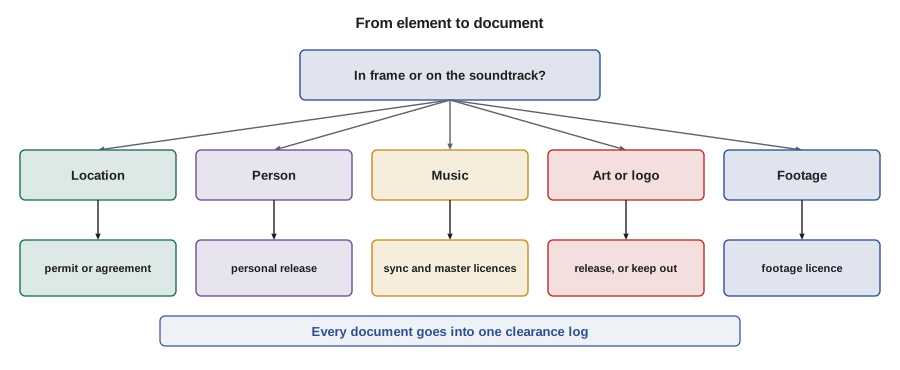
A beautiful short film that cannot be screened is a portfolio problem. Festivals, broadcasters and online platforms ask whether the film has the rights to everything in it: locations, people, music, artwork, logos and footage. If the paperwork is missing, the film may be rejected or have to be re-cut. The producer usually manages clearances, but the DP makes many of the choices that create clearance problems, such as framing a recognizable mural, a brand logo, a television showing a broadcast or a stranger in a public place. This lesson covers location permits, personal releases, minors, music licensing, artwork and trademarks, and errors and omissions insurance, with the main differences between Canada and the United States.
Why clearances matter to the DP
Clearance means confirming that you have permission, or do not need permission, for each element of the film. A DP who understands clearance can avoid problems while composing, rather than creating them for the editor to fix.
- Keep recognizable logos, artwork, posters and screens out of frame unless they are cleared.
- Avoid capturing identifiable members of the public in a way that features them, unless they sign releases.
- Know which locations are covered by permits and where the boundaries are.
- Record the details of any art, props or screens you do feature, so the producer can clear them.
- Do not shoot from places you have no permission to be, such as private rooftops or rail property.
Location permits
Filming on public property, such as streets, parks, transit stations and government buildings, usually needs a permit from the city film office or the property owner. Requirements depend on the size of the crew, equipment on sidewalks or roads, parking, hours and any special elements such as weapons, smoke or drones.
- Contact the film office early; many need at least a few business days and some need weeks.
- Ask whether there is a student permit or a small-crew category with lower fees.
- Provide a certificate of insurance if asked (Lesson 4).
- Notify residents or businesses if the permit requires it.
- Carry the permit on set and follow its conditions exactly.
- Private locations need a location agreement with the owner, even if no city permit is required.
Parks, transit agencies, universities and shopping centers often have their own permit processes separate from the city. National and provincial or state parks have their own rules for commercial filming, which may include student work.
Personal releases
A personal release (also called an appearance or talent release) is a signed document in which a person agrees that their image, voice and performance may be used in the film and its promotion. Get releases from every cast member and from any identifiable person who is featured.
- Use the program's standard release where one exists.
- Get the release signed before shooting, not after.
- For background members of the public who are not featured, the rules differ by country and situation; posting notices about filming helps but does not replace releases for featured people.
- Store signed releases with the production's records.
In the United States, image rights are mostly state law. Many states recognize a right of publicity, which protects against using a person's name or likeness for commercial purposes without consent; New York's Civil Rights Law sections 50 and 51 and California Civil Code section 3344 are well-known examples. Courts often give more room to expressive works such as films than to advertising, but the safe practice is still to get releases from everyone identifiable and featured, because distributors and errors and omissions insurers will ask for them.
Minors on set
Working with performers under 18 brings extra rules: a parent or guardian must sign the release, working hours are limited, a guardian must usually be present and some places require permits or chaperones. Schools may also need notice when filming involves students.
- Have a parent or guardian sign the release and any program consent forms.
- Keep the minor's working hours within the legal limits and the program's rules.
- Never leave a minor alone with crew members; a guardian or chaperone must be present.
- Plan breaks, meals and schooling if the shoot falls on school days.
In the United States, child performer rules are set by states. California, for example, requires entertainment work permits for minors, limits hours by age, requires studio teachers on many sets and, under the Coogan law, requires part of a minor's earnings to be set aside in a trust account. Other states have their own rules, and some have few. Check the rules for the state where you are shooting, and follow the program's policy.
Music licensing
Music is the most common clearance failure in student films. Using a well-known song without permission can block festival screenings and online distribution. Two separate permissions are usually needed for recorded music.
- A synchronization (sync) license from the music publisher, for the composition.
- A master use license from the record label or owner of the recording, for the specific recording.
- Festival licenses are cheaper than worldwide all-media licenses; negotiate for the uses you actually need, with an option to extend.
- Original music written for the film, with a composer agreement, avoids most of these problems.
- Royalty-free and production music libraries provide music under license; read the terms for festival and online use.
- "Fair use" or "fair dealing" rarely covers music used as score or source music in a film.
In the United States, public performance rights are licensed through performing rights organizations such as ASCAP, BMI and SESAC, and mechanical rights are handled by organizations such as the Harry Fox Agency and the Mechanical Licensing Collective. The production still needs sync and master licenses for music in the film. Fair use under section 107 of the Copyright Act depends on four factors and rarely covers using a song as background or score.
Worked problem
Comparing music options
The director wants a song in the final scene. A festival-only license for a known song costs 600 dollars for sync plus 600 dollars for master, with a worldwide all-media upgrade later for 3,500 dollars. A local composer will write and record an original track for 400 dollars with all rights. The film's music budget is 500 dollars. What are the options?
Show solution
- Known song, festival only: 600 + 600 = 1,200 dollars, more than double the budget.
- Later upgrade for online release: a further 3,500 dollars.
- Original track: 400 dollars, within budget, with all rights for every use.
Answer: The original track fits the budget and covers festival and online use. The known song would cost 1,200 dollars for festivals alone and 4,700 dollars for full rights.
Artwork, logos, screens and products
Art on walls, logos on clothing and products, and images on television or computer screens can all need clearance if they are prominent and identifiable. Production designers usually replace or cover problem items, but the DP must watch the frame.
- Use original art made for the film, or get written permission from the artist.
- Cover or turn away logos on clothing and products, or use generic props.
- Create screen content (websites, messages, video calls) rather than filming real sites or broadcasts.
- Murals and public art may be protected by copyright; a wide shot where the mural is incidental is lower risk than featuring it.
- Architecture is treated differently in each country; Canada and the US both allow photographing buildings visible from public places in many cases (Copyright Act s. 32.2 in Canada; 17 U.S.C. section 120 in the US), but sculptures and art on buildings may be different.
Worked problem
A clearance log entry
In scene 3, a coffee mug with a recognizable chain's logo appears in four set-ups, and a framed print by a local photographer hangs behind the actors in two set-ups. What should the clearance log record and what should the team do?
Show solution
- Item 1: logo mug, scene 3, set-ups 3A to 3D; options are to swap it for a plain mug or turn the logo away.
- Item 2: framed print, scene 3, set-ups 3B and 3C; contact the photographer for written permission or replace it.
- Note the decision and the date in the log.
Answer: Log both items with scene and set-up numbers, swap the mug for a plain one and either get written permission for the print or replace it before shooting.
Footage, stills and archival material
Any footage or photographs you did not shoot need a license: news clips, stock footage, family photographs, other films playing on a television. Stock libraries sell clips with clear license terms. Family material needs permission from whoever owns it, usually the person who shot it or their family. Note every outside element in a clearance log with its source and license.
Errors and omissions insurance
Errors and omissions (E&O) insurance covers legal claims about content, such as copyright or privacy claims. Distributors, broadcasters and streamers usually require it before they acquire a film, along with a full clearance log and chain-of-title documents. Most festivals do not require E&O for shorts, but some distributors of short films do. If a capstone short is picked up for distribution, the producer will need to show that every element is cleared, which is why keeping good records from the start matters.
Putting it together: the clearance log
Keep a single clearance log for the production. Each row records an element, where it appears, who owns it, what permission you have and the document's location.
| Element | Scene and set-up | Owner | Permission | Document |
|---|---|---|---|---|
| Kitchen location | 2, 4, 5 | Apartment owner | Location agreement | Signed, in folder 03 |
| Actor A | All | Performer | Personal release | Signed, in folder 01 |
| Final scene music | 9 | Composer | Composer agreement, all rights | Signed, in folder 05 |
| Framed print | 3B, 3C | Local photographer | Written permission | Email saved in folder 05 |
| Street exterior | 7 | City film office | Student permit | PDF in folder 03 |
When to ask for help
Clearance questions can be complicated. If a scene features a real business, a famous artwork, a news event or a recognizable person who has not signed a release, ask the program's advisor or a legal clinic before shooting. Many film schools and some arts organizations offer access to legal advice for student and emerging filmmakers. It is much easier to change a prop or a framing than to re-cut a finished film.
Common mistakes
MistakeMusic found online is free to use in a student film.
InsteadMost music needs sync and master licenses; use original or properly licensed music.
MistakeReleases can be collected after the shoot.
InsteadGet releases signed before shooting, when people are most willing to sign.
MistakeThe DP has nothing to do with clearances.
InsteadThe DP's framing decides whether logos, art, screens and bystanders appear.
MistakeA permit for one street covers the whole neighborhood.
InsteadPermits have boundaries and conditions; shoot only where and when the permit allows.
MistakeFair use or fair dealing covers any short excerpt.
InsteadThese exceptions are narrow and rarely cover music or footage used as part of a narrative film.
Summary and key terms
- Clearance means having, or not needing, permission for every element of the film.
- Public locations usually need permits; private locations need location agreements.
- Get personal releases from cast and featured people before shooting; Quebec and US publicity laws make this especially important.
- Minors need guardian consent, limited hours and supervision under provincial or state rules.
- Recorded music usually needs a sync license and a master license; original music avoids most problems.
- Keep logos, art and screens out of frame unless cleared, and log what you feature.
- Keep one clearance log; distributors and E&O insurers will ask for it.
- Clearance
- Confirming permission, or that none is needed, for an element of a film.
- Film permit
- Permission from a city or property owner to film on public or managed property.
- Personal release
- A signed agreement allowing use of a person's image, voice and performance.
- Right of publicity
- In the US, a person's right to control commercial use of their name or likeness.
- Sync license
- Permission to use a musical composition in timed relation to images.
- Master use license
- Permission to use a specific sound recording.
- Composer agreement
- A contract with a composer for original music and its rights.
- Clearance log
- A record of every element that needs permission and the documents that grant it.
- Errors and omissions insurance
- Insurance against legal claims about a film's content.
- Chain of title
- Documents proving who owns the rights in a film and its underlying material.
Practice problems
Work each problem on paper first, then reveal the answer to check.
Name three things a DP can do to avoid clearance problems while framing.
Show answer
Keep logos, art and screens out unless cleared; avoid featuring identifiable bystanders; stay within permitted areas.
What two licenses does recorded music usually need?
Show answer
A sync license for the composition and a master use license for the recording.
Why are releases especially important in Quebec?
Show answer
The Civil Code and Charter protect a person's image, and the Aubry decision confirmed it.
What does a US right of publicity protect?
Show answer
Against commercial use of a person's name or likeness without consent.
A festival license costs 400 for sync and 450 for master. What is the total?
Show answer
850 dollars.
What extra rules apply to minors?
Show answer
Guardian consent, limited hours, supervision and sometimes permits or trust accounts.
What should a clearance log record?
Show answer
The element, scene and set-up, owner, permission and where the document is kept.
When is E&O insurance usually needed?
Show answer
When a distributor, broadcaster or streamer acquires the film.
How can screen content be cleared easily?
Show answer
Create original screen content rather than filming real websites or broadcasts.
Do public-place exceptions for buildings automatically cover sculptures?
Show answer
No; sculptures and art on buildings may be treated differently.
Lesson quiz · 5 questions
Score 60% or more to complete this lesson.
Create a free account to save your progress, take quizzes and earn a certificate.