
CINE-499 · Lesson 4 of 12 · 30 min
Budget and resources for a micro-budget short
Every creative decision in the look book has a cost, and a capstone budget is small. This lesson shows how to build a budget for a micro-budget short, how to find equipment, locations and crew without much money, where funding and in-kind support can come from in Canada and the United States, and how to protect the production with insurance. All money figures here are illustrative. Prices vary widely by city, program and year, so always get current quotes. The goal is not to make you a producer, but to give you the numbers a cinematographer needs to argue for the right equipment and to make sensible trade-offs when the money runs short.
The DP's role in the budget
On a capstone the producer usually owns the budget, but the DP shapes a large part of it: camera, lenses, grip, electric, data storage, expendables and sometimes the grade. A DP who can put numbers to their requests is far more persuasive than one who simply asks for "more lights".
- Prepare an equipment list with quantities and the number of days needed.
- Get at least two quotes for anything you rent, and ask about student or weekly rates.
- Show which items are essential and which are wish-list.
- Offer cheaper alternatives for each wish-list item.
- Track spending against the budget during the shoot.
The budget top sheet
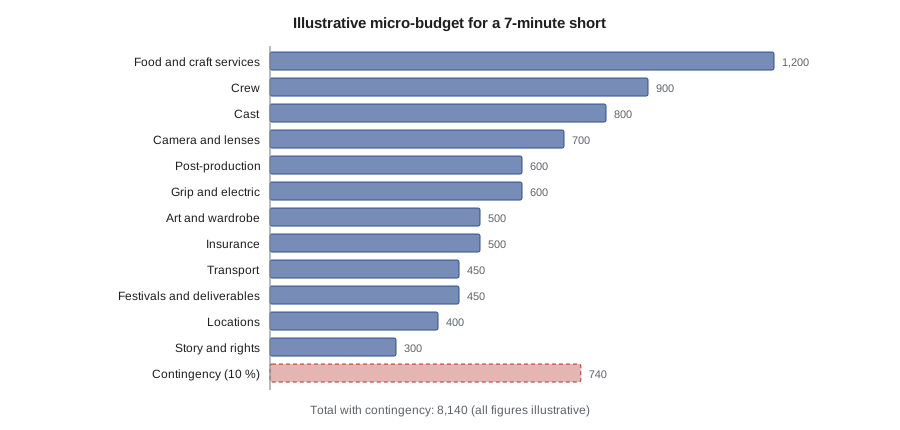
Budgets are organized into above-the-line costs (story, producer, director, principal cast) and below-the-line costs (crew, equipment, locations, post). A top sheet summarizes each category on one page.
| Category | Main items | Amount |
|---|---|---|
| Story and rights | Script, music license | 300 |
| Cast | Fees or honoraria, travel | 800 |
| Crew | Honoraria, travel | 900 |
| Camera and lenses | Rental beyond program kit | 700 |
| Grip and electric | Rental, expendables | 600 |
| Art and wardrobe | Props, set dressing, costumes | 500 |
| Locations | Fees, permits | 400 |
| Food and craft services | Meals for 5 days | 1,200 |
| Transport | Van, fuel, parking | 450 |
| Post-production | Storage, color, sound mix | 600 |
| Insurance | Short-term production policy | 500 |
| Festivals and deliverables | Submissions, DCP | 450 |
| Subtotal | 7,400 | |
| Contingency (10 %) | 740 | |
| Total | 8,140 |
Two lines surprise first-time producers. Food is often the largest single line, because feeding a crew and cast well is the cheapest way to keep morale up when nobody is paid much. Contingency is not optional: something always goes wrong, and 10 % is a common minimum.
Worked problem
Building the top sheet with contingency
A team's line items total 6,850 dollars before contingency. The program requires a 10 % contingency. The team has raised 7,200 dollars. Is the budget covered, and what are the options?
Show solution
- Contingency = 0.10 × 6,850 = 685 dollars.
- Total = 6,850 + 685 = 7,535 dollars.
- Shortfall = 7,535 − 7,200 = 335 dollars.
- Options: cut a wish-list item (for example, a second lens rental), seek in-kind support or raise a little more.
Answer: The budget is 335 dollars short. Cutting a non-essential rental or finding an in-kind donation closes the gap without touching the contingency.
Equipment: program kit, rentals and in-kind support
Most programs lend students a camera package, basic lights and grip. Use it first. Then rent only what the look genuinely needs.
- Ask rental houses about student rates, weekend rates (often one day's charge for a Friday-to-Monday rental) and weekly rates.
- Some rental houses support student films with discounts or loans in exchange for a credit; ask politely and early.
- Local film co-operatives often rent equipment to members at low cost.
- Borrowed equipment needs insurance just as rented equipment does.
- Check every item at pick-up against the order and photograph its condition.
Worked problem
Rental versus weekend rate
A lens set rents for 180 dollars a day, or 180 dollars for a weekend (Friday pick-up, Monday return). A weekly rate is 3 days' charge. The shoot is Friday to Tuesday. Which is cheaper: a weekend plus one day, or a week?
Show solution
- Weekend plus Monday and Tuesday: 180 + 2 × 180 = 540 dollars if Monday is charged; check the house's policy.
- Weekly rate: 3 × 180 = 540 dollars for up to 7 days.
- The weekly rate costs the same and covers a test day before the shoot.
Answer: Both cost about 540 dollars here, so the weekly rate is better value because it adds flexibility for tests or a reshoot.
Locations and permits
Locations can be free, cheap or expensive. Friends' apartments and family businesses are common, but treat them as professional locations with a signed agreement, a clear schedule and a clean-up plan. Public spaces usually need a film permit (Lesson 5).
- Ask for a location agreement even for free locations.
- Budget for a small thank-you fee or gift and for damage protection.
- Include parking, holding areas and power in the location cost.
- Student permits are often cheaper or free; ask the city film office.
Food, transport and the hidden costs
Hidden costs sink micro-budgets: parking tickets, fuel, extra hard drives, gels and gaffer tape, last-minute props, a replacement for a broken stand, a second day for a reshoot. Put them in the budget from the start.
- Expendables: tape, gels, diffusion, batteries, clamps, cleaning supplies.
- Data: at least two drives per copy of the footage, plus a cloud or third copy.
- Transport: van rental, fuel, parking, tolls.
- Food: meals, snacks, water and dietary needs for every shoot day.
Worked problem
Budgeting data storage
The camera records about 280 Mb/s. The team expects 3 hours of footage per shoot day for 5 days and keeps three copies. Drives cost about 25 dollars per terabyte. What is the storage budget?
Show solution
- Data per hour = 280 ÷ 8 × 3,600 = 126,000 MB ≈ 126 GB.
- Per day = 3 × 126 = 378 GB; for 5 days = 1,890 GB ≈ 1.9 TB.
- Three copies = 5.7 TB; round up to 6 TB plus working space, about 8 TB.
- Cost ≈ 8 × 25 = 200 dollars.
Answer: About 200 dollars for roughly 8 TB of drives, covering three copies and some working space.
Funding and support in Canada and the United States
Capstone films are mostly funded by the team, the program and small grants, crowdfunding or in-kind support. Larger public funds usually target professional emerging filmmakers rather than student projects, but it helps to know the landscape for your next film.
In the United States, emerging filmmakers usually start with the following kinds of support. Check eligibility and deadlines on each organization's current pages, because programs and amounts change.
- Local film collectives and media arts centers offer low-cost equipment, workshops and sometimes grants for members.
- State arts councils and state film offices may have small grants or support programs; state film incentives usually target larger productions.
- The National Endowment for the Arts funds nonprofit organizations rather than individual filmmakers, so individuals usually reach that money through a nonprofit partner.
- Fiscal sponsorship lets an individual project receive tax-deductible donations and some grants through a nonprofit sponsor such as Fractured Atlas, the International Documentary Association or SFFILM; sponsors charge a fee, usually a percentage of funds received.
- Festival labs, foundation grants and pitch competitions support emerging filmmakers, mostly after a first short.
Crowdfunding is common for capstones. A small campaign aimed at friends, family and the local community can raise enough to cover food, insurance and festival fees. Budget for the platform's fees and for any rewards you promise.
Worked problem
Net proceeds from a crowdfunding campaign
A campaign raises 3,000 dollars. The platform takes 5 % and payment processing about 3 %. Rewards (posters and downloads) cost about 250 dollars to make and send. What does the production receive for the film?
Show solution
- Platform and processing fees = 0.08 × 3,000 = 240 dollars.
- Net after fees = 3,000 − 240 = 2,760 dollars.
- After rewards = 2,760 − 250 = 2,510 dollars.
Answer: About 2,510 dollars, roughly 84 % of the amount raised.
Insurance
Insurance protects people, equipment and locations. Many programs have a policy that covers student productions; read it carefully to see what it includes. Rental houses and locations usually ask for a certificate of insurance naming them as additional insured or loss payee.
- Commercial general liability covers injury to third parties and damage to their property.
- Equipment coverage protects rented and borrowed gear.
- Workers' compensation or accident coverage protects crew; rules for volunteers and students vary.
- Errors and omissions insurance covers legal claims about content and is usually needed only for distribution (Lesson 5).
- Short-term production policies for independent shorts can be bought for a few days.
In the United States, workers' compensation rules are set by each state, and treatment of volunteers and interns varies. Programs often cover enrolled students under institutional policies; check before bringing outside crew.
Tracking costs during the shoot
Keep receipts for everything and log spending daily in a simple spreadsheet. Compare actual spending to the budget for each category at the end of each day. If a category is running over, decide early where the money will come from, usually by moving it from a category that is under budget or from contingency.
Negotiating with rental houses and suppliers
Rental houses and suppliers deal with students every season. A professional approach gets better results than asking for favors at the last minute. Contact them early, explain the project in a sentence, send a clear equipment list with dates and ask what student rates or packages they offer. Be honest about the budget; some houses can suggest cheaper alternatives that do the same job, such as an LED panel kit instead of a tungsten package. Pick up and return on time, return everything clean and in its case and report any damage immediately. If they support the film with a discount or loan, credit them correctly and send them the finished film. A good relationship with a rental house is one of the most valuable things you can build early in a career.
- Contact suppliers at least two weeks before the shoot.
- Send a clear list with quantities, dates and the production's insurance details.
- Ask what alternatives could meet the need for less money.
- Return equipment clean, complete and on time.
- Credit and thank supporters and send them the finished film.
Common mistakes
MistakeFood is a small line in a micro-budget.
InsteadFood is often the largest single line and the cheapest way to keep a volunteer crew motivated.
MistakeContingency can be skipped if the budget is tight.
InsteadAlways keep a contingency, commonly at least 10 %, because something always goes wrong.
MistakeFree locations need no paperwork.
InsteadUse a signed location agreement for every location, free or paid.
MistakeBorrowed equipment does not need insurance.
InsteadBorrowed and rented equipment both need coverage.
MistakeLarge public film funds are designed for student shorts.
InsteadMost large programs target professional emerging filmmakers; capstones rely on programs, co-ops, small grants and crowdfunding.
Summary and key terms
- The DP shapes much of the budget through camera, grip, electric, data and expendables.
- A top sheet summarizes above-the-line and below-the-line categories with a contingency.
- Use program kit first and rent only what the look needs, with student, weekend or weekly rates.
- Budget for hidden costs: expendables, data, transport, parking and food.
- Support comes from programs, co-ops, arts councils, crowdfunding and, in the US, fiscal sponsorship.
- Insurance protects people, equipment and locations, and rules differ by province or state.
- Track spending daily and move money early when a category runs over.
- Top sheet
- A one-page summary of a budget by category.
- Above the line
- Costs for story, producer, director and principal cast.
- Below the line
- Costs for crew, equipment, locations and post-production.
- Contingency
- A reserve added to a budget to cover unexpected costs.
- Weekend rate
- A rental rate that charges one day for a weekend pick-up and return.
- In-kind support
- Goods or services donated instead of cash.
- Fiscal sponsorship
- An arrangement in which a nonprofit receives funds on behalf of a project.
- Certificate of insurance
- A document proving that a policy covers a named party.
- Expendables
- Consumable supplies such as tape, gels and batteries.
- Location agreement
- A signed contract granting permission to film at a location.
Practice problems
Work each problem on paper first, then reveal the answer to check.
What equipment categories does the DP usually shape in the budget?
Show answer
Camera, lenses, grip, electric, data storage, expendables and sometimes the grade.
Line items total 5,000 dollars. What is the total with a 10 % contingency?
Show answer
5,500 dollars.
Why is food often the largest line?
Show answer
Feeding an unpaid or low-paid crew well keeps morale and performance up.
A drive plan needs three copies of 2 TB of footage plus 2 TB working space. How much storage?
Show answer
8 TB.
A campaign raises 2,000 dollars with 8 % fees and 150 dollars of rewards. What is left?
Show answer
2,000 − 160 − 150 = 1,690 dollars.
Name three kinds of insurance a short might need.
Show answer
Any three of general liability, equipment, workers' compensation or accident, errors and omissions, short-term production policy.
Why get a location agreement for a free location?
Show answer
It records permission, schedule, responsibilities and damage arrangements.
What does fiscal sponsorship allow in the US?
Show answer
Tax-deductible donations and some grants through a nonprofit sponsor, for a fee.
What should you check at equipment pick-up?
Show answer
Every item against the order, with photographs of its condition.
What should happen when a category runs over budget?
Show answer
Decide early where the money comes from, usually another category or contingency.
Lesson quiz · 5 questions
Score 60% or more to complete this lesson.
Create a free account to save your progress, take quizzes and earn a certificate.