
CINE-220 · Lesson 5 of 12 · 25 min
Photometrics and choosing fixtures
How much light does a fixture produce, and how much is needed? Gaffers answer these questions every day: when they plan a lighting package, decide how far a light can be from an actor, choose between a 4K and an 18K for a window, or work out whether LEDs can replace HMIs on a location with limited power. Photometrics, the measurement of light as the eye and camera see it, gives the numbers to make these decisions. This lesson covers luminous flux, intensity, illuminance and luminance; beam and field angles; reading manufacturer photometric data; the inverse square law and its limits; calculating the stop a fixture will give; the effect of diffusion, bounce and gels; matching fixtures to the exposure needed; and choosing a lighting package.
Photometric quantities
Four quantities describe light from a fixture:
- Luminous flux, measured in lumens (lm): the total amount of visible light emitted in all directions. Lamp and LED specifications often quote lumens, but lumens alone do not say how concentrated the light is.
- Luminous intensity, measured in candelas (cd): the light emitted in a particular direction. A narrow spotlight concentrates its lumens into a small angle, giving high candela values in the center of the beam.
- Illuminance, measured in lux (lumens per square meter) or foot-candles (lumens per square foot): the light falling on a surface, such as an actor's face. This is what an incident meter measures and what determines exposure (CINE-202).
- Luminance, measured in candelas per square meter (nits): the brightness of a surface as seen by the camera, such as a lit wall, a practical lampshade or a screen.
For a point source, illuminance at a distance \(d\) along the beam is related to intensity by:
where \(E\) is in lux, \(I\) in candelas and \(d\) in meters. This is the inverse square law in photometric form.
| Quantity | Unit | Describes | Measured with |
|---|---|---|---|
| Luminous flux | Lumen (lm) | Total light output | Integrating sphere (manufacturer) |
| Luminous intensity | Candela (cd) | Light in a direction | Goniophotometer (manufacturer) |
| Illuminance | Lux or foot-candle | Light falling on a surface | Incident meter |
| Luminance | cd/m² (nit) | Brightness of a surface | Spot meter, luminance meter |
Beam and field angles
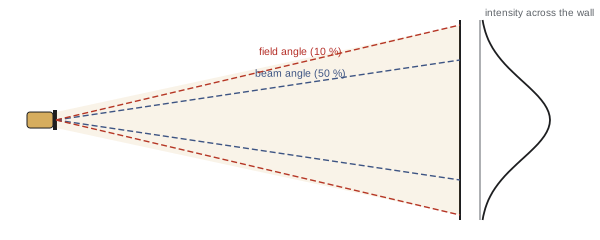
A fixture's beam is not uniform: it is brightest at the center and falls off toward the edges. The beam angle is defined as the angle at which intensity falls to 50 % of the center value; the field angle is where it falls to 10 %. A Fresnel at spot might have a beam angle of 10 to 15 degrees, and at flood 50 to 60 degrees. The diameter of the area lit within the beam angle at distance \(d\) is:
Knowing the beam diameter helps gaffers decide whether one light covers an actor's movement, or whether several lights or a wider unit are needed. The center of the beam, the hot spot, is brighter than the edges by up to one stop at the beam angle, which matters when an actor walks across the beam.
Reading photometric data
Manufacturers publish photometric tables or calculators showing the illuminance a fixture produces at various distances, beam settings and color modes, and the diameter of the lit area. For example, a 2 kW tungsten Fresnel might be listed as giving about 1,700 lux at 5 m at full spot with a 1.5 m beam diameter, and about 300 lux at 5 m at full flood with a 5 m diameter. LED manufacturers publish similar data for each color temperature and mode. Photometric apps and online tools compare fixtures side by side. Always check the conditions of the data: spot or flood, distance, mode, and whether the figure is for the center of the beam. Real-world output may be lower because of aging lamps, voltage drop on long cable runs, gels, diffusion and accessories.
The inverse square law and its limits
For a source that is small compared with the distance, illuminance falls with the square of distance: doubling the distance quarters the light, a loss of two stops; moving 1.4 times farther loses one stop (CINE-202). This lets gaffers estimate exposure at new positions quickly. The law does not hold for large sources at close range, such as a big soft box or a bounce board two meters from an actor, where the falloff is gentler, nor for collimated beams such as PARs and the sun, which fall off very slowly. Fresnels behave approximately as point sources at normal working distances, but their spot-flood setting changes their effective intensity. When precision matters, measure with a meter.
Calculating the stop
Once the illuminance on the subject is known, the T-stop follows from the exposure equation (CINE-202):
with \(E\) in lux, \(S\) the EI, \(t\) the exposure time and \(C\) a calibration constant of about 250. A convenient rule of thumb in North America is that at 24 fps with a 180-degree shutter, ISO 800 and T2.8, a correct exposure needs roughly 10 to 12 foot-candles (about 110 to 130 lux) on the subject, depending on the meter constant; each doubling of EI halves the light needed, and each stop closed doubles it.
Worked problem
Will this fixture give T4?
The DP wants T4 at EI 800, 24 fps, 180° shutter (1/48 s). A 1.2 kW HMI Fresnel at full spot gives about 9,000 lux at 5 m, according to the manufacturer. The actor is 7 m from the light. What stop will the light give, before diffusion?
Show solution
- Illuminance at 7 m: \(9000 \times (5/7)^2 \approx 9000 \times 0.51 = 4590\) lux.
- Compute \(N^2 = (4590 \times 800 \times 1/48)/250 = 76{,}500/250 = 306\).
- \(N \approx 17.5\), between T16 and T22.
- That is about 3 stops more than T4, so the light can be pushed through heavy diffusion, flooded, or replaced by a smaller unit.
Answer: About T16 to T22 at 7 m, roughly 3 stops more than needed for T4.
The effect of diffusion, bounce and gels
Every modifier costs light. Light diffusion such as quarter or half frost may lose a quarter to half a stop; heavier diffusion such as full grid cloth or a silk can lose one to two stops, while spreading the light into a larger, softer source. Bouncing light off a white board or a wall typically loses two to four stops or more, depending on the surface, size and distance, because the bounced light spreads widely. Color correction gels also lose light: full CTB about 1.5 stops, full CTO about two-thirds of a stop, quarter gels much less (Lesson 6). Planning a fixture choice must account for these losses. Manufacturers of diffusion materials publish transmission values, and experienced gaffers know approximate losses for common setups.
| Modifier | Approximate light loss |
|---|---|
| 1/4 CTO | About 1/3 stop |
| Full CTO | About 2/3 stop |
| Full CTB | About 1.5 stops |
| Light frost (e.g. 216 half) | About 1/2 stop |
| Full grid cloth or 216 white diffusion | About 1.5 stops |
| Bounce off a white board at close range | About 2–3 stops |
| Bounce off a distant white ceiling | 3–5 stops or more |
Matching fixtures to the job
Choosing the right fixture involves the required exposure at the subject, the distance from the light to the subject, the quality of light needed (hard, soft or bounced), the coverage area, the color balance, the power available and the space for rigging. A gaffer might reason: the window light must reach an actor 6 m inside a room at T2.8 at EI 800, through a 12 × 12 frame of grid cloth 3 m outside the window; the frame loses about 1.5 stops; therefore the light needs to provide about 3 times the required illuminance at the frame; a 4K HMI PAR at the right distance does it with room to spare, while an LED panel might not. Building a mental library of how many foot-candles each common fixture gives at typical distances speeds these decisions.
Choosing a lighting package
A lighting package is the set of fixtures, stands, cables, distribution and grip equipment rented or owned for a production. Gaffers build packages from the script, the DP's lighting approach, location scouts, the shooting schedule and the budget. A typical small feature package might include several large HMIs or high-output LEDs for windows and exteriors, a selection of LED panels and tubes for interiors, tungsten Fresnels for hard accents, practical bulbs and dimmers, diffusion frames and textiles, a generator or battery distribution, cable and distribution boxes, and spares. Packages are adjusted for special days, such as large night exteriors needing condors and big units. Rental houses provide photometric data, test facilities and advice. Over-ordering wastes money, while under-ordering costs time on set; experience and good communication with the DP strike the balance.
Photometric planning tools
Software and apps help with photometric planning. Manufacturer calculators show output at a distance; lighting design software originally developed for theater and architecture can model sets and fixtures in three dimensions, showing illuminance across the set; and previsualization tools allow cinematographers to plan lighting in virtual models of sets and locations. Even with these tools, on-set measurement with incident and spot meters remains essential, since real sets, materials and conditions always differ from models.
Foot-candle shortcuts on set
Many North American gaffers think in foot-candles because older meters and manuals used them, and because simple rules of thumb are easy to remember. At EI 800 and 24 fps with a 180-degree shutter, about 10 to 12 foot-candles give T2.8; doubling to about 20 to 25 gives T4, and about 40 to 50 gives T5.6. At EI 400, double each value. These shortcuts let a gaffer glance at a meter reading in foot-candles and know the stop immediately. European and many Canadian crews use lux, and modern meters display either unit, along with T-stops directly.
Coverage and evenness
For wide shots and moving actors, the evenness of light across an area matters as much as its peak level. A single Fresnel at spot creates a bright center and dim edges; at flood, it covers a wider area more evenly but with less intensity. Multiple overlapping sources, large soft sources and overhead soft boxes create even coverage. Gaffers check evenness by walking the area with a meter, aiming for differences within about a third to half a stop where the light should feel uniform. Where unevenness is wanted, such as pools of light in a corridor, its positions and levels are planned deliberately.
Throw distance
Throw is the distance over which a fixture can deliver useful light. Narrow-beam fixtures such as PARs and spotted Fresnels throw much farther than floodlights and soft panels of the same power, because their light is concentrated. For night exteriors, large narrow-beam HMIs on lifts throw light hundreds of meters to create moonlight over streets and fields. Throw also matters on stages, where lights hanging high above sets must reach the floor with enough intensity. Photometric data for different beam settings shows how far each fixture can throw.
Reflectance and the camera
The camera records luminance, the light reflected from surfaces, not illuminance. A white wall and a dark wooden panel receiving the same illuminance appear very different on camera, because they reflect different proportions of light. Gaffers therefore consider reflectance when planning: a dark set may need much more light than a pale one for the same visual brightness, and bright surfaces near actors may need flagging. Spot meters and false color show the resulting luminance directly.
Photometrics for practicals and backgrounds
Photometric thinking applies to practicals and backgrounds too. A lampshade's luminance can be measured with a spot meter and compared with the key, deciding whether to dim it; a background wall's reflected level can be checked against the face to ensure separation. Planning these levels in stops relative to the key keeps the whole frame under control.
Common mistakes
MistakeComparing fixtures by wattage alone.
InsteadCompare photometric data at working distances.
MistakeApplying the inverse square law to large soft sources at close range.
InsteadMeasure, since falloff is gentler.
MistakeForgetting losses from diffusion, bounce and gels.
InsteadAccount for modifier losses when choosing fixtures.
MistakeIgnoring the hot spot in the beam.
InsteadCheck evenness across the actor's movement.
MistakeOrdering a package without scouting.
InsteadBase packages on the script, locations and plans.
Summary and key terms
- Lumens, candelas, lux and nits describe flux, intensity, illuminance and luminance.
- Beam angle is at 50 % intensity, field angle at 10 %.
- Photometric data shows illuminance and coverage at distances.
- Illuminance falls with the square of distance for small sources.
- The exposure equation converts illuminance to a T-stop.
- Diffusion, bounce and gels cost predictable amounts of light.
- Packages match fixtures to exposure, distance, quality, power and budget.
- Lumen
- Unit of luminous flux.
- Candela
- Unit of luminous intensity.
- Lux
- Unit of illuminance, lumens per square meter.
- Foot-candle
- Illuminance of one lumen per square foot.
- Nit
- Candela per square meter.
- Beam angle
- Angle at 50 % of center intensity.
- Field angle
- Angle at 10 % of center intensity.
- Hot spot
- Brightest center of a beam.
- Photometric data
- Manufacturer measurements of output.
- Lighting package
- Fixtures and equipment for a production.
Practice problems
Work each problem on paper first, then reveal the answer to check.
What does illuminance describe?
Show answer
Light falling on a surface.
Illuminance at 4 m from 8,000 cd?
Show answer
500 lux.
What is the beam angle?
Show answer
Where intensity falls to 50 % of center.
Beam diameter at 5 m for a 30° beam?
Show answer
About 2.7 m.
Stops lost moving from 3 m to 6 m?
Show answer
2 stops.
When does the inverse square law not hold well?
Show answer
Large sources up close and collimated beams.
Light needed for T2.8 at EI 800, 24 fps?
Show answer
About 10–12 fc (110–130 lux).
Approximate loss of full CTB?
Show answer
About 1.5 stops.
Approximate loss of a close white bounce?
Show answer
About 2–3 stops.
What is a lighting package?
Show answer
The fixtures and equipment for a production.
Lesson quiz · 5 questions
Score 60% or more to complete this lesson.
Create a free account to save your progress, take quizzes and earn a certificate.