
CINE-220 · Lesson 1 of 12 · 23 min
Lighting for the moving image and the electric department
Lighting is the cinematographer's most powerful tool. It decides what the audience sees and what stays hidden, gives faces their shape and mood, separates actors from backgrounds, tells us the time of day and the emotional temperature of a scene, and lets the camera record an image with the exposure and contrast the story needs. Lighting for film and television shares principles with stills photography, but it works under different conditions: light must be continuous, it must hold up as actors and cameras move, it must match across many shots filmed over hours or days, and it must be built, rigged and powered by a crew working safely under time pressure. This course introduces the fixtures, photometrics, color, control, shaping tools, lighting patterns, exposure ratios and electrical power that underpin set lighting, and the people who make it happen. This first lesson looks at what makes motion-picture lighting distinctive, the departments involved, how a lighting setup is created on the day, and a vocabulary that the rest of the course builds on.
How lighting for motion differs from stills
A photographer lighting a portrait can adjust lights between frames and fire a flash for a fraction of a second. On a film set, light must be continuous, since every frame of every take is exposed, and it must work for an entire shot that may last minutes, during which actors walk, sit, turn and cross the frame. The camera may move too, revealing parts of the set that were not visible at the start. A scene is usually covered from several angles, with a wide master, singles, close-ups and inserts, and the lighting must look consistent from each angle and believable when the shots are cut together. Shooting days run long and natural light changes, so lighting must also maintain continuity across time. Finally, lights on set are larger, more powerful and more numerous than in most stills studios, so they need substantial electrical power, rigging and a trained crew. These differences shape every choice in this course.
| Consideration | Stills portrait | Film or television scene |
|---|---|---|
| Light source | Often flash | Continuous light |
| Subject movement | Posed, small changes | Blocking across the set |
| Camera | Fixed per frame | Moves, several angles per scene |
| Duration | Fraction of a second | Minutes per take, hours per scene |
| Continuity | Within a session | Across shots, days and locations |
| Crew | Photographer and assistant | Electric and grip departments |
Who lights a film
On a professional production, lighting is a collaboration led by the director of photography (DP), also called the cinematographer, who is responsible for the look of the film and designs the lighting with the director and production designer. The DP's ideas are carried out by two departments:
- The electric department, led by the gaffer, the chief lighting technician, who plans fixtures, power and distribution with the DP and directs the electricians. The best boy electric, or second electric, manages crew, equipment, paperwork and the electrical inventory. Electricians, often called set lighting technicians or juicers, rig, place, power and adjust lights. A dimmer board operator or lighting console programmer controls fixtures remotely, and a rigging gaffer and rigging crew pre-rig large sets and locations before the shooting crew arrives. A generator operator runs and monitors the power plant.
- The grip department, led by the key grip, shapes light without electricity: flags, nets, silks, frames, bounce, and the stands and rigging that hold them, as well as camera support such as dollies and cranes. The best boy grip assists the key grip, and grips carry out the work. In the North American system, electricians handle anything with power and grips handle shaping and rigging that does not touch the lamps' electrics, though practices vary between countries.
On smaller productions, these roles combine, and a single gaffer may do everything with one or two assistants. Understanding the hierarchy and division of labor helps everyone communicate clearly on set.
In the United States, lighting technicians on union productions are commonly represented by IATSE locals such as Local 728 (studio electrical lighting technicians) in Los Angeles and Local 52 in New York, with grips in locals such as Local 80 in Los Angeles; collective agreements set classifications, rates and working conditions.
The language of a lighting setup
Set lighting has its own vocabulary, inherited from theater and the studio era. A setup is one camera position and its lighting. The key is the main light on a subject; the fill softens shadows created by the key; the back light or rim separates the subject from the background; a kicker is a light from behind and to the side that skims the cheek; and background lights illuminate the set. Practicals are lamps, fixtures and screens visible in the frame. Motivated light appears to come from a source the audience can see or imagine, such as a window, lamp or fire; CINE-221 explores motivation in depth. A light is "hot" when it is too bright and "flagged" when partly blocked. Electricians "spot" and "flood" Fresnels to narrow or widen the beam, "scrim" a light with wire mesh to reduce it, and "add a single" or "add a double" for a half or a full stop less light (Lesson 2). Clear calls such as "half a stop down on the key" or "warm up the kicker with a quarter CTO" keep the set moving.
Lighting a scene on the day
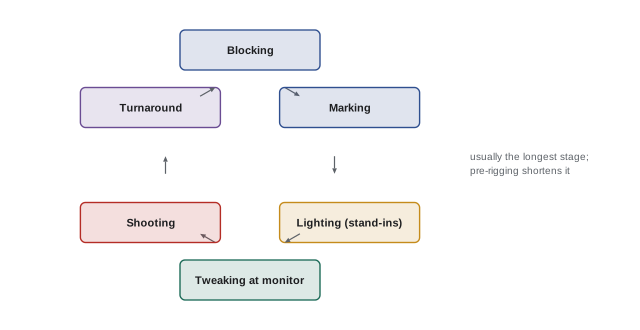
Although every production works differently, a typical sequence on set is:
- Blocking: the director rehearses the actors' movements with the DP, gaffer, key grip and camera crew watching.
- Marking: actors' positions are marked on the floor, and the DP decides camera positions and the order of shots.
- Lighting: the actors leave while stand-ins take their places, and the DP, gaffer and key grip direct their crews to place, power, shape and adjust lights. This is often the longest part of each setup.
- Tweaking: the DP checks the image on a calibrated monitor with the DIT (CINE-202), makes final adjustments, and confirms exposure.
- Shooting: the actors return, the scene is rehearsed on camera, and takes begin. Electricians stand by to adjust lights between takes and to respond to changing conditions.
- Turning around: when the scene moves to the reverse angle, much of the lighting may need to be rebuilt.
Efficient productions pre-light sets the day before, pre-rig overhead lighting and power, and plan the order of shots to minimize relighting. Lighting time is expensive: a crew of 50 or more waits while a setup is lit, so speed and clear communication are as important as artistry.
Lighting goals
Whatever the style, lighting for the moving image serves several purposes at once:
- Exposure: providing enough light, at the right level and contrast, for the camera to record the image cleanly with the chosen stop, frame rate and exposure index (CINE-202).
- Shape and dimension: revealing the form of faces, objects and spaces through highlights and shadows, so that the flat screen suggests depth.
- Separation: distinguishing subjects from backgrounds and foreground from background through tone, color and edge light.
- Mood and genre: supporting the story through high-key brightness, low-key shadow, warm comfort or cold tension.
- Attention: guiding the viewer's eye to what matters in the frame.
- Continuity and believability: keeping the light consistent and plausible across shots, so that viewers accept the world of the film.
Good lighting balances these goals with practical constraints of time, budget, power, space and safety.
Lighting style through history
Film lighting has evolved with technology and taste. Early silent films used sunlight on open stages and diffused skylights; the arrival of powerful arc lights and incandescent lamps allowed studio shooting. The classic Hollywood studio style of the 1930s and 1940s used three-point lighting, hard Fresnel sources and carefully controlled shadows to glamorize stars, while film noir pushed shadows and contrast to extremes. In the 1960s and 1970s, faster film stocks, location shooting and cinematographers such as Néstor Almendros, Vittorio Storaro and Gordon Willis favored naturalistic and motivated lighting, often using bounced and window light. The development of HMI lights in the 1970s made daylight-balanced, efficient light available on location. Digital cameras with high sensitivity and LED fixtures with variable color have, in the 2010s and 2020s, transformed practice again: scenes can be lit with far less power, color can be changed instantly from a tablet, and large soft overhead sources and LED walls are common. Knowing these traditions helps cinematographers choose an approach deliberately.
Safety as a constant
Set lighting involves high-powered electrical equipment, heavy fixtures on tall stands, work at heights, hot lamps and long hours. Safety is part of every decision: stands must be weighted and secured, cables routed and protected, circuits properly sized and protected, fixtures inspected, and only qualified people should handle power distribution. Lessons 2 to 4 discuss fixture-specific hazards, Lesson 11 covers electrical power and distribution, and CINE-340 covers production safety in depth. A safe set is also a faster set: accidents stop production and harm people.
Course overview
Lessons 2 to 4 introduce fixtures: tungsten, HMI and discharge, and LED. Lesson 5 covers photometrics, how to calculate light output and choose fixtures. Lesson 6 covers color temperature, gels and color quality. Lesson 7 covers control systems such as dimmers, DMX and wireless control. Lesson 8 covers shaping light with grip equipment. Lesson 9 covers lighting people for motion, and Lesson 10 exposure ratios and contrast. Lesson 11 covers power and distribution, and Lesson 12 brings everything together in lighting a scene and the capstone project.
Lighting for television formats
Lighting practice varies with the format. Multi-camera television sitcoms and talk shows, shot on stages with three or four cameras rolling simultaneously, traditionally use bright, even lighting from overhead grids so that every camera angle is usable without relighting, an approach that favors consistency and speed over shadow and mood. Single-camera dramas light each setup individually, like feature films, with more contrast and motivated sources. News and documentary crews often work with small LED kits and available light, prioritizing speed and discretion. Commercials and music videos may use elaborate, stylized lighting for short, intense shoots. Streaming dramas have pushed television lighting toward cinematic standards, with low-key looks once rare on broadcast television. Understanding the conventions and constraints of each format helps cinematographers choose an appropriate approach.
Learning to see light
The most important lighting skill is observation. Cinematographers train themselves to notice light everywhere: how a window lights a face at different times of day, how a street lamp creates pools on a wet road, how a kitchen looks under fluorescent tubes, how colors shift at dusk. Studying paintings by masters of light, such as Caravaggio, Rembrandt, Vermeer and Edward Hopper, and photographs and films by great cinematographers, builds a mental library of lighting ideas. Many cinematographers keep reference collections of images taken on their phones. Asking "where is the light coming from, how hard is it, what color is it, and what is it doing to the subject?" in everyday life develops the eye that set lighting depends on.
Lighting budgets and scale
Lighting budgets vary enormously. A short film may light with a few LED panels and household power; an independent feature may rent a modest truck package with a small generator; a studio feature may carry several lighting trucks, rigging crews for each stage and location, and dozens of electricians on big days. The principles are the same at every scale, and many of the most admired images in film history were lit simply. Good cinematographers match their lighting ambitions to the resources available and make the most of them.
Common mistakes
MistakeLighting only for the opening frame.
InsteadLight for the whole shot, including blocking and camera movement.
MistakeIgnoring the reverse angles.
InsteadPlan lighting that works across the coverage.
MistakeVague instructions to the crew.
InsteadUse clear set vocabulary and stops.
MistakeLighting with actors instead of stand-ins.
InsteadUse stand-ins and let actors rest.
MistakeTreating safety as an afterthought.
InsteadBuild safety into every setup.
Summary and key terms
- Motion lighting is continuous, must work during movement and must match across shots.
- The DP designs the lighting; the gaffer leads electricians and the key grip leads grips.
- Set vocabulary such as key, fill, back, kicker, practical, single and double speeds work.
- A setup moves through blocking, marking, lighting, tweaking and shooting.
- Lighting provides exposure, shape, separation, mood, attention and continuity.
- Lighting style has evolved with technology, from arcs to HMIs and LEDs.
- Safety is part of every lighting decision.
- Director of photography
- Head of camera and lighting, responsible for the look.
- Gaffer
- Chief lighting technician leading the electric department.
- Best boy electric
- Second-in-command who manages crew and equipment.
- Key grip
- Head of the grip department.
- Setup
- A camera position and its lighting.
- Practical
- A light source visible in the frame.
- Motivated light
- Light that appears to come from a source in the story.
- Stand-in
- Person who takes an actor's place during lighting.
- Pre-rig
- Installing lighting and power before shooting.
- Kicker
- Light from behind and to the side that skims the face.
Practice problems
Work each problem on paper first, then reveal the answer to check.
Name three differences between stills and motion lighting.
Show answer
Continuous light, movement, multiple angles, duration, continuity, crew.
Who leads the electric department?
Show answer
The gaffer.
What does the grip department do with light?
Show answer
Shapes it with flags, nets, silks, bounce and frames.
What is a practical?
Show answer
A light source visible in the frame.
What is a kicker?
Show answer
A light from behind and to the side that skims the cheek.
List the stages of a setup.
Show answer
Blocking, marking, lighting, tweaking, shooting, turning around.
Why use stand-ins?
Show answer
To light without tiring the actors.
Name four goals of lighting.
Show answer
Exposure, shape, separation, mood, attention, continuity.
What did HMIs make possible?
Show answer
Efficient daylight-balanced light on location.
How has LED changed lighting?
Show answer
Less power, instant color control, large soft sources.
Lesson quiz · 5 questions
Score 60% or more to complete this lesson.
Create a free account to save your progress, take quizzes and earn a certificate.