
CINE-220 · Lesson 11 of 12 · 25 min
Power and distribution on set
Every light on a set needs power, and a lighting plan is only as good as the electricity behind it. A small interview might run from a couple of household outlets or batteries; a large night exterior might need several generators producing more than a thousand amps, kilometers of cable and a team of electricians managing distribution. Understanding electrical basics allows cinematographers to plan realistic lighting, and is essential for gaffers and electricians, who are responsible for keeping everyone safe. This lesson introduces electrical quantities and the power formula, household circuits and their limits, distribution equipment and cable, single-phase and three-phase power, generators and battery power, tie-ins, load calculation and balancing, voltage drop, grounding and ground-fault protection, codes and qualifications, and electrical safety on set. It is an introduction, not a qualification: work on electrical distribution must be done by trained, qualified people following the applicable codes.
Volts, amps and watts
Three quantities describe electrical power. Voltage (V), measured in volts, is the electrical pressure that pushes current through a circuit. Current (I), measured in amperes or amps (A), is the rate of flow of electric charge. Power (P), measured in watts (W), is the rate at which energy is used, and for resistive loads such as tungsten lamps it is the product of voltage and current:
In Canada and the United States, standard household and commercial circuits supply about 120 volts, and larger appliances use 240 volts. A 1,000-watt tungsten light at 120 volts draws about 8.3 amps; a 2,000-watt light about 16.7 amps. Gaffers often use the "paper amps" shortcut of 10 amps per kilowatt at 120 volts, which slightly overestimates the current and builds in a margin. For electronic loads such as HMI ballasts and LED drivers, the power factor and electronic behavior affect the actual current drawn; manufacturers specify the current, and good ballasts include power factor correction.
Household circuits and their limits
Ordinary wall outlets in North America are usually on 15-amp or 20-amp circuits protected by breakers in the building's panel. Several outlets in a room often share one circuit, so plugging two 1K lights into outlets in the same room may trip a breaker. Electrical codes generally limit continuous loads, those running for three hours or more, to 80 % of a breaker's rating: 12 amps on a 15-amp circuit (about 1,440 watts at 120 volts) and 16 amps on a 20-amp circuit (about 1,920 watts). Finding which outlets share a circuit, by switching breakers off and testing, and spreading loads across separate circuits, is a standard task on small location shoots. Household power is enough for many LED setups, which is one reason LEDs have transformed small productions, but tungsten and HMI packages quickly exceed it.
Worked problem
Can this kit run from household outlets?
An interview kit includes a 1.2 kW HMI (ballast drawing about 12 A at 120 V), two LED panels at 200 W each, a 650 W tungsten Fresnel and a 300 W LED back light. The room has two 15 A circuits. How should the load be distributed?
Show solution
- HMI: about 12 A, which uses the full 80 % continuous limit of one 15 A circuit (12 A).
- Other lights: 400 W + 650 W + 300 W = 1,350 W, about 11.3 A at 120 V.
- Put the HMI alone on circuit 1, and the other three fixtures on circuit 2, at about 11.3 A, just under the 12 A limit.
- Confirm that no other loads (refrigerators, heaters) share these circuits, and consider a small generator or battery power for margin.
Answer: HMI alone on one circuit, the other fixtures on the second; the margin is small, so check for other loads or use additional power.
Distribution equipment and cable
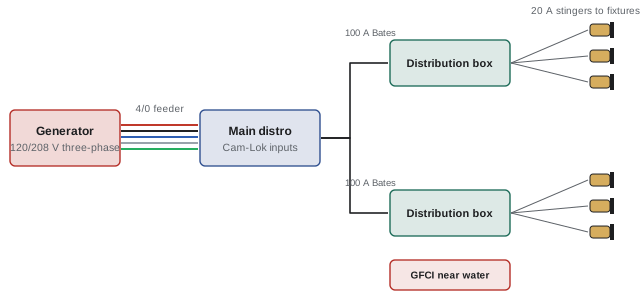
On professional sets, power flows from a source, such as a generator or a building tie-in, through a system of distribution boxes and cables, often called distro. Typical components in North America include:
- Feeder cable: heavy single-conductor cables, such as 2/0 or 4/0 American Wire Gauge, with Cam-Lok connectors, carrying hundreds of amps from the source to main distribution boxes.
- Main distribution boxes (spider boxes and main distros): connecting feeder cable and providing outlets for smaller cables.
- Lunch boxes and stage boxes: small boxes with several household-style outlets protected by breakers, powered from larger connectors.
- Bates (stage pin) cables and connectors, rated at 60 or 100 amps, and twist-lock connectors such as L6-20 or L21-30, for intermediate distribution and larger fixtures.
- Stingers: extension cables with household-style connectors, typically 12 AWG for 20 amps, for individual fixtures.
Cables must be rated for the current they carry and for the environment, such as outdoor and wet use; undersized cables overheat. Cables should be laid neatly, protected with cable ramps where people and vehicles cross, kept away from water, and labeled. Professional distribution equipment includes breakers and ground-fault protection appropriate to its use.
Single-phase and three-phase power
Buildings and generators supply power in different configurations. Single-phase 120/240 V service, common in homes, has two hot legs and a neutral: each leg supplies 120 V to neutral, and 240 V between legs. Three-phase 120/208 V service, common in commercial buildings and film generators, has three hot legs, each at 120 V to neutral and 208 V between legs, offset in time so that power is delivered more smoothly and efficiently. Larger installations use 277/480 V or 347/600 V three-phase services (the latter common in Canada), which must be transformed down for film equipment. Film generators commonly provide three-phase 120/208 V, with Cam-Lok outputs for each leg and the neutral and ground. Knowing the service type is essential for planning distribution and for balancing loads.
Load balancing
On multi-leg systems, loads should be spread evenly across the legs. Unbalanced loads overload one leg while others are lightly used, increase current in the neutral conductor on single-phase systems, cause voltage differences that affect lamp color, and can damage generators. Gaffers and best boys keep a running tally of the load on each leg as lights are added, and electricians plug fixtures into circuits on different legs to keep them balanced, typically within about 10 to 20 % of each other. Clamp meters measure the actual current on each leg and the neutral during the day. Electronic loads with poor power factor can create harmonic currents in the neutral on three-phase systems, which is why modern ballasts and LED drivers with power factor correction are preferred and neutral conductors in film distribution are often oversized.
| Leg | Fixtures | Approximate current at 120 V |
|---|---|---|
| A | Two 4K HMI ballasts (about 38 A each) | About 76 A |
| B | One 6K HMI ballast (about 55 A) and four 400 W LED panels (about 13 A) | About 68 A |
| C | One 5K tungsten (about 42 A), one 2K tungsten (about 17 A) and 1,000 W of practicals (about 8 A) | About 67 A |
Generators and battery power
Film generators range from small, quiet portable units of a few kilowatts, suitable for small LED kits, to tow plants and truck-mounted generators producing 1,000 to 2,000 amps or more per leg, often built into lighting trucks. Film generators are designed to be quiet, with sound-attenuated enclosures, stable in frequency (crystal-controlled frequency matters for magnetic HMIs and cameras), and to handle the electronic loads of LEDs and ballasts. They must be positioned away from the set for noise, ventilated to prevent carbon monoxide build-up, refueled safely, grounded according to the applicable rules, and operated by a trained generator operator. Battery power stations and battery-based distribution systems increasingly replace small generators for LED packages, reducing noise, emissions and fuel handling, and some productions use hybrid systems that combine batteries with generators for peak loads.
Tie-ins
A tie-in connects film distribution directly to a building's electrical service, typically in the main panel or a disconnect, allowing large amounts of power without a generator. Tie-ins involve working on live or energized building equipment and carry serious risks of electrocution and arc flash. They must be performed only by qualified, and in many jurisdictions licensed, electricians, often with permission from the building owner and sometimes a permit and inspection. Many productions avoid tie-ins altogether in favor of generators. Some studios and locations provide dedicated film power outlets (company switches or cam-lok panels) designed for this purpose, which are much safer to use.
Voltage drop
Long cable runs reduce voltage at the fixture because of the resistance of the cable. Voltage drop increases with current and cable length, and decreases with larger cable size. A drop of a few percent is normal, but larger drops reduce light output and, for tungsten, warm the color temperature, and can affect electronic ballasts. Gaffers calculate voltage drop for long runs and choose larger cable or place distribution closer to the set. A simplified estimate for a two-wire circuit is:
where \(L\) is the one-way cable length and \(R\) the resistance per meter of the conductor. Manufacturer tables and electrical handbooks give resistance values for each cable size.
Codes, qualifications and grounding
Electrical work on film sets is governed by electrical codes and occupational safety laws, which require proper grounding, overcurrent protection, appropriate cable and equipment, and qualified workers.
In the United States, the National Electrical Code (NFPA 70), adopted by states and municipalities, includes Article 530 for motion picture and television studios and similar locations, Article 520 for theaters, and Article 590 for temporary installations, including ground-fault protection requirements. Equipment must be listed by a nationally recognized testing laboratory such as UL. OSHA regulations and NFPA 70E on electrical safety in the workplace set requirements for qualified workers, lockout and arc flash protection, and tie-ins to building services generally require a licensed electrician under local rules.
Grounding connects the metal parts of equipment to earth through a low-resistance path, so that a fault causes a breaker to trip rather than energizing a fixture's housing. Ground-fault circuit interrupters (GFCIs) detect small leakage currents through a person and switch off in milliseconds, providing essential protection near water, outdoors and in wet conditions. Film distribution increasingly includes ground-fault protection designed for the larger currents and electronic loads of lighting equipment.
Electrical safety on set
Key safety practices include: inspecting cables, connectors and fixtures before use and removing damaged equipment; never overloading circuits or bypassing breakers; keeping connections dry, elevated and protected from rain, puddles and wet ground; using ground-fault protection near water, including rain, pools, wet-downs and special effects; routing cable to avoid trip hazards and damage; disconnecting power before changing lamps or working on fixtures; keeping non-qualified crew away from distribution; and communicating clearly when powering up ("striking") or powering down large systems. Water and electricity together are the most serious hazard, so scenes involving rain machines, pools or wet streets require careful planning with the gaffer, the special effects team and the safety supervisor. CINE-340 covers production safety in more depth.
Calculating generator size
To size a generator, add up the current of all fixtures planned to run simultaneously, add a margin of about 20 to 25 % for unexpected loads and inrush current, and divide by the number of legs. A package drawing a total of 300 amps at 120 volts, spread over three legs, needs about 100 amps per leg plus margin, so a generator rated at 150 amps per leg or more is appropriate. Large HMIs and LED fixtures may draw high inrush current when struck or switched on, so staggering their start-up avoids tripping breakers. Fuel consumption depends on load; the generator operator monitors fuel and plans refueling during breaks.
Power for LED-heavy packages
LED packages draw far less current than tungsten or HMI equivalents, which allows many locations to be lit from household circuits or batteries. However, many LEDs together still add up, so loads must still be calculated and circuits mapped.
Common mistakes
MistakePlugging several lights into outlets on one household circuit.
InsteadMap circuits and stay within 80 % of breaker ratings.
MistakeUnbalanced loads on generator legs.
InsteadTrack and balance loads with a running tally and clamp meter.
MistakeUndersized cables on long runs.
InsteadSize cable for current and voltage drop.
MistakeUnqualified tie-ins to building panels.
InsteadUse licensed electricians or generators.
MistakeRunning power near water without protection.
InsteadUse ground-fault protection and keep connections dry.
Summary and key terms
- Power equals voltage times current; 1 kW draws about 8.3 A at 120 V.
- Household circuits of 15–20 A are limited to 80 % for continuous loads.
- Distribution runs from feeder cable through boxes to stingers.
- Single-phase and three-phase services require different planning.
- Balance loads across legs and watch voltage drop.
- Generators, batteries and qualified tie-ins supply larger power.
- Codes, grounding, ground-fault protection and trained crews keep sets safe.
- Voltage
- Electrical pressure, in volts.
- Current
- Flow of charge, in amps.
- Watt
- Unit of power.
- Breaker
- Device that interrupts overcurrent.
- Distro
- Power distribution system on set.
- Feeder cable
- Heavy cable from source to distribution.
- Stinger
- Extension cable for individual fixtures.
- Three-phase
- Power supply with three offset hot legs.
- Tie-in
- Connection to a building's electrical service.
- GFCI
- Ground-fault circuit interrupter.
Practice problems
Work each problem on paper first, then reveal the answer to check.
Current drawn by a 2 kW lamp at 120 V?
Show answer
About 16.7 A.
What is the paper-amps shortcut?
Show answer
10 A per kilowatt at 120 V.
Continuous load limit on a 20 A circuit?
Show answer
16 A.
What is a stinger?
Show answer
An extension cable for a fixture.
Voltage between legs of 120/208 V three-phase?
Show answer
208 V.
Why balance loads?
Show answer
To avoid overloading legs and damaging generators.
What reduces voltage drop?
Show answer
Larger cable or shorter runs.
Who may perform tie-ins?
Show answer
Qualified, often licensed, electricians.
What does a GFCI do?
Show answer
Cuts power quickly when it detects leakage current.
Name three electrical safety practices.
Show answer
Inspect gear, don't overload, keep dry, use GFCI, protect cables.
Lesson quiz · 5 questions
Score 60% or more to complete this lesson.
Create a free account to save your progress, take quizzes and earn a certificate.