
CHEM-102 · Lesson 9 of 12 · 33 min
Acids and bases
Acids and bases are everywhere: in the hydrochloric acid of the stomach, the citric acid of lemons, the carbonic acid of soft drinks, the ammonia of window cleaner and the sodium hydroxide of drain cleaner. Blood is held at a pH between 7.35 and 7.45; a swing of a few tenths either way is a medical emergency. Lakes acidified by sulfur and nitrogen emissions lose their fish. CHEM-101 introduced acids and bases through neutralization and titration; BIOL-107 introduced pH and buffers for living systems. This lesson treats acid–base chemistry as an equilibrium problem, calculating pH for strong and weak acids and bases, and explaining why some salts make solutions acidic or basic. Lesson 10 continues with buffers and titrations.
Defining acids and bases
Three definitions are in common use, each broader than the last. The Swedish chemist Svante Arrhenius defined an acid as a substance that produces H⁺ ions in water and a base as one that produces OH⁻ ions. This works for HCl and NaOH but not for ammonia, which is basic without containing hydroxide.
In 1923 Johannes Brønsted in Denmark and Thomas Lowry in England independently proposed a more general definition: an acid is a proton (H⁺) donor and a base is a proton acceptor. An acid–base reaction is a proton transfer. When an acid donates a proton, what remains is its conjugate base; when a base accepts a proton, it becomes its conjugate acid.
In water, a free proton does not exist; it bonds to a water molecule, forming the hydronium ion, H₃O⁺. Writing H⁺(aq) is a convenient shorthand for H₃O⁺. Water itself can act as either an acid or a base: it is amphiprotic. With HF it accepts a proton; with ammonia it donates one: NH₃ + H₂O ⇌ NH₄⁺ + OH⁻.
The American chemist Gilbert N. Lewis offered the broadest definition: an acid is an electron-pair acceptor and a base is an electron-pair donor. Every Brønsted–Lowry base is a Lewis base, since accepting a proton requires a lone pair, but Lewis acids include species with no protons at all, such as BF₃, AlCl₃ and metal cations like Fe³⁺ and Cu²⁺, which accept electron pairs from water or ammonia. Lewis acid–base reactions underlie complex-ion formation (lesson 8) and much of organic chemistry (CHEM-261).
The autoionization of water and the pH scale
Pure water conducts electricity very slightly, because a tiny fraction of its molecules transfer protons to one another.
In pure water [H₃O⁺] = [OH⁻] = 1.0 × 10⁻⁷ M. In any aqueous solution at 25 °C, the product of the two concentrations remains 1.0 × 10⁻¹⁴, so when one rises the other falls. Because the concentrations span many powers of ten, chemists use the logarithmic pH scale, proposed by the Danish chemist Søren Sørensen in 1909 while working on brewing at the Carlsberg Laboratory.
At 25 °C a neutral solution has pH 7.00, an acidic one has pH below 7 and a basic one above 7. Each unit of pH is a factor of ten in [H₃O⁺]: a solution at pH 3 is ten times more acidic than one at pH 4 and a thousand times more than one at pH 6. K_w increases with temperature (the autoionization is endothermic), so at body temperature, 37 °C, neutral water has pH 6.8, not 7.0.
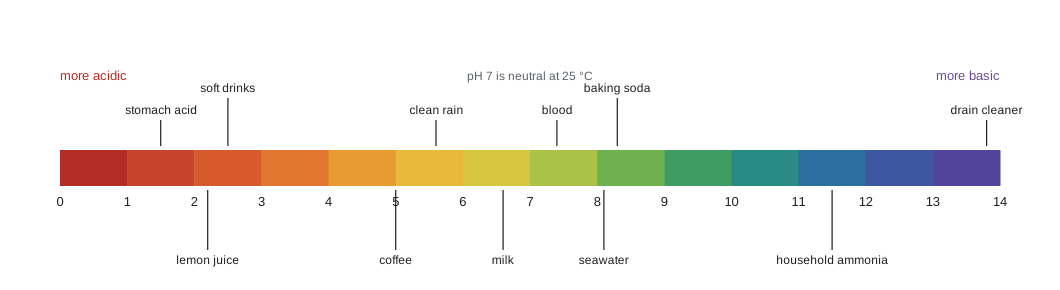
Normal rain is slightly acidic, about pH 5.6, because it dissolves carbon dioxide from the air to form carbonic acid. Rain below about pH 5 is called acid rain; it results from sulfur dioxide and nitrogen oxides, which form sulfuric and nitric acids. In the 1970s and 1980s acid rain damaged thousands of lakes in Ontario, Quebec, Nova Scotia, the Adirondacks and New England. The 1991 Canada–United States Air Quality Agreement and the US Clean Air Act amendments of 1990 cut sulfur dioxide emissions sharply, and many lakes are recovering, though slowly, because the soils in much of the Canadian Shield have little capacity to neutralize acid.
Strong acids and bases
Strong acids ionize completely in water. The common strong acids are HCl, HBr, HI, HNO₃, HClO₄ and H₂SO₄ (for its first proton). For a strong monoprotic acid, [H₃O⁺] simply equals the acid concentration. Strong bases are the soluble hydroxides of group 1 metals (LiOH, NaOH, KOH) and the heavier group 2 metals (Ca(OH)₂, Sr(OH)₂, Ba(OH)₂); each formula unit releases one or two OH⁻.
Worked problem
pH of strong acid and base solutions
Find the pH of (a) 0.025 M HNO₃ and (b) 0.0050 M Ba(OH)₂.
Show solution
- (a) [H₃O⁺] = 0.025 M; pH = −log(0.025) = 1.60.
- (b) [OH⁻] = 2 × 0.0050 = 0.010 M; pOH = 2.00; pH = 14.00 − 2.00 = 12.00.
Answer: (a) pH 1.60; (b) pH 12.00. For logarithms, the number of decimal places in the pH equals the number of significant figures in the concentration.
For very dilute strong acids, below about 10⁻⁶ M, the H₃O⁺ from water itself matters, and a 10⁻⁸ M HCl solution is not basic (pH 8) but very slightly acidic (pH about 6.98).
Weak acids and K_a
Most acids are weak: they ionize only partly, and an equilibrium is established. For a weak acid HA, the acid ionization constant K_a measures its strength; pK_a = −log K_a is often quoted instead, with smaller pK_a meaning a stronger acid.
| Acid | Formula | K_a at 25 °C | pK_a |
|---|---|---|---|
| Hydrofluoric acid | HF | 6.8 × 10⁻⁴ | 3.17 |
| Nitrous acid | HNO₂ | 4.5 × 10⁻⁴ | 3.35 |
| Formic acid | HCOOH | 1.8 × 10⁻⁴ | 3.74 |
| Lactic acid | CH₃CH(OH)COOH | 1.4 × 10⁻⁴ | 3.86 |
| Acetic acid | CH₃COOH | 1.8 × 10⁻⁵ | 4.74 |
| Carbonic acid (first H) | H₂CO₃ | 4.3 × 10⁻⁷ | 6.37 |
| Hypochlorous acid | HOCl | 3.0 × 10⁻⁸ | 7.52 |
| Ammonium ion | NH₄⁺ | 5.6 × 10⁻¹⁰ | 9.25 |
| Hydrocyanic acid | HCN | 4.9 × 10⁻¹⁰ | 9.31 |
Calculating the pH of a weak acid solution is an ICE table problem (lesson 7), almost always simplified by the small-x approximation.
Worked problem
pH of vinegar
Household vinegar is about 0.83 M acetic acid (5 % by mass). Find its pH and percent ionization. K_a = 1.8 × 10⁻⁵.
Show solution
- ICE: [CH₃COOH] = 0.83 − x, [H₃O⁺] = [CH₃COO⁻] = x.
- K_a = x²/(0.83 − x) ≈ x²/0.83 = 1.8 × 10⁻⁵, so x² = 1.49 × 10⁻⁵ and x = 3.9 × 10⁻³ M.
- Check: 3.9 × 10⁻³/0.83 = 0.47 %, well under 5 %, so the approximation holds.
- pH = −log(3.9 × 10⁻³) = 2.41.
Answer: pH ≈ 2.4, with only about 0.5 % of the acetic acid ionized. Most acetic acid molecules in vinegar remain intact.
Percent ionization increases as a weak acid is diluted, another consequence of Le Châtelier's principle: dilution favors the side with more dissolved particles. A 0.010 M acetic acid solution is about 4 % ionized, compared with 0.47 % for vinegar. The code below solves the exact quadratic and compares it with the approximation across a range of concentrations.
from math import log10, sqrt

def weak_acid_pH(c, Ka):
    """Exact [H3O+] from Ka = x^2/(c - x), ignoring water's own ionization."""
    x = (-Ka + sqrt(Ka * Ka + 4 * Ka * c)) / 2
    return x

Ka = 1.8e-5   # acetic acid
print(f"{'c (M)':>8s} {'pH exact':>9s} {'pH approx':>10s} {'% ionized':>10s}")
for c in (1.0, 0.10, 0.010, 0.0010, 0.00010):
    x = weak_acid_pH(c, Ka)
    x_approx = sqrt(Ka * c)
print(f"{c:8.5f} {-log10(x):9.2f} {-log10(x_approx):10.2f} {100 * x / c:10.1f}")c (M) pH exact pH approx % ionized 1.00000 2.37 2.37 0.4 0.10000 2.88 2.87 1.3 0.01000 3.38 3.37 4.2 0.00100 3.90 3.87 12.5 0.00010 4.46 4.37 34.4
The approximation is excellent at high concentrations but fails for dilute solutions, where the percent ionization exceeds 5 %. Always check.
K_a can also be found from a measured pH, which is how most tabulated values were obtained.
Worked problem
K_a from pH
A 0.100 M solution of a weak acid HA has pH 2.85. Find K_a.
Show solution
- [H₃O⁺] = 10^(−2.85) = 1.41 × 10⁻³ M = [A⁻].
- [HA] = 0.100 − 0.00141 = 0.0986 M.
- K_a = (1.41 × 10⁻³)²/0.0986 = 2.0 × 10⁻⁵.
Answer: K_a ≈ 2.0 × 10⁻⁵, close to acetic acid.
Polyprotic acids
Some acids can donate more than one proton: sulfuric acid (H₂SO₄), carbonic acid (H₂CO₃), phosphoric acid (H₃PO₄) and citric acid. They lose their protons one at a time, each with its own K_a, and each successive K_a is much smaller than the last, because removing a positive proton from an increasingly negative ion is harder. For phosphoric acid, K_a1 = 7.5 × 10⁻³, K_a2 = 6.2 × 10⁻⁸ and K_a3 = 4.2 × 10⁻¹³. Because the K_a values differ by factors of 10⁵ or more, the pH of a polyprotic acid solution is usually set by the first ionization alone. Phosphoric acid is the acid that gives cola drinks their sharpness; carbonic acid and its ions are the buffer of blood and the subject of the capstone in lesson 12.
Weak bases and K_b
Weak bases accept protons from water, producing OH⁻. Ammonia and its organic relatives, the amines, are the most important. Their strength is measured by the base ionization constant K_b.
Worked problem
pH of household ammonia
Find the pH of 0.50 M NH₃. K_b = 1.8 × 10⁻⁵.
Show solution
- K_b = x²/(0.50 − x) ≈ x²/0.50, so x = √(9.0 × 10⁻⁶) = 3.0 × 10⁻³ M = [OH⁻].
- Check: 3.0 × 10⁻³/0.50 = 0.6 %, fine.
- pOH = −log(3.0 × 10⁻³) = 2.52; pH = 14.00 − 2.52 = 11.48.
Answer: pH ≈ 11.5, matching typical household ammonia cleaners.
Conjugate pairs and K_a × K_b = K_w
An acid and its conjugate base are linked. Adding the ionization of HA and the reaction of A⁻ with water gives the autoionization of water, so their constants multiply to K_w.
The stronger an acid, the weaker its conjugate base, and vice versa. The conjugate bases of strong acids (Cl⁻, NO₃⁻, ClO₄⁻) are so weak that they have no measurable effect on pH. The conjugate base of a weak acid, such as acetate or fluoride, is a weak base. From K_a for acetic acid, K_b for acetate is 1.0 × 10⁻¹⁴/1.8 × 10⁻⁵ = 5.6 × 10⁻¹⁰.
Acid–base properties of salts
Dissolving a salt can change the pH, depending on whether its ions react with water (hydrolysis). The rule follows from conjugate pairs. Cations of strong bases (Na⁺, K⁺, Ca²⁺) and anions of strong acids (Cl⁻, NO₃⁻) are neutral. Anions of weak acids (CH₃COO⁻, F⁻, CO₃²⁻, PO₄³⁻) are basic. Cations that are conjugate acids of weak bases (NH₄⁺) are acidic, as are small, highly charged metal ions (Al³⁺, Fe³⁺), which make their water molecules acidic by pulling electron density from them.
| Salt | Cation | Anion | Solution |
|---|---|---|---|
| NaCl | neutral | neutral | neutral (pH 7) |
| NaCH₃COO (sodium acetate) | neutral | basic | basic |
| NH₄Cl | acidic | neutral | acidic |
| Na₂CO₃ (washing soda) | neutral | basic | basic |
| AlCl₃ | acidic (hydrated Al³⁺) | neutral | acidic |
| NH₄CH₃COO | acidic (K_a 5.6 × 10⁻¹⁰) | basic (K_b 5.6 × 10⁻¹⁰) | about neutral |
from math import log10, sqrt
Kw = 1.0e-14

def salt_pH(c, K, kind):
    """pH of a salt whose ion is a weak acid (kind='acid', K = Ka) or weak base (kind='base', K = Kb)."""
    x = sqrt(K * c)   # small-x approximation
    return -log10(x) if kind == "acid" else 14 + log10(x)

cases = [("0.10 M sodium acetate", 0.10, Kw / 1.8e-5, "base"),
         ("0.10 M sodium fluoride", 0.10, Kw / 6.8e-4, "base"),
         ("0.10 M ammonium chloride", 0.10, Kw / 1.8e-5, "acid"),
         ("0.10 M sodium carbonate", 0.10, Kw / 4.7e-11, "base")]
for label, c, K, kind in cases:
print(f"{label:26s} K = {K:.1e} -> pH = {salt_pH(c, K, kind):.2f}")0.10 M sodium acetate K = 5.6e-10 -> pH = 8.87 0.10 M sodium fluoride K = 1.5e-11 -> pH = 8.08 0.10 M ammonium chloride K = 5.6e-10 -> pH = 5.13 0.10 M sodium carbonate K = 2.1e-04 -> pH = 11.66
Washing soda (sodium carbonate) is a fairly strong base because carbonate is the conjugate base of a very weak acid, HCO₃⁻ (K_a2 = 4.7 × 10⁻¹¹). That is why it cuts grease and why it irritates skin.
Molecular structure and acid strength
Why is HCl a strong acid and HF a weak one? Two factors control how easily a proton leaves. The first is bond strength: going down a group, the H–X bond gets longer and weaker, so acid strength increases: HF < HCl < HBr < HI. The second is the stability of the conjugate base: the more electronegative the atom holding the negative charge, or the more the charge is spread out by resonance, the more stable the anion and the stronger the acid. For oxyacids, acid strength increases with the number of oxygen atoms on the central atom (HOCl < HClO₂ < HClO₃ < HClO₄), because the extra oxygens pull electron density away from the O–H bond and stabilize the anion. Carboxylic acids are much stronger than alcohols because the carboxylate ion's charge is shared over two oxygen atoms by resonance.
Common mistakes
MistakeA pH of 4 is twice as acidic as a pH of 2.
InsteadpH is logarithmic: pH 2 has 100 times the H₃O⁺ of pH 4.
MistakeWeak acids are dilute and strong acids are concentrated.
InsteadStrength refers to the extent of ionization, not concentration; 6 M acetic acid is concentrated but weak.
MistakeThe conjugate base of a strong acid is a strong base.
InsteadIt is a negligibly weak base; strong acids have very weak conjugate bases.
MistakeAll salts give neutral solutions.
InsteadSalts containing the conjugate base of a weak acid or the conjugate acid of a weak base change the pH.
MistakeNeutral water always has pH 7.
InsteadOnly at 25 °C; K_w rises with temperature, so neutral pH is lower at higher temperatures.
Summary and key terms
- Brønsted–Lowry acids donate protons and bases accept them; each acid has a conjugate base.
- Lewis acids accept electron pairs and Lewis bases donate them.
- K_w = [H₃O⁺][OH⁻] = 1.0 × 10⁻¹⁴ at 25 °C; pH = −log[H₃O⁺] and pH + pOH = 14.00.
- Strong acids and bases ionize completely; weak ones reach an equilibrium described by K_a or K_b.
- Weak acid pH comes from an ICE table, usually with the small-x approximation and the 5 % check.
- For a conjugate pair, K_a × K_b = K_w; the stronger the acid, the weaker its conjugate base.
- Salts are acidic, basic or neutral depending on whether their ions are conjugates of weak acids or bases.
- Brønsted–Lowry acid
- A proton donor.
- Brønsted–Lowry base
- A proton acceptor.
- conjugate acid–base pair
- Two species that differ by one proton.
- Lewis acid
- An electron-pair acceptor.
- hydronium ion
- H₃O⁺, the form of the hydrated proton in water.
- autoionization of water
- The transfer of a proton between water molecules, giving H₃O⁺ and OH⁻.
- pH
- The negative base-10 logarithm of the hydronium ion concentration.
- acid ionization constant
- K_a, the equilibrium constant for a weak acid donating a proton to water.
- polyprotic acid
- An acid that can donate more than one proton.
- amphiprotic
- Able to act as either a proton donor or a proton acceptor, as water can.
Practice problems
Work each problem on paper first, then reveal the answer to check.
Identify the conjugate acid–base pairs in HCO₃⁻ + OH⁻ ⇌ CO₃²⁻ + H₂O.
Show answer
HCO₃⁻/CO₃²⁻ and H₂O/OH⁻.
What is [OH⁻] in a solution with [H₃O⁺] = 2.5 × 10⁻⁴ M?
Show answer
1.0 × 10⁻¹⁴/2.5 × 10⁻⁴ = 4.0 × 10⁻¹¹ M.
Find the pH of 0.0030 M KOH.
Show answer
pOH = 2.52; pH = 11.48.
Find the pH of 0.20 M HF (K_a = 6.8 × 10⁻⁴).
Show answer
x = √(1.36 × 10⁻⁴) = 0.0117 M (5.8 %, so solve the quadratic: x = 0.0113); pH = 1.95.
A 0.050 M solution of a weak base has pH 10.90. Find K_b.
Show answer
[OH⁻] = 7.9 × 10⁻⁴; K_b = (7.9 × 10⁻⁴)²/0.0492 = 1.3 × 10⁻⁵.
K_a for HOCl is 3.0 × 10⁻⁸. Find K_b for OCl⁻.
Show answer
1.0 × 10⁻¹⁴/3.0 × 10⁻⁸ = 3.3 × 10⁻⁷.
Is a solution of KNO₂ acidic, basic or neutral?
Show answer
Basic; NO₂⁻ is the conjugate base of the weak acid HNO₂.
Is a solution of NH₄NO₃ acidic, basic or neutral?
Show answer
Acidic; NH₄⁺ is a weak acid and NO₃⁻ is neutral.
Which is the stronger acid, HClO₃ or HClO₂? Why?
Show answer
HClO₃; the extra oxygen stabilizes the conjugate base and weakens the O–H bond.
Why is BF₃ an acid even though it has no protons?
Show answer
It accepts an electron pair, making it a Lewis acid.
Lesson quiz · 5 questions
Score 60% or more to complete this lesson.
Create a free account to save your progress, take quizzes and earn a certificate.