
CHEM-102 · Lesson 11 of 12 · 35 min
Electrochemistry: redox, cells and electrolysis
A phone battery, a car's alternator charging a lead-acid battery, an aluminum smelter in Quebec, a pacemaker, the slow rusting of a bridge and the chrome plating on a faucet all involve the same chemistry: the transfer of electrons between substances. Electrochemistry studies reactions in which electron transfer is linked to an electric current. It brings together the redox reactions of CHEM-101 and the free energy and equilibrium of lessons 3 and 7. CHEM-103 treated corrosion and batteries from an engineering point of view; this lesson builds the underlying theory: balancing redox equations, galvanic cells, standard reduction potentials, the Nernst equation and electrolysis.
Oxidation, reduction and oxidation states
Oxidation is the loss of electrons, and reduction is the gain of electrons (a common memory aid is OIL RIG: oxidation is loss, reduction is gain). The two always occur together. The species that is oxidized gives its electrons to the species reduced; it is the reducing agent. The species reduced is the oxidizing agent. Oxidation states (oxidation numbers), introduced in CHEM-101, track the electrons: an element is oxidized when its oxidation state increases and reduced when it decreases.
The rules for assigning oxidation states in brief: elements are 0; monatomic ions equal their charge; oxygen is usually −2 (−1 in peroxides); hydrogen is +1 with nonmetals and −1 in metal hydrides; fluorine is always −1; and the oxidation states in a species add up to its charge.
Balancing redox equations: the half-reaction method
Redox equations in solution are often too tangled to balance by inspection. The half-reaction method splits the reaction into an oxidation half and a reduction half, balances each for mass and charge, and then combines them so the electrons cancel.
In acidic solution the steps are: write the two half-reactions; balance atoms other than O and H; balance O by adding H₂O; balance H by adding H⁺; balance charge by adding electrons; multiply the half-reactions so the electrons lost equal the electrons gained; add them and cancel. In basic solution, finish as in acid, then add OH⁻ to both sides to neutralize every H⁺, forming water, and cancel the extra water.
Worked problem
Permanganate and iron(II) in acid
Balance MnO₄⁻(aq) + Fe²⁺(aq) → Mn²⁺(aq) + Fe³⁺(aq) in acidic solution.
Show solution
- Oxidation: Fe²⁺ → Fe³⁺ + e⁻.
- Reduction: MnO₄⁻ → Mn²⁺. Add 4 H₂O to the right for oxygen, then 8 H⁺ to the left for hydrogen: MnO₄⁻ + 8 H⁺ → Mn²⁺ + 4 H₂O.
- Charge: left is −1 + 8 = +7, right is +2. Add 5 e⁻ to the left: MnO₄⁻ + 8 H⁺ + 5 e⁻ → Mn²⁺ + 4 H₂O.
- Multiply the oxidation by 5 and add: MnO₄⁻ + 8 H⁺ + 5 Fe²⁺ → Mn²⁺ + 5 Fe³⁺ + 4 H₂O.
- Check: Mn 1 = 1, Fe 5 = 5, O 4 = 4, H 8 = 8; charge +17 = +17.
Answer: MnO₄⁻ + 8 H⁺ + 5 Fe²⁺ → Mn²⁺ + 5 Fe³⁺ + 4 H₂O. Because permanganate is deep purple and Mn²⁺ is nearly colorless, this reaction is used in titrations without an indicator: the first permanent pink tinge marks the end point.
Worked problem
A redox equation in basic solution
Balance MnO₄⁻ + I⁻ → MnO₂ + I₂ in basic solution.
Show solution
- Oxidation: 2 I⁻ → I₂ + 2 e⁻.
- Reduction (in acid first): MnO₄⁻ + 4 H⁺ + 3 e⁻ → MnO₂ + 2 H₂O.
- Electrons: multiply oxidation by 3 and reduction by 2 (6 e⁻ each): 2 MnO₄⁻ + 8 H⁺ + 6 I⁻ → 2 MnO₂ + 3 I₂ + 4 H₂O.
- Add 8 OH⁻ to both sides: 8 H⁺ + 8 OH⁻ become 8 H₂O on the left. Cancel 4 H₂O.
Answer: 2 MnO₄⁻ + 4 H₂O + 6 I⁻ → 2 MnO₂ + 3 I₂ + 8 OH⁻.
Galvanic cells
When zinc metal is placed in copper(II) sulfate solution, copper deposits on the zinc and the blue color fades: Zn(s) + Cu²⁺(aq) → Zn²⁺(aq) + Cu(s). Electrons pass directly from zinc atoms to copper ions, and the energy released is lost as heat. If the two half-reactions are separated so that the electrons must travel through an external wire, the reaction can do electrical work. That arrangement is a galvanic (or voltaic) cell, named for the Italian scientists Luigi Galvani and Alessandro Volta.
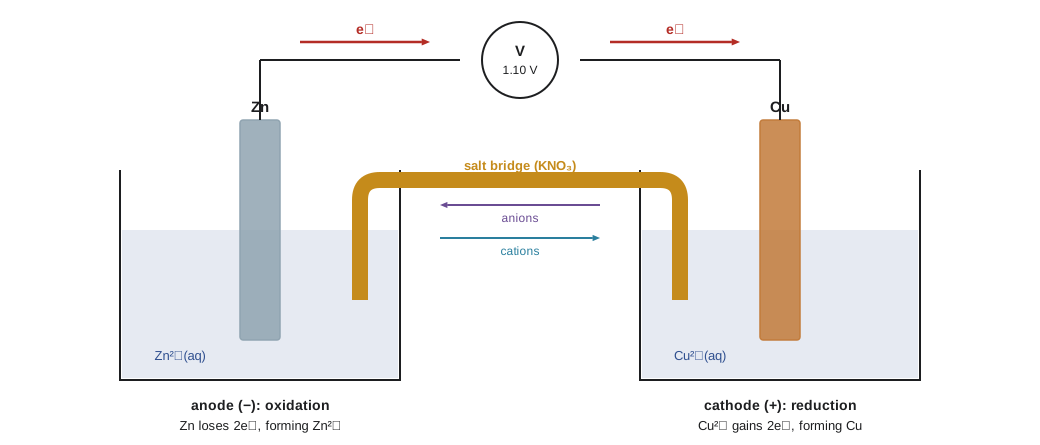
The electrode where oxidation occurs is the anode; the electrode where reduction occurs is the cathode. (Both "anode" and "oxidation" begin with vowels; "cathode" and "reduction" with consonants.) Electrons flow through the wire from anode to cathode. A salt bridge, a tube of an inert electrolyte such as KNO₃ in gel, completes the circuit by letting ions move between the compartments, keeping each solution electrically neutral. Without it, charge would build up and the current would stop almost at once.
Cells are written in a compact notation: anode on the left, cathode on the right, a single vertical line for a phase boundary and a double line for the salt bridge. For the Daniell cell: Zn(s) | Zn²⁺(aq) || Cu²⁺(aq) | Cu(s).
Cell potential and standard reduction potentials
The driving force of a cell is its cell potential, E_cell, or electromotive force, measured in volts (1 V = 1 J/C). Under standard conditions (1 M solutions, 1 bar gases, usually 25 °C) it is the standard cell potential, E°cell. The Daniell cell gives 1.10 V.
Individual half-cell potentials cannot be measured alone, only differences. Chemists therefore assign a reference: the standard hydrogen electrode (SHE), a platinum electrode in 1 M H⁺ with H₂ gas at 1 bar, is defined as exactly 0 V. Each half-reaction, written as a reduction, is given a standard reduction potential, E°, measured against the SHE. A large positive E° means a species is easily reduced, a strong oxidizing agent; a large negative E° means it is hard to reduce, so its reduced form is a strong reducing agent.
| Half-reaction (reduction) | E° (V) |
|---|---|
| F₂(g) + 2 e⁻ → 2 F⁻ | +2.87 |
| MnO₄⁻ + 8 H⁺ + 5 e⁻ → Mn²⁺ + 4 H₂O | +1.51 |
| Cl₂(g) + 2 e⁻ → 2 Cl⁻ | +1.36 |
| O₂(g) + 4 H⁺ + 4 e⁻ → 2 H₂O | +1.23 |
| Ag⁺ + e⁻ → Ag | +0.80 |
| Fe³⁺ + e⁻ → Fe²⁺ | +0.77 |
| O₂(g) + 2 H₂O + 4 e⁻ → 4 OH⁻ | +0.40 |
| Cu²⁺ + 2 e⁻ → Cu | +0.34 |
| 2 H⁺ + 2 e⁻ → H₂(g) | 0.00 (by definition) |
| Pb²⁺ + 2 e⁻ → Pb | −0.13 |
| Ni²⁺ + 2 e⁻ → Ni | −0.26 |
| Fe²⁺ + 2 e⁻ → Fe | −0.45 |
| Zn²⁺ + 2 e⁻ → Zn | −0.76 |
| Al³⁺ + 3 e⁻ → Al | −1.66 |
| Mg²⁺ + 2 e⁻ → Mg | −2.37 |
| Na⁺ + e⁻ → Na | −2.71 |
| Li⁺ + e⁻ → Li | −3.04 |
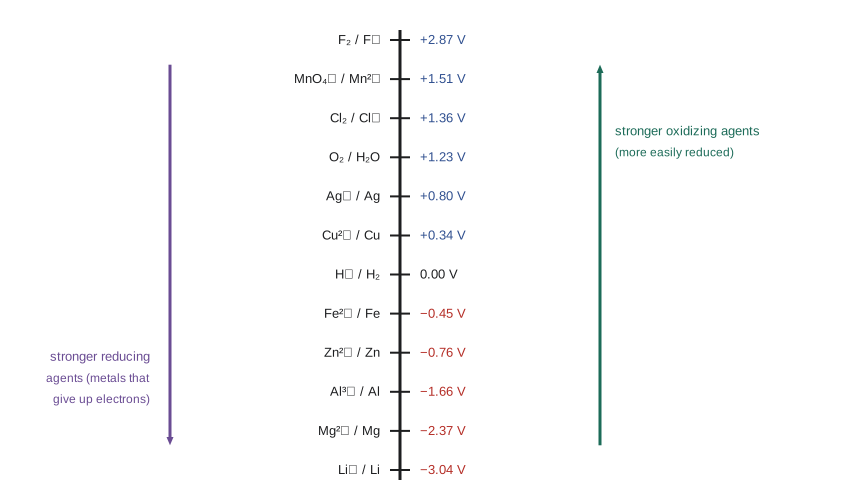
The standard cell potential is the reduction potential of the cathode minus that of the anode, both taken directly from the table as reductions.
Two points trip up beginners. First, do not change the sign of the anode potential before subtracting; the subtraction does that. Second, do not multiply E° by coefficients when balancing: potential is an intensive property, like temperature, measured per unit of charge, so it does not depend on how many electrons transfer.
Worked problem
Standard potential of a cell
A cell is made from a silver electrode in 1 M AgNO₃ and a nickel electrode in 1 M Ni(NO₃)₂. Which is the anode, what is E°cell and what is the overall reaction?
Show solution
- Ag⁺/Ag has E° = +0.80 V; Ni²⁺/Ni has −0.26 V. Silver ions are more easily reduced, so the silver electrode is the cathode and nickel is the anode.
- E°cell = 0.80 − (−0.26) = +1.06 V.
- Reaction: 2 Ag⁺ + Ni → 2 Ag + Ni²⁺ (the silver half-reaction is doubled to balance electrons, but its E° is not).
Answer: Nickel is the anode; E°cell = +1.06 V; 2 Ag⁺(aq) + Ni(s) → 2 Ag(s) + Ni²⁺(aq).
A positive E°cell means the reaction is spontaneous as written under standard conditions. The table thus predicts redox reactions in general: any species on the left of a half-reaction will oxidize the reduced form of any species below it. Chlorine oxidizes bromide and iodide; zinc reduces copper(II); and metals with negative E° values (iron, zinc, aluminum) dissolve in 1 M acid, releasing hydrogen, while copper and silver do not.
Cell potential, free energy and K
The electrical work a cell can do is its charge times its voltage. The charge carried by one mole of electrons is the Faraday constant, F = 96,485 C/mol. Because the maximum non-expansion work equals −ΔG (lesson 3),
where n is the number of moles of electrons transferred in the balanced equation. These relationships tie together the three ways of judging a reaction: positive E°cell, negative ΔG° and K greater than 1 all mean the same thing.
from math import exp, log10

F, R, T = 96485, 8.314, 298.15
cells = {   # name: (E_cathode, E_anode, n)
    "Daniell: Zn | Zn2+ || Cu2+ | Cu": (0.34, -0.76, 2),
    "Ni | Ni2+ || Ag+ | Ag":           (0.80, -0.26, 2),
    "Fe2+ | Fe3+ || Ag+ | Ag":         (0.80, 0.77, 1),
    "Cu | Cu2+ || Zn2+ | Zn (reverse)":(-0.76, 0.34, 2),
}
for name, (Ec, Ea, n) in cells.items():
    E = Ec - Ea
    dG = -n * F * E / 1000
    logK = n * E / 0.05916
print(f"{name:34s} E = {E:+.2f} V dG = {dG:+7.1f} kJ log K = {logK:+6.1f}")Daniell: Zn | Zn2+ || Cu2+ | Cu E = +1.10 V dG = -212.3 kJ log K = +37.2 Ni | Ni2+ || Ag+ | Ag E = +1.06 V dG = -204.5 kJ log K = +35.8 Fe2+ | Fe3+ || Ag+ | Ag E = +0.03 V dG = -2.9 kJ log K = +0.5 Cu | Cu2+ || Zn2+ | Zn (reverse) E = -1.10 V dG = +212.3 kJ log K = -37.2
The Daniell cell's K of about 10³⁷ means the reaction goes essentially to completion: copper ions would be reduced until almost none remained. The Fe²⁺/Ag⁺ cell, with a potential of only 0.03 V, has K near 3, so substantial amounts of reactants and products coexist at equilibrium.
The Nernst equation
Cell potentials change as concentrations change; a battery's voltage drops as it is used. The German chemist Walther Nernst combined ΔG = ΔG° + RT ln Q with ΔG = −nFE to give
As a galvanic cell discharges, products build up and reactants are used up, so Q rises and E falls. When Q reaches K, E = 0 and the battery is dead: the reaction is at equilibrium.
Worked problem
A cell under non-standard conditions
Find E for the Daniell cell when [Zn²⁺] = 1.50 M and [Cu²⁺] = 0.0100 M at 25 °C.
Show solution
- Q = [Zn²⁺]/[Cu²⁺] = 1.50/0.0100 = 150 (solids are omitted).
- E = 1.10 − (0.0592/2) log 150 = 1.10 − 0.0296 × 2.176 = 1.10 − 0.064.
Answer: E = 1.04 V. Even a large change in concentration changes the voltage only modestly, because of the logarithm.
Concentration cells use the same half-reaction on both sides at different concentrations; E° is zero, and the voltage comes entirely from the Q term. A pH meter works on this principle: its glass electrode develops a potential that depends on [H⁺], changing by about 59 mV per pH unit at 25 °C. Nerve cells also maintain concentration differences across their membranes, of potassium and sodium ions, which generate the resting potential of about −70 mV.
Batteries
A battery is one or more galvanic cells packaged for use. Primary batteries cannot be recharged; alkaline batteries (zinc and manganese dioxide in potassium hydroxide, about 1.5 V) are the common household example. Secondary batteries can be recharged by forcing current through them in reverse.
The lead-acid battery, used to start almost every gasoline car, has six cells of about 2.0 V each, giving 12 V. Its anode is lead, its cathode lead dioxide, and its electrolyte sulfuric acid; both electrodes turn into lead sulfate as it discharges. Lead-acid batteries are heavy but cheap and robust, and they are among the most recycled consumer products in North America; Canadian provinces and many US states run deposit or take-back programs.
Lithium-ion batteries power phones, laptops and electric vehicles. During discharge, lithium ions move from a graphite anode, where they are stored between carbon layers, through an organic electrolyte to a metal oxide cathode such as lithium cobalt oxide, lithium iron phosphate or nickel manganese cobalt oxide, while electrons flow through the external circuit. Lithium's very negative reduction potential and low mass give high cell voltages (3.2 to 3.7 V) and energy densities of roughly 150 to 300 watt-hours per kilogram, but that is still well below gasoline's chemical energy per kilogram (lesson 2). The organic electrolyte is flammable, so damaged or overheated cells can catch fire; that is why airlines restrict spare lithium batteries in checked baggage, a rule applied by both Transport Canada and the US Federal Aviation Administration.
Fuel cells are galvanic cells supplied continuously with fuel and oxidant. A hydrogen fuel cell combines H₂ and O₂ to make water, with E° = 1.23 V, and is used in some buses, forklifts and trucks. Ballard Power Systems of Burnaby, British Columbia, has been a long-standing developer of fuel-cell technology.
Corrosion
Corrosion is unwanted electrochemistry. When iron rusts, small regions of the metal act as anodes, where iron is oxidized (Fe → Fe²⁺ + 2 e⁻), and other regions act as cathodes, where oxygen is reduced (O₂ + 2 H₂O + 4 e⁻ → 4 OH⁻). Water carries ions between them; the iron(II) ions are further oxidized and precipitate as hydrated iron(III) oxide, rust. Dissolved salt speeds corrosion by making the water a better conductor, which is why road salt (lesson 4) is so hard on cars and bridges in Canada and the northern US.
Iron is protected in several ways. Paint and coatings keep out water and oxygen. Galvanizing coats steel with zinc, which has a more negative E° and corrodes preferentially, protecting the iron even where the coating is scratched. Cathodic protection connects a buried pipeline, ship hull or water heater tank to a sacrificial anode of magnesium or zinc, or to an external power source, making the protected metal the cathode. Pipeline operators in both countries are required to use cathodic protection on buried steel lines.
Electrolysis
An electrolytic cell uses an external power source to drive a non-spontaneous reaction. It runs a galvanic reaction in reverse, or carries out reactions that would never happen by themselves. The anode is still where oxidation occurs and the cathode where reduction occurs, but now the anode is positive and the cathode negative, because the power source pushes electrons onto the cathode.
Electrolysis is how reactive metals are produced. Aluminum is made by the Hall–Héroult process, electrolyzing aluminum oxide dissolved in molten cryolite at about 960 °C. Because it takes so much electricity, smelters are built near cheap power: Quebec's hydroelectricity makes Canada one of the world's largest aluminum producers. Electrolysis also makes chlorine and sodium hydroxide from brine (the chlor-alkali process), refines copper, plates metals, and splits water to make hydrogen.
Faraday's law relates the amount of substance produced to the charge passed. The charge is the current times the time, Q = It, and the moles of electrons are Q/F.
F = 96485   # C per mol of electrons

def mass_deposited(I, t_s, n, M):
    """Mass in grams deposited by current I (A) for t_s seconds; n electrons per ion; molar mass M."""
    return I * t_s / F / n * M

# Silver plating: 2.00 A for 30.0 min, Ag+ + e- -> Ag
print(f"silver: {mass_deposited(2.00, 30 * 60, 1, 107.87):.2f} g")
# Copper refining: 150 A for 24 h, Cu2+ + 2e- -> Cu
print(f"copper: {mass_deposited(150, 24 * 3600, 2, 63.55) / 1000:.2f} kg")
# Aluminum: one smelting cell at 400,000 A for 24 h, Al3+ + 3e- -> Al, 95 % current efficiency
m_al = mass_deposited(400_000, 24 * 3600, 3, 26.98) * 0.95 / 1000
print(f"aluminum: {m_al:,.0f} kg per cell per day")
# Energy per kg of Al at 4.2 V cell voltage (ideal, before efficiency losses)
charge_per_kg = 1000 / 26.98 * 3 * F
print(f"electrical energy: about {charge_per_kg * 4.2 / 3.6e6:.1f} kWh per kg of aluminum (at 100 % efficiency)")silver: 4.02 g copper: 4.27 kg aluminum: 3,060 kg per cell per day electrical energy: about 12.5 kWh per kg of aluminum (at 100 % efficiency)
Real aluminum smelters use about 13 to 15 kWh of electricity per kilogram, somewhat more than the ideal figure because of resistance losses and less-than-perfect current efficiency. Recycling aluminum takes only about 5 % of that energy, which is why recycling cans pays.
Common mistakes
MistakeThe anode is always the positive electrode.
InsteadOxidation always happens at the anode; it is negative in a galvanic cell and positive in an electrolytic cell.
MistakeMultiply E° by the coefficient when a half-reaction is doubled.
InsteadE° is intensive and does not change with coefficients; only ΔG scales.
MistakeReverse the sign of the anode potential and then subtract.
InsteadUse E°cell = E°cathode − E°anode with both values taken as reductions from the table.
MistakeA salt bridge carries electrons between the beakers.
InsteadElectrons travel through the wire; the salt bridge carries ions.
MistakeA battery is dead when it runs out of electrons.
InsteadIt is dead when the cell reaction reaches equilibrium, so E = 0.
Summary and key terms
- Oxidation is loss of electrons, reduction is gain; oxidation states track the transfer.
- Redox equations are balanced by the half-reaction method, with H₂O, H⁺ (and OH⁻ in base) and electrons.
- In a galvanic cell, oxidation occurs at the anode and reduction at the cathode; electrons flow anode to cathode through the wire.
- E°cell = E°cathode − E°anode; standard potentials are measured against the standard hydrogen electrode.
- ΔG° = −nFE°; E° = (0.0592/n) log K at 25 °C; positive E° means spontaneous.
- Nernst equation: E = E° − (0.0592/n) log Q at 25 °C.
- Electrolysis drives non-spontaneous reactions; Faraday’s law relates charge to the amount of product.
- oxidizing agent
- The species that gains electrons and is reduced.
- half-reaction
- An equation showing only the oxidation or only the reduction part of a redox reaction.
- galvanic cell
- A cell that uses a spontaneous redox reaction to generate electrical energy.
- anode
- The electrode where oxidation occurs.
- cathode
- The electrode where reduction occurs.
- salt bridge
- An ionic connection between half-cells that maintains electrical neutrality.
- standard reduction potential
- The potential of a reduction half-reaction under standard conditions, relative to the standard hydrogen electrode.
- Faraday constant
- The charge of one mole of electrons, 96,485 C/mol.
- Nernst equation
- An equation giving the cell potential under non-standard conditions.
- electrolysis
- Using electrical energy to drive a non-spontaneous chemical reaction.
Practice problems
Work each problem on paper first, then reveal the answer to check.
Find the oxidation state of Cr in Cr₂O₇²⁻.
Show answer
2x + 7(−2) = −2, so x = +6.
Balance Cr₂O₇²⁻ + Fe²⁺ → Cr³⁺ + Fe³⁺ in acid.
Show answer
Cr₂O₇²⁻ + 14 H⁺ + 6 Fe²⁺ → 2 Cr³⁺ + 6 Fe³⁺ + 7 H₂O.
Calculate E° for a Mg | Mg²⁺ || Cu²⁺ | Cu cell.
Show answer
0.34 − (−2.37) = 2.71 V.
Will Cl₂ oxidize I⁻? (E° for I₂/I⁻ = +0.54 V.)
Show answer
Yes: E° = 1.36 − 0.54 = +0.82 V.
Will copper metal dissolve in 1 M HCl?
Show answer
No: E° = 0.00 − 0.34 = −0.34 V, non-spontaneous.
Calculate ΔG° for the Daniell cell.
Show answer
−2 × 96,485 × 1.10 = −212 kJ.
Calculate K at 25 °C for a reaction with n = 2 and E° = 0.10 V.
Show answer
log K = 2(0.10)/0.0592 = 3.38; K = 2.4 × 10³.
Find E for a Daniell cell with [Zn²⁺] = 0.010 M and [Cu²⁺] = 1.0 M.
Show answer
E = 1.10 − 0.0296 log(0.010) = 1.10 + 0.059 = 1.16 V.
How long does a 5.00 A current take to deposit 10.0 g of nickel from Ni²⁺?
Show answer
t = 10.0/58.69 × 2 × 96,485/5.00 = 6,576 s, about 1.8 h.
Why does zinc protect steel even where a galvanized coating is scratched?
Show answer
Zinc has a more negative E°, so it is oxidized instead of the iron (sacrificial protection).
Lesson quiz · 5 questions
Score 60% or more to complete this lesson.
Create a free account to save your progress, take quizzes and earn a certificate.