
CHEM-102 · Lesson 2 of 12 · 35 min
Thermochemistry II: enthalpy and Hess's law
Calorimetry measures enthalpy changes directly, but many reactions cannot be studied in a calorimeter. Some are too slow, some produce mixtures of products, and some are simply dangerous. Fortunately, because enthalpy is a state function, enthalpy changes can be added and subtracted like the legs of a journey. This lesson develops Hess's law, standard enthalpies of formation and bond enthalpies, the three tools chemists use to calculate ΔH for reactions that have never been measured, and applies them to fuels and energy.
Hess's law
In 1840 the Swiss-Russian chemist Germain Hess observed that the heat released by a reaction was the same whether it happened in one step or several. We now see this as a consequence of enthalpy being a state function: ΔH depends only on where a reaction starts and ends. Hess's law states that if a reaction can be written as the sum of two or more steps, its enthalpy change is the sum of the enthalpy changes of the steps.
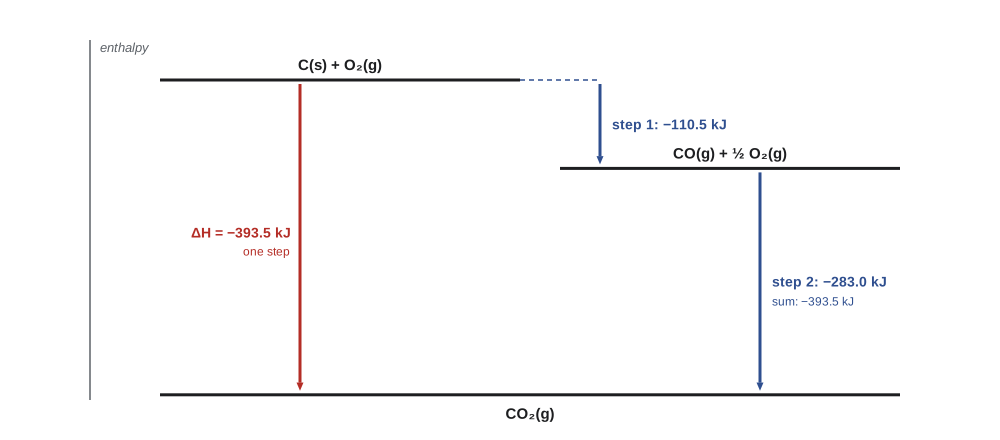
A classic example is carbon monoxide. Burning carbon in a limited supply of oxygen always gives a mixture of CO and CO₂, so the enthalpy of C(s) + ½ O₂(g) → CO(g) cannot be measured cleanly. But the complete combustion of carbon and of carbon monoxide can both be measured, and the target reaction is their difference.
Worked problem
Enthalpy of formation of carbon monoxide
Given (1) C(s) + O₂(g) → CO₂(g), ΔH₁ = −393.5 kJ, and (2) CO(g) + ½ O₂(g) → CO₂(g), ΔH₂ = −283.0 kJ, find ΔH for C(s) + ½ O₂(g) → CO(g).
Show solution
- Keep equation (1) as written: C(s) + O₂(g) → CO₂(g), −393.5 kJ.
- Reverse equation (2) so that CO appears as a product: CO₂(g) → CO(g) + ½ O₂(g), +283.0 kJ.
- Add them: CO₂ cancels, and ½ O₂ cancels from O₂, leaving C(s) + ½ O₂(g) → CO(g).
- ΔH = −393.5 + 283.0 = −110.5 kJ.
Answer: −110.5 kJ per mole of CO. Forming CO releases less than a third of the energy of complete combustion, which is why incomplete combustion in a poorly tuned furnace wastes fuel as well as producing a poison.
The strategy for any Hess's law problem is the same. Arrange the given equations so that the target's reactants are on the left and its products on the right, reversing equations (and changing the signs of their ΔH values) as needed. Multiply equations (and their ΔH values) by factors so that intermediate species cancel. Then add both the equations and the enthalpies.
Worked problem
A three-step Hess’s law problem
Find ΔH for the formation of methane, C(s) + 2 H₂(g) → CH₄(g), from the combustion data: (1) C(s) + O₂(g) → CO₂(g), −393.5 kJ; (2) H₂(g) + ½ O₂(g) → H₂O(l), −285.8 kJ; (3) CH₄(g) + 2 O₂(g) → CO₂(g) + 2 H₂O(l), −890.3 kJ.
Show solution
- Equation (1) as written: −393.5 kJ (carbon on the left, as in the target).
- Equation (2) times 2: 2 H₂(g) + O₂(g) → 2 H₂O(l), 2 × (−285.8) = −571.6 kJ.
- Equation (3) reversed: CO₂(g) + 2 H₂O(l) → CH₄(g) + 2 O₂(g), +890.3 kJ.
- Adding: CO₂, 2 H₂O and 2 O₂ all cancel. ΔH = −393.5 − 571.6 + 890.3 = −74.8 kJ.
Answer: −74.8 kJ/mol, the standard enthalpy of formation of methane. Nobody makes methane from graphite and hydrogen in a calorimeter; the number comes from combustion measurements combined by Hess’s law.
The bookkeeping can be automated. Each equation becomes a vector of coefficients (negative for reactants, positive for products), and the problem becomes finding the multipliers that combine the given equations into the target, a small linear algebra problem.
import numpy as np

species = ["C", "H2", "O2", "CO2", "H2O", "CH4"]
# rows: given reactions as coefficient vectors (products +, reactants -)
given = np.array([
    [-1,  0, -1,  1, 0, 0],    # C + O2 -> CO2
    [ 0, -1, -0.5, 0, 1, 0],   # H2 + 1/2 O2 -> H2O
    [ 0,  0, -2,  1, 2, -1],   # CH4 + 2 O2 -> CO2 + 2 H2O
])
dH = np.array([-393.5, -285.8, -890.3])
target = np.array([-1, -2, 0, 0, 0, 1])   # C + 2 H2 -> CH4

# solve multipliers x so that x @ given = target (least squares gives the exact answer here)
x, *_ = np.linalg.lstsq(given.T, target, rcond=None)
print("multipliers:", np.round(x, 3))
print("check residual:", np.round(x @ given - target, 10))
print(f"dH(target) = {x @ dH:.1f} kJ")multipliers: [ 1. 2. -1.] check residual: [-0. 0. -0. 0. -0. 0.] dH(target) = -74.8 kJ
The multipliers, 1, 2 and −1, are exactly the steps chosen by hand: keep the first equation, double the second, reverse the third.
Standard states and standard enthalpies of formation
To tabulate enthalpies usefully, chemists agree on reference conditions. The standard state of a substance is its pure form at a pressure of 1 bar (100 kPa) and a specified temperature, usually 25 °C (298.15 K). For a solute it is a concentration of 1 M. A superscript ° marks a standard quantity: ΔH° is the enthalpy change when reactants in their standard states become products in their standard states.
The standard enthalpy of formation, ΔH°f, of a compound is the enthalpy change when one mole of it forms from its elements in their standard states. For an element in its standard state, the most stable form at 1 bar and 25 °C, ΔH°f is zero by definition: O₂(g), N₂(g), C(graphite), Br₂(l), Na(s). Formation equations often need fractional coefficients so that exactly one mole of product forms, for example ½ N₂(g) + 3/2 H₂(g) → NH₃(g).
| Substance | ΔH°f (kJ/mol) | Substance | ΔH°f (kJ/mol) |
|---|---|---|---|
| H₂O(l) | −285.8 | CO₂(g) | −393.5 |
| H₂O(g) | −241.8 | CO(g) | −110.5 |
| CH₄(g) | −74.8 | NH₃(g) | −45.9 |
| C₂H₆(g) | −84.0 | NO(g) | +91.3 |
| C₃H₈(g) | −103.8 | NO₂(g) | +33.2 |
| C₂H₅OH(l) | −277.6 | SO₂(g) | −296.8 |
| C₆H₁₂O₆(s) | −1,273 | CaCO₃(s) | −1,207 |
| C₈H₁₈(l) | −250 | CaO(s) | −635.1 |
Formation enthalpies let us calculate the standard enthalpy of any reaction whose reactants and products are tabulated. Imagine taking the reactants apart into their elements, then building the products from those elements. By Hess's law,
where n and m are the coefficients in the balanced equation. Elements in their standard states contribute zero.
Worked problem
Combustion of propane
Calculate ΔH° for C₃H₈(g) + 5 O₂(g) → 3 CO₂(g) + 4 H₂O(l).
Show solution
- Products: 3(−393.5) + 4(−285.8) = −1,180.5 − 1,143.2 = −2,323.7 kJ.
- Reactants: (−103.8) + 5(0) = −103.8 kJ.
- ΔH° = −2,323.7 − (−103.8) = −2,219.9 kJ.
Answer: −2,220 kJ per mole of propane, or about 50.3 kJ per gram. This is the energy released when a barbecue or a rural home furnace burns propane.
# Standard enthalpies of formation, kJ/mol (approximate table values)
Hf = {"CO2(g)": -393.5, "H2O(l)": -285.8, "H2O(g)": -241.8, "O2(g)": 0.0,
      "CH4(g)": -74.8, "C3H8(g)": -103.8, "C8H18(l)": -250.0, "C2H5OH(l)": -277.6,
      "H2(g)": 0.0}

def dH_rxn(reactants, products):
    return (sum(n * Hf[s] for s, n in products.items())
            - sum(n * Hf[s] for s, n in reactants.items()))

fuels = {   # fuel: (molar mass g/mol, reactants, products)
    "hydrogen": (2.016, {"H2(g)": 1, "O2(g)": 0.5}, {"H2O(l)": 1}),
    "methane":  (16.04, {"CH4(g)": 1, "O2(g)": 2}, {"CO2(g)": 1, "H2O(l)": 2}),
    "propane":  (44.10, {"C3H8(g)": 1, "O2(g)": 5}, {"CO2(g)": 3, "H2O(l)": 4}),
    "octane":   (114.23, {"C8H18(l)": 1, "O2(g)": 12.5}, {"CO2(g)": 8, "H2O(l)": 9}),
    "ethanol":  (46.07, {"C2H5OH(l)": 1, "O2(g)": 3}, {"CO2(g)": 2, "H2O(l)": 3}),
}
print(f"{'fuel':10s}{'kJ/mol':>10s}{'kJ/g':>8s}{'g CO2 per MJ':>14s}")
for name, (M, r, p) in fuels.items():
    dH = dH_rxn(r, p)
    co2 = p.get("CO2(g)", 0) * 44.01
    per_MJ = co2 / (-dH / 1000)
print(f"{name:10s}{dH:10.1f}{-dH / M:8.1f}{per_MJ:14.1f}")fuel kJ/mol kJ/g g CO2 per MJ hydrogen -285.8 141.8 0.0 methane -890.3 55.5 49.4 propane -2219.9 50.3 59.5 octane -5470.2 47.9 64.4 ethanol -1366.8 29.7 64.4
The table shows two ways of judging a fuel. Hydrogen releases by far the most energy per gram and no carbon dioxide at the point of use, though how the hydrogen is made decides its overall footprint. Among the carbon fuels, methane gives the least carbon dioxide per megajoule because it has the highest ratio of hydrogen to carbon. Ethanol stores less energy per gram than octane because it is already partly oxidized: one of its atoms is oxygen.
Enthalpies of formation and stability
A large negative ΔH°f means a compound is much lower in enthalpy than its elements; it is energetically stable with respect to decomposing into them. Carbon dioxide and water, the end products of combustion, have large negative values, which is why burning releases so much energy. A positive ΔH°f, as for nitrogen monoxide (+91.3 kJ/mol), means the compound is higher in enthalpy than its elements. NO forms only at the high temperatures of engines and lightning, and it slowly reacts further in the atmosphere, contributing to smog and acid rain.
Energetic stability is not the same as reactivity, however. Whether a reaction actually happens depends also on entropy (lesson 3) and on its rate (lessons 5 and 6). Diamond has ΔH°f = +1.9 kJ/mol relative to graphite, yet diamonds do not turn into graphite on any human time scale.
Bond enthalpies
When formation enthalpies are not available, bond enthalpies give an estimate. The bond enthalpy (or bond dissociation energy) is the enthalpy needed to break one mole of a particular bond in gaseous molecules. Breaking bonds always absorbs energy; forming bonds always releases it. A reaction's enthalpy is roughly the energy needed to break the bonds in the reactants minus the energy released in forming the bonds of the products.
| Bond | D (kJ/mol) | Bond | D (kJ/mol) |
|---|---|---|---|
| H–H | 436 | C=O (in CO₂) | 799 |
| C–H | 413 | O=O | 498 |
| C–C | 348 | O–H | 463 |
| C=C | 614 | N≡N | 945 |
| C≡C | 839 | N–H | 391 |
| C–O | 358 | H–Cl | 431 |
| C–Cl | 328 | Cl–Cl | 243 |
Worked problem
Estimating the combustion of methane from bond enthalpies
Estimate ΔH for CH₄(g) + 2 O₂(g) → CO₂(g) + 2 H₂O(g) using average bond enthalpies.
Show solution
- Bonds broken: 4 C–H + 2 O=O = 4(413) + 2(498) = 1,652 + 996 = 2,648 kJ.
- Bonds formed: 2 C=O + 4 O–H = 2(799) + 4(463) = 1,598 + 1,852 = 3,450 kJ.
- ΔH ≈ 2,648 − 3,450 = −802 kJ.
Answer: About −802 kJ, in close agreement with the value of −802.3 kJ from formation enthalpies for water vapor. Such good agreement is partly luck; estimates usually fall within about 5 to 10 %.
Bond enthalpy estimates are less accurate than formation-enthalpy calculations for two reasons. Tabulated bond enthalpies are averages over many molecules, and a C–H bond in methane is not identical to one in ethanol. And bond enthalpies apply only to gases, so reactions involving liquids or solids also require enthalpies of vaporization or sublimation. Their value is insight: they show why a reaction is exothermic. Combustion releases energy because the C=O and O–H bonds formed are stronger than the C–H and O=O bonds broken.
Enthalpies of solution and lattice energy
Dissolving a salt involves two competing steps: breaking up the crystal lattice, which absorbs energy (the lattice energy from CHEM-101's Born–Haber cycles), and hydrating the separated ions, which releases energy as water molecules cluster around them. The enthalpy of solution is the sum. When hydration wins, dissolving is exothermic, as for calcium chloride (about −82.8 kJ/mol), which is why calcium chloride melts ice on roads even in deep cold. When the lattice wins, dissolving is endothermic, as for ammonium nitrate (about +25.7 kJ/mol), the basis of instant cold packs.
Fuels, food and energy density
Formation enthalpies underpin the energy comparisons used in public policy. Gasoline and diesel store about 46 MJ/kg and about 34 MJ per liter; lithium-ion batteries store roughly 0.5 to 0.9 MJ/kg (lesson 11 explains why). Food energy is the same chemistry run slowly: oxidizing glucose releases 2,803 kJ/mol, or about 15.6 kJ/g, and fats release more than twice as much per gram as carbohydrates because they are less oxidized. Nutrition labels use rounded values of 4, 4 and 9 Calories per gram for carbohydrate, protein and fat.
Worked problem
Food energy from formation enthalpies
Use formation enthalpies to calculate the energy released by oxidizing 1.00 g of glucose: C₆H₁₂O₆(s) + 6 O₂(g) → 6 CO₂(g) + 6 H₂O(l). ΔH°f(glucose) = −1,273 kJ/mol; M = 180.16 g/mol.
Show solution
- Products: 6(−393.5) + 6(−285.8) = −2,361 − 1,714.8 = −4,075.8 kJ.
- Reactants: −1,273 kJ.
- ΔH° = −4,075.8 + 1,273 = −2,802.8 kJ/mol.
- Per gram: 2,802.8 ÷ 180.16 = 15.56 kJ/g, or 15.56 ÷ 4.184 = 3.72 Calories per gram.
Answer: About 15.6 kJ/g, consistent with the rounded figure of 4 Calories per gram used on nutrition labels.
Common mistakes
MistakeWhen you multiply an equation by 2 in a Hess's law problem, ΔH stays the same.
InsteadEnthalpy is extensive; ΔH is multiplied by the same factor.
MistakeΔH°f of O₂(g) is the energy needed to form oxygen from atoms.
InsteadBy definition, ΔH°f is zero for an element in its standard state.
MistakeΔH°rxn = Σ ΔH°f(reactants) − Σ ΔH°f(products).
InsteadIt is products minus reactants, each multiplied by its coefficient.
MistakeForming bonds absorbs energy.
InsteadBreaking bonds absorbs energy; forming bonds releases it.
MistakeBond-enthalpy estimates are exact.
InsteadThey use averages and apply to gases, so they give approximate values.
Summary and key terms
- Hess’s law: because H is a state function, ΔH for an overall reaction is the sum of ΔH for its steps.
- Reverse an equation and its ΔH changes sign; multiply an equation and its ΔH is multiplied too.
- Standard state: pure substance at 1 bar (1 M for solutes), usually at 25 °C.
- ΔH°f is the enthalpy of forming one mole of a compound from its elements; it is zero for elements in their standard states.
- ΔH°rxn = Σ nΔH°f(products) − Σ mΔH°f(reactants).
- Bond enthalpies give approximate ΔH values: energy to break bonds minus energy released forming them.
- Fuel and food energies, energy densities and enthalpies of solution all follow from these tools.
- Hess's law
- The enthalpy change of a reaction equals the sum of the enthalpy changes of any series of steps that add up to it.
- standard state
- The pure substance at 1 bar (or 1 M for solutes) at a specified temperature, usually 25 °C.
- standard enthalpy of formation
- ΔH for forming one mole of a compound from its elements in their standard states.
- bond enthalpy
- The enthalpy required to break one mole of a given bond in gaseous molecules.
- enthalpy of solution
- The enthalpy change when a substance dissolves in a solvent.
- hydration
- The clustering of water molecules around dissolved ions, which releases energy.
- heating value
- The heat released by complete combustion of a unit mass of fuel.
- energy density
- Energy stored per unit mass or volume of a fuel or battery.
- extensive property
- A property, such as ΔH, that is proportional to the amount of substance.
- formation equation
- The equation for forming one mole of a compound from its elements in their standard states.
Practice problems
Work each problem on paper first, then reveal the answer to check.
Given S(s) + O₂(g) → SO₂(g), ΔH = −296.8 kJ and 2 SO₂(g) + O₂(g) → 2 SO₃(g), ΔH = −197.8 kJ, find ΔH for S(s) + 3/2 O₂(g) → SO₃(g).
Show answer
−296.8 + ½(−197.8) = −395.7 kJ.
Write the formation equation for liquid ethanol.
Show answer
2 C(s) + 3 H₂(g) + ½ O₂(g) → C₂H₅OH(l).
What is ΔH°f of Br₂(l)?
Show answer
Zero; liquid bromine is the standard state of bromine.
Calculate ΔH° for CaCO₃(s) → CaO(s) + CO₂(g).
Show answer
−635.1 − 393.5 − (−1,207) = +178.4 kJ.
Why is the decomposition of limestone done in hot kilns?
Show answer
It is strongly endothermic, so heat must be supplied; making cement and lime therefore uses much energy.
Calculate ΔH° for 2 NO(g) + O₂(g) → 2 NO₂(g).
Show answer
2(33.2) − 2(91.3) = −116.2 kJ.
Estimate ΔH for H₂(g) + Cl₂(g) → 2 HCl(g) from bond enthalpies.
Show answer
436 + 243 − 2(431) = −183 kJ.
Estimate ΔH for C₂H₄ + H₂ → C₂H₆ from bond enthalpies.
Show answer
Break C=C + H–H = 614 + 436 = 1,050; form C–C + 2 C–H = 348 + 826 = 1,174; ΔH ≈ −124 kJ.
Why does dissolving CaCl₂ warm the water?
Show answer
The hydration energy of its ions exceeds the lattice energy, so the process is exothermic.
Which releases more CO₂ per megajoule, methane or octane? Why?
Show answer
Octane; it has a lower hydrogen-to-carbon ratio, so more of its energy comes from forming CO₂.
Lesson quiz · 5 questions
Score 60% or more to complete this lesson.
Create a free account to save your progress, take quizzes and earn a certificate.