
CHEM-102 · Lesson 12 of 12 · 39 min
Capstone: the chemistry of ocean acidification
This final lesson applies the whole course to one real system: the carbon dioxide–carbonate equilibria that link the atmosphere, the oceans and the shells of marine life. As people burn fossil fuels, the concentration of carbon dioxide in the air has risen from about 280 parts per million before industrialization to roughly 425 to 430 ppm in 2025, according to measurements at Mauna Loa by NOAA and the Scripps Institution of Oceanography. The oceans have absorbed roughly a quarter to a third of the carbon dioxide released by human activity, slowing climate change but changing seawater chemistry. Every step of that story is chemistry from this course: Henry's law (lesson 4), equilibrium and Le Châtelier's principle (lesson 7), solubility (lesson 8), weak acids (lesson 9), buffers (lesson 10), thermodynamics (lessons 1 to 3) and kinetics (lessons 5 and 6). The lesson ends with an integrated problem set.
From air to water: Henry's law
Carbon dioxide dissolves in water in proportion to its partial pressure (Henry's law, lesson 4). At 25 °C the Henry's law constant for CO₂ in fresh water is about 0.034 mol/(L·atm); it is somewhat lower in seawater and higher in cold water, which is one reason cold polar seas absorb carbon dioxide readily.
Dissolved CO₂ reacts with water to form carbonic acid, a weak diprotic acid (lesson 9). Only a small fraction exists as true H₂CO₃; by convention the dissolved CO₂ and H₂CO₃ are counted together and written H₂CO₃* or CO₂(aq). The two ionization steps produce bicarbonate and carbonate.
These are the fresh-water values at 25 °C. In seawater, the high concentration of other ions changes the effective constants, which oceanographers measure directly; the apparent values at 25 °C and typical salinity are about pK₁* = 5.86 and pK₂* = 8.92.
Why rain is acidic
The first ionization alone sets the pH of pure water in contact with air. This is a weak-acid calculation with one twist: the concentration of dissolved CO₂ is fixed by the atmosphere, not by how much acid was added.
Worked problem
The pH of clean rain
Calculate the pH of pure water in equilibrium with air containing 420 ppm CO₂ at 25 °C and 1.00 atm. Use k_H = 0.034 mol/(L·atm) and K_a1 = 4.3 × 10⁻⁷.
Show solution
- P(CO₂) = 420 × 10⁻⁶ atm = 4.20 × 10⁻⁴ atm.
- [CO₂(aq)] = 0.034 × 4.20 × 10⁻⁴ = 1.43 × 10⁻⁵ M, held constant by the air.
- K_a1 = [H⁺][HCO₃⁻]/[CO₂(aq)] with [H⁺] = [HCO₃⁻] = x: x² = 4.3 × 10⁻⁷ × 1.43 × 10⁻⁵ = 6.14 × 10⁻¹².
- x = 2.48 × 10⁻⁶ M; pH = 5.61.
Answer: pH ≈ 5.6, the familiar value for unpolluted rain. Acid rain (lesson 9) is rain below about pH 5, made more acidic by sulfuric and nitric acids. Doubling CO₂ would lower this pH by only 0.15, because [H⁺] grows as the square root of P(CO₂).
Speciation: which form dominates?
In a solution containing a fixed total amount of dissolved inorganic carbon (DIC = [CO₂(aq)] + [HCO₃⁻] + [CO₃²⁻]), the fraction present in each form depends only on pH. Below pK₁ dissolved CO₂ dominates; between pK₁ and pK₂ bicarbonate dominates; above pK₂ carbonate dominates. The fractions follow from the two equilibrium expressions.
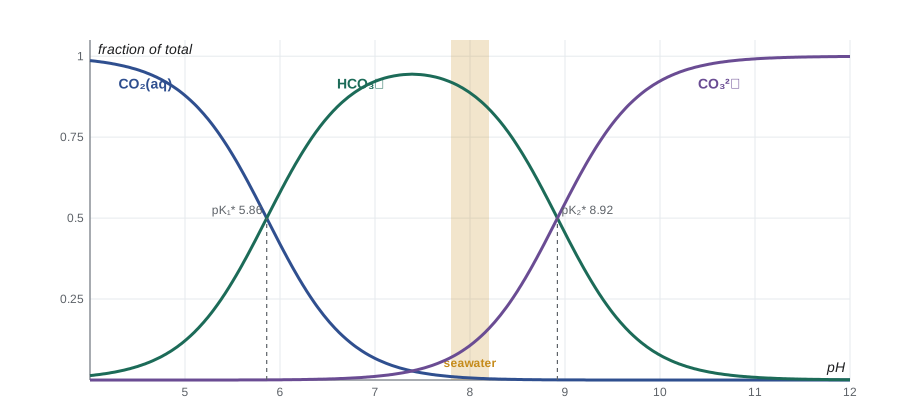
Surface seawater sits near pH 8.1, where about 85 to 90 % of the dissolved inorganic carbon is bicarbonate, most of the rest is carbonate, and less than 1 % is dissolved CO₂. This is why the ocean can hold about fifty times as much carbon as the atmosphere.
The ocean as a buffer
Seawater is buffered (lesson 10), mainly by the bicarbonate–carbonate system along with borate. When carbon dioxide dissolves, the H⁺ it produces is largely consumed by carbonate ions, forming more bicarbonate. Adding the reactions shows the net effect.
The buffer keeps the pH from falling as fast as it would in unbuffered water, but it does so by using up carbonate. Since the industrial revolution, average surface-ocean pH has fallen by about 0.1 unit, from roughly 8.2 to 8.1. Because pH is logarithmic, that is about a 26 % increase in hydrogen ion concentration (10^0.1 = 1.26). Projections under high-emission scenarios suggest a further fall of 0.3 or more by 2100.
# Simplified model: carbonate speciation in seawater at constant total dissolved inorganic carbon
# (apparent constants at 25 C, salinity 35). Real ocean calculations use measured alkalinity too;
# the numbers here illustrate the trend and are not predictions.
K1, K2 = 10 ** -5.86, 10 ** -8.92
DIC = 2.0e-3            # mol/kg, typical surface value (illustrative)
Ca = 0.0103             # mol/kg calcium in seawater
Ksp_arag = 6.65e-7      # apparent Ksp of aragonite at 25 C, (mol/kg)^2

print(f"{'pH':>4s} {'CO2(aq) %':>10s} {'HCO3- %':>8s} {'CO3 2- %':>9s} {'CO3 2- umol/kg':>15s} {'Omega':>6s}")
for pH in (8.2, 8.1, 8.0, 7.8):
    H = 10 ** -pH
    d = 1 + H / K2 + H * H / (K1 * K2)
    a2 = 1 / d
    a1 = (H / K2) / d
    a0 = (H * H / (K1 * K2)) / d
    co3 = a2 * DIC
    omega = Ca * co3 / Ksp_arag
print(f"{pH:4.1f} {100 * a0:10.2f} {100 * a1:8.1f} {100 * a2:9.1f} {co3 * 1e6:15.0f} {omega:6.2f}")pH CO2(aq) % HCO3- % CO3 2- % CO3 2- umol/kg Omega 8.2 0.38 83.7 15.9 319 4.94 8.1 0.50 86.4 13.1 262 4.05 8.0 0.64 88.7 10.7 213 3.30 7.8 1.06 92.0 7.0 140 2.16
Shells, saturation and solubility
Corals, oysters, mussels, sea urchins and many plankton build shells and skeletons of calcium carbonate, as calcite or aragonite (a slightly more soluble crystal form). Whether seawater favors building or dissolving these minerals depends on the ion product compared with K_sp (lesson 8), expressed as the saturation state.
When Ω > 1, seawater is supersaturated and shells form easily; when Ω < 1, it is undersaturated and unprotected carbonate tends to dissolve. Calcium is plentiful and nearly constant in seawater, so Ω tracks the carbonate concentration. As the code shows, a fall of a few tenths of a pH unit removes a large share of the carbonate and lowers Ω markedly, even in this simplified model. Organisms can build shells below the thermodynamic threshold by controlling the chemistry at their growth sites, but doing so costs energy, and larval shellfish are especially vulnerable.
The effects are already measurable in the northeast Pacific, where upwelling brings naturally CO₂-rich deep water to the surface and human emissions add to it. Oyster hatcheries in Oregon and Washington suffered heavy larval losses during corrosive-water episodes in the late 2000s; many now monitor seawater chemistry continuously and buffer their intake water, with support from NOAA's Ocean Acidification Program. Shellfish growers in British Columbia faced similar problems.
Temperature, kinetics and the long view
Thermodynamics and kinetics shape the story over different time scales. Warming lowers the solubility of CO₂ (lesson 4), so a warmer ocean absorbs less, a feedback that leaves more carbon dioxide in the air. Calcium carbonate is unusual in being less soluble in warm water, which is why carbonate sediments accumulate in warm, shallow tropical seas and dissolve in the cold, high-pressure deep ocean, below a depth called the carbonate compensation depth. Dissolving CO₂ into surface water is fast, taking months; mixing it into the deep ocean takes centuries; and neutralizing it by dissolving carbonate sediments and weathering rocks takes thousands to hundreds of thousands of years. That is why ocean acidification, once it happens, is effectively irreversible on human time scales, even if emissions stop.
Chemistry also points to responses. Cutting emissions addresses the cause. Researchers are testing ocean alkalinity enhancement, adding finely ground minerals or alkaline solutions to seawater to raise its pH and absorb more CO₂, with field trials off Nova Scotia and elsewhere; the approach raises questions about side effects and verification that are still being studied. Seaweed and seagrass beds raise the pH of nearby water as they photosynthesize, offering local refuges for shellfish.
Integrated problem set
The problems below draw on every lesson. Work them before reading the solutions; they are typical of the questions a final examination in general chemistry asks.
Worked problem
Problem 1: energy and fuel (lessons 1–3)
Natural gas (methane) heats a home that needs 7.5 × 10⁴ MJ of heat in a winter. Using ΔH° = −890 kJ/mol (water as liquid) and a furnace efficiency of 95 %, what mass of methane is burned and what mass of CO₂ is produced?
Show solution
- Heat from fuel: 7.5 × 10⁴ MJ ÷ 0.95 = 7.89 × 10⁴ MJ = 7.89 × 10⁷ kJ.
- Moles of CH₄: 7.89 × 10⁷ kJ ÷ 890 kJ/mol = 8.87 × 10⁴ mol.
- Mass of CH₄: 8.87 × 10⁴ mol × 16.04 g/mol = 1.42 × 10⁶ g = 1,420 kg.
- CO₂: one mole per mole of CH₄, 8.87 × 10⁴ mol × 44.01 g/mol = 3.90 × 10⁶ g.
Answer: About 1,400 kg of methane, producing about 3,900 kg of CO₂, roughly what one detached house in a cold climate emits from gas heating in a year.
Worked problem
Problem 2: kinetics (lessons 5–6)
The hydration of dissolved CO₂ to H₂CO₃ is first order in CO₂ with k ≈ 0.037 s⁻¹ at 25 °C. What is its half-life? If Eₐ ≈ 70 kJ/mol, by what factor is it slower in 5 °C water?
Show solution
- t½ = 0.693/0.037 = 18.7 s.
- k ratio: ln(k₂₉₈/k₂₇₈) = (70,000/8.314)(1/278.15 − 1/298.15) = 8,420 × 2.41 × 10⁻⁴ = 2.03.
- Factor: e^2.03 = 7.6.
Answer: A half-life of about 19 s at 25 °C, roughly 7 to 8 times slower in 5 °C water. The enzyme carbonic anhydrase speeds this reaction about a million-fold in blood and in the cells of corals and shellfish.
Worked problem
Problem 3: equilibrium and acids (lessons 7 and 9)
A soft drink is bottled under CO₂ at 4.0 atm. Estimate its pH from the carbonic acid alone, ignoring other acids. Use k_H = 0.034 mol/(L·atm) and K_a1 = 4.3 × 10⁻⁷.
Show solution
- [CO₂(aq)] = 0.034 × 4.0 = 0.136 M.
- [H⁺] = √(4.3 × 10⁻⁷ × 0.136) = √(5.85 × 10⁻⁸) = 2.42 × 10⁻⁴ M.
- pH = 3.62.
Answer: About pH 3.6 from carbonic acid alone. Colas are more acidic, near pH 2.5, because they also contain phosphoric acid; sour candies and citrus drinks add citric acid.
Worked problem
Problem 4: solubility (lesson 8)
Hard water from a limestone aquifer contains 120 mg/L of Ca²⁺. Will calcium carbonate precipitate in a kettle if heating raises [CO₃²⁻] to 1.0 × 10⁻⁴ M? (K_sp of calcite ≈ 3.4 × 10⁻⁹; assume the value holds approximately at the higher temperature.)
Show solution
- [Ca²⁺] = 0.120 g/L ÷ 40.08 g/mol = 2.99 × 10⁻³ M.
- Q = (2.99 × 10⁻³)(1.0 × 10⁻⁴) = 3.0 × 10⁻⁷.
- Q is about 90 times K_sp.
Answer: Yes: Q far exceeds K_sp, so scale forms. In fact calcite is even less soluble in hot water, which makes precipitation more certain.
Worked problem
Problem 5: buffers (lesson 10)
Blood’s bicarbonate buffer has pK_a ≈ 6.1 (under physiological conditions) and [HCO₃⁻] = 24 mM. What concentration of dissolved CO₂ gives a pH of 7.40? If a lung disease raises dissolved CO₂ to 1.8 mM with bicarbonate unchanged, what is the new pH?
Show solution
- 7.40 = 6.1 + log(24/[CO₂]), so log(24/[CO₂]) = 1.30 and 24/[CO₂] = 20.0; [CO₂] = 1.2 mM.
- New pH = 6.1 + log(24/1.8) = 6.1 + 1.12 = 7.22.
Answer: 1.2 mM CO₂ gives pH 7.40; raising it to 1.8 mM drops the pH to about 7.2, a respiratory acidosis that the kidneys partly correct over days by retaining bicarbonate.
Worked problem
Problem 6: electrochemistry (lesson 11)
A marine buoy uses a magnesium sacrificial anode to protect its steel frame. Using E°(Mg²⁺/Mg) = −2.37 V and E°(O₂/OH⁻) = +0.40 V, find E° for the corrosion of magnesium by dissolved oxygen, and the mass of magnesium consumed by an average protection current of 0.050 A over one year.
Show solution
- E° = 0.40 − (−2.37) = 2.77 V, strongly spontaneous.
- Charge in a year: 0.050 A × 3.156 × 10⁷ s = 1.58 × 10⁶ C.
- Moles of Mg: 1.58 × 10⁶ ÷ (2 × 96,485) = 8.18 mol; mass = 8.18 × 24.31 = 199 g.
Answer: E° = 2.77 V, and about 0.2 kg of magnesium is consumed per year, so anodes are sized and replaced on a schedule.
The code below runs a final integrated calculation: the pH of clean rain at different atmospheric CO₂ levels, from preindustrial times to a high-emission future, combining Henry's law with the weak-acid equilibrium.
from math import log10, sqrt

kH, Ka1 = 0.034, 4.3e-7       # mol/(L atm) and first ionization constant at 25 C
for label, ppm in (("preindustrial", 280), ("1960", 317), ("2025", 425), ("doubling", 560), ("high-emission 2100", 900)):
    co2 = kH * ppm * 1e-6
    H = sqrt(Ka1 * co2)
print(f"{label:19s} {ppm:4d} ppm: [CO2(aq)] = {co2:.2e} M, rain pH = {-log10(H):.2f}")preindustrial 280 ppm: [CO2(aq)] = 9.52e-06 M, rain pH = 5.69 1960 317 ppm: [CO2(aq)] = 1.08e-05 M, rain pH = 5.67 2025 425 ppm: [CO2(aq)] = 1.45e-05 M, rain pH = 5.60 doubling 560 ppm: [CO2(aq)] = 1.90e-05 M, rain pH = 5.54 high-emission 2100 900 ppm: [CO2(aq)] = 3.06e-05 M, rain pH = 5.44
Clean rain becomes only slightly more acidic as CO₂ rises, because the ocean and land buffers do not apply to a raindrop and [H⁺] varies only as the square root of P(CO₂). The ocean's story is different and more serious, because it is the carbonate concentration, not pH alone, that matters to marine life. Working through a real system like this, connecting enthalpy, entropy, rates, equilibria, solubility, acid–base chemistry and electrochemistry, is exactly what the physical, analytical and environmental chemistry courses that follow (CHEM-211, CHEM-271) build on.
Common mistakes
MistakeOcean acidification means the ocean has become acidic.
InsteadSeawater is still basic (pH about 8.1); "acidification" means its pH is falling.
MistakeA pH drop of 0.1 is too small to matter.
InsteadIt is a 26 % rise in [H⁺], and it removes a significant share of carbonate ions.
MistakeDissolved CO₂ mostly stays as CO₂ in seawater.
InsteadAt pH 8.1, almost 90 % of dissolved inorganic carbon is bicarbonate; less than 1 % is CO₂.
MistakeThe ocean's buffer prevents any change in its chemistry.
InsteadBuffering slows the pH change but consumes carbonate, lowering the saturation state of shell minerals.
MistakeStopping emissions would reverse acidification within a few years.
InsteadMixing into the deep ocean takes centuries and neutralization by carbonate sediments takes millennia.
Summary and key terms
- Atmospheric CO₂ dissolves in water by Henry’s law and forms carbonic acid, a weak diprotic acid.
- Clean rain has pH about 5.6 from dissolved CO₂; [H⁺] varies as the square root of P(CO₂).
- At seawater pH, most dissolved inorganic carbon is bicarbonate; speciation depends only on pH and the two K values.
- The ocean buffers added CO₂ by converting carbonate to bicarbonate, so carbonate falls.
- Surface-ocean pH has fallen about 0.1 since industrialization, a 26 % rise in [H⁺].
- The saturation state Ω = [Ca²⁺][CO₃²⁻]/K′sp decides whether calcium carbonate shells form or dissolve.
- Temperature, kinetics and slow mixing make acidification effectively irreversible on human time scales.
- ocean acidification
- The ongoing decrease in seawater pH caused by absorption of atmospheric CO₂.
- dissolved inorganic carbon
- The total of dissolved CO₂, bicarbonate and carbonate in water.
- speciation
- The distribution of a substance among its different chemical forms.
- carbonic acid
- H₂CO₃, the weak diprotic acid formed when CO₂ dissolves in water.
- bicarbonate
- HCO₃⁻, the dominant form of dissolved inorganic carbon at seawater pH.
- saturation state
- Ω, the ion product of a mineral divided by its solubility product.
- aragonite
- A crystal form of calcium carbonate used by corals and many shellfish, more soluble than calcite.
- apparent equilibrium constant
- An equilibrium constant measured in a specific medium such as seawater, written with a star.
- carbonate compensation depth
- The ocean depth below which calcium carbonate dissolves faster than it accumulates.
- ocean alkalinity enhancement
- Proposed methods that add alkaline materials to seawater to raise its pH and absorb more CO₂.
Practice problems
Work each problem on paper first, then reveal the answer to check.
What fraction of an increase in [H⁺] corresponds to a pH drop from 8.1 to 7.8?
Show answer
10^0.3 = 2.0, so [H⁺] doubles.
At what pH are dissolved CO₂ and bicarbonate equal in seawater (pK₁* = 5.86)?
Show answer
pH 5.86.
At what pH are bicarbonate and carbonate equal in seawater (pK₂* = 8.92)?
Show answer
pH 8.92.
Calculate [CO₂(aq)] in fresh water under 425 ppm CO₂ at 25 °C.
Show answer
0.034 × 4.25 × 10⁻⁴ = 1.45 × 10⁻⁵ M.
Why do cold polar waters absorb CO₂ readily?
Show answer
Gas solubility increases as temperature falls.
Why is calcium carbonate found in shallow tropical sediments but not in the deep ocean?
Show answer
It is less soluble in warm water and more soluble in cold, high-pressure deep water.
Write the net reaction by which carbonate buffers added CO₂.
Show answer
CO₂ + CO₃²⁻ + H₂O → 2 HCO₃⁻.
If Ω for aragonite is 3.0, is seawater supersaturated or undersaturated?
Show answer
Supersaturated (Ω > 1); shells form readily.
Find the pH of a buffer of 24 mM HCO₃⁻ and 2.4 mM CO₂ (pK_a 6.1).
Show answer
6.1 + log 10 = 7.1.
Why does a raindrop’s pH change little as CO₂ rises while marine carbonate changes a lot?
Show answer
Rain pH depends on √P(CO₂); seawater carbonate is consumed by the buffer reaction, so its concentration falls substantially.
Lesson quiz · 5 questions
Score 60% or more to complete this lesson.
Create a free account to save your progress, take quizzes and earn a certificate.