
CHEM-101 · Lesson 9 of 12 · 29 min
Chemical bonding I: ionic and covalent bonds and Lewis structures
Atoms rarely exist alone. Apart from the noble gases, elements are found bonded to other atoms, in salts, molecules, metals and networks. A chemical bond forms when the arrangement of nuclei and electrons in the bonded atoms has lower energy than the separated atoms. This lesson describes the two most important kinds of bonding, ionic and covalent, introduces Lewis structures as a simple but powerful way to show how valence electrons are arranged, and uses formal charge and resonance to decide which structures best describe real molecules. Lesson 10 builds on Lewis structures to predict molecular shapes.
Lewis symbols and the octet rule
Gilbert N. Lewis, working at the University of California in the 1910s, proposed representing an atom's valence electrons as dots around its symbol. Carbon, with four valence electrons, is written with four dots; chlorine, with seven, with seven dots arranged as three pairs and one single dot. Lewis noticed that atoms in stable compounds often end up with eight valence electrons, the configuration of a noble gas (or two, for hydrogen, like helium). This observation, the octet rule, is not a law of nature, and there are many exceptions, but it organizes a great deal of chemistry for the second-period elements carbon, nitrogen, oxygen and fluorine.
Ionic bonding
When an element with a low ionization energy meets one with a high electron affinity, such as sodium and chlorine, electrons transfer from the metal to the nonmetal, forming cations and anions. The oppositely charged ions attract one another strongly in all directions, building a three-dimensional crystal lattice. In sodium chloride, each Na⁺ is surrounded by six Cl⁻ and each Cl⁻ by six Na⁺. There are no discrete NaCl molecules; the formula gives only the ratio of ions.
It might seem that transferring an electron from sodium to chlorine is favorable in itself, but it is not. Removing sodium's electron costs 496 kJ/mol, and chlorine's electron affinity releases only 349 kJ/mol, so forming separated gaseous Na⁺ and Cl⁻ ions from atoms costs energy overall. What makes ionic compounds stable is the large energy released when the gaseous ions come together to form the lattice. The lattice energy is the energy required to separate one mole of an ionic solid into its gaseous ions; for NaCl it is 787 kJ/mol.
Lattice energy follows Coulomb's law: the energy of attraction between two charges is proportional to the product of the charges and inversely proportional to the distance between them.
So lattice energy increases with ionic charge and decreases with ionic size. MgO (Mg²⁺ and O²⁻) has a lattice energy of about 3,800 kJ/mol, roughly five times that of NaCl, which is why magnesium oxide melts at about 2,800 °C and is used to line furnaces, while sodium chloride melts at 801 °C. Among the alkali-metal chlorides, lattice energy falls from LiCl to CsCl as the cation grows.
The Born–Haber cycle
Lattice energies cannot be measured directly. Instead they are calculated with a Born–Haber cycle, which applies the principle that the total energy change for a process is the same whatever route is taken (Hess's law, developed in CHEM-102). Forming NaCl(s) from its elements can be broken into steps whose energies are all measurable: vaporizing sodium, ionizing it, breaking the Cl–Cl bond, adding an electron to each chlorine atom, and finally assembling the lattice. The unknown lattice energy is whatever makes the cycle add up.
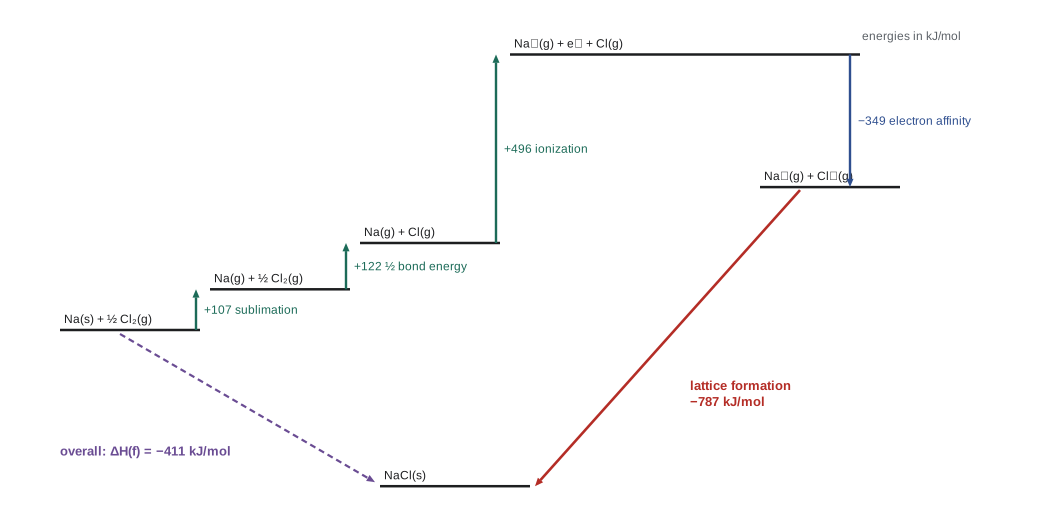
# Born-Haber cycle for NaCl (all values in kJ/mol)
steps = {
    "sublimation of Na(s) -> Na(g)":         +107,
    "half the Cl-Cl bond energy":            +122,
    "first ionization energy of Na":         +496,
    "electron affinity of Cl":               -349,
}
dHf = -411      # standard enthalpy of formation of NaCl(s), measured

total_before_lattice = sum(steps.values())
lattice_formation = dHf - total_before_lattice     # energy released forming the lattice
for name, val in steps.items():
    print(f"{name:40s} {val:+5d}")
print(f"{'sum of the steps above':40s} {total_before_lattice:+5d}")
print(f"{'lattice formation (from the cycle)':40s} {lattice_formation:+5d}")
print(f"lattice energy (to separate the ions) = {-lattice_formation} kJ/mol")sublimation of Na(s) -> Na(g) +107 half the Cl-Cl bond energy +122 first ionization energy of Na +496 electron affinity of Cl -349 sum of the steps above +376 lattice formation (from the cycle) -787 lattice energy (to separate the ions) = 787 kJ/mol
The cycle shows that, energetically, ionic compounds exist because of the lattice. The steps that create ions from atoms cost energy, and the lattice repays that cost many times over.
Covalent bonding
When two nonmetals combine, neither atom can easily lose electrons, so electrons are shared instead. In a covalent bond, a pair of electrons is held between two nuclei, attracted to both. Consider two hydrogen atoms approaching each other. As they get closer, each electron is attracted to both nuclei and the energy falls. At very short distances the repulsion between the nuclei dominates and the energy rises sharply. The minimum of the energy curve defines the bond length (74 pm for H₂), and the depth of the minimum is the bond energy (436 kJ/mol).
Atoms can share more than one pair. A single bond shares one pair, a double bond two pairs, and a triple bond three pairs. The number of shared pairs is the bond order. Higher bond orders give shorter, stronger bonds between the same two atoms.
| Bond | Bond order | Typical length (pm) | Typical energy (kJ/mol) |
|---|---|---|---|
| C–C | 1 | 154 | 347 |
| C=C | 2 | 134 | 614 |
| C≡C | 3 | 120 | 839 |
| C–O | 1 | 143 | 358 |
| C=O | 2 | 123 | 799 (in CO₂) |
| N≡N | 3 | 110 | 941 |
The very strong triple bond of N₂ explains why nitrogen gas, 78 % of the atmosphere, is so unreactive, and why breaking it to make ammonia requires the high temperatures, pressures and catalysts of the Haber–Bosch process described in lesson 5.
Polar bonds and electronegativity
Electrons are shared equally only between identical atoms. When the atoms differ in electronegativity, the more electronegative atom pulls the shared pair toward itself, acquiring a partial negative charge (δ−) and leaving the other atom partially positive (δ+). The bond is polar covalent. The difference in electronegativity, ΔEN, provides a rough guide to bond type: a difference below about 0.4 gives an essentially nonpolar bond, a difference from about 0.4 to 1.8 a polar covalent bond, and a larger difference a bond that is mostly ionic. These boundaries are conventions; in reality, bonding runs continuously from purely covalent to largely ionic.
# Classify bonds by electronegativity difference (Pauling scale)
EN = {"H": 2.20, "C": 2.55, "N": 3.04, "O": 3.44, "F": 3.98, "Na": 0.93,
      "Mg": 1.31, "Cl": 3.16, "S": 2.58, "K": 0.82}

def classify(a, b):
    d = abs(EN[a] - EN[b])
    if d < 0.4:
        kind = "nonpolar covalent"
    elif d <= 1.8:
        kind = "polar covalent"
    else:
        kind = "mostly ionic"
    neg = a if EN[a] > EN[b] else b
    return d, kind, neg

for a, b in [("C", "H"), ("O", "H"), ("C", "O"), ("H", "Cl"), ("C", "S"), ("Na", "Cl"), ("K", "F")]:
    d, kind, neg = classify(a, b)
print(f"{a}-{b:2s} dEN = {d:.2f} {kind:18s} (negative end: {neg})")C-H dEN = 0.35 nonpolar covalent (negative end: C) O-H dEN = 1.24 polar covalent (negative end: O) C-O dEN = 0.89 polar covalent (negative end: O) H-Cl dEN = 0.96 polar covalent (negative end: Cl) C-S dEN = 0.03 nonpolar covalent (negative end: S) Na-Cl dEN = 2.23 mostly ionic (negative end: Cl) K-F dEN = 3.16 mostly ionic (negative end: F)
Bond polarity has large consequences. The polar O–H bonds of water, combined with its bent shape (lesson 10), make water a polar molecule able to dissolve salts and form hydrogen bonds (lesson 12). The nearly nonpolar C–H bonds of hydrocarbons are why oil and water do not mix.
Drawing Lewis structures
A Lewis structure shows how the valence electrons of a molecule or polyatomic ion are arranged as bonding pairs (drawn as lines) and lone pairs (drawn as pairs of dots). A reliable procedure works for most molecules:
| Step | What to do |
|---|---|
| 1 | Add up the valence electrons of all atoms; add one for each negative charge, subtract one for each positive charge. |
| 2 | Choose a skeleton: the least electronegative atom (never hydrogen) usually goes in the center; hydrogen and fluorine are always terminal. |
| 3 | Connect the atoms with single bonds, each using two electrons. |
| 4 | Complete octets on the outer atoms with lone pairs (hydrogen needs only two electrons). |
| 5 | Place any remaining electrons on the central atom. |
| 6 | If the central atom has fewer than eight electrons, move lone pairs from outer atoms to form double or triple bonds. |
Worked problem
Lewis structures of CO₂ and NH₄⁺
Draw Lewis structures for carbon dioxide and the ammonium ion.
Show solution
- CO₂: valence electrons = 4 + 2(6) = 16. Skeleton O–C–O uses 4; completing the oxygen octets uses 12; none remain.
- Carbon has only 4 electrons, so move one lone pair from each oxygen into a double bond: O=C=O, with two lone pairs on each oxygen. Every atom now has an octet.
- NH₄⁺: valence electrons = 5 + 4(1) − 1 = 8. Four N–H single bonds use all 8. Nitrogen has an octet, each hydrogen has 2, and the whole ion carries a 1+ charge, shown with brackets.
Answer: O=C=O with two lone pairs on each O; [NH₄]⁺ with four N–H bonds and no lone pairs.
Formal charge
Sometimes more than one Lewis structure obeys the octet rule. Formal charge helps choose among them. It compares the number of valence electrons an atom “owns” in the structure, counting all its lone-pair electrons and half its bonding electrons, with the number it has as a free atom:
The formal charges in a structure always add up to the overall charge. The preferred structure is generally the one with formal charges as close to zero as possible, and with any negative formal charge on the more electronegative atom. Formal charge is a bookkeeping device, like oxidation number, and does not represent the actual charge distribution, but it is very useful for judging structures.
# Formal charges for competing Lewis structures of the thiocyanate ion, SCN-
VALENCE = {"S": 6, "C": 4, "N": 5, "O": 6}

def formal_charge(atom, lone_electrons, bonds):
    """bonds = number of shared pairs (bond order sum) on this atom"""
    return VALENCE[atom] - lone_electrons - bonds

structures = {
    "S=C=N (S: 2 lone pairs, N: 2 lone pairs)": [("S", 4, 2), ("C", 0, 4), ("N", 4, 2)],
    "S-C#N (S: 3 lone pairs, N: 1 lone pair)":  [("S", 6, 1), ("C", 0, 4), ("N", 2, 3)],
    "S#C-N (S: 1 lone pair,  N: 3 lone pairs)": [("S", 2, 3), ("C", 0, 4), ("N", 6, 1)],
}
for name, atoms in structures.items():
    fcs = [formal_charge(a, l, b) for a, l, b in atoms]
print(f"{name}: formal charges S, C, N = {fcs}, total = {sum(fcs)}")S=C=N (S: 2 lone pairs, N: 2 lone pairs): formal charges S, C, N = [0, 0, -1], total = -1 S-C#N (S: 3 lone pairs, N: 1 lone pair): formal charges S, C, N = [-1, 0, 0], total = -1 S#C-N (S: 1 lone pair, N: 3 lone pairs): formal charges S, C, N = [1, 0, -2], total = -1
The first two structures have only a single −1 formal charge, which is as close to zero as an ion with a 1− charge allows. In the first the negative charge sits on nitrogen, the more electronegative atom, which makes it the better structure by the usual rule; in the second it sits on sulfur. Measured bond lengths show that both contribute to the real ion, with the first more important. The third structure, with +1 on sulfur and −2 on nitrogen, is clearly the poorest. When several reasonable structures exist, the real molecule is a blend of them, which leads to the idea of resonance.
Resonance
The nitrate ion, NO₃⁻, can be drawn with one N=O double bond and two N–O single bonds, but the double bond can be placed on any of the three oxygens, giving three equivalent structures. Experiment shows that all three N–O bonds in nitrate are identical, intermediate in length between a single and a double bond. No single Lewis structure describes the ion. Instead, the real structure is a resonance hybrid, an average of the contributing resonance structures, drawn with double-headed arrows between them. The electrons in the extra bond are delocalized, spread over all three N–O bonds; the average bond order is 4/3.
Resonance does not mean the molecule flips back and forth between structures. A useful analogy: a rhinoceros might be described as a cross between a dragon and a unicorn, two imaginary animals, but the rhinoceros itself is a real animal that does not alternate between them. Benzene, C₆H₆, is the classic example in organic chemistry, with six identical C–C bonds of order 1.5, a topic for CHEM-261.
Exceptions to the octet rule
Three kinds of molecules break the octet rule. Odd-electron molecules, or free radicals, have an odd number of valence electrons, so at least one atom must have an unpaired electron; nitrogen monoxide, NO, with 11 valence electrons, is an example, and radicals of this kind play roles in air pollution and in cell signaling. Some molecules have an incomplete octet, notably compounds of boron and beryllium: boron trifluoride, BF₃, has only six electrons around boron, which makes it eager to accept an electron pair from another molecule. Finally, elements of the third period and beyond can have an expanded octet, with more than eight electrons around the central atom, as in phosphorus pentachloride (PCl₅, ten electrons around P) and sulfur hexafluoride (SF₆, twelve around S). The traditional explanation invoked empty d orbitals; modern calculations attribute expanded octets mainly to the larger size of these atoms, which lets more atoms crowd around them, but the Lewis structures are drawn the same way.
Bond energies and reaction energies
Breaking bonds always requires energy, and forming bonds always releases it. A rough estimate of the energy change of a gas-phase reaction can be made by adding the energies of the bonds broken and subtracting the energies of the bonds formed. Because tabulated bond energies are averages over many molecules, the estimate is approximate; CHEM-102 develops accurate methods based on enthalpies of formation.
# Estimate the energy change for CH4 + 2 O2 -> CO2 + 2 H2O from average bond energies (kJ/mol)
D = {"C-H": 413, "O=O": 498, "C=O (CO2)": 799, "O-H": 463}

broken = 4 * D["C-H"] + 2 * D["O=O"]
formed = 2 * D["C=O (CO2)"] + 4 * D["O-H"]
dH = broken - formed
print(f"bonds broken: {broken} kJ   bonds formed: {formed} kJ")
print(f"estimated dH = {dH} kJ per mol of CH4")
print("measured value (with water as a gas): about -802 kJ")bonds broken: 2648 kJ bonds formed: 3450 kJ estimated dH = -802 kJ per mol of CH4 measured value (with water as a gas): about -802 kJ
The estimate agrees well with the measured value. Methane releases so much energy when it burns because the bonds in carbon dioxide and water are, in total, much stronger than the bonds in methane and oxygen.
Common mistakes
MistakeSodium chloride consists of NaCl molecules.
InsteadSodium chloride is a lattice of Na⁺ and Cl⁻ ions; the formula gives only their ratio.
MistakeIonic compounds form because electron transfer from metal to nonmetal releases energy.
InsteadForming gaseous ions costs energy; the large lattice energy is what makes ionic solids stable.
MistakeResonance structures interconvert rapidly, like a molecule switching shape.
InsteadThe real molecule is a single hybrid; the resonance structures are only partial descriptions of it.
MistakeWhen counting valence electrons for an anion, subtract one electron per negative charge.
InsteadAdd one electron for each negative charge and subtract one for each positive charge.
MistakeFormal charges show the actual charge on each atom.
InsteadFormal charge is a bookkeeping device for comparing structures; real charge distributions depend on electronegativity.
Summary and key terms
- Lewis symbols show valence electrons; the octet rule describes the tendency of many atoms to reach eight valence electrons.
- Ionic bonds form by electron transfer; the lattice energy, which follows Coulomb’s law, makes ionic solids stable.
- Born–Haber cycles calculate lattice energies from measurable steps.
- Covalent bonds share electron pairs; higher bond orders give shorter, stronger bonds.
- Electronegativity differences make bonds nonpolar, polar covalent or largely ionic, on a continuous scale.
- Lewis structures follow a systematic procedure; formal charge helps choose the best structure, and resonance describes delocalized electrons.
- Odd-electron molecules, incomplete octets and expanded octets are exceptions; average bond energies give rough reaction energies.
- octet rule
- The tendency of atoms in compounds to have eight valence electrons.
- ionic bond
- The electrostatic attraction between oppositely charged ions.
- lattice energy
- The energy required to separate one mole of an ionic solid into its gaseous ions.
- covalent bond
- A bond formed by sharing one or more pairs of electrons between atoms.
- bond order
- The number of shared electron pairs between two atoms.
- polar covalent bond
- A covalent bond in which electrons are shared unequally.
- Lewis structure
- A diagram showing the bonding pairs and lone pairs of valence electrons in a molecule or ion.
- formal charge
- The charge an atom would have if bonding electrons were shared equally.
- resonance hybrid
- The actual structure of a molecule described by two or more resonance structures.
- expanded octet
- More than eight electrons around a central atom, possible from period 3 onward.
Practice problems
Work each problem on paper first, then reveal the answer to check.
Which has the larger lattice energy, NaF or KBr? Why?
Show answer
NaF; its ions are smaller, so they are closer together.
Which has the larger lattice energy, CaO or KCl?
Show answer
CaO; its ions have charges of 2+ and 2−.
How many valence electrons are in the sulfate ion, SO₄²⁻?
Show answer
6 + 4(6) + 2 = 32.
Draw the Lewis structure of HCN and give the bond orders.
Show answer
H–C≡N with one lone pair on N; H–C order 1, C–N order 3.
Calculate the formal charge on each atom in O=C=O.
Show answer
All zero.
How many resonance structures does the carbonate ion have, and what is the average C–O bond order?
Show answer
Three; 4/3.
Classify the bond in HF as nonpolar, polar covalent or ionic (EN: H 2.20, F 3.98).
Show answer
ΔEN = 1.78; polar covalent (very polar).
Why does BF₃ readily accept an electron pair?
Show answer
Boron has only six electrons, an incomplete octet.
How many electrons surround sulfur in SF₄?
Show answer
Ten (four bonds plus one lone pair): an expanded octet.
Estimate ΔH for H₂ + Cl₂ → 2 HCl (D: H–H 436, Cl–Cl 242, H–Cl 431 kJ/mol).
Show answer
436 + 242 − 2(431) = −184 kJ.
Lesson quiz · 5 questions
Score 60% or more to complete this lesson.
Create a free account to save your progress, take quizzes and earn a certificate.