
CHEM-101 · Lesson 10 of 12 · 27 min
Chemical bonding II: molecular shape, polarity and bonding theories
A Lewis structure tells us which atoms are bonded and where the lone pairs are, but it is drawn flat on paper. Real molecules are three-dimensional, and their shapes control their properties: whether they are polar, how they pack in solids, how they fit into the active sites of enzymes, and how they smell and taste. This lesson predicts molecular shapes with VSEPR theory, uses shape to decide whether a molecule is polar, and then looks at two quantum-mechanical descriptions of bonding, valence bond theory and molecular orbital theory, that explain what Lewis structures cannot.
VSEPR theory
The valence-shell electron-pair repulsion (VSEPR) model, developed by Ronald Gillespie and Ronald Nyholm in 1957 (Gillespie spent most of his career at McMaster University in Hamilton, Ontario), rests on one idea: electron groups around a central atom repel each other and arrange themselves as far apart as possible. An electron group, or electron domain, is any region of electron density around the central atom: a lone pair, a single bond, or a multiple bond. A double or triple bond counts as one group, because its electrons all lie in the region between the same two atoms.
The number of electron groups determines the electron-group geometry: two groups are linear (180°), three are trigonal planar (120°), four are tetrahedral (109.5°), five are trigonal bipyramidal (90° and 120°) and six are octahedral (90°). The molecular geometry, the shape we name, describes only the positions of the atoms, not the lone pairs.
| Electron groups | Bonding groups | Lone pairs | Molecular geometry | Example | Ideal angle |
|---|---|---|---|---|---|
| 2 | 2 | 0 | Linear | CO₂, BeCl₂ | 180° |
| 3 | 3 | 0 | Trigonal planar | BF₃, SO₃ | 120° |
| 3 | 2 | 1 | Bent | SO₂, O₃ | < 120° |
| 4 | 4 | 0 | Tetrahedral | CH₄ | 109.5° |
| 4 | 3 | 1 | Trigonal pyramidal | NH₃ | 107° |
| 4 | 2 | 2 | Bent | H₂O | 104.5° |
| 5 | 5 | 0 | Trigonal bipyramidal | PCl₅ | 90°, 120° |
| 5 | 4 | 1 | Seesaw | SF₄ | < 90°, < 120° |
| 5 | 3 | 2 | T-shaped | ClF₃ | < 90° |
| 5 | 2 | 3 | Linear | XeF₂, I₃⁻ | 180° |
| 6 | 6 | 0 | Octahedral | SF₆ | 90° |
| 6 | 5 | 1 | Square pyramidal | BrF₅ | < 90° |
| 6 | 4 | 2 | Square planar | XeF₄ | 90° |
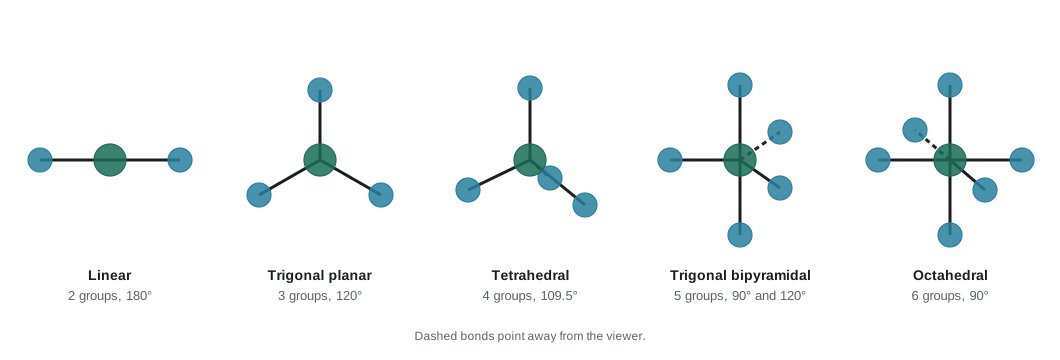
Lone pairs take up more room than bonding pairs, because they are held by only one nucleus and spread out closer to it. They therefore push bonding pairs together slightly. The bond angle shrinks from 109.5° in methane, to 107° in ammonia (one lone pair), to 104.5° in water (two lone pairs). The repulsions rank lone pair–lone pair > lone pair–bonding pair > bonding pair–bonding pair. Multiple bonds also take up a little more room than single bonds.
In the trigonal bipyramid, the five positions are not equivalent: three equatorial positions lie in a plane at 120°, and two axial positions lie above and below at 90° to the plane. Lone pairs always occupy equatorial positions, where they have fewer 90° neighbors. That is why SF₄ is seesaw-shaped and XeF₂ is linear, with its three lone pairs around the equator.
Worked problem
Predicting shapes
Predict the molecular geometry and approximate bond angles of (a) PCl₃, (b) CO₃²⁻ and (c) XeF₄.
Show solution
- (a) PCl₃: 26 valence electrons; P has three bonds and one lone pair, so four groups: tetrahedral electron geometry, trigonal pyramidal molecule, angles slightly under 109.5° (measured 100°).
- (b) CO₃²⁻: 24 valence electrons; C has three bonding groups (one double bond in each resonance structure) and no lone pairs: trigonal planar, 120°.
- (c) XeF₄: 36 valence electrons; Xe has four bonds and two lone pairs, so six groups: octahedral electron geometry; the lone pairs sit opposite each other, leaving a square planar molecule with 90° angles.
Answer: (a) trigonal pyramidal, about 100°; (b) trigonal planar, 120°; (c) square planar, 90°.
# A VSEPR lookup: (bonding groups, lone pairs) -> molecular geometry
GEOM = {
    (2, 0): "linear", (3, 0): "trigonal planar", (2, 1): "bent (from trigonal planar)",
    (4, 0): "tetrahedral", (3, 1): "trigonal pyramidal", (2, 2): "bent (from tetrahedral)",
    (5, 0): "trigonal bipyramidal", (4, 1): "seesaw", (3, 2): "T-shaped", (2, 3): "linear",
    (6, 0): "octahedral", (5, 1): "square pyramidal", (4, 2): "square planar",
}

def shape(central_valence, n_bonded, charge=0, multiple_bond_electrons=0):
    """Lone pairs on the central atom = (valence e - charge - electrons used in bonds to it) / 2.
    Each single bond to a terminal atom uses 1 electron from the central atom;
    multiple_bond_electrons counts the extra central-atom electrons in double/triple bonds."""
    used = n_bonded + multiple_bond_electrons
    lone = (central_valence - charge - used) // 2
    return lone, GEOM[(n_bonded, lone)]

molecules = [("CH4", 4, 4, 0, 0), ("NH3", 5, 3, 0, 0), ("H2O", 6, 2, 0, 0),
             ("SF4", 6, 4, 0, 0), ("ClF3", 7, 3, 0, 0), ("XeF4", 8, 4, 0, 0),
             ("SO2", 6, 2, 0, 2), ("CO2", 4, 2, 0, 2)]
for name, val, nb, q, extra in molecules:
    lone, g = shape(val, nb, q, extra)
print(f"{name:5s} bonded atoms = {nb}, lone pairs on central atom = {lone}: {g}")CH4 bonded atoms = 4, lone pairs on central atom = 0: tetrahedral NH3 bonded atoms = 3, lone pairs on central atom = 1: trigonal pyramidal H2O bonded atoms = 2, lone pairs on central atom = 2: bent (from tetrahedral) SF4 bonded atoms = 4, lone pairs on central atom = 1: seesaw ClF3 bonded atoms = 3, lone pairs on central atom = 2: T-shaped XeF4 bonded atoms = 4, lone pairs on central atom = 2: square planar SO2 bonded atoms = 2, lone pairs on central atom = 1: bent (from trigonal planar) CO2 bonded atoms = 2, lone pairs on central atom = 0: linear
Molecular polarity
A molecule is polar if it has a net dipole moment: a separation of positive and negative charge, measured in debyes (D). Whether a molecule is polar depends on two things: whether its bonds are polar (lesson 9), and whether its shape lets the bond dipoles cancel. Each bond dipole can be treated as a vector pointing toward the more electronegative atom; the molecular dipole is their vector sum.
Carbon dioxide has two very polar C=O bonds, but it is linear, so the two bond dipoles point in opposite directions and cancel exactly: CO₂ is nonpolar. Water also has two polar bonds, but its bent shape means they add to a net dipole of 1.85 D pointing toward the oxygen side. Similarly, symmetric molecules such as BF₃, CH₄, CCl₄, PCl₅ and SF₆ are nonpolar despite polar bonds, while NH₃, CHCl₃ and SO₂ are polar.
import numpy as np

def net_dipole(bond_dipole, directions):
    """Sum equal bond dipoles pointing along the given unit-vector directions."""
    total = sum(bond_dipole * np.array(d) / np.linalg.norm(d) for d in directions)
    return np.linalg.norm(total)

theta = np.radians(104.5)       # water bond angle
water = [(np.sin(theta / 2), np.cos(theta / 2), 0), (-np.sin(theta / 2), np.cos(theta / 2), 0)]
co2 = [(1, 0, 0), (-1, 0, 0)]
tetra = [(1, 1, 1), (1, -1, -1), (-1, 1, -1), (-1, -1, 1)]

print(f"H2O (bond dipole 1.51 D): net = {net_dipole(1.51, water):.2f} D")
print(f"CO2 (bond dipole 2.3 D):  net = {net_dipole(2.3, co2):.2f} D")
print(f"CCl4 (bond dipole 1.5 D): net = {net_dipole(1.5, tetra):.2f} D")H2O (bond dipole 1.51 D): net = 1.85 D CO2 (bond dipole 2.3 D): net = 0.00 D CCl4 (bond dipole 1.5 D): net = 0.00 D
The value of about 1.5 D for each O–H bond dipole in water was chosen to reproduce the measured molecular dipole; the calculation shows how geometry turns two bond dipoles into one molecular dipole, and how symmetry cancels them in CO₂ and CCl₄. Polarity governs solubility (“like dissolves like”), boiling points (lesson 12) and how molecules respond to electric fields. A microwave oven heats food because the oscillating field makes polar water molecules rotate, converting the energy into heat.
Valence bond theory
Lewis structures and VSEPR say nothing about where the shared electrons are in terms of orbitals. Valence bond (VB) theory, developed by Walter Heitler, Fritz London and Linus Pauling in the late 1920s and 1930s, says a covalent bond forms when an orbital on one atom overlaps an orbital on another and the two orbitals share a pair of electrons with opposite spins. The greater the overlap, the stronger the bond.
Overlap along the line between the nuclei gives a sigma (σ) bond, with electron density concentrated on the internuclear axis. Side-by-side overlap of parallel p orbitals gives a pi (π) bond, with electron density above and below the axis. A single bond is one σ bond; a double bond is one σ and one π; a triple bond is one σ and two π. Pi bonds prevent rotation about a double bond, which is why cis and trans isomers of compounds such as 2-butene are different, stable substances.
Hybridization
VB theory runs into a problem with methane. Carbon's ground-state valence configuration is 2s² 2p², with only two unpaired electrons, yet carbon forms four identical bonds pointing to the corners of a tetrahedron. Pauling's solution was hybridization: the 2s orbital and three 2p orbitals mix to form four equivalent sp³ hybrid orbitals, each pointing toward a tetrahedral corner. Each hybrid holds one electron and overlaps a hydrogen 1s orbital to form a C–H σ bond.
Different mixtures give different geometries. The number of hybrid orbitals equals the number of atomic orbitals mixed, and the hybridization of a central atom matches its VSEPR electron-group geometry.
| Electron groups | Hybridization | Geometry | Unhybridized p orbitals | Example |
|---|---|---|---|---|
| 2 | sp | Linear | 2 (can form two π bonds) | C in CO₂ and HC≡CH |
| 3 | sp² | Trigonal planar | 1 (can form one π bond) | C in H₂C=CH₂, B in BF₃ |
| 4 | sp³ | Tetrahedral | 0 | C in CH₄, N in NH₃, O in H₂O |
| 5 | sp³d (description debated) | Trigonal bipyramidal | – | P in PCl₅ |
| 6 | sp³d² (description debated) | Octahedral | – | S in SF₆ |
In ethene, H₂C=CH₂, each carbon is sp² hybridized. Its three sp² hybrids form σ bonds to two hydrogens and the other carbon, in a plane at 120°. The remaining unhybridized p orbital on each carbon stands perpendicular to the plane, and these two p orbitals overlap side by side to form the π bond. In ethyne (acetylene), HC≡CH, each carbon is sp hybridized, giving a linear molecule with one σ and two π bonds between the carbons. For the expanded-octet molecules, the sp³d and sp³d² labels are still widely taught as a convenient description of shape, although modern calculations show that d orbitals contribute little.
Molecular orbital theory
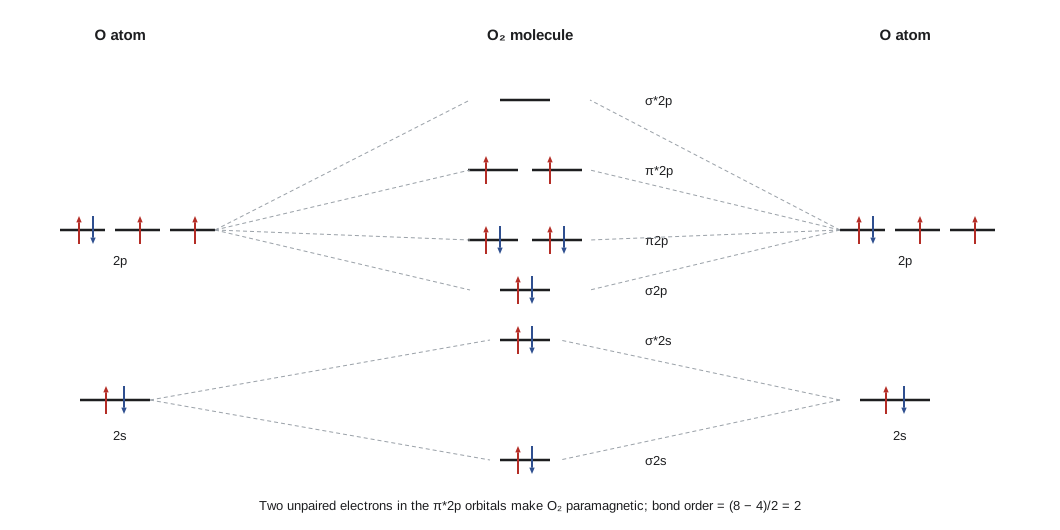
VB theory keeps electrons localized between pairs of atoms, which works well for most molecules but fails in some striking cases. The simplest is oxygen. The Lewis structure of O₂, O=O with two lone pairs on each atom, has all its electrons paired, so O₂ should be diamagnetic. Yet liquid oxygen is visibly attracted to a magnet: it is paramagnetic, with two unpaired electrons. Molecular orbital (MO) theory explains this.
In MO theory, atomic orbitals on all the atoms combine to form molecular orbitals that belong to the molecule as a whole. Two atomic orbitals combine to give two molecular orbitals. Adding them in phase gives a bonding orbital, lower in energy than the atomic orbitals, with electron density between the nuclei. Combining them out of phase gives an antibonding orbital (marked with an asterisk), higher in energy, with a node between the nuclei. Electrons fill molecular orbitals following the same rules as atomic orbitals: lowest energy first, two electrons per orbital with opposite spins, and Hund's rule for orbitals of equal energy.
For H₂, the two electrons fill the σ1s bonding orbital: bond order 1. For He₂, four electrons fill both σ1s and σ*1s: bond order 0, so He₂ does not exist as a stable molecule, as observed. For the second-period diatomic molecules, the 2s and 2p orbitals combine to form σ2s, σ*2s, two π2p, σ2p, two π*2p and σ*2p orbitals. For B₂, C₂ and N₂, mixing between the 2s and 2p orbitals pushes σ2p above π2p; for O₂ and F₂, σ2p lies below π2p.
# Fill molecular orbitals for second-period homonuclear diatomics and report bond order and unpaired electrons
ORDER_BCN = [("s2s", 2, True), ("s*2s", 2, False), ("p2p", 4, True), ("s2p", 2, True), ("p*2p", 4, False), ("s*2p", 2, False)]
ORDER_OF = [("s2s", 2, True), ("s*2s", 2, False), ("s2p", 2, True), ("p2p", 4, True), ("p*2p", 4, False), ("s*2p", 2, False)]
VALENCE = {"Li2": 2, "Be2": 4, "B2": 6, "C2": 8, "N2": 10, "O2": 12, "F2": 14, "Ne2": 16}

def analyse(mol):
    order = ORDER_OF if mol in ("O2", "F2", "Ne2") else ORDER_BCN
    left, bonding, anti, unpaired = VALENCE[mol], 0, 0, 0
    for name, cap, is_bonding in order:
        n = min(cap, left)
        left -= n
        if is_bonding: bonding += n
        else: anti += n
        orbitals = cap // 2                        # 1 for sigma, 2 for the pi pair
        unpaired += n if n <= orbitals else 2 * orbitals - n
    return (bonding - anti) / 2, unpaired

for mol in VALENCE:
    bo, up = analyse(mol)
    mag = "paramagnetic" if up else "diamagnetic"
print(f"{mol:4s} bond order = {bo:3.1f}, unpaired electrons = {up}, {mag}")Li2 bond order = 1.0, unpaired electrons = 0, diamagnetic Be2 bond order = 0.0, unpaired electrons = 0, diamagnetic B2 bond order = 1.0, unpaired electrons = 2, paramagnetic C2 bond order = 2.0, unpaired electrons = 0, diamagnetic N2 bond order = 3.0, unpaired electrons = 0, diamagnetic O2 bond order = 2.0, unpaired electrons = 2, paramagnetic F2 bond order = 1.0, unpaired electrons = 0, diamagnetic Ne2 bond order = 0.0, unpaired electrons = 0, diamagnetic
The results match experiment. O₂ has bond order 2, consistent with its double bond, and two unpaired electrons in the π*2p orbitals, explaining its paramagnetism. N₂ has bond order 3, matching its very strong triple bond. B₂ is paramagnetic, which is evidence for the reversal of the σ2p and π2p levels in the lighter diatomics. Be₂ and Ne₂, with bond order 0, are not stable molecules. MO theory also explains why removing an electron from N₂ weakens its bond (a bonding electron is lost), while removing one from O₂ strengthens it (an antibonding electron is lost).
Each theory has its place. Lewis structures and VSEPR are quick and predict shapes reliably. Valence bond theory with hybridization gives an intuitive picture of localized bonds that organic chemists use every day. Molecular orbital theory is more rigorous, handles delocalized electrons and magnetism naturally, and underlies the computational chemistry used throughout modern research; CHEM-241 and CHEM-271 develop it further.
Common mistakes
MistakeThe molecular geometry of water is tetrahedral.
InsteadWater's electron-group geometry is tetrahedral, but its molecular geometry, which describes only the atoms, is bent.
MistakeA molecule with polar bonds must be polar.
InsteadSymmetric shapes can cancel bond dipoles; CO₂ and CCl₄ have polar bonds but are nonpolar.
MistakeA double bond counts as two electron groups in VSEPR.
InsteadA multiple bond counts as one electron group.
MistakeLone pairs in a trigonal bipyramid go in the axial positions.
InsteadLone pairs occupy equatorial positions, where they have fewer 90° repulsions.
MistakeThe Lewis structure of O₂ correctly predicts that it is diamagnetic.
InsteadO₂ is paramagnetic; molecular orbital theory explains its two unpaired electrons.
Summary and key terms
- VSEPR predicts shapes from the number of electron groups around a central atom; multiple bonds count as one group.
- Molecular geometry names the arrangement of atoms; lone pairs compress bond angles and occupy equatorial positions in trigonal bipyramids.
- A molecule is polar if its bond dipoles do not cancel; symmetric molecules can be nonpolar despite polar bonds.
- Valence bond theory describes bonds as overlapping orbitals: σ bonds lie along the axis, π bonds above and below it.
- Hybrid orbitals (sp, sp², sp³) match electron-group geometries; unhybridized p orbitals form π bonds.
- Molecular orbital theory forms bonding and antibonding orbitals over the whole molecule; bond order = ½(bonding − antibonding electrons).
- MO theory explains the paramagnetism of O₂ and B₂ and the instability of He₂ and Ne₂.
- electron group
- A region of electron density around a central atom: a lone pair or a single or multiple bond.
- VSEPR theory
- A model predicting molecular shape from repulsions between electron groups.
- molecular geometry
- The three-dimensional arrangement of the atoms in a molecule.
- dipole moment
- A measure of the separation of positive and negative charge in a molecule.
- sigma bond
- A covalent bond with electron density along the internuclear axis.
- pi bond
- A covalent bond formed by side-by-side overlap of p orbitals, with density above and below the axis.
- hybridization
- The mixing of atomic orbitals to form new, equivalent orbitals suited to bonding geometry.
- molecular orbital
- An orbital extending over a whole molecule, formed by combining atomic orbitals.
- antibonding orbital
- A molecular orbital higher in energy than the atomic orbitals, with a node between the nuclei.
- bond order (MO)
- Half the difference between the numbers of bonding and antibonding electrons.
Practice problems
Work each problem on paper first, then reveal the answer to check.
Predict the shape of SiCl₄.
Show answer
Tetrahedral (four bonding groups, no lone pairs).
Predict the shape and bond angle of H₂S.
Show answer
Bent, angle a little under 109.5° (measured about 92°).
Predict the shape of the I₃⁻ ion.
Show answer
Linear (two bonds and three equatorial lone pairs on the central I).
Is BCl₃ polar? Is NCl₃ polar?
Show answer
BCl₃ is trigonal planar and nonpolar; NCl₃ is trigonal pyramidal and polar.
Which is polar: cis-1,2-dichloroethene or trans-1,2-dichloroethene?
Show answer
The cis isomer; in the trans isomer the C–Cl dipoles cancel.
Give the hybridization of each carbon in propene, CH₂=CH–CH₃.
Show answer
sp², sp², sp³.
How many σ and π bonds are in HC≡C–CH₃?
Show answer
Six σ (three C–H on CH₃, one C–H on the end, two C–C) and two π.
What is the bond order of O₂⁺?
Show answer
(8 − 3)/2 = 2.5.
Is C₂ paramagnetic or diamagnetic according to MO theory?
Show answer
Diamagnetic; its eight valence electrons fill σ2s, σ*2s and the two π2p orbitals.
Why does He₂ not exist as a stable molecule?
Show answer
Its bond order is zero: two bonding and two antibonding electrons.
Lesson quiz · 5 questions
Score 60% or more to complete this lesson.
Create a free account to save your progress, take quizzes and earn a certificate.