
CHEM-101 · Lesson 12 of 12 · 30 min
Liquids, solids, intermolecular forces and capstone
Gases are simple because their molecules hardly interact. Liquids and solids are where molecules feel each other strongly. The forces between molecules, much weaker than the bonds within them, decide whether a substance is a gas, liquid or solid at room temperature, how high it boils, how it flows and how it crystallizes. This final lesson explains these intermolecular forces, applies them to the properties of liquids and solids and to phase changes, and closes with a capstone investigation that draws on every lesson in the course.
Intermolecular forces
Intermolecular forces are attractions between molecules (or between ions and molecules). They are electrostatic, like ionic and covalent bonds, but much weaker: about 1–40 kJ/mol, compared with 150–1,000 kJ/mol for covalent bonds. Boiling water breaks the hydrogen bonds between molecules, not the O–H bonds within them. Four kinds are important.
London dispersion forces exist between all molecules. At any instant, the electrons in a molecule may be distributed unevenly, creating a temporary dipole that induces a dipole in a neighbor; the two attract. Fritz London explained these forces with quantum mechanics in 1930. Their strength depends on polarizability, how easily the electron cloud is distorted, which increases with the number of electrons and the size of the molecule. Dispersion forces explain why the halogens progress from gases (F₂, Cl₂) through a liquid (Br₂) to a solid (I₂), and why boiling points rise steadily along the series of straight-chain alkanes. Molecular shape matters too: long, thin molecules have more surface contact than compact, branched ones, so pentane boils at 36 °C while its compact isomer neopentane boils at 10 °C.
Dipole–dipole forces act between polar molecules, whose permanent dipoles line up with positive ends near negative ends. Acetone (polar) boils at 56 °C, while butane, with a similar molar mass but nonpolar, boils at −1 °C.
Hydrogen bonds are an especially strong kind of dipole–dipole attraction. They form when hydrogen is bonded to a small, highly electronegative atom, nitrogen, oxygen or fluorine, and is attracted to a lone pair on another N, O or F atom. The very polar bond leaves the hydrogen almost bare of electron density, and its tiny size lets it approach the neighboring lone pair closely. Hydrogen bonds hold together the two strands of DNA, give proteins their shapes, and explain many of water's unusual properties.
Ion–dipole forces attract ions to polar molecules. They are why ionic compounds dissolve in water: water molecules cluster around each ion, with their oxygen ends toward cations and their hydrogen ends toward anions, and the energy released helps pull ions out of the crystal lattice.
| Force | Acts between | Typical strength (kJ/mol) | Example |
|---|---|---|---|
| Ion–dipole | Ions and polar molecules | 40–600 | Na⁺ surrounded by water |
| Hydrogen bonding | H on N, O or F and a lone pair on N, O or F | 10–40 | Water, ammonia, DNA base pairs |
| Dipole–dipole | Polar molecules | 5–25 | Acetone, HCl |
| London dispersion | All molecules and atoms | 0.05–40 (grows with size) | Noble gases, I₂, hydrocarbons |
Boiling points and intermolecular forces
Boiling points are the clearest window on intermolecular forces. The hydrogen compounds of groups 14 to 17 show the effect dramatically. Down group 14 (CH₄ to SnH₄), boiling points rise smoothly, as expected from increasing dispersion forces in nonpolar molecules. In groups 15, 16 and 17, the heavier hydrides follow the same rising trend, but the first member of each group, NH₃, H₂O and HF, boils far higher than the trend predicts, because of hydrogen bonding. Without hydrogen bonds, water would be expected to boil at roughly −80 °C, and Earth would have no liquid oceans.
# Boiling points (degrees C) of the hydrides of groups 14-17, periods 2-5
bp = {
    14: {"CH4": -162, "SiH4": -112, "GeH4": -88, "SnH4": -52},
    15: {"NH3": -33, "PH3": -88, "AsH3": -62, "SbH3": -17},
    16: {"H2O": 100, "H2S": -60, "H2Se": -41, "H2Te": -2},
    17: {"HF": 20, "HCl": -85, "HBr": -67, "HI": -35},
}
for group, data in bp.items():
    names, temps = list(data), list(data.values())
    # extrapolate the period-2 value from the trend of periods 3-5 (straight line through them)
    slope = (temps[3] - temps[1]) / 2
    predicted = temps[1] - slope
    print(f"group {group}: {names[0]:4s} actual {temps[0]:5d} C, "
f"trend from heavier hydrides predicts about {predicted:5.0f} C")group 14: CH4 actual -162 C, trend from heavier hydrides predicts about -142 C group 15: NH3 actual -33 C, trend from heavier hydrides predicts about -124 C group 16: H2O actual 100 C, trend from heavier hydrides predicts about -89 C group 17: HF actual 20 C, trend from heavier hydrides predicts about -110 C
Group 14 shows no anomaly, because methane cannot form hydrogen bonds. In the other groups, the period-2 hydride boils far above the trend. (The straight-line extrapolation is crude, but the size of the gap is unmistakable.)
Properties of liquids
Surface tension is the energy needed to increase a liquid's surface area. Molecules at the surface have neighbors only below and beside them, so they are pulled inward, and the surface behaves like a stretched skin. Water's strong hydrogen bonding gives it a high surface tension, which lets water striders walk on ponds and makes water form near-spherical droplets. Viscosity, resistance to flow, also increases with intermolecular forces and with molecular size and entanglement: glycerol, with three OH groups per molecule, is far more viscous than water, and honey and motor oil more viscous still. Viscosity falls as temperature rises, which is why engine oils are rated for both cold starts and running temperature. Capillary action, the rise of a liquid in a narrow tube, occurs when adhesion to the tube walls exceeds cohesion within the liquid; it helps draw water up through the fibers of paper towels and the xylem of plants.
Vapor pressure and boiling
In a closed container, molecules at the surface of a liquid with enough kinetic energy escape into the vapor, while vapor molecules strike the surface and return. When the two rates are equal, the system is in dynamic equilibrium, and the pressure of the vapor is the liquid's vapor pressure. Vapor pressure depends only on the substance and the temperature, not on how much liquid is present. Liquids with weak intermolecular forces, such as diethyl ether and acetone, have high vapor pressures and are described as volatile.
Vapor pressure rises steeply with temperature, because a larger fraction of molecules has enough energy to escape. A liquid boils when its vapor pressure equals the external pressure. The normal boiling point is the temperature at which the vapor pressure is 1 atm (100 °C for water). At lower pressure, as in the mountains, liquids boil at lower temperatures; in a pressure cooker, at higher ones. The Clausius–Clapeyron equation relates vapor pressure to temperature through the enthalpy of vaporization, ΔH_vap:
import math
R = 8.314           # J/(mol K)
dHvap = 40.7e3      # J/mol for water near its boiling point
T1, P1 = 373.15, 101.325   # normal boiling point (K, kPa)

def boiling_point(P_kPa):
    """Temperature at which water's saturation pressure equals P (Clausius-Clapeyron)."""
    inv_T2 = 1 / T1 - R * math.log(P_kPa / P1) / dHvap
    return 1 / inv_T2 - 273.15

places = [("sea level", 101.3), ("Calgary", 89.0), ("Denver", 83.0),
          ("Banff area peaks (about 3,000 m)", 70.0), ("Mount Logan summit (5,959 m)", 48.0),
          ("pressure cooker (about 200 kPa)", 200.0)]
for name, P in places:
print(f"{name:34s} P = {P:6.1f} kPa water boils at about {boiling_point(P):5.1f} C")sea level P = 101.3 kPa water boils at about 100.0 C Calgary P = 89.0 kPa water boils at about 96.3 C Denver P = 83.0 kPa water boils at about 94.4 C Banff area peaks (about 3,000 m) P = 70.0 kPa water boils at about 89.8 C Mount Logan summit (5,959 m) P = 48.0 kPa water boils at about 79.9 C pressure cooker (about 200 kPa) P = 200.0 kPa water boils at about 120.4 C
The predicted boiling points agree with measurements to within about a degree; the small error comes from assuming that ΔH_vap does not change with temperature.
Phase changes and heating curves
Melting (fusion), vaporization and sublimation (solid directly to gas) absorb energy; freezing, condensation and deposition release it. During a phase change at constant pressure, the temperature stays constant even though heat is being added or removed, because the energy goes into overcoming (or forming) intermolecular attractions rather than raising the kinetic energy of the molecules. A heating curve shows this as flat steps. For water, the enthalpy of fusion is 6.01 kJ/mol and the enthalpy of vaporization 40.7 kJ/mol; vaporization needs almost seven times as much energy as melting, because it separates the molecules completely instead of merely loosening them. This is why steam burns are so severe: condensing steam releases a large amount of energy onto the skin. CHEM-102 develops the calorimetry of these energy changes quantitatively.
Phase diagrams
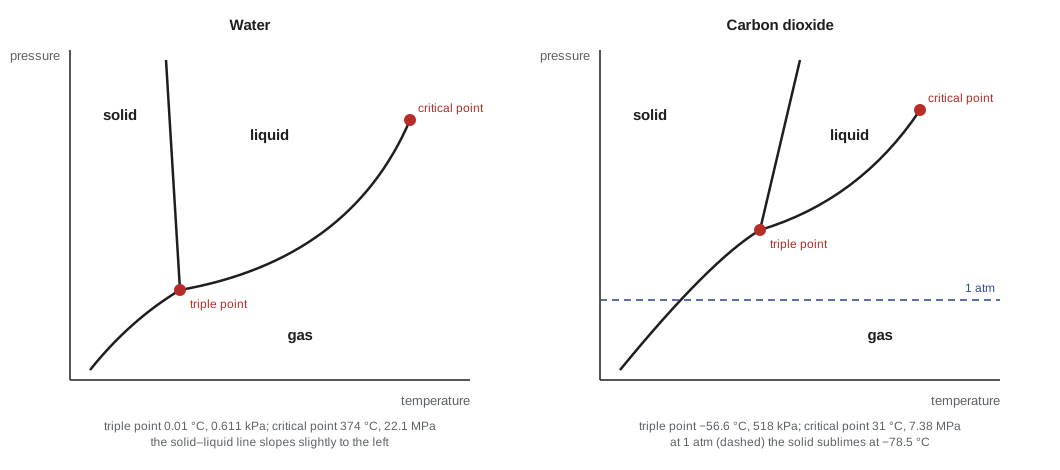
A phase diagram shows which phase is stable at each combination of temperature and pressure. Lines mark conditions where two phases coexist in equilibrium. The three lines meet at the triple point, where solid, liquid and gas coexist; for water it is 0.01 °C and 0.611 kPa. The liquid–gas line ends at the critical point (374 °C and 22.1 MPa for water), beyond which liquid and gas can no longer be distinguished and the substance is a supercritical fluid.
Water's phase diagram has an unusual feature: its solid–liquid line slopes slightly backward, to the left. Increasing pressure lowers the melting point of ice, because liquid water is denser than ice. For almost every other substance, the solid is denser and the line slopes forward. Carbon dioxide's triple point is at −56.6 °C and 518 kPa, above atmospheric pressure, so at 1 atm solid CO₂ never melts; it sublimes at −78.5 °C, which is why it is called dry ice. Supercritical carbon dioxide (above 31 °C and 7.38 MPa) is an excellent, non-toxic solvent, used to decaffeinate coffee and to extract flavours and essential oils without organic solvents.
Water's unusual properties
Hydrogen bonding makes water exceptional among small molecules. It has a high boiling point for its size, a high specific heat (4.18 J/g·°C) that moderates coastal climates and stabilizes body temperature, a high enthalpy of vaporization that makes sweating an effective coolant, and a high surface tension. Most strikingly, ice is less dense than liquid water. In ice, each molecule is hydrogen-bonded to four others in an open hexagonal lattice with a lot of empty space. When ice melts, the lattice partly collapses and the molecules pack more closely, so liquid water is denser, with a maximum density at about 4 °C. Ice therefore floats, insulating the water beneath it; lakes across Canada and the northern United States freeze from the top down, and fish survive the winter below. The expansion of freezing water also splits rocks, heaves pavement and bursts unprotected pipes, a familiar winter problem.
Types of solids
Solids are crystalline, with particles arranged in a regular, repeating pattern, or amorphous, with no long-range order (glass, many plastics). Crystalline solids are classified by the particles at the lattice points and the forces that hold them together.
| Type | Particles | Forces | Properties | Examples |
|---|---|---|---|---|
| Ionic | Cations and anions | Ionic bonds | Hard, brittle, high melting; conduct when molten or dissolved | NaCl, MgO, CaF₂ |
| Molecular | Molecules or atoms | Intermolecular forces | Soft, low melting, nonconducting | Ice, dry ice, sucrose, I₂ |
| Covalent network | Atoms | Covalent bonds throughout | Very hard, very high melting, usually nonconducting | Diamond, quartz (SiO₂), silicon carbide |
| Metallic | Cations in a sea of electrons | Metallic bonding | Lustrous, malleable, conducting; wide range of melting points | Cu, Fe, Na, W |
Carbon illustrates how structure controls properties. In diamond, each carbon is bonded tetrahedrally (sp³) to four others in a three-dimensional network, making it the hardest natural substance and an electrical insulator. In graphite, each carbon is bonded (sp²) to three others in flat hexagonal sheets held together only by dispersion forces; the sheets slide past each other, making graphite soft and slippery, and delocalized π electrons let it conduct along the sheets. A single sheet is graphene, isolated in 2004, which is extremely strong and conductive.
Unit cells and crystal density
A crystal lattice can be described by its unit cell, the smallest repeating unit that builds the whole crystal by stacking. Three cubic unit cells are common among metals. In a simple cubic cell, atoms sit only at the eight corners; each corner atom is shared by eight cells, so the cell contains 8 × ⅛ = 1 atom. A body-centered cubic (bcc) cell adds one atom at the center: 2 atoms per cell (iron at room temperature, sodium, tungsten). A face-centered cubic (fcc) cell adds an atom at the center of each face, each shared by two cells: 8 × ⅛ + 6 × ½ = 4 atoms per cell (copper, aluminum, gold, silver). The fcc arrangement is one of the two closest-packed structures, filling 74 % of space.
Combining the number of atoms per cell with the edge length (measured by X-ray diffraction) gives the density, linking the atomic scale to a measurable bulk property.
import math
NA = 6.02214076e23

def cubic_density(M, atoms_per_cell, edge_pm):
    a_cm = edge_pm * 1e-10              # 1 pm = 1e-10 cm
    mass = atoms_per_cell * M / NA      # g per cell
    return mass / a_cm**3               # g/cm^3

metals = [("Cu (fcc)", 63.55, 4, 361.5, 8.96), ("Al (fcc)", 26.98, 4, 404.9, 2.70),
          ("Fe (bcc)", 55.85, 2, 286.7, 7.87), ("Na (bcc)", 22.99, 2, 429.1, 0.97)]
for name, M, z, a, measured in metals:
    d = cubic_density(M, z, a)
    print(f"{name:9s} edge {a:6.1f} pm -> calculated density {d:5.2f} g/cm3 (measured {measured})")

# atomic radius from the fcc geometry: atoms touch along the face diagonal, 4r = a*sqrt(2)
r_cu = 361.5 * math.sqrt(2) / 4
print(f"copper atomic radius from the unit cell: {r_cu:.0f} pm")Cu (fcc) edge 361.5 pm -> calculated density 8.94 g/cm3 (measured 8.96) Al (fcc) edge 404.9 pm -> calculated density 2.70 g/cm3 (measured 2.7) Fe (bcc) edge 286.7 pm -> calculated density 7.87 g/cm3 (measured 7.87) Na (bcc) edge 429.1 pm -> calculated density 0.97 g/cm3 (measured 0.97) copper atomic radius from the unit cell: 128 pm
Calculations like these confirmed atomic theory spectacularly in the early twentieth century: densities calculated from X-ray measurements and the Avogadro constant matched the densities measured with a balance.
Capstone: identifying an unknown liquid
The final investigation brings the whole course together. A teaching laboratory receives an unlabeled bottle of a clear, colorless, volatile liquid. The task is to identify it using the methods of this course. The data are invented but realistic.
| Measurement | Result |
|---|---|
| Combustion of 0.1000 g of liquid | 0.1910 g CO₂ and 0.1173 g H₂O; no other products |
| Vapor density: 0.250 L flask at 100.0 °C and 101.3 kPa | Mass of vapor 0.380 g |
| Normal boiling point | 78 °C |
| Behavior with water | Mixes completely in all proportions |
| Safety data | Label fragment shows the flame pictogram and the signal word DANGER |
# Capstone: from raw data to an identification
R = 8.314
M_C, M_H, M_O = 12.011, 1.008, 15.999

# 1. Combustion analysis (lesson 3)
sample, co2, h2o = 0.1000, 0.1910, 0.1173
mC = co2 * M_C / (M_C + 2 * M_O)
mH = h2o * 2 * M_H / (2 * M_H + M_O)
mO = sample - mC - mH
mol = {"C": mC / M_C, "H": mH / M_H, "O": mO / M_O}
small = min(mol.values())
ratio = {k: round(v / small, 2) for k, v in mol.items()}
print("1. mole ratio C:H:O =", ratio)

# 2. Molar mass from gas density (lesson 11)
P, V, T, m = 101.3, 0.250, 373.15, 0.380
M = m * R * T / (P * V)
emp = 2 * M_C + 6 * M_H + M_O
print(f"2. molar mass = {M:.1f} g/mol; empirical formula C2H6O has mass {emp:.2f} g/mol; multiple = {M / emp:.2f}")

# 3. Candidates with formula C2H6O and their boiling points (lessons 9, 10, 12)
candidates = {"ethanol, CH3CH2OH": 78.4, "dimethyl ether, CH3OCH3": -24.0}
for name, bp in candidates.items():
    print(f"3. {name:26s} boils at {bp:6.1f} C")
best = min(candidates, key=lambda k: abs(candidates[k] - 78))
print(" best match to the measured boiling point (78 C):", best)1. mole ratio C:H:O = {'C': 2.0, 'H': 6.0, 'O': 1.0}
2. molar mass = 46.6 g/mol; empirical formula C2H6O has mass 46.07 g/mol; multiple = 1.01
3. ethanol, CH3CH2OH boils at 78.4 C
3. dimethyl ether, CH3OCH3 boils at -24.0 C
best match to the measured boiling point (78 C): ethanol, CH3CH2OHThe reasoning runs through the course. Combustion analysis (lesson 3) gives a mole ratio of 2 : 6 : 1, so the empirical formula is C₂H₆O. The vapor density (lesson 11) gives a molar mass of about 46 g/mol, equal to the empirical formula mass, so the molecular formula is also C₂H₆O. Two molecules have this formula: ethanol and dimethyl ether, structural isomers whose Lewis structures (lesson 9) differ in how the atoms are connected. Both have bent, polar C–O–C or C–O–H arrangements (lesson 10). Only ethanol has an O–H bond and can form hydrogen bonds (lesson 12), which explains its much higher boiling point (78 °C against −24 °C) and its complete miscibility with water. The unknown is ethanol, and the flame pictogram and DANGER signal word (lesson 1) fit: ethanol is a highly flammable liquid, to be stored away from ignition sources.
A good laboratory report would go further: it would state the uncertainty in each measurement, check that the percent composition of ethanol (52.1 % C, 13.1 % H, 34.7 % O) matches the combustion data within experimental error, and propose a confirming test, such as measuring the density (0.789 g/cm³ at 20 °C, lesson 1) or recording an infrared spectrum, a technique introduced in CHEM-211 and CHEM-261.
Looking ahead
CHEM-101 has built the atomic and molecular foundation of chemistry: measurement, atoms and the mole, reactions and stoichiometry, quantum structure and the periodic table, bonding and shape, and the states of matter. CHEM-102 asks the next questions. How much energy do reactions release or absorb (thermochemistry)? How fast do they go (kinetics)? How far do they go (equilibrium)? And how do acids, bases and electrochemical cells work? The tools from this course, especially stoichiometry, gas laws and the ideas of bonding and intermolecular forces, are used in every one of those topics.
Common mistakes
MistakeBoiling water breaks O–H covalent bonds.
InsteadBoiling overcomes intermolecular forces (hydrogen bonds) between molecules; the molecules stay intact.
MistakeAny molecule containing hydrogen can form hydrogen bonds.
InsteadHydrogen bonding requires H bonded to N, O or F; methane cannot form hydrogen bonds.
MistakeNonpolar molecules have no intermolecular forces.
InsteadAll molecules have London dispersion forces, which can be strong for large molecules.
MistakeTemperature rises steadily while water boils if heat keeps being added.
InsteadTemperature stays constant during a phase change; the energy breaks intermolecular attractions.
MistakeAn fcc unit cell contains 14 atoms (8 corners + 6 faces).
InsteadShared atoms count fractionally: 8 × ⅛ + 6 × ½ = 4 atoms per cell.
Summary and key terms
- Intermolecular forces (dispersion, dipole–dipole, hydrogen bonding, ion–dipole) are much weaker than covalent bonds but control physical properties.
- Dispersion forces grow with molecular size; hydrogen bonding requires H on N, O or F and explains the high boiling points of NH₃, H₂O and HF.
- Surface tension and viscosity increase with intermolecular forces; vapor pressure decreases.
- A liquid boils when its vapor pressure equals the external pressure; the Clausius–Clapeyron equation relates vapor pressure to temperature.
- Phase diagrams show stable phases, the triple point and the critical point; water’s solid–liquid line slopes backward because ice is less dense than liquid water.
- Crystalline solids are ionic, molecular, covalent network or metallic; cubic unit cells contain 1, 2 or 4 atoms and give densities from X-ray data.
- The capstone combined combustion analysis, gas density, Lewis structures, polarity and hydrogen bonding to identify an unknown as ethanol.
- intermolecular forces
- Attractive forces between molecules, weaker than chemical bonds.
- London dispersion forces
- Attractions caused by temporary dipoles, present between all molecules.
- polarizability
- How easily a molecule’s electron cloud can be distorted.
- hydrogen bond
- An attraction between H bonded to N, O or F and a lone pair on another N, O or F.
- vapor pressure
- The pressure of a vapor in dynamic equilibrium with its liquid at a given temperature.
- normal boiling point
- The temperature at which a liquid’s vapor pressure equals 1 atm.
- triple point
- The temperature and pressure at which solid, liquid and gas coexist.
- critical point
- The end of the liquid–gas line, beyond which the substance is a supercritical fluid.
- unit cell
- The smallest repeating unit of a crystal lattice.
- covalent network solid
- A solid in which atoms are joined by covalent bonds throughout, such as diamond.
Practice problems
Work each problem on paper first, then reveal the answer to check.
Identify the strongest intermolecular force in CH₃OH, CH₃Cl and CH₄.
Show answer
Hydrogen bonding; dipole–dipole; dispersion.
Which has the higher boiling point, Br₂ or Cl₂? Why?
Show answer
Br₂; it has more electrons and stronger dispersion forces.
Explain why HF boils at 20 °C while HCl boils at −85 °C.
Show answer
HF forms hydrogen bonds; HCl does not.
Why does a liquid boil at a lower temperature at high altitude?
Show answer
The external pressure is lower, so the vapor pressure reaches it at a lower temperature.
Water’s vapor pressure is 3.17 kPa at 25 °C. Use ΔH_vap = 43.9 kJ/mol to estimate it at 35 °C.
Show answer
ln(P₂/3.17) = −(43,900/8.314)(1/308.15 − 1/298.15) = 0.575; P₂ ≈ 5.6 kPa.
What phase change occurs when dry ice is left at room temperature?
Show answer
Sublimation (solid to gas) at −78.5 °C.
Classify as ionic, molecular, covalent network or metallic: quartz, sucrose, brass, KBr.
Show answer
Covalent network; molecular; metallic; ionic.
How many atoms are in a body-centered cubic unit cell?
Show answer
Two.
Silver is fcc with an edge length of 408.6 pm. Calculate its density.
Show answer
4 × 107.87/(6.022 × 10²³) ÷ (4.086 × 10⁻⁸ cm)³ = 10.5 g/cm³.
Why does ice float on water?
Show answer
Hydrogen bonding holds ice in an open lattice that is less dense than liquid water.
Lesson quiz · 5 questions
Score 60% or more to complete this lesson.
Create a free account to save your progress, take quizzes and earn a certificate.