
CHEM-101 · Lesson 6 of 12 · 28 min
Light, quantum theory and the hydrogen atom
Rutherford's nuclear atom raised a puzzle. If electrons orbit the nucleus like planets, classical physics predicts that they should radiate energy continuously and spiral into the nucleus in a fraction of a second. Atoms are obviously stable. The resolution came from studying light, and it required a new kind of physics, quantum mechanics, in which energy comes in discrete packets and electrons behave like waves. This lesson follows that story from the nature of light to the quantum numbers that describe electrons in atoms. Lesson 7 uses those quantum numbers to explain the periodic table.
Electromagnetic radiation
Light is electromagnetic radiation: oscillating electric and magnetic fields traveling through space at the speed of light, c = 2.998 × 10⁸ m/s in a vacuum. Like any wave, it has a wavelength, λ (the distance between crests), and a frequency, ν (the number of crests passing a point per second, in hertz, Hz = s⁻¹). Their product is the speed:
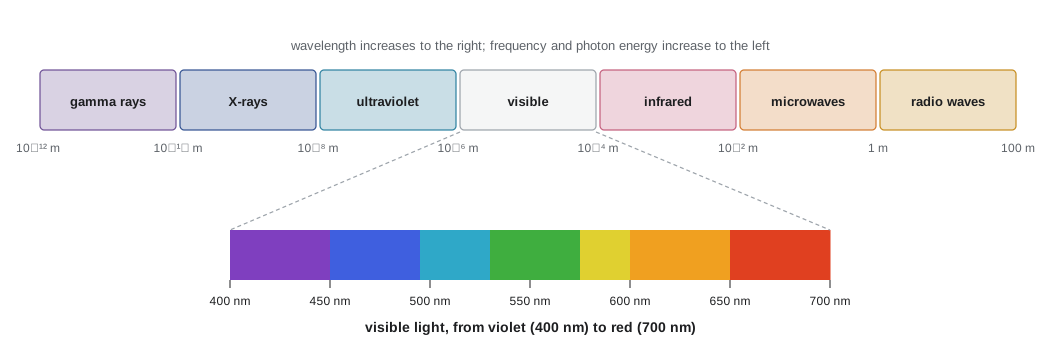
Visible light, the narrow band our eyes detect, spans wavelengths from about 400 nm (violet) to 700 nm (red). Shorter wavelengths, with higher frequencies, include ultraviolet, X-rays and gamma rays; longer wavelengths include infrared, microwaves and radio waves. The whole range is the electromagnetic spectrum.
Worked problem
Wavelength and frequency
A Canadian or US FM radio station broadcasts at 99.9 MHz. What is the wavelength? What is the frequency of green light at 532 nm?
Show solution
- Radio: λ = c/ν = 2.998 × 10⁸ m/s ÷ 99.9 × 10⁶ s⁻¹ = 3.00 m.
- Green light: ν = c/λ = 2.998 × 10⁸ m/s ÷ 532 × 10⁻⁹ m = 5.64 × 10¹⁴ Hz.
Answer: The radio wave is 3.00 m long; green light has a frequency of 5.64 × 10¹⁴ Hz, about six million times higher.
Quantization: Planck and Einstein
Two experiments around 1900 could not be explained if light were only a wave. The first was blackbody radiation, the glow of hot objects: classical theory predicted that a hot object should emit unlimited ultraviolet radiation, which it does not. In 1900 Max Planck fixed the theory by assuming that energy is emitted and absorbed only in whole-number multiples of a smallest unit, a quantum, proportional to the frequency:
The constant h is now called the Planck constant; since 2019 its exact value defines the kilogram, as lesson 1 noted. The second puzzle was the photoelectric effect. Light shining on a clean metal surface can eject electrons, but only if its frequency is above a threshold that depends on the metal. Below the threshold, no electrons emerge however bright the light. Above it, even dim light ejects electrons immediately, and brighter light ejects more of them without making them faster.
In 1905 Albert Einstein explained this by treating light itself as a stream of particles, later called photons, each carrying energy hν. An electron is ejected only if one photon delivers at least the energy binding the electron to the metal, the work function Φ. Any excess becomes the electron's kinetic energy:
Worked problem
The photoelectric effect
Sodium has a work function of 3.65 × 10⁻¹⁹ J. What is the threshold wavelength? What is the kinetic energy of electrons ejected by 400 nm violet light?
Show solution
- Threshold: λ₀ = hc/Φ = (6.626 × 10⁻³⁴)(2.998 × 10⁸) / 3.65 × 10⁻¹⁹ = 5.44 × 10⁻⁷ m = 544 nm.
- Photon energy at 400 nm: hc/λ = 1.986 × 10⁻²⁵ J m ÷ 4.00 × 10⁻⁷ m = 4.97 × 10⁻¹⁹ J.
- Kinetic energy: 4.97 × 10⁻¹⁹ − 3.65 × 10⁻¹⁹ = 1.32 × 10⁻¹⁹ J.
Answer: Light shorter than 544 nm (green and bluer) ejects electrons from sodium; 400 nm light gives them 1.32 × 10⁻¹⁹ J of kinetic energy.
Light therefore has a dual nature: it behaves as a wave in interference and diffraction, and as a stream of particles when it exchanges energy with matter. Neither picture alone is complete. Solar panels and the light sensors in digital cameras, including the image sensors discussed in the photography courses, depend on the particle behavior of light.
Line spectra
White light passed through a prism spreads into a continuous spectrum of all colors. But light emitted by a gas of excited atoms, such as hydrogen in a discharge tube or sodium in a flame, contains only a few specific wavelengths, seen as bright lines. Each element has its own pattern of lines, a fingerprint used to identify elements in stars, in street lamps and in the flame tests of the teaching laboratory. Fireworks colors come from the same source: strontium gives red, barium green, copper blue and sodium yellow-orange.
In 1885 Johann Balmer, a Swiss schoolteacher, found a formula for the four visible lines of hydrogen, and Johannes Rydberg generalized it to all of hydrogen's lines:
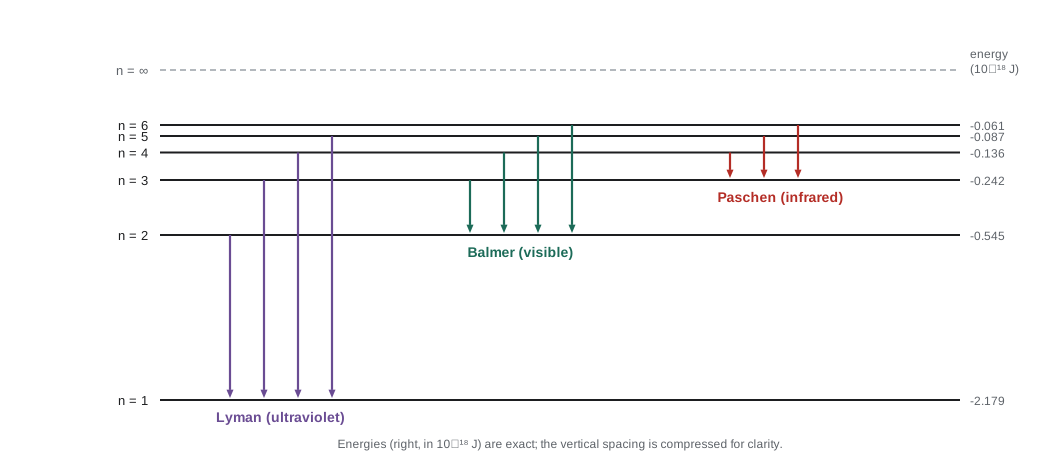
For the visible Balmer series, n₁ = 2 and n₂ = 3, 4, 5, 6. Lines with n₁ = 1 (the Lyman series) lie in the ultraviolet, and with n₁ = 3 (the Paschen series) in the infrared. Why whole numbers should appear was a mystery until 1913.
The Bohr model
Niels Bohr proposed that the electron in a hydrogen atom moves in circular orbits of fixed energy, and that it can occupy only certain allowed orbits, labeled by a quantum number n = 1, 2, 3, …. In these orbits it does not radiate. Light is emitted or absorbed only when the electron jumps between orbits, as a photon whose energy equals the difference in orbit energies. Bohr's calculation gave the allowed energies as:
The energy is negative because the electron is bound: zero corresponds to the electron completely removed from the atom. The lowest-energy state, n = 1, is the ground state; higher levels are excited states. When an electron falls from level n₂ to a lower level n₁, the emitted photon has energy ΔE = 2.179 × 10⁻¹⁸ J (1/n₁² − 1/n₂²), which reproduces Rydberg's formula exactly. The energy needed to remove the electron from the ground state, 2.179 × 10⁻¹⁸ J per atom or 1,312 kJ/mol, is hydrogen's ionization energy.
# Hydrogen emission lines from the Bohr energy levels
h, c = 6.626e-34, 2.998e8
E1 = 2.179e-18          # J, magnitude of the n = 1 energy

def wavelength_nm(n_upper, n_lower):
    dE = E1 * (1 / n_lower**2 - 1 / n_upper**2)
    return h * c / dE * 1e9

def region(nm):
    if nm < 400: return "ultraviolet"
    if nm <= 700: return "visible"
    return "infrared"

for n_lower, name in [(1, "Lyman"), (2, "Balmer"), (3, "Paschen")]:
    print(f"{name} series (to n = {n_lower}):")
    for n_upper in range(n_lower + 1, n_lower + 5):
        nm = wavelength_nm(n_upper, n_lower)
print(f" {n_upper} -> {n_lower}: {nm:7.1f} nm ({region(nm)})")Lyman series (to n = 1): 2 -> 1: 121.6 nm (ultraviolet) 3 -> 1: 102.6 nm (ultraviolet) 4 -> 1: 97.2 nm (ultraviolet) 5 -> 1: 95.0 nm (ultraviolet) Balmer series (to n = 2): 3 -> 2: 656.4 nm (visible) 4 -> 2: 486.2 nm (visible) 5 -> 2: 434.1 nm (visible) 6 -> 2: 410.2 nm (visible) Paschen series (to n = 3): 4 -> 3: 1875.4 nm (infrared) 5 -> 3: 1282.0 nm (infrared) 6 -> 3: 1094.0 nm (infrared) 7 -> 3: 1005.1 nm (infrared)
The Balmer lines at 656, 486, 434 and 410 nm are exactly the red, blue-green, blue and violet lines seen in a hydrogen discharge tube. The red 656 nm line, called hydrogen-alpha, is what amateur astronomers photograph in glowing nebulae. The same physics, with oxygen and nitrogen atoms rather than hydrogen, produces the green (557.7 nm) and red auroras seen across northern Canada and Alaska and, during strong solar storms, much farther south.
The Bohr model was a triumph for hydrogen but failed for atoms with more than one electron, and its picture of electrons in neat circular orbits turned out to be wrong. What survived was the central idea: atoms have quantized energy levels, and spectra come from transitions between them.
Matter waves and uncertainty
In 1924 Louis de Broglie suggested that if light waves can behave as particles, particles might behave as waves. He proposed that any particle with momentum p = mv has a wavelength:
For everyday objects the wavelength is absurdly small, but for electrons it is comparable to the spacing of atoms in crystals. In 1927 Clinton Davisson and Lester Germer in the United States, and George Paget Thomson in Scotland, observed electron diffraction, confirming de Broglie's idea. Electron microscopes, including the cryo-electron microscopes now used to image proteins, exploit the short wavelength of fast electrons to see far smaller details than light microscopes can.
# de Broglie wavelengths of a pitched baseball and of electrons
h = 6.626e-34
m_e = 9.109e-31

baseball = h / (0.145 * 40.0)         # 145 g ball at 40 m/s
print(f"baseball: {baseball:.2e} m")

for volts in (100, 10_000, 300_000):   # accelerating voltage
    E = volts * 1.602e-19               # kinetic energy in J (non-relativistic estimate)
    v = (2 * E / m_e) ** 0.5
    lam = h / (m_e * v)
print(f"electron accelerated through {volts:>7,} V: v = {v:.2e} m/s, wavelength = {lam * 1e12:7.2f} pm")baseball: 1.14e-34 m electron accelerated through 100 V: v = 5.93e+06 m/s, wavelength = 122.65 pm electron accelerated through 10,000 V: v = 5.93e+07 m/s, wavelength = 12.27 pm electron accelerated through 300,000 V: v = 3.25e+08 m/s, wavelength = 2.24 pm
The last line shows the limit of the simple formula: at 300,000 V it gives a speed greater than the speed of light, which is impossible. Electrons that fast must be treated with relativity, which gives a true wavelength of about 1.97 pm, close to the rough estimate. Either way, it is hundreds of thousands of times shorter than visible light.
Werner Heisenberg showed in 1927 that a wave-like particle cannot have both a precise position and a precise momentum at the same time. The uncertainty principle, Δx · Δp ≥ h/4π, means we cannot track an electron along an orbit. The best we can do is give the probability of finding it in a region of space.
Quantum mechanics and orbitals
In 1926 Erwin Schrödinger wrote an equation for the wave behavior of an electron in an atom. Its solutions, called wave functions (ψ), describe allowed states of the electron, each with a definite energy. The square of the wave function, ψ², gives the probability density, the likelihood of finding the electron at each point. A region of space where an electron with a given wave function is likely to be found is called an orbital. Orbitals are often drawn as surfaces enclosing about 90 % of the probability.
For hydrogen, Schrödinger's equation reproduces Bohr's energies exactly, but describes the electron as a three-dimensional standing wave rather than a particle in an orbit. Each orbital is specified by three quantum numbers, which emerge from the mathematics rather than being assumed.
| Quantum number | Symbol | Allowed values | What it describes |
|---|---|---|---|
| Principal | n | 1, 2, 3, … | Size and energy level (shell) |
| Angular momentum (azimuthal) | l | 0 to n − 1 | Shape of the orbital (subshell): 0 = s, 1 = p, 2 = d, 3 = f |
| Magnetic | mₗ | −l to +l in whole steps | Orientation of the orbital in space |
| Spin | mₛ | +½ or −½ | Spin of the electron (not part of the orbital) |
A shell with principal quantum number n has n subshells and n² orbitals. The n = 1 shell has only a 1s orbital. The n = 2 shell has a 2s orbital and three 2p orbitals. The n = 3 shell has 3s, three 3p and five 3d orbitals. The letters s, p, d and f come from old descriptions of spectral lines (sharp, principal, diffuse, fundamental).
# List the allowed orbitals and their counts for n = 1 to 4
letters = "spdf"
for n in range(1, 5):
    subshells = []
    total = 0
    for l in range(n):
        count = 2 * l + 1               # values of m_l from -l to +l
        subshells.append(f"{n}{letters[l]} ({count})")
        total += count
print(f"n = {n}: {', '.join(subshells):34s} orbitals = {total:2d}, electrons = {2 * total}")n = 1: 1s (1) orbitals = 1, electrons = 2 n = 2: 2s (1), 2p (3) orbitals = 4, electrons = 8 n = 3: 3s (1), 3p (3), 3d (5) orbitals = 9, electrons = 18 n = 4: 4s (1), 4p (3), 4d (5), 4f (7) orbitals = 16, electrons = 32
Orbitals have characteristic shapes. An s orbital is spherical. A p orbital has two lobes on opposite sides of the nucleus, with a node, a plane of zero probability, between them; the three p orbitals point along the x, y and z axes. The five d orbitals have more complex four-lobed and ring shapes. Larger n means a larger orbital with more nodes: the 2s orbital has one spherical node and the 3s has two.
Electrons also have an intrinsic property called spin, which makes each electron behave like a tiny magnet with two possible orientations, described by the spin quantum number mₛ = +½ or −½. Spin was discovered from the splitting of spectral lines and from the 1922 Stern–Gerlach experiment, in which a beam of silver atoms split in two in a magnetic field. Lesson 7 shows how spin, together with the Pauli exclusion principle, determines how electrons fill orbitals in many-electron atoms.
Common mistakes
MistakeBrighter light always ejects faster photoelectrons.
InsteadBrightness increases the number of photons and electrons; only frequency changes each electron’s energy.
MistakeHigher-frequency light has a longer wavelength.
InsteadFrequency and wavelength are inversely related: c = λν.
MistakeIn the Bohr model, energies become more negative as n increases.
InsteadEnergies become less negative (closer to zero) as n increases; n = 1 is lowest.
MistakeAn orbital is a fixed path the electron follows.
InsteadAn orbital is a region of probability; the uncertainty principle forbids exact paths.
MistakeThe 3d subshell exists in the n = 2 shell.
Insteadl ranges from 0 to n − 1, so d orbitals (l = 2) first appear at n = 3.
Summary and key terms
- Electromagnetic radiation has wavelength and frequency related by c = λν; visible light spans about 400–700 nm.
- Planck proposed that energy is quantized (E = hν); Einstein explained the photoelectric effect with photons.
- Atoms emit line spectra; the hydrogen lines fit the Rydberg formula.
- Bohr’s model gives hydrogen energies Eₙ = −2.179 × 10⁻¹⁸ J/n² and explains spectral lines as transitions, but fails for other atoms.
- De Broglie showed that particles have wavelengths λ = h/mv; electron diffraction confirmed it.
- The uncertainty principle forbids exact electron paths; Schrödinger’s wave functions define orbitals as probability regions.
- Orbitals are labeled by n, l and mₗ; electrons also have spin mₛ = ±½.
- wavelength
- The distance between successive crests of a wave.
- frequency
- The number of wave cycles passing a point per second.
- photon
- A particle of light carrying energy hν.
- work function
- The minimum energy needed to remove an electron from a metal surface.
- line spectrum
- A spectrum containing only specific wavelengths, characteristic of an element.
- ground state
- The lowest-energy state of an atom.
- ionization energy
- The energy needed to remove an electron from an atom in the gas phase.
- uncertainty principle
- The principle that position and momentum cannot both be known exactly.
- orbital
- A region of space, described by a wave function, where an electron is likely to be found.
- node
- A surface where the probability of finding an electron is zero.
Practice problems
Work each problem on paper first, then reveal the answer to check.
Calculate the frequency of 650 nm red light.
Show answer
4.61 × 10¹⁴ Hz.
What is the energy of one photon of 650 nm light? Of one mole of such photons?
Show answer
3.06 × 10⁻¹⁹ J; 184 kJ/mol.
A metal has a work function of 4.30 × 10⁻¹⁹ J. Will 500 nm light eject electrons?
Show answer
Photon energy 3.97 × 10⁻¹⁹ J is less than the work function, so no.
Calculate the wavelength of the hydrogen line for the transition n = 4 → n = 2.
Show answer
486 nm (blue-green).
What is the energy of the hydrogen electron in the n = 3 level?
Show answer
−2.179 × 10⁻¹⁸/9 = −2.42 × 10⁻¹⁹ J.
Why can’t the Bohr model be used for helium?
Show answer
It works only for one-electron systems; electron–electron repulsions are not included.
Calculate the de Broglie wavelength of an electron moving at 2.0 × 10⁶ m/s.
Show answer
λ = 6.626 × 10⁻³⁴ / (9.109 × 10⁻³¹ × 2.0 × 10⁶) = 3.6 × 10⁻¹⁰ m = 0.36 nm.
How many orbitals are in the n = 4 shell?
Show answer
16.
Give the possible values of mₗ for a d orbital.
Show answer
−2, −1, 0, +1, +2.
Which set of quantum numbers is not allowed: (2, 1, 0), (3, 3, 1), (4, 2, −2)?
Show answer
(3, 3, 1); l must be less than n.
Lesson quiz · 5 questions
Score 60% or more to complete this lesson.
Create a free account to save your progress, take quizzes and earn a certificate.