
CHE-314 · Lesson 9 of 12 · 21 min
Packed column hydraulics: flooding, pressure drop and wetting
A packed column that transfers mass beautifully on paper can still fail in the field if its hydraulics are wrong. Too much gas for its diameter and the liquid cannot run down: the column floods, pressure drop soars and liquid is blown out of the top. Too little liquid for its area and the packing does not wet properly, so much of the surface the design counted on stays dry. Theo's first design pass gave a water rate and a height. Now he must choose the packing, size the diameter, estimate the pressure drop the vent fans must overcome and check that the packing wets. The check changes his design.
Packings
Packings are chosen to give a large surface area for mass transfer, a high open volume for gas flow and good spreading of the liquid. Random packings are dumped into the column and come in several generations. Raschig rings, simple hollow cylinders, are the oldest and are now rare. Pall rings have windows cut in their walls with the tongues bent inward, which opens the ring to gas and liquid and roughly doubles its capacity. Modern high-performance random packings, such as saddle-ring hybrids, push capacity and efficiency further. Random packings come in metal, plastic or ceramic and in sizes from about 15 to 90 mm; larger sizes have more capacity but lower specific area and so larger transfer unit heights.
Structured packings are made of corrugated sheets of metal or plastic, crimped and stacked in blocks so the channels run at an angle and cross each other. They give high specific area, low pressure drop and low transfer unit heights, but cost more and need good liquid distribution. They dominate vacuum distillation and many large absorbers. For the vent scrubber, where the gas is wet, the liquid is water with fermentation solids and fouling is possible, Theo picks 50 mm metal Pall rings: sturdy, easy to clean, well understood and available from several suppliers.
| Packing (approximate data) | Specific area a (m²/m³) | Void fraction | Packing factor F_p (1/m) |
|---|---|---|---|
| 50 mm ceramic Raschig rings | 95 | 0.74 | about 210 |
| 50 mm metal Pall rings | 105 | 0.96 | about 89 |
| 50 mm plastic Pall rings | 100 | 0.92 | about 85 |
| Metal structured packing, 250 m²/m³ class | 250 | 0.97 | about 70 |
Loading and flooding
As the gas rate rises at a fixed liquid rate, the pressure drop through irrigated packing rises roughly with the square of the gas velocity, just as through dry packing but a little higher because the liquid takes up some of the open space. At a certain point, the loading point, the gas starts to hold up the liquid: the liquid holdup rises and the pressure drop climbs faster. A little further, at the flooding point, liquid can no longer flow down against the gas, accumulates above the packing and is carried out of the top. Columns are designed to run at 60 to 80 % of the flooding gas rate, comfortably below the loading region, which gives some margin for upsets and for uncertainty in the correlation.
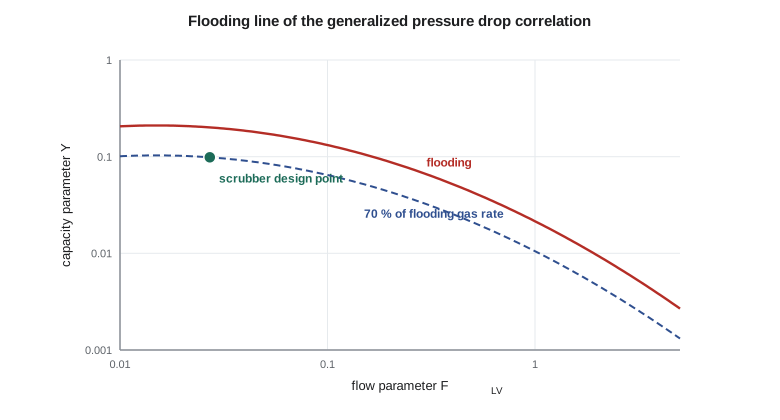
The classic way to predict flooding is the generalized pressure drop correlation developed by Sherwood, Leva and Eckert. It plots a capacity parameter against the flow parameter:
Here \(L'\) and \(G'\) are the liquid and gas mass fluxes in kg/(m\(^2\) s), \(F_p\) is the packing factor in m\(^{-1}\), \(\psi\) is the ratio of the density of water to that of the liquid, and \(\mu_L\) is the liquid viscosity in mPa s. The flooding line on this chart is often represented by a curve fit, \(\log_{10}Y = -1.668 - 1.085\log_{10}F_{LV} - 0.297(\log_{10}F_{LV})^2\), which is accurate enough for preliminary sizing. Newer correlations, such as those of Billet and Schultes and vendor-specific methods, are used for final design.
Sizing the diameter
The design procedure is straightforward: compute \(F_{LV}\) from the flows and densities, read or calculate the flooding value of \(Y\), solve for the gas mass flux at flooding, take a fraction of it as the design flux, and divide the gas mass flow by that flux to get the area. For the scrubber, the gas is about 5.05 kg/s of carbon dioxide with a density of 1.76 kg/m\(^3\), and the flow parameter is small, about 0.014 to 0.027 depending on the water rate, because the gas flow is large and the liquid flow modest. The flooding gas flux is about 6.4 to 6.5 kg/(m\(^2\) s), almost independent of the water rate in this range.
# Packed column hydraulics: flooding, column diameter, pressure drop and wetting rate
import math
g = 9.81
G_mol, MG = 113.0 * 1.015, 0.04402       # mol/s gas (CO2 + ethanol), kg/mol
T, P = 305.15, 101325.0
rhoG = P * MG / (8.314 * T)              # kg/m3
rhoL, muL = 995.0, 0.765                 # kg/m3, mPa s (water at 32 C)
Gm = G_mol * MG                          # kg/s gas
Fp = 89.0                                # 1/m packing factor, 50 mm metal Pall rings (approximate)

def flood_flux(Lm):
    X = Lm / Gm * math.sqrt(rhoG / rhoL)                       # flow parameter
    lx = math.log10(X)
    Y = 10 ** (-1.668 - 1.085 * lx - 0.297 * lx ** 2)          # curve fit to the flooding line
    psi = 1000.0 / rhoL
    Gf = math.sqrt(Y * rhoG * rhoL * g / (Fp * psi * muL ** 0.2))   # kg/(m2 s) at flooding
    return X, Y, Gf

for LG_mol in (0.846, 1.129, 1.60):
    Lm = LG_mol * 113.0 * 0.01802                              # kg/s water
    X, Y, Gf = flood_flux(Lm)
    A_need = Gm / (0.70 * Gf)
    D = math.sqrt(4 * A_need / math.pi)
    print(f"L/G = {LG_mol}: F_LV = {X:.4f}, Y = {Y:.3f}, flooding flux = {Gf:.2f} kg/(m2 s), D at 70 % flood = {D:.2f} m")

D = 1.2; A = math.pi * D ** 2 / 4
print(f"gas density = {rhoG:.2f} kg/m3, gas = {Gm:.2f} kg/s, superficial velocity in a {D} m column = {Gm / rhoG / A:.2f} m/s")

# Wetting rate check
a_p = 105.0                              # m2/m3 specific area of the packing (approximate)
MWR = 0.08                               # m3/(m h) minimum wetting rate for random packings (rule of thumb)
q_min = MWR * a_p                        # m3/(m2 h)
for LG_mol in (0.846, 1.129, 1.60):
    q = LG_mol * 113.0 * 0.01802 / rhoL * 3600 / A
    print(f"L/G = {LG_mol}: liquid load = {q:.1f} m3/(m2 h); minimum about {q_min:.1f} -> {'ok' if q >= q_min else 'too low'}")

# Pressure drop estimate with a simple correlation for irrigated random packing (illustrative constants)
C1, C2 = 14.0, 0.010                     # dry-bed and liquid-load constants for this packing
u = Gm / rhoG / A
for LG_mol in (0.846, 1.60):
    q = LG_mol * 113.0 * 0.01802 / rhoL * 3600 / A
    dp = C1 * rhoG * u ** 2 * 10 ** (C2 * q)   # Pa per m, a common exponential form
print(f"L/G = {LG_mol}: pressure drop about {dp:.0f} Pa/m; over 8 m about {dp * 8 / 1000:.1f} kPa")L/G = 0.846: F_LV = 0.0143, Y = 0.210, flooding flux = 6.52 kg/(m2 s), D at 70 % flood = 1.19 m L/G = 1.129: F_LV = 0.0191, Y = 0.209, flooding flux = 6.50 kg/(m2 s), D at 70 % flood = 1.19 m L/G = 1.6: F_LV = 0.0271, Y = 0.201, flooding flux = 6.38 kg/(m2 s), D at 70 % flood = 1.20 m gas density = 1.76 kg/m3, gas = 5.05 kg/s, superficial velocity in a 1.2 m column = 2.54 m/s L/G = 0.846: liquid load = 5.5 m3/(m2 h); minimum about 8.4 -> too low L/G = 1.129: liquid load = 7.4 m3/(m2 h); minimum about 8.4 -> too low L/G = 1.6: liquid load = 10.4 m3/(m2 h); minimum about 8.4 -> ok L/G = 0.846: pressure drop about 180 Pa/m; over 8 m about 1.4 kPa L/G = 1.6: pressure drop about 202 Pa/m; over 8 m about 1.6 kPa
At 70 % of flooding the required diameter is 1.19 to 1.20 m, so Theo specifies a 1.2 m column. The superficial gas velocity is about 2.5 m/s, typical for atmospheric scrubbers with this packing. The column is short relative to the large stack, and its pressure drop is modest: about 180 to 200 Pa per meter of packing, or under 2 kPa for the whole bed, which the existing vent fans can supply.
Wetting: the check that changes the design
Mass transfer in a packed bed happens on the wetted surface. If the liquid rate is too low, the liquid runs in rivulets and leaves parts of the packing dry, and the effective interfacial area, and so \(K_ya\), drops sharply. Packing vendors give a minimum liquid load, often expressed as a minimum wetting rate per unit of packing perimeter. A long-standing rule of thumb for random packings is about 0.08 m\(^3\) of liquid per hour per meter of wetted perimeter, which multiplied by the specific area gives a minimum liquid load in m\(^3\)/(m\(^2\) h). For 50 mm Pall rings with about 105 m\(^2\)/m\(^3\), that is about 8.4 m\(^3\)/(m\(^2\) h).
The first design pass, at 1.5 times the minimum water rate, gives only 5.5 m\(^3\)/(m\(^2\) h) in the 1.2 m column, well below the minimum. Even twice the minimum gives only 7.4. The packing would not wet properly, and the transfer unit height of 0.86 m used in lesson 8 would not be achieved. Theo has three choices: a smaller column, which would flood; a recirculation loop pumping part of the bottoms back to the top, which raises the wetting rate but also raises the liquid composition at the top and so the outlet gas concentration; or more fresh water. Because the slurry tank needs makeup water anyway, he raises the fresh water to \(L/G = 1.60\), about 11.7 m\(^3\)/h, which gives a liquid load of 10.4 m\(^3\)/(m\(^2\) h), comfortably above the minimum.
Worked problem
Wetting rate in the 1.2 m column
Check the liquid load at \(L/G = 1.60\) mol/mol with \(G = 113\) mol/s, a 1.2 m column, and water at 995 kg/m\(^3\).
Show solution
- Water: \(1.60 \times 113 = 181\) mol/s \(= 3.26\) kg/s \(= 11.8\) m\(^3\)/h.
- Area: \(\pi \times 1.2^2/4 = 1.131\) m\(^2\).
- Liquid load: \(11.8/1.131 = 10.4\) m\(^3\)/(m\(^2\) h), above the 8.4 minimum.
Answer: The extra water also raises the absorption factor from 1.49 to 2.81, so the column can be shorter, as lesson 12 shows.
Liquid distribution and internals
Good liquid distribution matters as much as wetting. Liquid poured onto packing in a few streams does not spread out across the bed for many packing diameters, and liquid tends to migrate toward the wall, where the packing is looser. Distributors therefore provide many drip points, typically 40 to 100 per square meter for random packings, and beds are limited in height, often to 5 to 8 m or 6 to 10 column diameters for rings, before a collector and redistributor gathers and resprays the liquid. The ratio of column diameter to packing size should be at least about 10 to 15 so that the wall does not dominate; a 1.2 m column with 50 mm rings has a ratio of 24.
Other internals are specified with the same care: a support plate with a high open area so it does not flood before the packing, a bed limiter to keep packing in place during surges, a gas inlet that spreads the incoming gas, and a mist eliminator to keep droplets carrying dissolved ethanol out of the stack. For the scrubber Theo specifies two beds of about 3.5 m each with a redistributor between them, a trough distributor and a chevron mist eliminator, and he asks for spray nozzles above each bed for cleaning, because fermentation solids carried in the gas could foul the packing.
Pressure drop and the fan
The pressure drop through irrigated random packing is often estimated with correlations of the form \(\Delta P/Z = C_1\rho_G u^2\,10^{C_2 L_q}\), where \(L_q\) is the liquid load, with constants that depend on the packing; the generalized correlation also gives pressure drop contours. Design values for atmospheric absorbers are usually 150 to 400 Pa per meter. Over the 7 m bed the scrubber adds about 1.5 kPa, plus losses in the internals and ducting, well within the margin of the fans that already push the fermentation gas to the stack. A larger diameter would reduce the pressure drop but would make the wetting problem worse, a reminder that the hydraulic checks pull in different directions.
Common mistakes
MistakeDesigning at or near the flooding point.
InsteadUse 60 to 80 % of the flooding gas rate.
MistakeIgnoring the minimum wetting rate.
InsteadCheck the liquid load; dry packing gives much lower effective area.
MistakeFixing low wetting with recirculation without checking the top composition.
InsteadRecirculated liquid carries solute to the top and raises the outlet gas concentration.
MistakeUsing one very tall bed.
InsteadLimit bed heights and redistribute; liquid migrates to the wall.
Summary and key terms
- Random packings (rings, saddles) and structured packings trade cost, capacity, area and fouling resistance.
- Pressure drop rises with gas rate; past the loading point it climbs steeply, and at flooding liquid cannot descend.
- The generalized pressure drop correlation relates the capacity parameter \(Y\) to the flow parameter \(F_{LV}\).
- Size the diameter for 60 to 80 % of the flooding gas flux; the scrubber needs 1.2 m.
- Check the minimum wetting rate; for the scrubber it forced the water rate up to \(L/G = 1.60\), about 11.7 m\(^3\)/h.
- Distributors, redistributors, supports and mist eliminators are as important as the packing itself.
- Random packing
- Pieces such as rings or saddles dumped into a column to create a large wetted surface.
- Structured packing
- Corrugated sheets arranged in blocks to give high area and low pressure drop.
- Packing factor
- An empirical constant describing the hydraulic resistance of a packing, used in flooding correlations.
- Loading point
- The gas rate above which liquid holdup and pressure drop rise sharply.
- Flooding
- The condition in which liquid can no longer flow down against the gas and is carried out of the column.
- Flow parameter
- F_LV = (L′/G′)√(ρG/ρL), the abscissa of the generalized pressure drop correlation.
- Minimum wetting rate
- The smallest liquid load that keeps the packing surface effectively wetted.
Practice problems
Work each problem on paper first, then reveal the answer to check.
Compute \(F_{LV}\) for \(L' = 3.0\), \(G' = 4.5\) kg/(m\(^2\) s), \(\rho_G = 1.2\), \(\rho_L = 1000\) kg/m\(^3\).
Show answer
\((3.0/4.5)\sqrt{0.0012} = 0.023\).
If the flooding gas flux is 6.0 kg/(m\(^2\) s), what flux do you design for at 75 %?
Show answer
4.5 kg/(m\(^2\) s).
A column must carry 4.0 kg/s of gas at 4.0 kg/(m\(^2\) s). What diameter?
Show answer
Area 1.0 m\(^2\); diameter 1.13 m.
Find the minimum liquid load for a packing with 150 m\(^2\)/m\(^3\) using 0.08 m\(^3\)/(m h).
Show answer
12 m\(^3\)/(m\(^2\) h).
Why does recirculating scrubber bottoms raise the outlet ethanol?
Show answer
The liquid at the top is no longer clean, so the gas can only approach \(m x_2 > 0\).
Roughly how many drip points per square meter should a random-packing distributor have?
Show answer
About 40 to 100.
Lesson quiz · 5 questions
Score 60% or more to complete this lesson.
Create a free account to save your progress, take quizzes and earn a certificate.