
CHE-314 · Lesson 11 of 12 · 23 min
Drying of solids
The rotary dryers are the largest energy users in the plant after the distillation section. They turn wet distillers grains, mixed with the concentrated syrup from the evaporators, into dried distillers grains with solubles that can be stored and shipped as animal feed. The expanded fermentation capacity will send more wet grains to the dryers, and the plant must decide whether they can keep up or whether some product should be sold wet to nearby cattle feeders. Theo is asked to run the numbers and to explain to the operators why their product sometimes leaves the dryer with moist centers. Drying combines heat transfer, mass transfer through the gas and diffusion inside the solid, and this lesson puts the pieces together.
Moisture content and the material balance
Drying engineers describe moisture two ways, and confusing them is common. The wet-basis moisture \(w\) is the mass of water per mass of wet material, the number most commercial specifications quote. The dry-basis moisture \(X\) is the mass of water per mass of dry solid, which is more convenient for calculation because the mass of dry solid does not change as the material dries. They convert as \(X = w/(1 - w)\) and \(w = X/(1 + X)\). A feed at 65 % moisture on a wet basis holds \(X = 0.65/0.35 = 1.857\) kg of water per kilogram of dry solid; a product at 10 % wet basis holds \(X = 0.111\).
Worked problem
Water the dryers must evaporate
The expanded plant will make about 17.1 t/h of DDGS at 10 % moisture (wet basis). The feed to the dryers is a blend of wet grains and syrup at 65 % moisture. How much water must the dryers evaporate?
Show solution
- Dry solids: \(17.1 \times 0.90 = 15.4\) t/h.
- Water in: \(15.4 \times 1.857 = 28.6\) t/h; water out: \(15.4 \times 0.111 = 1.71\) t/h.
- Evaporated: \(28.6 - 1.71 = 26.9\) t/h.
Answer: Almost 27 metric tons of water an hour, nearly one and three quarter metric tons for every metric ton of product. At roughly 3.4 MJ of heat per kilogram of water evaporated in a direct-fired dryer, that is about 25 MW of heat.
Equilibrium moisture
A moist solid exposed long enough to air at a fixed temperature and humidity reaches an equilibrium moisture content \(X^*\), at which it neither gains nor loses water. Plotting \(X^*\) against relative humidity at constant temperature gives a sorption isotherm. For grains and feeds the isotherm is S-shaped: at low humidity the water is held tightly in a monolayer on the solid; at intermediate humidity it is held in multilayers and fine capillaries; and near saturation it is free water. Water above \(X^*\) is free moisture that can be removed at the given air conditions; water below it cannot. The equilibrium moisture also matters in storage: DDGS stored in humid air slowly picks up moisture, and above about 12 to 13 % it becomes prone to mold and caking, which is why the product is cooled and dried to around 10 %.
The drying rate curve
When a wet solid is dried in air at constant conditions, as in a laboratory tray dryer, its moisture falls with time in a characteristic way. Converting the moisture-time data to a drying rate, \(N = -(m_s/A)\,dX/dt\), where \(m_s\) is the dry solid mass and \(A\) the drying area, and plotting it against moisture content gives the drying rate curve.
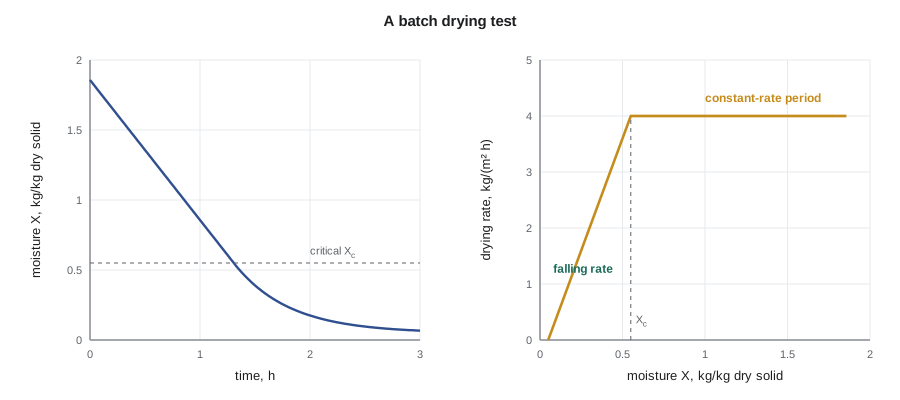
After a short warm-up, the curve usually shows a constant-rate period, in which the surface stays fully wet and behaves like a pool of water. The rate is set entirely by heat and mass transfer through the gas, the surface sits at the wet-bulb temperature of the air, and nothing about the solid matters. Below a critical moisture content \(X_c\), the surface is no longer kept wet by moisture moving up from inside, and the rate falls. In this falling-rate period the rate depends on how water moves within the solid: by capillary flow in coarse porous materials, by diffusion in fine or gel-like materials such as grains and starchy feeds, or by both. The rate eventually falls to zero at the equilibrium moisture.
The constant-rate period
In the constant-rate period, the surface is at the wet-bulb temperature \(T_s\), and the heat that reaches it is all used to evaporate water. A heat balance gives the drying flux directly from the heat transfer coefficient:
where \(\lambda_s\) is the latent heat at the surface temperature and \(W_s\) is the saturation humidity at that temperature. The second form is the same rate written as mass transfer from the surface to the air, and the two are linked by the Lewis relation of lesson 10. Raising the air temperature, raising the air velocity (which raises \(h\)) or lowering the air humidity all increase the constant rate. In a dryer with hot air at 120 °C and a surface at a wet bulb of about 45 °C, with \(h = 60\) W/(m\(^2\) K), the constant rate is about 7 kg/(m\(^2\) h).
The falling-rate period
For materials where internal diffusion controls the falling-rate period, the solution of lesson 4 applies: the time to reach a given moisture scales as the square of the particle size divided by the moisture diffusivity. In practice the diffusivity of moisture in grain particles varies strongly with moisture content and temperature, so engineers often use a simpler empirical model in which the rate falls linearly with the free moisture: \(N = N_c(X - X^*)/(X_c - X^*)\). Integrating the rate equation through both periods gives the total batch drying time:
The first term is the constant-rate time and the second the falling-rate time. The logarithm means the last bit of moisture is slow to remove: halving the free moisture remaining at the end adds a fixed increment of time however small it is. This is why overdrying a product costs disproportionate energy and dryer capacity.
# Drying of wet distillers grains: moisture bases, dryer water load and batch drying time
import math
ethanol_L_h = 200e6 / 8400           # L/h
ddgs_kg_h = ethanol_L_h * 0.72      # kg/h product at 10 % moisture (about 0.72 kg per liter)
dry_solids = ddgs_kg_h * 0.90
def X_dry(w): return w / (1 - w)     # wet basis fraction -> dry basis
w_in, w_out = 0.65, 0.10
water_in = dry_solids * X_dry(w_in)
water_out = dry_solids * X_dry(w_out)
evap = water_in - water_out
print(f"product {ddgs_kg_h / 1000:.1f} t/h, dry solids {dry_solids / 1000:.1f} t/h")
print(f"moisture: feed X = {X_dry(w_in):.3f}, product X = {X_dry(w_out):.3f} kg water/kg dry solid")
print(f"water evaporated = {evap / 1000:.1f} t/h")
q = evap / 3600 * 3.4                # MW, using about 3.4 MJ per kg of water evaporated in a direct-fired dryer
print(f"dryer heat input about {q:.0f} MW")

# Batch drying test in the lab tray dryer: constant-rate and linear falling-rate periods
ms, A = 0.20, 0.050                  # kg dry solid, m2 drying area
Nc = 4.0                             # kg water/(m2 h) in the constant-rate period
Xc, Xe = 0.55, 0.05                  # critical and equilibrium moisture (dry basis)
X0, Xf = X_dry(w_in), X_dry(w_out)
tc = ms * (X0 - Xc) / (A * Nc)
tf = ms * (Xc - Xe) / (A * Nc) * math.log((Xc - Xe) / (Xf - Xe))
print(f"constant-rate time = {tc:.2f} h, falling-rate time = {tf:.2f} h, total = {tc + tf:.2f} h")

# Constant-rate drying flux from the gas side: N = k_Y (Y_s - Y), with heat balance at the wet-bulb surface
h, lam = 60.0, 2.33e6                # W/(m2 K), J/kg at the surface temperature
T_air, T_s = 120.0, 45.0             # C, surface at the wet-bulb temperature of the dryer air
N_heat = h * (T_air - T_s) / lam * 3600
print(f"constant-rate flux from the heat balance = {N_heat:.1f} kg/(m2 h)")product 17.1 t/h, dry solids 15.4 t/h moisture: feed X = 1.857, product X = 0.111 kg water/kg dry solid water evaporated = 26.9 t/h dryer heat input about 25 MW constant-rate time = 1.31 h, falling-rate time = 1.05 h, total = 2.36 h constant-rate flux from the heat balance = 7.0 kg/(m2 h)
Worked problem
Drying time in the lab tray test
A tray holds 0.20 kg of dry solid over 0.050 m\(^2\), starting at \(X_0 = 1.857\). The test shows \(N_c = 4.0\) kg/(m\(^2\) h), \(X_c = 0.55\) and \(X^* = 0.05\). How long to reach \(X_f = 0.111\)?
Show solution
- \(m_s/(AN_c) = 0.20/(0.050 \times 4.0) = 1.0\) h per unit of \(X\).
- Constant rate: \(1.0 \times (1.857 - 0.55) = 1.31\) h.
- Falling rate: \(1.0 \times 0.50 \times \ln(0.50/0.061) = 1.05\) h; total about 2.4 h.
Answer: Under these conditions almost half the drying time is spent removing the last 0.44 kg of water per kilogram of solid, below the critical moisture.
Industrial dryers
Rotary dryers, like the plant's, are long inclined cylinders that turn slowly. Flights on the inside lift the wet material and shower it through a stream of hot gas from a natural gas burner, often mixed with recycled exhaust. The material moves from the feed end to the discharge end as the drum turns, with a residence time of perhaps 15 to 40 minutes. Ethanol plants usually back-mix some dry product with the wet feed so it does not stick to the drum. Other dryer types suit other materials: ring and flash dryers suspend fine particles in a fast gas stream for a few seconds, fluidized beds dry granules on a bed of air, spray dryers turn solutions into powders, and indirect steam-tube dryers heat the solids through metal walls with no contact with combustion gases.
Dryer design combines a heat and mass balance on the gas with the drying kinetics of the solid. The exhaust gas leaves warm and very humid, carrying the 27 t/h of evaporated water plus small amounts of volatile organic compounds and particulates released from the hot grains. In ethanol plants, those emissions go to a thermal oxidizer, which Theo met in CHE-280, and the dryer and oxidizer together are one of the main emission sources covered by an air construction permit from the Iowa Department of Natural Resources, with emission limits for volatile organic compounds and hazardous air pollutants carried into the plant's Title V operating permit. Hot organic dust in a dryer is also a fire and explosion hazard, so dryers have spark detection, deluge systems and explosion venting, and their design follows the fire code adopted by the state and the relevant combustible dust standards.
Why the centers stay moist
The operators' observation fits the falling-rate picture. The surfaces of the particles dry quickly in the hot gas, and once the average moisture reaches the 10 % target, the product leaves the drum. But inside each particle the moisture profile is still steep, as lesson 4 showed: when the average moisture ratio is about 0.2, the center is noticeably wetter than the surface. Larger clumps make it worse, because drying time scales with the square of size. Moisture then evens out during storage, sometimes raising the surface moisture enough to cause caking. Theo's recommendations: keep the back-mixing ratio steady so clumps stay small, cool the product before storage, and set the moisture target on samples taken after a short conditioning period rather than straight from the drum.
Common mistakes
MistakeMixing wet-basis and dry-basis moisture in a balance.
InsteadConvert to dry basis, where the dry solid mass is constant.
MistakeExpecting the surface to be hotter than the wet bulb in the constant-rate period.
InsteadThe surface stays at the wet-bulb temperature while it is fully wet.
MistakeUsing the constant rate to estimate the whole drying time.
InsteadBelow the critical moisture the rate falls; add the falling-rate time.
MistakeDrying far below the target to be safe.
InsteadThe last moisture is slow and costly to remove, and overdried product may be scorched.
Summary and key terms
- Dry-basis moisture \(X = w/(1 - w)\) is the convenient basis for drying calculations.
- The dryers must evaporate about 26.9 t/h of water, needing roughly 25 MW of heat.
- Equilibrium moisture sets the lowest moisture reachable at given air conditions.
- In the constant-rate period, the surface is at the wet bulb and the rate is \(h(T_{\mathrm{air}} - T_s)/\lambda_s\).
- In the falling-rate period, internal moisture movement controls; the rate falls toward zero at \(X^*\).
- Batch drying time is the sum of constant-rate and falling-rate terms; the last moisture is the slowest to remove.
- Wet-basis moisture
- Mass of water per unit mass of wet material.
- Dry-basis moisture
- Mass of water per unit mass of dry solid.
- Equilibrium moisture
- The moisture content a solid reaches when it neither gains nor loses water to air at given conditions.
- Sorption isotherm
- A plot of equilibrium moisture against relative humidity at constant temperature.
- Constant-rate period
- The drying period in which the surface stays fully wet and gas-side transfer sets the rate.
- Critical moisture content
- The moisture at which the drying rate begins to fall.
- Falling-rate period
- The drying period in which internal moisture movement limits the rate.
Practice problems
Work each problem on paper first, then reveal the answer to check.
Convert 25 % wet-basis moisture to dry basis.
Show answer
\(X = 0.25/0.75 = 0.333\).
A material at \(X = 1.0\) is dried to \(X = 0.10\). How much water is removed per kilogram of dry solid?
Show answer
0.90 kg.
Why does the surface temperature stay at the wet bulb during the constant-rate period?
Show answer
All the heat arriving goes into evaporation, as at a wet-bulb thermometer.
How does raising the air velocity affect the constant rate?
Show answer
It raises \(h\) and so the rate.
What drying time is needed to go from \(X = 0.30\) to \(X = 0.10\) if \(X_c = 0.30\), \(X^* = 0.05\) and \(m_s/(AN_c) = 2\) h?
Show answer
\(2 \times 0.25 \times \ln(0.25/0.05) = 0.80\) h.
Name two dryer types other than rotary dryers.
Show answer
Flash or ring dryers, fluidized beds, spray dryers, indirect steam-tube dryers.
Lesson quiz · 5 questions
Score 60% or more to complete this lesson.
Create a free account to save your progress, take quizzes and earn a certificate.