
CHE-314 · Lesson 12 of 12 · 24 min
Mass transfer with chemical reaction and the scrubber design
Theo's scrubber now recovers ethanol well on paper, but Wren has one more requirement. The vent gas also carries about 150 ppmv of acetaldehyde, a by-product of fermentation, and the permit limits how much of it can leave the stack. Water alone absorbs acetaldehyde poorly. Many ethanol plants add sodium or ammonium bisulfite to the scrubber water, because bisulfite reacts quickly with acetaldehyde to form a stable, water-soluble adduct, and the scrubber water then returns to the process. Designing for that needs the theory of mass transfer with chemical reaction. This final lesson develops it, touches on the related problem of reaction inside porous catalysts, and then assembles the full scrubber design for Ingrid's review.
Why reaction speeds up absorption
Lesson 3 showed that a reaction in the liquid film consumes the dissolved gas as it diffuses, steepening the concentration gradient at the interface and raising the flux. Reaction helps absorption in two distinct ways. First, it raises the liquid-side coefficient by the enhancement factor \(E\). Second, by converting the dissolved gas into another species, it keeps the concentration of free, unreacted gas in the bulk liquid near zero, so the liquid never approaches equilibrium with the gas and its capacity is set by the reagent rather than by physical solubility. For a solute such as acetaldehyde, whose equilibrium slope \(m\) of about 5 gives an absorption factor below 1 with any reasonable water rate, the second effect matters most: it changes an absorber that cannot work into one that can.
Regimes of reactive absorption
For a gas A reacting with a dissolved reagent B by a second-order reaction with rate constant \(k_2\), the Hatta number is defined with the pseudo-first-order rate constant \(k_2c_B\):
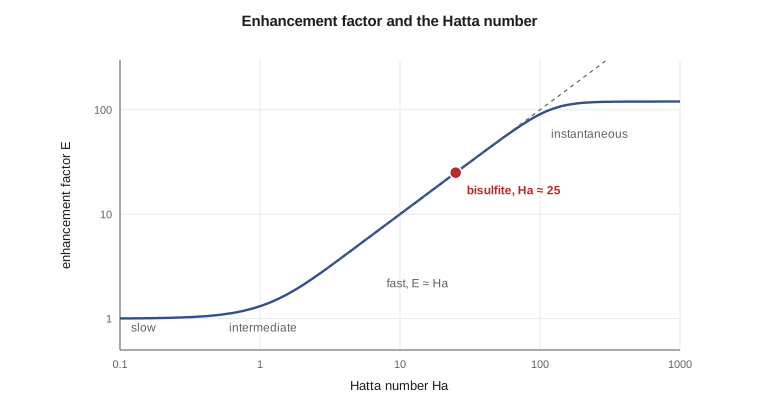
Its value places the system in one of several regimes. When \(Ha < 0.3\), the reaction is slow: almost all of it happens in the bulk liquid, absorption is physical, and the reaction only keeps the bulk concentration low if the liquid holdup is large enough. When \(0.3 < Ha < 3\), reaction happens partly in the film and partly in the bulk. When \(Ha > 3\), the reaction is fast and happens almost entirely in the film; if B is plentiful, the enhancement factor is close to \(Ha\) and the absorption rate becomes independent of \(k_L\), because \(Ek_L = \sqrt{k_2c_BD_A}\). If the reaction is so fast that B is depleted near the interface, the rate becomes limited by how fast B can diffuse toward it, and the enhancement factor levels off at an upper limit set by the concentrations and diffusivities of A and B, the instantaneous-reaction regime.
Worked problem
Is the bisulfite reaction fast?
Take an illustrative second-order rate constant of 500 m\(^3\)/(mol s) for acetaldehyde and bisulfite, a bisulfite concentration of 20 mol/m\(^3\), \(D_A = 1.4\times10^{-9}\) m\(^2\)/s and \(k_L = 1.5\times10^{-4}\) m/s. Find \(Ha\) and the regime.
Show solution
- \(k_2c_B = 500 \times 20 = 10^4\) s\(^{-1}\).
- \(Ha = \sqrt{10^4 \times 1.4\times10^{-9}}/1.5\times10^{-4} = 3.74\times10^{-3}/1.5\times10^{-4} = 25\).
Answer: Fast regime: the reaction happens in the liquid film and \(E \approx 25\), provided enough bisulfite is present.
Effect on the column
With reaction, the liquid-side resistance in the overall coefficient of lesson 7 is divided by the enhancement factor, \(1/K_ya = 1/k_ya + m/(Ek_xa)\), and because free acetaldehyde is consumed, the equilibrium back-pressure \(y^*\) stays close to zero throughout the column. The absorber then behaves like one with a very large absorption factor, and \(N_{OG} = \ln(y_1/y_2)\). For the scrubber, the liquid resistance for acetaldehyde falls from about 71 % of the total to about 9 %, \(K_ya\) rises from about 43 to 136 mol/(m\(^3\) s), and the predicted removal in a 7 m bed rises from about 32 % with water alone to more than 99.9 %.
Theo treats that last number with care. The model assumes plug flow of gas, perfect liquid distribution, a constant excess of bisulfite and an irreversible reaction. In practice, gas bypassing near the walls, uneven bisulfite dosing and the slow reversal of the adduct in warm water all reduce performance. Stack tests on similar scrubbers report acetaldehyde removals that are high but well short of the model, so the permit application uses a conservative guaranteed removal from the vendor, and the plant will confirm it by a stack test after start-up.
Reagent demand
Bisulfite reacts with acetaldehyde one to one. At 150 ppmv in 113 mol/s of gas, the scrubber captures about 0.017 mol/s, or 2.7 kg/h, of acetaldehyde. At 1.5 times the stoichiometric demand, to keep an excess everywhere in the column and cover other aldehydes and oxidation of bisulfite by oxygen, the feed is about 90 mol/h of bisulfite. Because the scrubber water goes to the slurry tank, the dose must be low enough not to harm the yeast downstream; vendors of scrubber chemicals publish yeast-compatibility data for this reason, and Ingrid insists on a trial at plant scale before committing to a dose.
Reaction inside porous catalysts
A related problem arises when a reaction happens inside the pores of a solid catalyst, such as the catalysts used to make specialty chemicals from ethanol. Reactants diffuse into the pellet while reacting, so the concentration falls toward the center and the inner part of the pellet works less hard. The Thiele modulus \(\phi\) compares the reaction rate with the rate of diffusion through the pellet. For a first-order reaction in a sphere of radius \(R\),
where \(\eta\) is the effectiveness factor, the ratio of the actual rate to the rate if the whole pellet saw the surface concentration. For small \(\phi\), \(\eta\) is near 1 and the catalyst is fully used; for large \(\phi\), \(\eta \approx 3/\phi\) and only an outer shell works. The mathematics is the same as the Hatta analysis of a liquid film, with the pellet in place of the film. Reactor engineers choose pellet size and pore structure to balance effectiveness against pressure drop, a trade-off CHE-345 takes up.
Worked problem
Effectiveness of a catalyst pellet
A first-order reaction with \(k = 2.0\) s\(^{-1}\) runs in spherical pellets with \(D_{\mathrm{eff}} = 3.3\times10^{-7}\) m\(^2\)/s (lesson 4). Find the effectiveness for pellets of 1.5 mm radius.
Show solution
- \(\phi = 0.0015\sqrt{2.0/3.3\times10^{-7}} = 0.0015 \times 2462 = 3.69\).
- \(\eta = (3/3.69)(1/\tanh 3.69 - 1/3.69) = 0.813 \times (1.001 - 0.271) = 0.59\).
Answer: Only 59 % of the pellet's potential is used. Pellets of 0.5 mm radius would reach 91 %, at the cost of higher pressure drop.
# Mass transfer with reaction, catalyst effectiveness, and the scrubber design summary
import math
# 1. Acetaldehyde in the vent: physical absorption alone versus reactive (bisulfite) scrubbing
G, LG = 113.0, 1.60                  # mol/s, final liquid-to-gas ratio (lesson 9)
S = math.pi * 1.2 ** 2 / 4           # m2 column area
kya, kxa = 150.0, 300.0              # mol/(m3 s), film coefficients (lesson 7)
m_acet = 5.0                         # approximate equilibrium slope for acetaldehyde in water at 32 C
Z = 7.0                              # m packed height chosen for the scrubber

def removal(NOG, A):
    if A > 50: return 1 - math.exp(-NOG)
    r = (math.exp(NOG * (1 - 1 / A)) - 1 / A) / (1 - 1 / A)
    return 1 - 1 / r

Kya = 1 / (1 / kya + m_acet / kxa)
A = LG / m_acet
print(f"physical absorption: Kya = {Kya:.0f} mol/(m3 s), A = {A:.2f}, removal = {removal(Z / (G / (S * Kya)), A) * 100:.0f} %")

# 2. Hatta number for the bisulfite reaction in the liquid film
k2 = 5.0e2                           # m3/(mol s) second-order rate constant (illustrative)
c_B = 20.0                           # mol/m3 bisulfite in the scrubber water
DL, kL = 1.4e-9, 1.5e-4              # m2/s, m/s
Ha = math.sqrt(k2 * c_B * DL) / kL
E = Ha                               # fast pseudo-first-order regime
Kya_r = 1 / (1 / kya + m_acet / (E * kxa))
print(f"Hatta number = {Ha:.0f}; enhancement E = {E:.0f}; Kya with reaction = {Kya_r:.0f} mol/(m3 s)")
# the reaction keeps free acetaldehyde in the liquid near zero, so the absorption factor is effectively very large
print(f"with bisulfite (model): removal = {removal(Z / (G / (S * Kya_r)), 1e9) * 100:.3f} %")

# 3. Bisulfite demand
y_acet = 150e-6                      # mole fraction acetaldehyde in (illustrative)
acet = G * y_acet * 0.998            # mol/s absorbed
print(f"acetaldehyde captured = {acet * 44.05 * 3.6:.1f} kg/h; bisulfite needed at 1.5 x stoichiometric = {acet * 1.5 * 3600:.0f} mol/h")

# 4. Catalyst effectiveness factor for a first-order reaction in a spherical pellet
def eta_sphere(phi):
    return 3 / phi * (1 / math.tanh(phi) - 1 / phi)
Deff, k = 3.3e-7, 2.0                # m2/s (lesson 4), 1/s
for Rp in (0.5e-3, 1.5e-3, 3e-3):
    phi = Rp * math.sqrt(k / Deff)
    print(f"pellet radius {Rp * 1000:.1f} mm: Thiele modulus = {phi:.2f}, effectiveness = {eta_sphere(phi):.2f}")

# 5. Design summary of the vent scrubber for ethanol at the final water rate
HOG = 0.86                           # m, ethanol HOG (lesson 8)
m_e, y1 = 0.57, 0.015
A_e = LG / m_e
for Zp in (5.0, 6.0, 7.0):
    Ne = Zp / HOG
    r = (math.exp(Ne * (1 - 1 / A_e)) - 1 / A_e) / (1 - 1 / A_e)
    y2 = y1 / r
    lost = G * y2 * 0.04607 * 3600
    print(f"Z = {Zp} m: ethanol removal = {(1 - 1 / r) * 100:.2f} %, ethanol to air = {lost:.2f} kg/h")
print(f"water {LG * G * 0.01802 * 3.6:.1f} m3/h, A = {A_e:.2f}, liquid leaving x1 = {(y1 * 0.99) / LG:.4f}")physical absorption: Kya = 43 mol/(m3 s), A = 0.32, removal = 32 % Hatta number = 25; enhancement E = 25; Kya with reaction = 136 mol/(m3 s) with bisulfite (model): removal = 99.993 % acetaldehyde captured = 2.7 kg/h; bisulfite needed at 1.5 x stoichiometric = 91 mol/h pellet radius 0.5 mm: Thiele modulus = 1.23, effectiveness = 0.91 pellet radius 1.5 mm: Thiele modulus = 3.69, effectiveness = 0.59 pellet radius 3.0 mm: Thiele modulus = 7.39, effectiveness = 0.35 Z = 5.0 m: ethanol removal = 98.46 %, ethanol to air = 4.32 kg/h Z = 6.0 m: ethanol removal = 99.28 %, ethanol to air = 2.04 kg/h Z = 7.0 m: ethanol removal = 99.66 %, ethanol to air = 0.96 kg/h water 11.7 m3/h, A = 2.81, liquid leaving x1 = 0.0093
The scrubber design
Theo's design summary for Ingrid pulls the course together. The basis is the expanded plant's vent: 113 mol/s of carbon dioxide at 32 °C, with 1.5 mol % ethanol and about 150 ppmv acetaldehyde. Diffusivities from lesson 2 and coefficients from lessons 5 and 6 fed the film coefficients of lesson 7, which showed ethanol absorption to be about 78 % gas-film controlled. Lesson 8 set the method and gave a first pass of 9.2 m of packing at 6.2 m\(^3\)/h of water. Lesson 9 fixed the diameter at 1.2 m for 70 % of flooding, then showed that the packing would not wet at that water rate, which raised the fresh water to 11.7 m\(^3\)/h, \(L/G = 1.60\) and an absorption factor of 2.81.
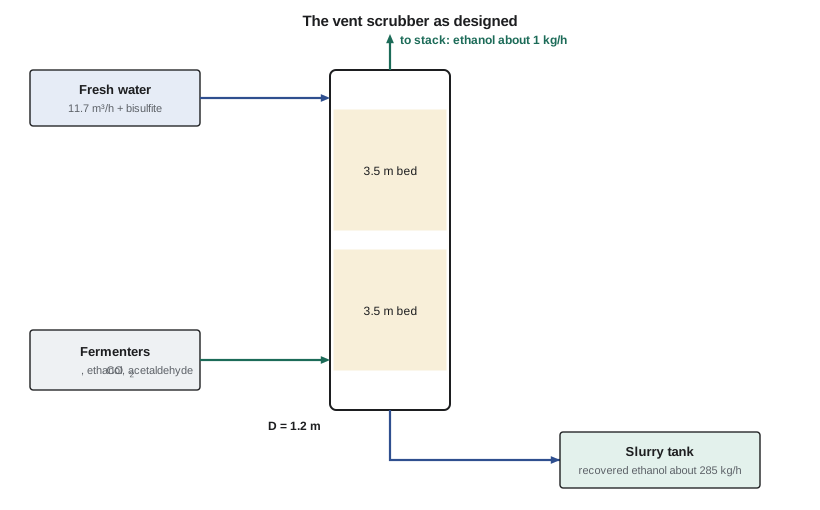
| Item | Design value |
|---|---|
| Column diameter | 1.2 m |
| Packing | 50 mm metal Pall rings, two beds of 3.5 m |
| Fresh water | 11.7 m³/h, L/G = 1.60 mol/mol |
| Ethanol recovery | about 99.7 % at 7 m (target 99 %) |
| Ethanol to atmosphere | about 1 kg/h |
| Ethanol recovered to the slurry tank | about 285 kg/h |
| Acetaldehyde | bisulfite dosing about 90 mol/h; removal per vendor guarantee, confirmed by stack test |
| Pressure drop | about 1.5 kPa over the packing |
| Liquid load | 10.4 m³/(m² h), above the minimum of about 8.4 |
With the higher water rate, the 7 m bed gives about 99.7 % ethanol recovery, comfortably above the 99 % target, sending about 1 kg/h of ethanol to the stack instead of nearly 290 kg/h. Theo notes that the transfer unit height of 0.86 m was estimated at the first-pass water rate; at the higher rate \(H_L\) changes a little, but the larger absorption factor makes the liquid side matter even less, so the estimate is conservative. The design gives the plant two margins: a recovery above target if the packing performs as expected, and a recovery still above 99 % if the packing performs about 15 % worse than expected, which is roughly the same as having only 6 m of effective height.
Review, responsibility and next steps
Ingrid reviews the calculations line by line, checking each property against its source and each assumption against plant data, before she signs the design as a licensed PE; Theo's report records which numbers came from correlations, which from vendors and which from plant measurements. Wren takes the emission estimates to the department, using the vendor's guaranteed acetaldehyde removal rather than the model's ideal value. The vendor is asked for pressure drop and transfer unit data for the specified packing at the design loads. And the operators get a one-page explanation of why the scrubber water rate must not be cut to save water: below about 8 m\(^3\)/h the packing stops wetting and the recovery falls quickly. The next course, CHE-350, takes these ideas into staged separations, where the same equilibrium and operating lines appear on a different kind of diagram.
Common mistakes
MistakeAssuming any reaction makes absorption complete.
InsteadCheck the Hatta number and the reagent supply; slow reactions or depleted reagent give little enhancement.
MistakeUsing the ideal model removal in a permit application.
InsteadUse a vendor guarantee or test data, and confirm with a stack test.
MistakeIgnoring the effect of the scrubber chemical downstream.
InsteadScrubber water returns to fermentation; check yeast compatibility and dose.
MistakeApplying the Thiele effectiveness formula for the wrong geometry or reaction order.
InsteadUse the form for the actual pellet shape and kinetics.
Summary and key terms
- Reaction speeds absorption by enhancing the liquid-side coefficient and by keeping free solute in the liquid near zero.
- The Hatta number \(\sqrt{k_2c_BD_A}/k_L\) sets the regime: slow below 0.3, fast above 3 with \(E \approx Ha\).
- Bisulfite makes acetaldehyde absorbable: the model removal rises from about 32 % to over 99.9 %, but permits rely on guaranteed and tested values.
- The Thiele modulus and effectiveness factor describe reaction with diffusion in catalyst pellets.
- The final scrubber: 1.2 m diameter, 7 m of 50 mm Pall rings, 11.7 m\(^3\)/h of water, about 99.7 % ethanol recovery.
- Every number in a design needs a source, and the design needs an engineer's review and seal.
- Reactive absorption
- Absorption accompanied by a chemical reaction of the dissolved gas in the liquid.
- Hatta number
- The ratio of reaction rate in the liquid film to physical mass transfer across it.
- Enhancement factor
- The ratio of the absorption flux with reaction to the flux without it.
- Fast reaction regime
- The regime in which reaction is complete within the liquid film and E is about Ha.
- Instantaneous reaction
- A reaction so fast that the rate is limited by diffusion of the reagent toward the interface.
- Thiele modulus
- A ratio of reaction rate to diffusion rate within a catalyst pellet.
- Effectiveness factor
- The ratio of the actual reaction rate in a pellet to the rate with no internal diffusion limit.
Practice problems
Work each problem on paper first, then reveal the answer to check.
A system has \(k_2c_B = 400\) s\(^{-1}\), \(D_A = 1.5\times10^{-9}\) m\(^2\)/s and \(k_L = 1\times10^{-4}\) m/s. Find \(Ha\).
Show answer
\(\sqrt{400 \times 1.5\times10^{-9}}/10^{-4} = 7.7\): fast regime.
Why does a reaction allow high removal of a solute with \(A < 1\)?
Show answer
It keeps free solute in the liquid near zero, so the liquid's capacity is set by the reagent.
Compute the effectiveness of a sphere with \(\phi = 10\).
Show answer
\(\eta = 0.3 \times (1.0 - 0.1) = 0.27\).
At 150 ppmv in 113 mol/s, how much acetaldehyde enters the scrubber?
Show answer
About 0.017 mol/s, 2.7 kg/h.
Give two reasons real acetaldehyde removal falls short of the model.
Show answer
Gas bypassing or poor distribution, uneven dosing, adduct reversal in warm water.
Why must operators not cut the scrubber water below about 8 m\(^3\)/h?
Show answer
The packing stops wetting properly and recovery falls.
Lesson quiz · 5 questions
Score 60% or more to complete this lesson.
Create a free account to save your progress, take quizzes and earn a certificate.