
CHE-314 · Lesson 3 of 12 · 24 min
Steady diffusion in gases and liquids
The quality control lab keeps small vials of ethanol standards in a fume hood, and the senior technician, Dev Raman, has noticed that the liquid level in an open vial falls by a few millimeters over a day. He asks Theo whether that loss is enough to upset the calibration. The question is a classic one in mass transfer: ethanol evaporates at the liquid surface and diffuses up through the still air in the neck of the vial. Solving it introduces the two basic cases of steady one-dimensional diffusion, and the same mathematics later describes the gas film in the scrubber. The lesson ends with diffusion accompanied by a chemical reaction, which returns in lesson 12 when bisulfite reacts with acetaldehyde in the scrubber water.
Setting up a diffusion problem
Diffusion problems are solved the same way as conduction problems in CHE-312. Choose a control volume, write a mole balance for the diffusing species, substitute the flux expression, and apply boundary conditions. For steady diffusion in one direction with no chemical reaction, the balance on a thin slice says that the flux entering equals the flux leaving, so \(dN_A/dz = 0\) and \(N_A\) is constant along the path. In a tube or slab of constant area the flux is the same at every height. In a sphere or cylinder the area changes with radius, so it is the total rate \(N_A \times \text{area}\) that stays constant.
The boundary conditions come from the physical situation. At a liquid surface, the gas just above it is usually taken to be in equilibrium with the liquid, so the partial pressure equals the vapor pressure (for a pure liquid) or the equilibrium partial pressure (for a solution). At the open end of a tube, the concentration equals that of the surrounding gas. At an impermeable wall, the flux is zero. Choosing these conditions carefully is most of the work.
Equimolar counterdiffusion
In equimolar counterdiffusion, equal numbers of molecules of A and B move in opposite directions, so \(N_A = -N_B\) and the bulk-flow term in the flux equation vanishes. This happens in distillation of mixtures whose components have similar molar heats of vaporization: each mole of the more volatile component that vaporizes is replaced by a mole of the less volatile one that condenses. It also happens when two gases at the same pressure diffuse through a connecting tube. With \(N_A\) constant and \(c\) and \(D_{AB}\) constant, integrating Fick's law over a path of length \(L\) gives a linear concentration profile and
This result is exactly like steady conduction through a plane wall, with \(cD_{AB}/L\) playing the role of \(k/L\). It is also the simplest model of a mass transfer coefficient: if all the resistance is in a stagnant layer of thickness \(L\), the coefficient is \(D_{AB}/L\). Lesson 5 develops that idea into film theory.
Diffusion of A through stagnant B
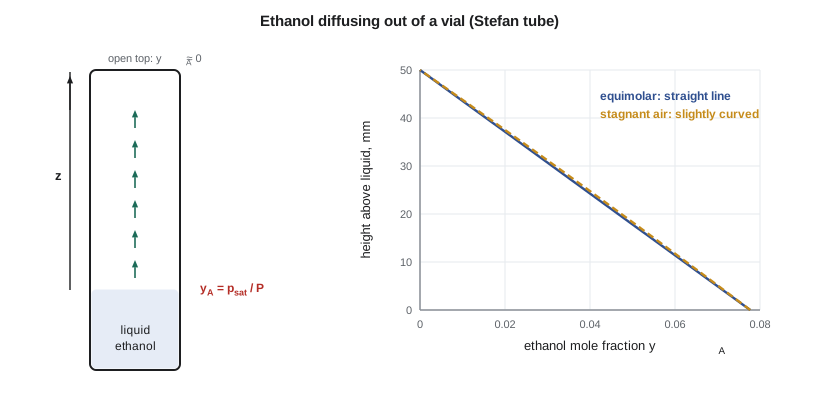
The more common case in absorption, drying and evaporation is that only A moves. In the vial, ethanol evaporates and diffuses upward, but air does not dissolve in the liquid ethanol, so air has no net flux: \(N_B = 0\). Air molecules still diffuse downward relative to the mixture, because their concentration is higher at the top, but that diffusion is exactly canceled by the upward bulk flow the evaporating ethanol creates. The flux equation becomes \(N_A = -cD_{AB}\,dy_A/dz + y_A N_A\). Rearranging and integrating gives
where \(y_{B,\mathrm{lm}}\) is the logarithmic mean of the mole fractions of B at the two ends, \((y_{B2} - y_{B1})/\ln(y_{B2}/y_{B1})\). The flux is larger than in equimolar counterdiffusion by the factor \(1/y_{B,\mathrm{lm}}\), because the bulk flow helps carry A along. The concentration profile is no longer linear: \(1 - y_A\) varies exponentially with height. For dilute systems, \(y_{B,\mathrm{lm}}\) is close to 1 and the two results almost coincide. For concentrated systems, such as water evaporating near its boiling point, the bulk-flow factor becomes large and cannot be ignored.
Worked problem
Evaporation from the standards vial
The vial neck has 50 mm of still air above the liquid at 25 °C and 101.3 kPa. The vapor pressure of ethanol at 25 °C is about 7.87 kPa, and the air at the top of the neck holds almost no ethanol because of the fume hood draught. Take \(D_{AB} = 1.25\times10^{-5}\) m\(^2\)/s from lesson 2. Find the evaporation flux, treating air as stagnant.
Show solution
- \(c = P/RT = 40.9\) mol/m\(^3\); \(y_{A1} = 7.87/101.3 = 0.0777\), \(y_{A2} = 0\).
- \(N_A = (cD_{AB}/L)\ln[(1 - 0)/(1 - 0.0777)] = (40.9 \times 1.25\times10^{-5}/0.050) \times 0.0809\).
- \(N_A = 8.26\times10^{-4}\) mol/(m\(^2\) s), about 4 % more than the equimolar result of \(7.94\times10^{-4}\).
Answer: The bulk-flow correction is small here because ethanol is only about 8 % of the gas at the surface.
A pseudo-steady problem: how fast the level falls
As ethanol evaporates, the liquid level drops and the diffusion path lengthens, so the flux slowly decreases. Because the level moves very slowly compared with the time diffusion takes to set up a profile across the neck, the flux at each moment can be taken as the steady value for the current length. This pseudo-steady assumption turns the problem into a simple ordinary differential equation. The rate of loss of liquid equals the diffusive flux: \(c_L\,dL/dt = N_A = (cD_{AB}/L)\ln[(1 - y_{A2})/(1 - y_{A1})]\), where \(c_L\) is the molar density of the liquid. Separating variables and integrating from \(L_0\) to \(L_1\),
This equation is also the basis of the Stefan tube method for measuring gas diffusivities: the level is measured over time, and \(D_{AB}\) is the only unknown. It works well for volatile liquids and gives values accurate to a few percent if the temperature is controlled and the air at the top is swept steadily.
# Steady one-dimensional diffusion: equimolar counterdiffusion, diffusion through a stagnant gas,
# and diffusion with a first-order reaction
import math
R, T, P = 8.314, 298.15, 101325.0
c = P / (R * T)                 # mol/m3
D = 1.25e-5                     # m2/s, ethanol in air at 25 C (Fuller estimate, lesson 2)
L = 0.050                       # m, depth of gas above the liquid in a vial (Stefan tube)
p_sat = 7.87e3                  # Pa, ethanol vapor pressure at 25 C (approximate)
yA1, yA2 = p_sat / P, 0.0

N_emd = c * D * (yA1 - yA2) / L
yB1, yB2 = 1 - yA1, 1 - yA2
yBlm = (yB2 - yB1) / math.log(yB2 / yB1)
N_stag = c * D / L * math.log((1 - yA2) / (1 - yA1))
print(f"equimolar counterdiffusion flux = {N_emd * 1e3:.4f} mmol/(m2 s)")
print(f"stagnant-air flux               = {N_stag * 1e3:.4f} mmol/(m2 s)")
print(f"log-mean y_B = {yBlm:.4f}; bulk-flow factor 1/y_Blm = {1 / yBlm:.3f}")

# Time for the level in a 10 mm wide vial to fall 5 mm (pseudo-steady Stefan tube)
rho_L, M = 789.0, 0.04607       # kg/m3, kg/mol
cL = rho_L / M                  # mol/m3 of liquid
L0, L1 = 0.050, 0.055
f = c * D * math.log((1 - yA2) / (1 - yA1))
t = cL * (L1 ** 2 - L0 ** 2) / (2 * f)
print(f"time for the liquid level to fall 5 mm = {t / 3600:.1f} h")

# Diffusion with a first-order homogeneous reaction in a stagnant liquid film
# Absorption of a gas that reacts: compare flux with and without reaction
DL = 1.8e-9          # m2/s
delta = 50e-6        # m, film thickness
k1 = 50.0            # 1/s, pseudo-first-order rate constant (illustrative)
cAi = 1.0            # mol/m3 at the interface; bulk liquid holds no free A
Ha = delta * math.sqrt(k1 / DL)
N_phys = DL * cAi / delta
N_rxn = DL * cAi / delta * Ha / math.tanh(Ha)
print(f"Hatta number = {Ha:.2f}")
print(f"flux without reaction = {N_phys * 1e6:.1f} umol/(m2 s), with reaction = {N_rxn * 1e6:.1f} umol/(m2 s)")
print(f"enhancement factor = {N_rxn / N_phys:.2f}")equimolar counterdiffusion flux = 0.7937 mmol/(m2 s) stagnant-air flux = 0.8262 mmol/(m2 s) log-mean y_B = 0.9606; bulk-flow factor 1/y_Blm = 1.041 time for the liquid level to fall 5 mm = 30.2 h Hatta number = 8.33 flux without reaction = 36.0 umol/(m2 s), with reaction = 300.0 umol/(m2 s) enhancement factor = 8.33
The answer to Dev's question is about 30 hours for the level to fall 5 mm, which matches what he sees. The loss changes the volume but not much else for pure ethanol. For a standard made up as a dilute solution in water, however, the more volatile ethanol leaves faster than the water, so the concentration of the standard drifts downward. Theo recommends crimped caps and storing standards outside the fume hood draught, where the gas at the vial mouth is not continuously swept clean.
Diffusion in liquids and from spheres
The same equations apply to liquids, with \(c\) the total molar concentration of the liquid and \(D_{AB}\) the liquid diffusivity. A gas dissolving into a still liquid film, such as oxygen into a thin layer of broth on a wall, follows the equimolar form when the solute is dilute, because the bulk-flow term \(x_A(N_A + N_B)\) is negligible. Spheres need a little more care. For steady diffusion from a sphere of radius \(r_0\) into an infinite stagnant medium, the total rate is constant with radius, and the solution gives \(N_A = D_{AB}(c_{A,s} - c_{A,\infty})/r_0\) at the surface. Written as a mass transfer coefficient, \(k_c = D_{AB}/r_0 = 2D_{AB}/d\), or a Sherwood number \(Sh = k_c d/D_{AB} = 2\). That limit reappears in lesson 6 as the starting value of the correlations for droplets and particles.
Diffusion with a chemical reaction
When the diffusing species reacts as it moves, the flux is no longer constant along the path. Consider a gas A absorbing into a stagnant liquid film of thickness \(\delta\), where it is consumed by a first-order reaction with rate constant \(k_1\). The steady balance on a thin slice is now \(D_{AB}\,d^2c_A/dz^2 = k_1 c_A\). With the interface concentration \(c_{Ai}\) at \(z = 0\) and no free A reaching the bulk liquid at \(z = \delta\), the solution is a hyperbolic sine profile, and the flux into the liquid at the interface is
The Hatta number \(Ha\) compares the rate of reaction in the film with the rate of diffusion across it. When \(Ha\) is small, the reaction is slow, little A reacts in the film, and the flux is the physical value \(D_{AB}c_{Ai}/\delta\). When \(Ha\) is larger than about 3, \(\tanh Ha\) is close to 1 and the flux is enhanced by a factor equal to \(Ha\). Reaction steepens the concentration gradient at the interface, so more A diffuses in. The ratio of the flux with reaction to the flux without it is the enhancement factor \(E\).
Worked problem
Enhancement by a reaction in the liquid film
A gas absorbs into a liquid film 50 µm thick with \(D_{AB} = 1.8\times10^{-9}\) m\(^2\)/s, and reacts with a pseudo-first-order rate constant of 50 s\(^{-1}\). Find the Hatta number and the enhancement factor.
Show solution
- \(Ha = 50\times10^{-6}\sqrt{50/1.8\times10^{-9}} = 50\times10^{-6} \times 1.67\times10^{5} = 8.3\).
- \(E = Ha/\tanh Ha = 8.3/1.000 = 8.3\).
Answer: The reaction raises the absorption rate more than eightfold. Lesson 12 uses this effect to capture acetaldehyde, which water alone absorbs poorly.
Common mistakes
MistakeUsing the equimolar result for evaporation of a concentrated vapor.
InsteadWhen only A moves, include the bulk-flow factor \(1/y_{B,\mathrm{lm}}\).
MistakeAssuming the flux is constant in a sphere.
InsteadThe total rate is constant; the flux falls as \(1/r^2\).
MistakeForgetting that a reaction makes the flux change along the path.
InsteadWrite the balance with the reaction term and solve for the new profile.
MistakeTaking the gas at a liquid surface as free of the solute.
InsteadIt is at equilibrium with the liquid, usually at the vapor pressure for a pure liquid.
Summary and key terms
- For steady one-dimensional diffusion without reaction, the flux is constant through a slab or tube; the total rate is constant in spheres and cylinders.
- Equimolar counterdiffusion gives a linear profile and \(N_A = cD_{AB}(y_{A1} - y_{A2})/L\).
- Diffusion through a stagnant gas adds bulk flow: \(N_A = (cD_{AB}/L)\ln[(1 - y_{A2})/(1 - y_{A1})]\).
- Slow processes such as the falling level in a vial can be treated as pseudo-steady.
- Steady diffusion from a sphere into still fluid gives \(Sh = 2\).
- A reaction in the film raises the flux by about the Hatta number when \(Ha > 3\).
- Equimolar counterdiffusion
- Diffusion in which equal molar fluxes of two species move in opposite directions, so there is no bulk flow.
- Stagnant film
- A layer through which one species diffuses while the other has no net flux.
- Log-mean mole fraction
- The logarithmic mean of the non-diffusing species mole fractions at the two ends of the path.
- Stefan tube
- A vertical tube in which a liquid evaporates and diffuses upward through a gas; used to measure diffusivities.
- Pseudo-steady state
- An approximation in which a slowly changing problem is treated as a sequence of steady states.
- Hatta number
- A dimensionless ratio of reaction rate in a liquid film to diffusion rate across it.
- Enhancement factor
- The ratio of the absorption flux with chemical reaction to the flux without it.
Practice problems
Work each problem on paper first, then reveal the answer to check.
Water evaporates at 60 °C (vapor pressure 19.9 kPa) through 20 mm of still air at 101.3 kPa. Compute the bulk-flow factor \(1/y_{B,\mathrm{lm}}\).
Show answer
\(y_{B1} = 0.804\), \(y_{B2} = 1\), \(y_{B,\mathrm{lm}} = 0.898\), factor about 1.11.
Why is the profile curved for diffusion through a stagnant gas?
Show answer
Bulk flow carries part of the flux, so the diffusive part and the gradient vary along the path.
State the steady Sherwood number for a sphere in still fluid.
Show answer
\(Sh = 2\).
How does the time for a level to fall depend on the path lengths?
Show answer
On \(L_1^2 - L_0^2\).
If \(Ha = 0.2\), is the reaction important in the film?
Show answer
No; \(E \approx 1\) and absorption is essentially physical.
Give a physical example of equimolar counterdiffusion.
Show answer
Distillation of components with similar molar latent heats.
Lesson quiz · 5 questions
Score 60% or more to complete this lesson.
Create a free account to save your progress, take quizzes and earn a certificate.