
CHE-314 · Lesson 10 of 12 · 23 min
Humidification and water cooling
The plant's cooling tower rejects the heat from the fermenters, the distillation condensers and the evaporators. On hot, humid afternoons the cooling water returns warmer than design, the fermenters run warm and the yeast struggle. The plant is adding fermentation capacity, so the tower must take more heat, and the utilities engineer has asked Theo to check whether adding a cell will do it. A cooling tower is a humidifier: it cools water by evaporating part of it into air. Heat and mass transfer happen together at the same interface, so this lesson brings together the psychrometrics of air and water with the analogy from lesson 6.
Humid air
Air and water vapor form a mixture whose properties are described with a few standard quantities. The humidity ratio \(W\) is the mass of water vapor per mass of dry air. It relates to the partial pressure of water vapor \(p_v\) through \(W = 0.622\,p_v/(P - p_v)\), where 0.622 is the ratio of the molar masses of water and air. The relative humidity is \(p_v/p_{\mathrm{sat}}(T)\), the ratio of the actual vapor pressure to the saturation vapor pressure at the air temperature. The dew point is the temperature at which the air would become saturated if cooled at constant humidity ratio. The specific enthalpy of humid air, per kilogram of dry air with 0 °C as the reference, is
The first term is the sensible heat of the dry air, 2501 kJ/kg is the latent heat of vaporization of water at 0 °C, and 1.86 kJ/(kg K) is the heat capacity of the vapor. The saturation vapor pressure can be computed from a Magnus-type formula, \(p_{\mathrm{sat}} = 0.61094\exp[17.625T/(T + 243.04)]\) kPa, accurate to well under 1 % over the range of a cooling tower. These relationships are what a psychrometric chart plots.
Adiabatic saturation and the wet bulb
If unsaturated air flows over water in an insulated channel long enough, the water evaporates and cools the air until the air is saturated at a temperature called the adiabatic saturation temperature. Every kilogram of water evaporated takes its latent heat from the air, so the air's enthalpy is almost unchanged. A thermometer with a wet wick in an air stream, the wet-bulb thermometer, settles at a temperature set by a balance between heat transfer to the wick and evaporation from it:
where \(k_Y\) is a mass transfer coefficient per unit humidity ratio difference. For air and water, the Lewis relation from the Chilton-Colburn analogy says that \(h/(k_Y c_s) \approx (Sc/Pr)^{2/3} \approx 1\), where \(c_s\) is the humid heat of the air. This happy coincidence makes the wet-bulb temperature almost equal to the adiabatic saturation temperature for air-water mixtures, so the wet bulb, which is easy to measure, fixes the enthalpy of the air. It is not true for other liquids: an ethanol-soaked wick in air settles at a temperature quite different from the adiabatic saturation temperature, because the Lewis number for ethanol vapor in air is not close to 1.
Worked problem
The design air
Design summer air for the tower is 31 °C dry bulb and 23 °C wet bulb at 101.3 kPa. Find the humidity ratio, relative humidity, dew point and enthalpy.
Show solution
- At the wet bulb: \(p_{\mathrm{sat}}(23) = 2.81\) kPa, so \(W_{s,wb} = 0.622 \times 2.81/(101.3 - 2.81) = 0.0178\).
- Psychrometric equation: \(W = [(2501 - 2.326 \times 23)(0.0178) - 1.006 \times 8]/(2501 + 1.86 \times 31 - 4.186 \times 23) = 0.0143\).
- \(p_v = 0.0143 \times 101.3/(0.622 + 0.0143) = 2.28\) kPa; \(p_{\mathrm{sat}}(31) = 4.49\) kPa; RH \(= 51\%\); dew point 19.6 °C.
- \(h = 1.006 \times 31 + 0.0143 \times (2501 + 1.86 \times 31) = 67.8\) kJ/kg dry air.
Answer: The air's enthalpy, 67.8 kJ/kg, is almost exactly the enthalpy of saturated air at its 23 °C wet bulb, as the Lewis relation predicts.
How a cooling tower works
In a cooling tower, warm water is sprayed or distributed over fill, which spreads it into films or droplets, and air is drawn upward or across it by fans. A small fraction of the water evaporates, typically about 1 % for every 6 to 7 K of cooling, and the latent heat of that evaporation cools the rest. Some sensible heat also passes from water to air while the air is cooler than the water. The water can be cooled below the dry-bulb temperature of the air, but never below its wet-bulb temperature. Two numbers describe performance: the range, the drop in water temperature from inlet to outlet, and the approach, the difference between the cold-water temperature and the wet bulb. The plant's tower has a range of 11 K, from 40 to 29 °C, with an approach of 6 K to a 23 °C design wet bulb.
The Merkel equation
In 1925 Merkel showed how to combine the heat and mass transfer at the water surface into a single driving force. With the Lewis relation close to 1 and a few small terms neglected, the total heat transfer from water to air is proportional to the difference between the enthalpy of saturated air at the water temperature, \(h_s(T_w)\), and the enthalpy of the bulk air, \(h_a\). A heat balance on a slice of tower then gives the Merkel number:
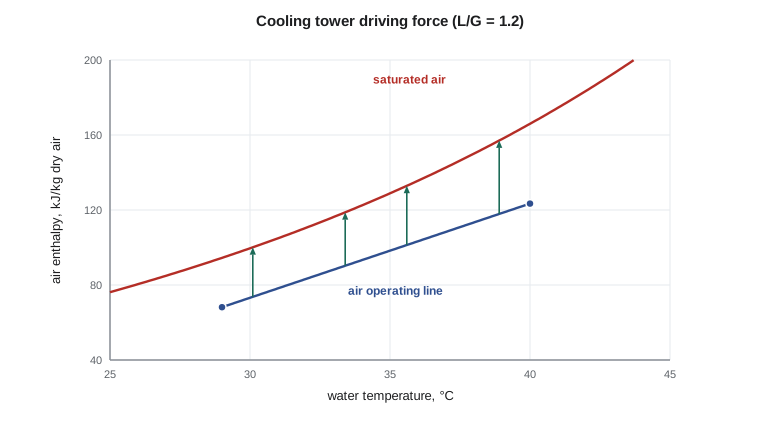
Here \(K\) is a mass transfer coefficient, \(a\) the interfacial area per unit volume, \(V\) the fill volume and \(L\) the water mass flow. The left side measures what the tower provides, much like \(N_{OG}\) in an absorber, and the right side is the duty the conditions demand. The air enthalpy rises along the tower according to an energy balance, \(h_a = h_{a,\mathrm{in}} + (L/G)c_{pw}(T_w - T_{\mathrm{cold}})\), where \(G\) is the dry air mass flow; on an enthalpy-temperature diagram this is a straight operating line below the curved saturation line. The integral is usually evaluated with the four-point Chebyshev rule, at water temperatures 10, 40, 60 and 90 % of the way across the range.
# Humidification and water cooling: air-water properties and the Merkel number of a cooling tower
import math
P = 101.325                                   # kPa
def psat(T):                                  # kPa, Magnus form over water
    return 0.61094 * math.exp(17.625 * T / (T + 243.04))
def W_from(T, p_v):                           # humidity ratio kg water / kg dry air
    return 0.622 * p_v / (P - p_v)
def h_air(T, W):                              # kJ/kg dry air, reference 0 C
    return 1.006 * T + W * (2501 + 1.86 * T)

# Outdoor design air: 31 C dry bulb, 23 C wet bulb
Tdb, Twb = 31.0, 23.0
Ws_wb = W_from(Twb, psat(Twb))
W = ((2501 - 2.326 * Twb) * Ws_wb - 1.006 * (Tdb - Twb)) / (2501 + 1.86 * Tdb - 4.186 * Twb)
p_v = W * P / (0.622 + W)
RH = p_v / psat(Tdb)
Tdp = 243.04 * math.log(p_v / 0.61094) / (17.625 - math.log(p_v / 0.61094))
print(f"humidity ratio = {W:.4f} kg/kg, RH = {RH * 100:.0f} %, dew point = {Tdp:.1f} C, enthalpy = {h_air(Tdb, W):.1f} kJ/kg")

# Merkel number for the plant cooling tower: hot water 40 C, cold water 29 C, inlet air enthalpy at 23 C wet bulb
T_hot, T_cold, cpw = 40.0, 29.0, 4.186
h_in = h_air(Twb, Ws_wb)                      # air enthalpy depends only on the wet bulb
for LG in (1.0, 1.2, 1.5):
    def h_air_at(Tw):                         # operating line: air gains what the water loses
        return h_in + LG * cpw * (Tw - T_cold)
    def h_sat(Tw):
        return h_air(Tw, W_from(Tw, psat(Tw)))
    rng = T_hot - T_cold
    pts = [T_cold + f * rng for f in (0.1, 0.4, 0.6, 0.9)]            # Chebyshev four-point rule
    me = cpw * rng / 4 * sum(1 / (h_sat(t) - h_air_at(t)) for t in pts)
    h_out = h_air_at(T_hot)
    print(f"L/G = {LG}: KaV/L = {me:.2f}, air leaves at {h_out:.1f} kJ/kg")

# Water losses: evaporation, drift and blowdown
flow = 3000.0                                  # m3/h circulating water
evap = flow * (T_hot - T_cold) * cpw / 2400 # m3/h, latent heat about 2400 kJ/kg
coc = 5.0                                      # cycles of concentration
blow = evap / (coc - 1)
drift = 0.0005 / 100 * flow
print(f"evaporation = {evap:.1f} m3/h, blowdown = {blow:.1f} m3/h, drift = {drift:.3f} m3/h, makeup = {evap + blow + drift:.1f} m3/h")humidity ratio = 0.0143 kg/kg, RH = 51 %, dew point = 19.6 C, enthalpy = 67.8 kJ/kg L/G = 1.0: KaV/L = 1.33, air leaves at 114.2 kJ/kg L/G = 1.2: KaV/L = 1.50, air leaves at 123.4 kJ/kg L/G = 1.5: KaV/L = 1.89, air leaves at 137.2 kJ/kg evaporation = 57.6 m3/h, blowdown = 14.4 m3/h, drift = 0.015 m3/h, makeup = 72.0 m3/h
The code shows how the Merkel number required rises with \(L/G\): about 1.33 at \(L/G = 1.0\), 1.50 at 1.2 and 1.89 at 1.5. Less air per kilogram of water means the air heats up and humidifies faster, the operating line steepens toward the saturation curve and the driving force shrinks. A tower's fill delivers a characteristic \(KaV/L\) that falls as \(L/G\) rises, usually given by the manufacturer as \(C(L/G)^{-n}\) with \(n\) around 0.5 to 0.8. The operating point is where the fill's curve meets the required curve. Adding a cell to the plant's tower adds fill and air at the same \(L/G\), so the new cell carries its share of the extra heat load at the same approach.
Worked problem
Effect of a warmer wet bulb
On a very humid day the wet bulb reaches 25 °C. If the tower must still deliver a range of 11 K at the same \(L/G\), why does the cold water temperature rise?
Show solution
- The inlet air enthalpy rises from about 68.4 to about 76.2 kJ/kg (saturated air at 25 °C).
- The whole operating line moves up, closer to the saturation curve, so the driving force at each water temperature falls.
- The fill provides a fixed \(KaV/L\), so the water temperatures must shift upward until the driving force recovers: the cold water ends up roughly 1.5 to 2 K warmer.
Answer: This is the problem the fermenters see on humid afternoons. The fix is more tower capacity, or chillers on the most sensitive duties.
Water losses and treatment
Evaporation removes pure water, so dissolved salts concentrate in the circulating water. The plant controls this by blowdown, a small continuous discharge, and adds makeup water to replace evaporation, blowdown and drift, the fine droplets carried out by the air. If the water is allowed to reach \(N\) cycles of concentration, so that its dissolved solids are \(N\) times those of the makeup, the blowdown is \(E/(N - 1)\), where \(E\) is the evaporation rate. For the plant's 3,000 m\(^3\)/h of circulating water with an 11 K range, evaporation is about 58 m\(^3\)/h, and at five cycles the blowdown is about 14 m\(^3\)/h. Modern drift eliminators hold drift below about 0.0005 % of the circulating flow. Drift matters for public health, because cooling towers can spread Legionella bacteria if the water is not treated, and owners follow water management programs to control it.
Humidification and dehumidification in the plant
The same principles run in reverse in other equipment. Air drawn through a wetted pad is cooled and humidified, the basis of evaporative coolers for the plant's motor control rooms. Air cooled below its dew point on a cold coil loses water by condensation, which is how dehumidifiers work. And the dryer of lesson 11 is a humidifier for its own air stream, which leaves the dryer close to saturation with water evaporated from the grains. In every case the humidity ratio, the enthalpy and the wet bulb, combined with a heat-mass analogy, are enough for a first design.
Common mistakes
MistakeExpecting a cooling tower to cool water below the wet-bulb temperature.
InsteadThe wet bulb is the theoretical limit; the approach is always positive.
MistakeUsing the dry-bulb temperature to fix the inlet air enthalpy.
InsteadThe wet bulb fixes the enthalpy of the air for air-water systems.
MistakeApplying the wet-bulb equals adiabatic saturation rule to other liquids.
InsteadIt holds for air-water because the Lewis relation is close to 1; not for ethanol in air.
MistakeForgetting blowdown in the makeup water estimate.
InsteadMakeup equals evaporation plus blowdown plus drift.
Summary and key terms
- Humid air is described by humidity ratio, relative humidity, dew point and enthalpy.
- For air and water, the Lewis relation makes the wet-bulb temperature almost equal to the adiabatic saturation temperature.
- Cooling towers cool water mainly by evaporation; they cannot reach below the wet bulb.
- The Merkel equation uses the enthalpy difference \(h_s(T_w) - h_a\) as a single driving force.
- The required Merkel number rises with the water-to-air ratio; the tower's fill sets what is available.
- Evaporation concentrates salts; blowdown and makeup control the cycles of concentration.
- Humidity ratio
- Mass of water vapor per unit mass of dry air.
- Relative humidity
- The ratio of the actual vapor pressure to the saturation vapor pressure at the same temperature.
- Wet-bulb temperature
- The temperature reached by a wetted thermometer in an air stream, where heat gain balances evaporation.
- Lewis relation
- The near-equality of h/(k_Y c_s) and 1 for air-water systems.
- Range
- The drop in water temperature across a cooling tower.
- Approach
- The difference between the cold-water temperature and the wet-bulb temperature.
- Merkel number
- KaV/L, a dimensionless measure of the transfer a cooling tower fill provides or a duty requires.
Practice problems
Work each problem on paper first, then reveal the answer to check.
Find the humidity ratio of air at 101.3 kPa with a vapor pressure of 1.8 kPa.
Show answer
\(W = 0.622 \times 1.8/99.5 = 0.0113\).
What limits the lowest water temperature a cooling tower can achieve?
Show answer
The wet-bulb temperature of the inlet air.
A tower has a range of 10 K and a 5 K approach to a 24 °C wet bulb. What are the hot and cold water temperatures?
Show answer
Cold 29 °C, hot 39 °C.
Estimate the evaporation from 1,000 m\(^3\)/h of water cooled by 8 K.
Show answer
\(1000 \times 8 \times 4.186/2400 = 14\) m\(^3\)/h.
At 4 cycles of concentration with 14 m\(^3\)/h evaporation, what is the blowdown?
Show answer
\(14/3 = 4.7\) m\(^3\)/h.
Why does a humid day hurt cooling tower performance more than a hot, dry one?
Show answer
The wet bulb, and so the inlet air enthalpy, is higher, shrinking the driving force.
Lesson quiz · 5 questions
Score 60% or more to complete this lesson.
Create a free account to save your progress, take quizzes and earn a certificate.