
BIOL-360 · Lesson 10 of 12 · 30 min
Sex determination and germ cells
Two developmental questions concern reproduction directly. How does an embryo set aside the cells that will make eggs and sperm, the germ line that carries genes to the next generation? And how does it decide whether to develop as female or male? The answers vary across animals more than for most developmental processes. Germ cells may be specified by inherited cytoplasm or by signals; sex may be set by chromosomes, by temperature or by social environment. BIOL-201 lesson 7 covered sex chromosomes, sex linkage and the genetics of chromosomal sex determination. This lesson focuses on the developmental mechanisms: how germ cells are specified and migrate, how the gonad chooses between testis and ovary, how that choice is maintained, and how animals without sex chromosomes make the same decision.
The germ line and the soma
In 1892 August Weismann proposed that the germ line, which transmits heredity, is separate from the soma, the body, which dies with the individual. This germ plasm theory explains why changes acquired by the body are not inherited. In most animals the germ line is set aside early, as primordial germ cells (PGCs), which are protected from the differentiation signals around them, migrate to the developing gonads, and only there begin gametogenesis. PGCs share features across species: they are transcriptionally quiet during early stages, they repress somatic gene programs, and they express conserved RNA-binding proteins such as Vasa, Nanos and Piwi.
Two ways to specify germ cells
Germ cells are specified in one of two ways. In preformation, a specialized cytoplasm, the germ plasm, is localized in the egg and inherited by the cells that will become germ cells. Drosophila, C. elegans, Xenopus and zebrafish use germ plasm. In Drosophila, the pole plasm at the posterior of the egg contains Oskar protein, which nucleates the assembly of germ granules containing Vasa, Nanos and other proteins and RNAs. Nuclei that enter the pole plasm bud off as pole cells, the first cells to form in the embryo. Transplanting pole plasm to the anterior of an egg causes nuclei there to form pole cells, which can produce functional gametes if moved to the gonad region. The polar granules of Drosophila and the P granules of C. elegans are examples of biomolecular condensates, membraneless compartments formed by phase separation of proteins and RNAs.
In induction, used by mammals and probably by the common ancestor of animals, germ cells are specified by signals rather than inherited determinants. In the mouse, BMP4 from the extraembryonic ectoderm, together with Wnt3, induces a small group of about 40 epiblast cells, around embryonic day 6.25, to express the transcription factors Blimp1, Prdm14 and Tfap2c. These factors repress the somatic mesodermal program the cells would otherwise follow, reactivate pluripotency genes and begin the epigenetic reprogramming of the germ line. Remarkably, Mitinori Saitou's group showed in 2011 that mouse embryonic stem cells can be converted into PGC-like cells in culture, which form functional sperm and eggs when transplanted, and in 2016 Katsuhiko Hayashi's laboratory completed the entire cycle of mouse oogenesis in a dish. Human PGC-like cells have also been made, though human germ cell specification differs from that of mice, requiring SOX17 rather than Sox2.
Migration and reprogramming of germ cells
PGCs usually form far from the gonads and must migrate there. In mice they arise at the base of the allantois, are carried into the hindgut by the movements of gastrulation, and then migrate actively through the gut mesentery to the genital ridges, guided by the chemokine Cxcl12 (also known as SDF-1) acting through its receptor Cxcr4, and supported by the growth factor Steel (Kit ligand) acting on the Kit receptor. Mice with mutations in Kit or Steel have few germ cells, as well as pigment and blood defects, because the same pathway supports melanocyte and blood stem cells. PGCs that wander off course normally die, but rare survivors can form germ cell tumors such as teratomas, which contain mixtures of differentiated tissues.
During and after migration, mammalian PGCs undergo dramatic epigenetic reprogramming. Genome-wide DNA methylation falls to very low levels, and the parental imprints described in lesson 2 are erased. New imprints are then established according to the sex of the embryo: paternal imprints in the developing male germ line and maternal imprints in the female germ line. This resetting ensures that each generation transmits imprints appropriate to the parent of origin. Errors in germ line reprogramming contribute to imprinting disorders and may allow some epigenetic marks to escape erasure, a topic of current research on transgenerational inheritance.
The bipotential gonad
In mammals, the gonad begins as a bipotential structure, the genital ridge, formed from intermediate mesoderm and coelomic epithelium. Until about the sixth week of human development, the gonads of XX and XY embryos look identical, and both sexes have two pairs of ducts: the Wolffian ducts, which can form male reproductive tracts, and the Müllerian ducts, which can form oviducts, uterus and upper vagina. Supporting cells in the gonad, the precursors of Sertoli cells in testes or granulosa cells in ovaries, make the decision. In 1947 Alfred Jost removed the gonads from rabbit embryos and found that all developed female reproductive tracts regardless of their chromosomes, showing that the testis directs male development and the female pathway was long thought of as a default. Modern work shows that ovary development is also an active genetic program.
SRY and the testis pathway
In 1990 Peter Goodfellow, Robin Lovell-Badge and colleagues identified SRY (sex-determining region of the Y) as the testis-determining gene in humans and mice. XY people with mutations in SRY develop as females (Swyer syndrome), and XX people carrying a translocated piece of Y containing SRY develop as males. The definitive experiment came in 1991, when Koopman and colleagues introduced a 14-kilobase fragment containing mouse Sry into XX mouse embryos and some developed as males, although they were sterile because they lacked other Y-chromosome genes needed for sperm production.
SRY acts briefly, in mice for only about two days around embryonic day 11.5, and its main target is SOX9, a related transcription factor. SRY, with the steroidogenic factor SF1, binds an enhancer of Sox9 called TESCO and, in humans, a far upstream enhancer region. Once activated, SOX9 maintains its own expression through positive feedback loops involving FGF9 and prostaglandin D2, and it drives supporting cells to become Sertoli cells. Sertoli cells organize the testis cords, recruit cells to form Leydig cells, which make testosterone, and secrete anti-Müllerian hormone, which causes the Müllerian ducts to regress. Duplications of SOX9 can cause testis development in XX people even without SRY, and loss of SOX9 causes campomelic dysplasia, a skeletal disorder often accompanied by XY sex reversal.
The ovary pathway and mutual antagonism
In XX gonads without SRY, supporting cells activate a different program. The secreted protein R-spondin 1 (RSPO1) and Wnt4 activate β-catenin signaling, and the transcription factor FOXL2 promotes granulosa cell identity. The testis and ovary pathways actively antagonize each other: SOX9 and FGF9 repress Wnt4 and β-catenin, while β-catenin and FOXL2 repress Sox9. The outcome is a bistable switch that settles firmly into one state. Strikingly, the decision must be maintained throughout life. When Foxl2 was deleted in adult female mice in 2009, granulosa cells transdifferentiated into Sertoli-like cells and began making testosterone; conversely, deleting the transcription factor Dmrt1 in adult male mice caused Sertoli cells to become granulosa-like. Sex determination in mammals is therefore not a single event but an ongoing balance.
| System | Example organisms | Primary signal | Key genes or mechanism |
|---|---|---|---|
| XX/XY with dominant Y | Most mammals | Presence of Y chromosome | SRY activates SOX9; RSPO1/WNT4/FOXL2 in ovary |
| ZZ/ZW (dosage) | Birds, some reptiles, butterflies | Number of Z chromosomes | DMRT1 dosage (two copies in ZZ males) |
| X counting | Drosophila | Number of X chromosomes | Sex-lethal (Sxl) switch and alternative splicing |
| Temperature-dependent | Many turtles, crocodilians, some lizards | Incubation temperature | Kdm6b, Dmrt1 and aromatase; calcium and redox signaling |
| Social or environmental | Clownfish, wrasses, some gobies | Social rank, size | Hormonal shifts, aromatase changes in adults |
Other chromosomal systems
Birds use a ZZ/ZW system, in which females are the heterogametic sex. The Z chromosome carries DMRT1, and two copies in ZZ embryos promote testis development, while the single copy in ZW embryos is insufficient; knocking out one copy of DMRT1 in ZZ chickens produces ovaries. Bird cells also show cell-autonomous sex identity: chickens that are half ZZ and half ZW, gynandromorphs, are visibly male on one side and female on the other, which suggests that each cell's chromosomes influence its sexual characteristics directly, not only through hormones.
In Drosophila, sex depends on the number of X chromosomes. Embryos with two X chromosomes activate the gene Sex-lethal (Sxl) early in development, because X-linked signal proteins reach a threshold; once activated, Sxl protein maintains its own production by controlling the splicing of its own pre-mRNA. Sxl then controls a cascade of alternative splicing, through transformer to doublesex, producing female-specific Doublesex protein in XX flies and male-specific Doublesex in XY flies. Sxl also prevents the male-specific dosage compensation complex from forming in females; in males this complex doubles transcription from the single X. Doublesex and mammalian DMRT1 share a DNA-binding DM domain, a sign that some components of sex determination are ancient even though the upstream triggers differ.
Temperature-dependent sex determination
In many reptiles there are no sex chromosomes, and sex is set by the temperature at which the egg incubates during a sensitive window in the middle third of development. In most turtles, warm temperatures produce females and cool temperatures produce males (pattern Ia); in crocodilians and some turtles and lizards, females develop at both high and low extremes, males at intermediate temperatures (pattern II). The pivotal temperature, at which a 1:1 sex ratio is produced, is often around 29 °C in sea turtles. In 2018, a study of the red-eared slider turtle showed that the chromatin-modifying enzyme Kdm6b, expressed more at cool temperatures, removes repressive marks from the Dmrt1 gene, promoting testis development. Upstream, temperature appears to act through calcium influx and the transcription factor STAT3 in the gonad.
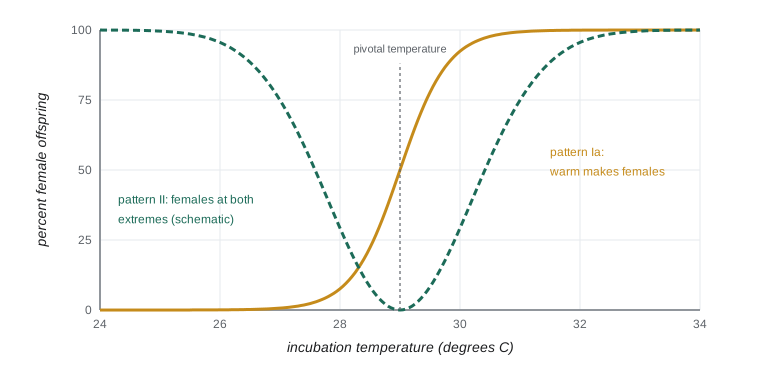
Temperature-dependent sex determination makes some species vulnerable to climate change. A 2018 study of green sea turtles nesting on the northern Great Barrier Reef found that more than 99 percent of recently hatched turtles were female, because sand temperatures have risen. Conservation programs shade nests or move eggs to cooler hatcheries. The loggerhead and leatherback sea turtles that nest along the beaches of the southeastern United States and that forage in Canadian Atlantic waters face the same pressure. Some reptiles show more complex interactions: the Australian central bearded dragon has ZZ/ZW chromosomes, but at high temperatures ZZ embryos develop as females, overriding the chromosomes.
import math
# Hatchling sex ratio under temperature-dependent sex determination (pattern Ia).
# p_female(T) = 1 / (1 + exp(-(T - Tpiv) / s)); nest temperatures vary around a mean.
Tpiv, s = 29.2, 0.6           # pivotal temperature and transition width, degC (illustrative, sea-turtle-like)
def p_female(T):
    return 1 / (1 + math.exp(-(T - Tpiv) / s))
def nest_ratio(mean_T, sd_T=1.0, n=401):
    # average over a normal distribution of nest temperatures (simple numerical integration)
    tot = w_sum = 0.0
    for i in range(n):
        T = mean_T - 4 * sd_T + 8 * sd_T * i / (n - 1)
        w = math.exp(-0.5 * ((T - mean_T) / sd_T) ** 2)
        tot += w * p_female(T); w_sum += w
    return tot / w_sum
print("mean nest temp (degC)   share of hatchlings female")
for mean_T in (27.5, 28.5, 29.2, 30.0, 31.0, 32.0):
    print(f"        {mean_T:4.1f}                 {100 * nest_ratio(mean_T):5.1f}%")
# temperature needed to bring a 90%-female beach back to 50% by shading
target = next(t / 100 for t in range(3200, 2700, -1) if nest_ratio(t / 100) <= 0.5)
print(f"cooling nests to a mean of about {target:.1f} degC restores a 1:1 ratio")mean nest temp (degC) share of hatchlings female
27.5 12.0%
28.5 31.2%
29.2 50.0%
30.0 71.2%
31.0 89.3%
32.0 97.0%
cooling nests to a mean of about 29.2 degC restores a 1:1 ratioThe model shows how steep the response can be: because the transition from all-male to all-female spans only a few degrees, a warming of 1 to 2 °C in mean nest temperature can shift a beach from balanced to strongly female. The real situation is more complicated, because the sensitive period is only part of incubation, metabolic heating raises temperatures in the center of large clutches, and temperature affects hatching success and the fitness of hatchlings as well as their sex.
Sex change in adults
Some fish change sex as adults in response to social cues. Clownfish live in groups dominated by a breeding pair, with the female the largest; if she dies, the male becomes female and the largest non-breeder becomes the new male. The bluehead wrasse shows the reverse: females can become males within days when the dominant male is removed, beginning with behavioral changes within hours, followed by changes in gonads. Such sequential hermaphroditism shows that the gonad's identity can be plastic in some vertebrates throughout life, an exaggerated version of the maintenance seen in mice lacking Foxl2 or Dmrt1.
Differences of sex development in people
In humans, variations in the genes and hormones of sex development cause differences of sex development (DSD), a term adopted in a 2006 consensus statement to replace older terminology. They include variations in sex chromosome number, such as Turner syndrome (45,X) and Klinefelter syndrome (47,XXY); variations in gonad development, such as Swyer syndrome in XY people with SRY mutations; and variations in hormone production or response, such as complete androgen insensitivity syndrome, in which XY people with mutations in the androgen receptor develop female external anatomy with internal testes, and congenital adrenal hyperplasia, in which XX people exposed to excess adrenal androgens may have masculinized external genitalia. Clinical care has shifted toward multidisciplinary teams, delaying irreversible surgery where possible and involving patients in decisions. These cases show that biological sex involves several developmental layers, chromosomes, gonads, hormones and the responses of tissues to them, which usually align but do not always.
Worked problem
Working through a sex reversal case
A mouse with an XY karyotype develops ovaries. Its Sry gene is normal in sequence and is expressed at the right time, but Sox9 fails to be upregulated in the gonad. In a second mouse, XX, the gonads develop as testes. It carries a duplication of a region upstream of Sox9. Explain both results.
Show solution
- In the first mouse, Sry is present and expressed, so the defect must lie downstream, in the activation of Sox9.
- A likely cause is a mutation in the Sox9 enhancer bound by SRY and SF1 (such as TESCO), or in a cofactor required for its activation.
- Without Sox9, supporting cells follow the RSPO1, Wnt4 and FOXL2 pathway and form granulosa cells, so ovaries develop.
- In the second mouse, extra copies of an enhancer region raise Sox9 expression in XX gonads without SRY, and positive feedback through FGF9 locks in the testis pathway.
Answer: SRY works mainly by activating SOX9; disrupting this step causes XY ovary development, and raising SOX9 expression can cause XX testis development. Similar regulatory variants upstream of human SOX9 have been found in people with DSD.
Common mistakes
MistakeThinking all animals specify germ cells with inherited germ plasm.
InsteadFlies, worms, frogs and fish do, but mammals induce germ cells with signals such as BMP4.
MistakeSaying female development in mammals is simply passive.
InsteadOvary development is an active program driven by RSPO1, Wnt4, β-catenin and FOXL2.
MistakeAssuming SRY is needed throughout life to maintain the testis.
InsteadSRY acts briefly; SOX9, DMRT1 and feedback loops maintain testis identity.
MistakeThinking sex determination is fixed once made.
InsteadAdult mice lacking Foxl2 or Dmrt1 show gonadal transdifferentiation, and some fish change sex.
MistakeAssuming birds use a Y chromosome like mammals.
InsteadBirds use ZZ/ZW, with DMRT1 dosage on the Z promoting testis development.
MistakeBelieving temperature-dependent sex determination always produces males at cool temperatures.
InsteadPatterns differ: some species produce females at both temperature extremes.
Summary and key terms
- Germ cells are specified by inherited germ plasm (flies, worms, frogs, fish) or by induction (mammals, through BMP4 and Blimp1, Prdm14, Tfap2c).
- Mammalian PGCs migrate to the gonads using Cxcl12/Cxcr4 and Kit signaling and erase and reset imprints.
- The bipotential gonad becomes a testis when SRY activates SOX9, which drives Sertoli cells, AMH and testosterone.
- The ovary pathway uses RSPO1, Wnt4, β-catenin and FOXL2, and mutual antagonism makes the choice bistable and maintained for life.
- Birds use DMRT1 dosage on the Z; Drosophila uses X counting by Sex-lethal and a splicing cascade.
- Many reptiles use incubation temperature, making them vulnerable to warming.
- Differences of sex development in people reflect variation at chromosomal, gonadal and hormonal levels.
- primordial germ cell
- An early precursor of the gametes, set aside from somatic cells.
- germ plasm
- Specialized cytoplasm that specifies germ cells in species using preformation.
- pole cells
- The germ cell precursors of the Drosophila embryo, formed at the posterior pole.
- Blimp1
- A transcription factor that specifies mouse germ cells by repressing somatic programs.
- bipotential gonad
- The early gonad, which can become either a testis or an ovary.
- SRY
- The Y-linked gene that initiates testis development in most mammals.
- SOX9
- A transcription factor activated by SRY that drives Sertoli cell differentiation.
- anti-Müllerian hormone
- A hormone from Sertoli cells that causes regression of the Müllerian ducts.
- FOXL2
- A transcription factor that promotes and maintains granulosa cell identity in the ovary.
- DMRT1
- A DM-domain transcription factor that promotes testis development, dosage-sensitive in birds.
- temperature-dependent sex determination
- Determination of sex by incubation temperature during a sensitive period.
- pivotal temperature
- The incubation temperature producing a 1:1 sex ratio.
Practice problems
Work each problem on paper first, then reveal the answer to check.
What experiment showed that Drosophila pole plasm is sufficient to specify germ cells?
Show answer
Transplanting pole plasm to the anterior made nuclei there form pole cells that could produce functional gametes.
How are mouse germ cells specified?
Show answer
BMP4 from extraembryonic ectoderm, with Wnt3, induces epiblast cells to express Blimp1, Prdm14 and Tfap2c.
Why do mice with Kit mutations have pigment and blood defects as well as few germ cells?
Show answer
Kit signaling supports melanocytes and blood stem cells as well as PGC survival and migration.
What did Jost's experiments show?
Show answer
Without gonads, rabbit embryos developed female tracts, so the testis directs male development.
What evidence shows SRY is sufficient for testis development?
Show answer
An Sry transgene caused XX mice to develop as males.
Describe the positive feedback that stabilizes testis fate.
Show answer
SOX9 activates FGF9 and prostaglandin D2, which maintain SOX9 expression.
What happens when Foxl2 is deleted in adult female mice?
Show answer
Granulosa cells transdifferentiate into Sertoli-like cells and testosterone is produced.
How does a gynandromorph chicken show cell-autonomous sex identity?
Show answer
One side is male and the other female, matching the chromosomes of the cells, despite shared hormones.
In the TSD model, why does a small warming have a large effect?
Show answer
The transition between all-male and all-female spans only a few degrees.
What is complete androgen insensitivity syndrome?
Show answer
XY people with nonfunctional androgen receptors develop female external anatomy with internal testes.
Lesson quiz · 5 questions
Score 60% or more to complete this lesson.
Create a free account to save your progress, take quizzes and earn a certificate.