
BIOC-200 · Lesson 7 of 12 · 25 min
Lipids and biological membranes
▶ Video coming soon A video version of this lesson is on the way.
Lipids are defined not by a common structure but by a common behavior: they dissolve poorly in water and well in nonpolar solvents such as chloroform or ether. The group therefore includes molecules as different as the fats in olive oil, the waxes on leaves, the phospholipids of cell membranes, cholesterol and the steroid hormones, and fat-soluble vitamins such as A and D. Lipids store energy more densely than any other biological molecule, they form the membranes that enclose every cell and organelle, and they carry signals between cells. This lesson describes the main classes of lipids and then the membranes they build, which are among the most important structures in biology.
Fatty acids
Fatty acids are the building blocks of most lipids. A fatty acid is a hydrocarbon chain with a carboxyl group at one end. Most natural fatty acids have an even number of carbons, usually 12 to 24, because they are built two carbons at a time from acetyl-CoA. At the pH of a cell the carboxyl group is ionized, and the fatty acid is a carboxylate anion with a long nonpolar tail, an amphipathic molecule. Soaps are the sodium or potassium salts of fatty acids, and they clean by burying grease in the tails of micelles while their charged heads face the water.
Saturated fatty acids contain only single bonds between their carbons and so hold as many hydrogen atoms as possible. Palmitic acid (16 carbons) and stearic acid (18 carbons) are the most common. Unsaturated fatty acids contain one or more carbon–carbon double bonds. In natural fatty acids these are almost always cis, which puts a rigid bend of about 30° in the chain. Oleic acid, the main fatty acid of olive oil, has 18 carbons and one double bond. A shorthand notation gives the number of carbons and double bonds, so stearic acid is 18:0 and oleic acid 18:1. The position of the first double bond counted from the methyl end gives the omega number: linoleic acid (18:2) is an omega-6 and alpha-linolenic acid (18:3) an omega-3 fatty acid. These two are essential fatty acids, because humans cannot put double bonds that close to the methyl end and must get them from food.
The bends of cis double bonds explain why fats and oils behave differently. Straight saturated chains pack tightly side by side and hold together with many van der Waals contacts, so saturated fats such as butter and lard are solid at room temperature. Bent unsaturated chains cannot pack closely, so unsaturated fats such as vegetable oils are liquid. Melting points show the effect clearly: stearic acid melts at about 70 °C, oleic acid at about 13 °C and linoleic acid at about −5 °C. Partial hydrogenation, once used to turn vegetable oils into margarine and shortening, converted some cis double bonds into trans double bonds, which leave the chain nearly straight. Trans fats raise the risk of heart disease, and partially hydrogenated oils were banned from foods in the United States in 2018.
| Fatty acid | Notation | Melting point (°C) | Common source |
|---|---|---|---|
| Lauric acid | 12:0 | 44 | Coconut and palm kernel oil |
| Palmitic acid | 16:0 | 63 | Palm oil, meat, dairy |
| Stearic acid | 18:0 | 70 | Cocoa butter, meat |
| Oleic acid | 18:1 (omega-9) | 13 | Olive and canola oil |
| Linoleic acid | 18:2 (omega-6) | −5 | Sunflower, corn and soybean oil |
| Alpha-linolenic acid | 18:3 (omega-3) | −11 | Flaxseed and canola oil |
Triacylglycerols: stored fuel
Triacylglycerols, also called triglycerides, are the fats and oils of food and the main energy store of animals. Each is three fatty acids joined by ester bonds to the three hydroxyl groups of glycerol. With no charged groups they are completely nonpolar, and in cells they gather into oily droplets. Fat cells, called adipocytes, are filled almost entirely by a single large droplet.
Fat is an excellent fuel for two reasons. First, its carbons are more reduced than those of carbohydrates, carrying more hydrogen and less oxygen, so oxidizing them releases more energy: about 37 kJ per gram for fat against 17 kJ per gram for carbohydrate or protein. Second, fat is stored without water, whereas glycogen carries about twice its weight in water. As the worked example in Lesson 6 showed, together these make fat about six times more compact than hydrated glycogen. A person of normal weight carries enough fat to survive for weeks without food. Fat also insulates; in whales and seals a thick layer of blubber keeps the body warm in cold water, and brown fat in newborn babies and hibernating animals burns fatty acids to generate heat directly, as Lesson 11 explains.
Membrane lipids
Membranes are made mainly of lipids that, unlike triacylglycerols, have a polar head as well as nonpolar tails. The most common are the glycerophospholipids. In these, two fatty acids are attached to carbons 1 and 2 of glycerol and a phosphate group to carbon 3, and the phosphate is linked in turn to a small polar group such as choline, ethanolamine, serine or inositol. The resulting phosphatidylcholine, phosphatidylethanolamine, phosphatidylserine and phosphatidylinositol differ in their heads but share the same design: a charged or polar head and two long hydrocarbon tails, one of which usually has a cis double bond.
Sphingolipids are built on sphingosine, a long-chain amino alcohol, rather than glycerol. Sphingomyelin, with a phosphocholine head, is abundant in the myelin sheath that insulates nerve fibers. Glycolipids carry sugars as their head groups; gangliosides, with complex sugar chains, are concentrated in the outer surface of nerve cells, and the inherited disorder Tay-Sachs disease results from the loss of an enzyme that breaks one of them down.
Cholesterol is a sterol, built of four fused rings with a short hydrocarbon tail and a single hydroxyl group. It is a major component of animal cell membranes, where it slips between the phospholipids with its hydroxyl near their heads. Cholesterol is also the starting material for the steroid hormones, including cortisol, aldosterone, estradiol and testosterone, for vitamin D and for the bile acids that help digest fats. Plants make related sterols, and bacteria generally make none.
The lipid bilayer
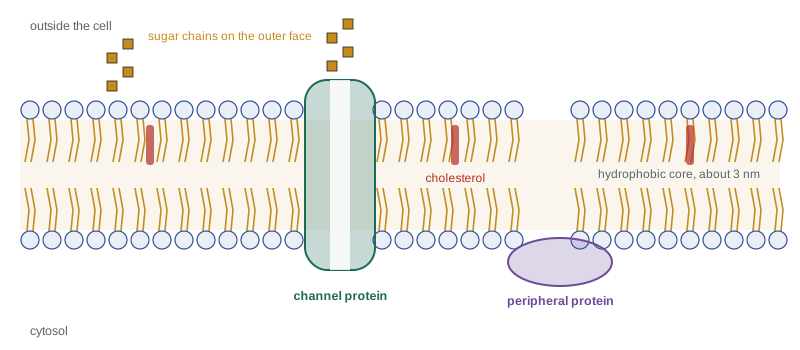
When phospholipids are placed in water they assemble spontaneously into a lipid bilayer: two layers of molecules with their tails pointing inward, away from the water, and their heads facing the water on both sides. Two tails make a phospholipid roughly cylindrical, so it packs best into a flat sheet rather than the spherical micelles formed by single-tailed soaps. The hydrophobic effect drives the assembly, just as it drives protein folding. A bilayer is about 3 nm thick in its hydrophobic core and about 5 nm including the heads. Bilayers close on themselves to avoid exposed edges, forming sealed compartments called vesicles or liposomes. Liposomes are used to deliver drugs, and lipid nanoparticles, a related design, carried the messenger RNA of the COVID-19 vaccines into cells.
The hydrophobic core makes the bilayer a barrier. Small nonpolar molecules such as oxygen, carbon dioxide and steroid hormones dissolve in the core and cross easily. Water and small uncharged polar molecules such as urea and ethanol cross more slowly. Large polar molecules such as glucose cross very slowly, and ions hardly at all: the permeability of a bilayer to sodium or potassium ions is about a billion times lower than its permeability to water. That barrier is what allows cells to keep different concentrations of ions and molecules inside and outside, and to use the differences to store energy and carry signals.
The fluid mosaic model
In 1972 S. J. Singer and Garth Nicolson proposed the fluid mosaic model of membranes, which remains the basic picture. The bilayer is a two-dimensional fluid in which lipids and many proteins move sideways freely. A phospholipid can diffuse about 2 µm, the length of a bacterium, in a second. Movement from one layer of the bilayer to the other is very different: flipping a polar head through the hydrophobic core is so slow that it happens spontaneously only once in hours to days, and cells use enzymes called flippases to move lipids between layers. As a result, the two layers have different compositions. In human cells, phosphatidylserine is kept almost entirely in the inner layer; its appearance on the outer surface is a signal, recognized by scavenger cells, that a cell is dying and should be removed.
Membrane fluidity must be kept within limits. Too stiff, and membrane proteins cannot move or change shape; too fluid, and the barrier leaks. Fatty acid composition is one control: shorter chains and more cis double bonds make a membrane more fluid. Bacteria, plants and cold-blooded animals adjust their fatty acids when the temperature changes, making more unsaturated lipids in the cold, a response called homeoviscous adaptation. Cholesterol is the other control. Its rigid rings stiffen the membrane at high temperature, but by separating the fatty acid chains it prevents them from packing into a gel at low temperature, so it broadens the range over which the membrane stays usefully fluid.
Proteins make up roughly half the mass of a typical membrane and carry out most of its functions. Integral membrane proteins are embedded in the bilayer; those that cross it, called transmembrane proteins, usually do so with alpha helices of about 20 hydrophobic residues, just long enough to span the 3 nm core, or with barrels of beta strands. Peripheral proteins sit on one surface, bound to the heads of lipids or to integral proteins. Membrane proteins include channels and transporters that move ions and molecules across, receptors that detect signals from outside, enzymes, and anchors that link the cell to its neighbors and to its internal skeleton. Roughly a quarter of human genes encode membrane proteins, and more than half of all drugs act on them.
Moving molecules across membranes
Molecules cross membranes in three main ways. Simple diffusion through the bilayer works only for small or nonpolar molecules, and always runs from high concentration to low. Facilitated diffusion uses proteins to speed the passage of polar molecules and ions, still downhill. Channels form pores that let specific ions through very quickly, up to 10⁸ ions per second; aquaporins let water through; carriers such as the GLUT glucose transporters bind their cargo and change shape to release it on the other side. Like enzymes, carriers saturate at high concentrations of their cargo.
Active transport moves substances uphill, against their concentration or electrical gradient, and must be paid for. Primary active transport uses ATP directly. The sodium-potassium pump, discovered by Jens Christian Skou in 1957, uses each ATP to pump three sodium ions out of the cell and two potassium ions in; it consumes about a quarter of the ATP of a resting human, and much more in the brain. Secondary active transport uses the gradient created by a pump to drive another substance uphill. The sodium-glucose cotransporter of the intestine lets sodium flow back into the cell down its gradient and carries glucose along with it, concentrating glucose inside the cell. Oral rehydration solutions, which have saved millions of lives from cholera and other diarrheal diseases, work by exploiting this transporter: the glucose they contain pulls sodium, and with it water, back into the body.
Lipids as signals
Some lipids carry messages. Steroid hormones made from cholesterol cross membranes easily and bind receptors inside cells that switch genes on and off. Eicosanoids, made from the 20-carbon fatty acid arachidonic acid, include the prostaglandins that cause pain, fever and inflammation; aspirin and ibuprofen relieve these symptoms by blocking cyclooxygenase, the first enzyme of their synthesis. Inside cells, fragments of phosphatidylinositol released by enzymes act as messengers that raise calcium levels and activate protein kinases in response to hormones.
A worked example: the energy of an ion gradient
Worked problem
What does it cost to pump an ion?
A cell keeps sodium at 12 mM inside and 145 mM outside, with the inside of the membrane 70 mV negative relative to the outside. How much free energy is released when one mole of Na⁺ flows into the cell at 37 °C? The free energy change is ΔG = RT ln(c_in/c_out) + zFΔψ, where ΔG is for moving the ion inward, z = +1, F = 96,485 C/mol and Δψ = ψ_in − ψ_out = −0.070 V.
Show solution
- The concentration term: RT = 8.314 × 310 = 2,577 J/mol. ln(12/145) = ln(0.0828) = −2.49. So RT ln(c_in/c_out) = 2,577 × (−2.49) = −6,420 J/mol.
- The electrical term: zFΔψ = 1 × 96,485 × (−0.070) = −6,750 J/mol. Sodium is positive and the inside is negative, so the voltage also pulls it in.
- Total ΔG = −6,420 − 6,750 = −13,200 J/mol, or about −13.2 kJ/mol. Sodium flowing in releases about 13 kJ per mole.
- Pumping sodium out costs the same 13.2 kJ/mol. Three sodium ions out cost about 40 kJ, and moving two potassium ions in, slightly uphill, adds about 5 kJ, for roughly 44 kJ per cycle. ATP hydrolysis under cellular conditions supplies about 50 to 60 kJ/mol, enough to drive the pump.
Answer: About −13 kJ/mol: each mole of Na⁺ entering the cell releases about 13 kJ, energy that the cell can use to drive secondary active transport.
A program: membranes and gradients
The program does two calculations. It estimates how long it takes a lipid molecule to wander a given distance in a membrane by sideways diffusion, using the two-dimensional relation for mean squared displacement, ⟨r²⟩ = 4Dt, with a typical lipid diffusion coefficient of 1 µm² per second. It then calculates the free energy stored in the sodium, potassium and calcium gradients of a typical human cell.
import math

# 1. Lateral diffusion of a lipid: mean squared displacement <r^2> = 4 D t in two dimensions
D = 1.0  # square micrometers per second
print("distance (um)   typical time")
for r in (0.1, 1, 2, 10, 50):
    t = r ** 2 / (4 * D)
    print(f"{r:13.1f}   {t:10.2f} s")

# 2. Free energy of moving one mole of ion INTO the cell at 37 C, membrane potential -70 mV
R, T, F = 8.314, 310.0, 96485.0
psi = -0.070
ions = [("Na+", +1, 12.0, 145.0), ("K+", +1, 140.0, 4.0), ("Ca2+", +2, 0.0001, 1.2)]
print()
print("ion    inside (mM)  outside (mM)  dG inward (kJ/mol)")
for name, z, cin, cout in ions:
    dg = R * T * math.log(cin / cout) + z * F * psi
print(f"{name:5s} {cin:12.4f} {cout:13.1f} {dg / 1000:18.1f}")distance (um) typical time
0.1 0.00 s
1.0 0.25 s
2.0 1.00 s
10.0 25.00 s
50.0 625.00 s
ion inside (mM) outside (mM) dG inward (kJ/mol)
Na+ 12.0000 145.0 -13.2
K+ 140.0000 4.0 2.4
Ca2+ 0.0001 1.2 -37.7A lipid crosses the length of a bacterium, about 2 µm, in roughly a second, but needs about ten minutes to cover 50 µm, the width of a large animal cell, because diffusion time grows with the square of the distance. The second table shows that sodium and calcium are both strongly drawn into the cell: the cell keeps calcium inside about ten thousand times lower than outside, which is why even a small opening of calcium channels produces a large signal. Potassium is close to balance, with its large outward concentration gradient nearly offset by the negative interior that pulls it back; in fact, the resting membrane potential arises mainly because the membrane is most permeable to potassium.
Common mistakes
MistakeLipids are defined by a shared chemical structure.
InsteadThey are defined by being insoluble in water and soluble in nonpolar solvents, so the group is structurally diverse.
MistakeUnsaturated fats are solid at room temperature.
InsteadCis double bonds bend the chains so they pack poorly; unsaturated fats are usually liquid oils, and saturated fats solid.
MistakePhospholipids in water form micelles like soap.
InsteadWith two tails they are roughly cylindrical and form bilayers; single-tailed soaps form micelles.
MistakeLipids flip freely between the two layers of a membrane.
InsteadSideways movement is fast, but flipping is very slow without flippase enzymes, so the two layers differ in composition.
MistakeCholesterol always makes membranes stiffer.
InsteadIt stiffens them at high temperature but keeps them fluid at low temperature, broadening the useful range.
MistakeIons cross membranes by dissolving in the lipid core.
InsteadCharged ions are almost excluded by the core and need channels, carriers or pumps.
Summary and key terms
- Lipids are a diverse group of water-insoluble molecules: fatty acids, triacylglycerols, phospholipids, sphingolipids and sterols.
- Saturated fatty acids pack into solids; cis double bonds bend unsaturated chains and lower melting points.
- Triacylglycerols store energy compactly, at about 37 kJ per gram and without water.
- Amphipathic phospholipids form bilayers whose hydrophobic core blocks ions and polar molecules; the fluid mosaic model describes their mobile lipids and proteins.
- Channels and carriers allow facilitated diffusion, while pumps such as the Na⁺/K⁺-ATPase use ATP for active transport and create gradients that drive secondary transport.
- Fatty acid
- A hydrocarbon chain with a carboxyl group at one end.
- Triacylglycerol
- Three fatty acids esterified to glycerol; the main form of stored fat.
- Phospholipid
- An amphipathic lipid with a phosphate-containing polar head and two hydrocarbon tails.
- Lipid bilayer
- A double layer of lipids with tails inward and heads facing water on both sides.
- Fluid mosaic model
- The model of membranes as a fluid bilayer containing mobile proteins.
- Active transport
- Movement of a substance against its gradient, driven by ATP or by another gradient.
- Sterol
- A lipid built of four fused rings, such as cholesterol.
Practice problems
Work each problem on paper first, then reveal the answer to check.
Write the shorthand notation for a 20-carbon fatty acid with four double bonds.
Show answer
20:4, as in arachidonic acid.
Why is olive oil liquid while butter is solid at room temperature?
Show answer
Olive oil is rich in oleic acid, whose cis double bond prevents close packing; butter is rich in saturated fatty acids.
Roughly how long does a lipid take to diffuse 4 µm if D = 1 µm²/s?
Show answer
t = r²/4D = 16/4 = 4 s.
Which molecule would cross a pure lipid bilayer faster: oxygen or glucose? Why?
Show answer
Oxygen, because it is small and nonpolar and dissolves in the hydrophobic core.
How many sodium ions does the Na⁺/K⁺ pump move per ATP, and in which direction?
Show answer
Three sodium ions out of the cell (and two potassium ions in).
Why do bacteria grown in the cold make more unsaturated fatty acids?
Show answer
Unsaturated chains keep the membrane fluid at low temperature.
Lesson quiz · 5 questions
Score 60% or more to complete this lesson.
Create a free account to save your progress, take quizzes and earn a certificate.