
BIOC-200 · Lesson 2 of 12 · 26 min
Water, pH and buffers
▶ Video coming soon A video version of this lesson is on the way.
Every reaction in this course takes place in water. Water makes up about 70% of the mass of a typical cell and about 60% of the body of an adult. It is not a passive background: its polarity decides which molecules dissolve and which cluster together, its hydrogen bonds shape proteins and nucleic acids, its ions take part in many enzyme reactions, and its tendency to ionize sets the pH that every biological molecule must cope with. This lesson reviews the properties of water that matter most to biochemistry and then develops the acid–base chemistry of weak acids and buffers, which recurs in every later lesson.
The structure of a water molecule
In a water molecule the oxygen atom is bonded to two hydrogen atoms at an angle of about 104.5°, close to the tetrahedral angle. Oxygen is much more electronegative than hydrogen, so the O–H bonds are polar: the oxygen carries a partial negative charge and each hydrogen a partial positive charge. Because the molecule is bent, these bond dipoles do not cancel, and water has a large overall dipole moment. Oxygen also has two lone pairs of electrons, which point roughly toward the other two corners of the tetrahedron.
This geometry lets each water molecule form up to four hydrogen bonds: two through its own hydrogen atoms, which it donates to neighboring oxygens, and two through its lone pairs, which accept hydrogens from neighbors. In ice every molecule makes all four, in a regular open lattice, which is why ice is less dense than liquid water and floats. In liquid water the network is constantly breaking and re-forming; each molecule makes on average about three and a half hydrogen bonds at any instant, and an individual hydrogen bond lasts only a few picoseconds. A hydrogen bond between water molecules is worth roughly 20 kJ/mol, far weaker than the O–H covalent bond (about 460 kJ/mol) but strong enough, in such numbers, to give water its unusual properties.
Why water's properties matter to life
Water has a much higher boiling point, heat capacity and heat of vaporization than other molecules of its size. Methane, with almost the same molar mass, boils at −161 °C; water boils at 100 °C because the hydrogen-bond network must be broken. The high heat capacity, about 4.18 J per gram per kelvin, means that the temperature of a cell, a body or a lake changes only slowly as heat is gained or lost. The high heat of vaporization makes sweating an effective way to cool: evaporating one gram of sweat from the skin removes about 2.4 kJ.
Water is also an excellent solvent for polar and ionic substances. Its high dielectric constant, about 80 at room temperature compared with about 2 for a hydrocarbon, weakens the attraction between opposite charges roughly forty-fold, so salts dissociate into ions. Each ion is surrounded by a shell of water molecules oriented with their oppositely charged ends toward it, a process called hydration. Polar molecules such as sugars, alcohols and amino acids dissolve because they can form hydrogen bonds with water. These substances are called hydrophilic, water-loving.
The hydrophobic effect
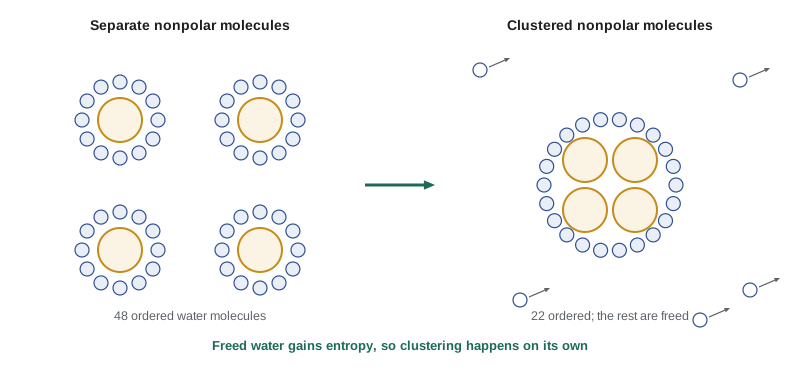
Nonpolar molecules such as hydrocarbons and the long tails of fatty acids cannot hydrogen-bond with water and are hydrophobic, water-fearing. When a nonpolar molecule is placed in water, the water molecules next to it cannot point their hydrogen bonds toward it. To keep as many hydrogen bonds as possible, they arrange themselves in an ordered cage-like shell around the nonpolar surface. That ordering lowers the entropy of the water. If several nonpolar molecules come together, the total nonpolar surface exposed to water shrinks, fewer water molecules are trapped in ordered shells, and the entropy of the water rises. The clustering is therefore driven mostly by entropy, not by any special attraction between the nonpolar molecules themselves.
The hydrophobic effect is the main force behind three structures in this course. Proteins fold so that most of their nonpolar side chains are buried inside, away from water (lesson 4). Phospholipids, which have a polar head and nonpolar tails, assemble into bilayers that form every cell membrane (lesson 7). And in DNA the flat, relatively nonpolar bases stack on top of one another in the middle of the double helix, while the charged sugar–phosphate backbone faces the water (lesson 8). Molecules with both polar and nonpolar parts are called amphipathic. In water, amphipathic molecules such as soaps form micelles, spheres with their tails inside and their heads facing outward, which is how soap carries grease away.
The ionization of water
Water molecules occasionally transfer a proton from one to another. The products are a hydronium ion, H₃O⁺, and a hydroxide ion, OH⁻. For simplicity the hydronium ion is usually written as H⁺, although a bare proton never exists free in water. The equilibrium lies far to the left; in pure water at 25 °C only about two molecules in every billion are ionized at any moment. The ion product of water is \(K_\mathrm{w} = [\mathrm{H^+}][\mathrm{OH^-}] = 1.0 \times 10^{-14}\) at 25 °C, where the brackets are molar concentrations. In pure water the two ions are equal, so each is \(1.0 \times 10^{-7}\ \mathrm{M}\).
Because hydrogen ion concentrations span many orders of magnitude, they are reported on a logarithmic scale. The pH is defined as \(\mathrm{pH} = -\log_{10}[\mathrm{H^+}]\). Pure water at 25 °C has a pH of 7.0, which is called neutral. Acidic solutions have pH below 7 and basic solutions above 7. Since \(K_\mathrm{w}\) is fixed, \(\mathrm{pH} + \mathrm{pOH} = 14.0\) at 25 °C. Each unit of pH is a tenfold change: a solution at pH 4 has ten times the hydrogen ion concentration of one at pH 5. At body temperature, 37 °C, \(K_\mathrm{w}\) is about \(2.4 \times 10^{-14}\) and neutral pH is about 6.8, so blood at pH 7.4 is slightly basic.
Biological fluids have characteristic pH values, and each is held within narrow limits. Blood plasma is kept between 7.35 and 7.45; outside that range a person is said to have acidosis or alkalosis, and values below about 6.8 or above about 7.8 are life-threatening. The cytosol of most cells is near pH 7.2. The stomach is strongly acidic, around pH 1.5 to 3.5, because its lining secretes hydrochloric acid, and the lysosomes inside cells, where worn-out molecules are digested, are kept near pH 5. These values matter because the charge, and therefore the behavior, of many biological molecules depends on pH.
Weak acids and the acid dissociation constant
A strong acid such as HCl dissociates completely in water. Most biological acids are weak: they give up their protons only partly, and an equilibrium is set up between the acid HA and its conjugate base A⁻. The acid dissociation constant is \(K_\mathrm{a} = [\mathrm{H^+}][\mathrm{A^-}]/[\mathrm{HA}]\). A larger \(K_\mathrm{a}\) means a stronger acid. Like hydrogen ion concentration, \(K_\mathrm{a}\) is usually reported as a logarithm, \(\mathrm{p}K_\mathrm{a} = -\log_{10} K_\mathrm{a}\); the smaller the \(\mathrm{p}K_\mathrm{a}\), the stronger the acid.
The weak acids of biochemistry include the carboxyl groups of amino acids and fatty acids (pKa around 2 to 5), the side chain of the amino acid histidine (pKa about 6.0), dihydrogen phosphate (pKa 7.2), the ammonium groups of amino acids (pKa around 9 to 10.5) and the bicarbonate system of the blood. The table below lists some useful values.
| Acid | Conjugate base | pKa (25 °C) |
|---|---|---|
| Phosphoric acid, H₃PO₄ | H₂PO₄⁻ | 2.15 |
| Formic acid | Formate | 3.75 |
| Lactic acid | Lactate | 3.86 |
| Acetic acid | Acetate | 4.76 |
| Carbonic acid (as dissolved CO₂) | Bicarbonate, HCO₃⁻ | 6.1 (in blood at 37 °C) |
| Dihydrogen phosphate, H₂PO₄⁻ | HPO₄²⁻ | 7.20 |
| Tris buffer (protonated) | Tris | 8.07 |
| Ammonium, NH₄⁺ | Ammonia | 9.25 |
| Bicarbonate, HCO₃⁻ | Carbonate | 10.33 |
The Henderson–Hasselbalch equation
Taking the negative logarithm of both sides of the expression for \(K_\mathrm{a}\) and rearranging gives the Henderson–Hasselbalch equation: \[\mathrm{pH} = \mathrm{p}K_\mathrm{a} + \log_{10}\frac{[\mathrm{A^-}]}{[\mathrm{HA}]}\] This equation, worked out by Lawrence Henderson in 1908 and put in logarithmic form by Karl Hasselbalch in 1916, is the most useful single equation in acid–base biochemistry. It says that the pH of a solution of a weak acid and its conjugate base depends only on the pKa and on the ratio of base to acid, not on their absolute concentrations.
Three consequences follow at once. When the acid and its conjugate base are present in equal amounts, the log term is zero and the pH equals the pKa; this gives the pKa a simple physical meaning, the pH at which the group is half dissociated. When the pH is one unit above the pKa, the ratio of base to acid is 10 to 1, so about 91% of the group is in the base form. When the pH is two units above, the ratio is 100 to 1. The same holds in the other direction. So a carboxyl group with pKa 4 is almost entirely deprotonated at pH 7, and an ammonium group with pKa 10 is almost entirely protonated: at physiological pH, amino acids carry both charges at once.
Titration curves and buffers
A titration curve shows how the pH of a solution of a weak acid changes as a strong base is added. At the start the solution contains mostly HA and the pH is low. As base is added, it converts HA to A⁻, and the pH rises. Near the midpoint, where half the acid has been converted, the curve is at its flattest: large additions of base change the pH only a little. That flat region, roughly one pH unit either side of the pKa, is the buffering region. Beyond it, once most of the HA has been used up, the pH climbs steeply.
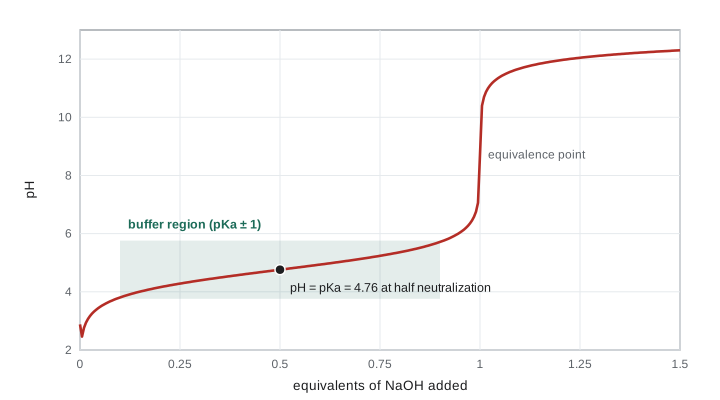
A buffer is a solution that resists changes in pH when acid or base is added. It is a mixture of a weak acid and its conjugate base, and it works because each component mops up one of the threats. Added H⁺ ions combine with A⁻ to form HA; added OH⁻ ions take a proton from HA to form water and A⁻. Either way, the ratio of A⁻ to HA changes only slowly, and so, by the Henderson–Hasselbalch equation, does the pH. A buffer works best at a pH close to its pKa, where the acid and base are present in similar amounts, and its capacity, the amount of acid or base it can absorb, is greater the more concentrated it is.
Laboratory biochemists choose buffers with a pKa close to the pH they need: acetate for pH 4 to 5.5, phosphate for pH 6 to 8, Tris for pH 7.5 to 9. A good biological buffer should not bind metal ions, react with the molecules being studied, absorb ultraviolet light or cross membranes, so a family of synthetic 'Good's buffers' such as HEPES and MOPS, introduced by Norman Good in 1966, is widely used for experiments with proteins and cells.
Buffers in the body
Cells and body fluids are buffered by three main systems. Inside cells, the phosphate system (H₂PO₄⁻ and HPO₄²⁻, pKa 7.2) is well placed for a cytosolic pH of about 7.2. Proteins are also buffers: their many ionizable side chains, especially histidine with pKa near 6, take up and release protons. Hemoglobin, which is packed at high concentration in red blood cells, is one of the most important buffers in the blood.
In blood plasma the main buffer is the bicarbonate system, and it is unusual because one of its components is a gas. Carbon dioxide produced by metabolism dissolves in blood and reacts with water to form carbonic acid, which dissociates to bicarbonate and a proton: \(\mathrm{CO_2 + H_2O \xrightleftharpoons{} H_2CO_3 \xrightleftharpoons{} H^+ + HCO_3^-}\). The first step is speeded up enormously by the enzyme carbonic anhydrase in red cells. Combining the two equilibria and using the dissolved CO₂ as the acid gives an effective pKa of 6.1 at 37 °C. The concentration of dissolved CO₂ is proportional to its partial pressure in the blood: about 0.0307 mmol/L for each millimeter of mercury. With a normal arterial partial pressure of 40 mmHg, the dissolved CO₂ is 1.2 mmol/L, and with the normal bicarbonate of 24 mmol/L the Henderson–Hasselbalch equation gives \(\mathrm{pH} = 6.1 + \log_{10}(24/1.2) = 6.1 + 1.30 = 7.40\).
At first sight the bicarbonate system looks like a poor buffer for blood, because its pKa of 6.1 is more than a unit away from pH 7.4. Its strength comes from being open. The lungs control the CO₂ and the kidneys control the bicarbonate, so both terms of the ratio can be adjusted. If acid is added to the blood, for example lactic acid from hard exercise, it converts bicarbonate to CO₂, and the extra CO₂ is breathed out; breathing faster and deeper removes it faster still. Over hours to days the kidneys excrete acid and make new bicarbonate. Doctors classify disturbances of blood pH by which side is at fault: a respiratory acidosis is caused by too much CO₂, as when breathing is depressed, and a metabolic acidosis by too little bicarbonate, as in uncontrolled diabetes, when ketone body acids accumulate (lesson 12).
A worked example: making a phosphate buffer
Worked problem
Designing a buffer
You need 1.00 L of 0.100 M sodium phosphate buffer at pH 7.40, made from NaH₂PO₄ and Na₂HPO₄. The pKa of H₂PO₄⁻ is 7.20. How many moles of each salt do you need?
Show solution
- Henderson–Hasselbalch: 7.40 = 7.20 + log([HPO₄²⁻]/[H₂PO₄⁻]), so the ratio of base to acid is 10^0.20 = 1.585.
- The total phosphate is 0.100 mol in 1.00 L, so base + acid = 0.100 mol.
- Acid = 0.100 ÷ (1 + 1.585) = 0.0387 mol of NaH₂PO₄.
- Base = 0.100 − 0.0387 = 0.0613 mol of Na₂HPO₄.
- Check: log(0.0613/0.0387) = 0.20, so pH = 7.40. In practice you would then measure the pH with a meter and adjust it slightly, because ionic strength shifts the effective pKa.
Answer: 0.0387 mol NaH₂PO₄ and 0.0613 mol Na₂HPO₄, dissolved and made up to 1.00 L.
A program: buffers at work
The program computes the pH of an acetate buffer as strong acid is added, compares it with the same amount of acid added to unbuffered water, and then applies the Henderson–Hasselbalch equation to the bicarbonate system of the blood at different CO₂ pressures.
import math

def hh(pka, base, acid):
    return pka + math.log10(base / acid)

# 1. Add HCl to 1.00 L of buffer containing 0.10 mol acetic acid and 0.10 mol acetate (pKa 4.76)
pka = 4.76
print("added HCl (mol)   buffer pH   pure water pH")
for added in (0.0, 0.01, 0.02, 0.05, 0.08):
    acid, base = 0.10 + added, 0.10 - added
    water_ph = 7.0 if added == 0 else -math.log10(added)    # strong acid in 1.00 L of water
    print(f"{added:14.2f} {hh(pka, base, acid):11.2f} {water_ph:15.2f}")

# 2. Blood: pH from bicarbonate and the partial pressure of CO2 (pKa' 6.1 at 37 C)
print()
print("pCO2 (mmHg)  dissolved CO2 (mM)  HCO3- (mM)   pH")
for pco2, hco3 in ((40, 24), (60, 24), (25, 24), (40, 12), (30, 12)):
    co2 = 0.0307 * pco2
print(f"{pco2:10d} {co2:19.2f} {hco3:11d} {hh(6.1, hco3, co2):7.2f}")added HCl (mol) buffer pH pure water pH
0.00 4.76 7.00
0.01 4.67 2.00
0.02 4.58 1.70
0.05 4.28 1.30
0.08 3.81 1.10
pCO2 (mmHg) dissolved CO2 (mM) HCO3- (mM) pH
40 1.23 24 7.39
60 1.84 24 7.21
25 0.77 24 7.60
40 1.23 12 7.09
30 0.92 12 7.21Adding 0.05 mol of HCl to a liter of pure water drops the pH from 7 to 1.3, but the same amount added to the acetate buffer moves it only from 4.76 to 4.28. The second table shows the blood at work; its first line gives 7.39 rather than 7.40 only because the dissolved CO₂ is not rounded to 1.2 mmol/L. Raising the CO₂ pressure to 60 mmHg, as happens when breathing is depressed, lowers the pH to 7.21, a respiratory acidosis. Halving the bicarbonate to 12 mmol/L, as in a metabolic acidosis, lowers the pH to 7.09, but if the person breathes harder and brings the CO₂ down to 30 mmHg, the pH recovers to 7.21. That is respiratory compensation: the lungs adjusting one side of the ratio to make up for a change in the other.
Common mistakes
MistakeA buffer keeps the pH exactly constant.
InsteadA buffer only resists change; its pH shifts slowly as acid or base is added, and once one component is used up the pH changes sharply.
MistakeThe pKa is the pH of a solution of the acid.
InsteadThe pKa is the pH at which the acid is half dissociated, when [A⁻] = [HA].
MistakeA buffer works equally well at any pH.
InsteadBuffers work best within about one pH unit of their pKa, where both acid and base are present in useful amounts.
MistakeThe hydrophobic effect is an attraction between nonpolar molecules.
InsteadIt is driven mainly by the increase in entropy of water released from ordered shells when nonpolar groups cluster.
MistakeBlood pH 7.4 is neutral.
InsteadAt 37 °C neutral pH is about 6.8, so blood is slightly basic; pH 7.0 is neutral only at 25 °C.
MistakeDiluting a buffer changes its pH a lot.
InsteadDilution leaves the ratio of base to acid unchanged, so the pH barely moves; it does lower the buffer's capacity.
Summary and key terms
- Water is polar and forms up to four hydrogen bonds per molecule, giving it a high heat capacity, heat of vaporization and dielectric constant.
- Polar and ionic substances dissolve in water; nonpolar groups cluster through the hydrophobic effect, which is driven by the entropy of water.
- pH = −log[H⁺]; at 25 °C, Kw = 1.0 × 10⁻¹⁴ and neutral pH is 7.0.
- For a weak acid, pH = pKa + log([A⁻]/[HA]); at pH = pKa the acid is half dissociated.
- Buffers resist pH change best within about one unit of their pKa; phosphate, proteins and bicarbonate buffer the body.
- Blood pH depends on the ratio of bicarbonate (set by the kidneys) to dissolved CO₂ (set by the lungs).
- Hydrogen bond
- A weak attraction between a hydrogen atom bonded to O or N and a lone pair on another O or N atom.
- Hydrophilic
- Attracted to water; polar or charged, and soluble in water.
- Amphipathic
- Having both polar and nonpolar parts, like a phospholipid or a soap molecule.
- pH
- The negative base-10 logarithm of the hydrogen ion concentration.
- pKa
- The negative logarithm of the acid dissociation constant; the pH at which an acid is half dissociated.
- Buffer
- A mixture of a weak acid and its conjugate base that resists changes in pH.
- Henderson–Hasselbalch equation
- pH = pKa + log([A⁻]/[HA]), relating pH to the ratio of conjugate base to acid.
Practice problems
Work each problem on paper first, then reveal the answer to check.
What is the pH of a solution with [H⁺] = 3.2 × 10⁻⁵ M?
Show answer
pH = −log(3.2 × 10⁻⁵) = 4.49.
Lactic acid has pKa 3.86. What fraction is in the lactate form at pH 7.4?
Show answer
Ratio = 10^(7.4 − 3.86) = 10^3.54 ≈ 3,500, so essentially all of it (more than 99.9%) is lactate.
Which buffer would you choose for an experiment at pH 8.0: acetate, phosphate or Tris?
Show answer
Tris, with pKa 8.07, is closest; phosphate (7.20) would work less well.
A patient has HCO₃⁻ = 24 mM and pCO₂ = 80 mmHg. Find the blood pH.
Show answer
Dissolved CO₂ = 0.0307 × 80 = 2.46 mM; pH = 6.1 + log(24/2.46) = 7.09, a severe respiratory acidosis.
Why does a micelle of soap have its tails inside?
Show answer
The hydrophobic tails cluster away from water to minimize the ordered water around them, leaving the polar heads in contact with water.
You dilute a 0.1 M acetate buffer at pH 4.76 tenfold with water. What happens to its pH and its capacity?
Show answer
The pH stays at about 4.76 because the ratio is unchanged, but the capacity falls tenfold.
Lesson quiz · 5 questions
Score 60% or more to complete this lesson.
Create a free account to save your progress, take quizzes and earn a certificate.